Sarajevo walking tour — three hours, four centuries, one brass line in the pavement
A self-guided walk from the Ottoman bazaar to the Habsburg quarter, crossing the exact metre where the empires meet. Eight stops, three hours, everything on foot, no ticket required.
Sarajevo is a walking city. Every experience most first-time visitors come for is inside a 1.2-kilometre corridor running east–west along the north bank of the Miljacka. This piece is the self-guided tour that connects them, from the 1462 Ottoman bazaar to the 1899 Habsburg Sacred Heart Cathedral, crossing the exact brass line in the pavement where the Ottoman city becomes Habsburg. Eight stops, three hours, everything on foot, no ticket required.
The whole route is on Google Maps if you follow the coordinates below. Bring comfortable shoes and about 25 BAM in cash for coffee and a small snack. Everything else is free.
The route in one line
Sebilj → Kazandžiluk → Gazi Husrev-beg complex → Sarači → the brass line → Ferhadija → Sacred Heart Cathedral → Latin Bridge. Roughly 1.2 km end to end, taking about three hours at a relaxed pace with stops for coffee and photos.
Stop 1 — The Sebilj (start here) · 09:00
Coordinates: 43.8597° N, 18.4313° E. The wooden-roofed Sebilj fountain in the middle of the bazaar square is the city’s meeting point and the obvious start. Built in 1753 by the Ottoman vizier Hadži-Mehmed paša Kukavica, rebuilt on the current site in 1891 by the Austro-Hungarian architect Aleksandar Wittek in a deliberate Pseudo-Moorish style. The tap works and locals drink from it (see our tap-water piece if you’re wondering whether you should too). The legend says a sip brings you back.
Feed the pigeons for one BAM if you like. Then walk east into Kazandžiluk.
Time here: 10 minutes.
Stop 2 — Kazandžiluk (the copper alley) · 09:15
Coordinates: 43.8596° N, 18.4318° E. Kazandžiluk, the coppersmiths’ alley, has been Sarajevo’s metalwork street since the 16th century. Sarajevo is one of the last European cities where you can hear a full workshop’s hammering as street noise. Walk slowly. Some of the shops are working workshops with the smith at the anvil; others sell already-finished pieces. Handmade džezva (Bosnian coffee pot) starts at around 15 BAM and rises with the intricacy of the engraving.
The bullet-shell coffee grinders and pens sold on this street, 25 to 40 BAM apiece, most made from recovered mortar casings from the 1990s siege, are their own tradition. See our longer piece if you want the story before you buy.
Time here: 20 minutes.
Stop 3 — Gazi Husrev-beg complex · 09:40
Coordinates: 43.8592° N, 18.4290° E. Walk west from Kazandžiluk along Bravadžiluk (past several ćevabdžinicas you can note for later), then turn south onto Sarači. The Gazi Husrev-beg Mosque sits on your right after 30 metres. This is the most architecturally accomplished Ottoman mosque in Bosnia, consecrated 1531, dome 26 metres high, financed by an endowment (vakuf) that also built a madrasa, a bath, a soup kitchen, a covered market, and a han (traveller’s inn). Most of that complex still stands and works.
Enter the mosque courtyard (free, outside prayer times; women should cover heads, all visitors remove shoes). If you have 20 minutes and 3 BAM, the interior is worth the tour. If not, the courtyard and the sadrvan (ablutions fountain) give you 80% of the experience.
Time here: 20 minutes (or 40 with the interior).
Stop 4 — Sarači · 10:00
Coordinates: 43.8594° N, 18.4297° E. Continue west on Sarači, the main east–west spine of the Ottoman bazaar. Working shops on both sides. This is one of the streets where the 1442 covered bezistan still sells textiles and rugs.
Stop for a coffee at Ministry of Ćejf (specialty coffee, flat whites and espresso, if you need modern) or Čajdžinica Džirlo (traditional Bosnian coffee and tea on a tiny corner terrace). Either way, take the ritual seriously; Bosnian coffee is one of the reasons to be in this city.
Time here: 30 minutes.
Stop 5 — The brass line on Ferhadija (the seam) · 10:30
Coordinates: 43.8593° N, 18.4278° E. Continue west along Sarači until it becomes Ferhadija. Look down at the pavement. A brass line, about 40 cm wide, sits embedded in the stone. It reads SARAJEVO, MEETING OF CULTURES / SUSRET KULTURA. This is the exact metre where the Ottoman bazaar ends and the Habsburg quarter begins. Six paces east: 400 years of Ottoman rule. Six paces west: 40 years of Habsburg administration and Vienna Ringstrasse architecture. No other European city has this seam so cleanly marked.
Half of the visitors miss the line entirely. Stand on it for a photo. See our Ferhadija piece for the fuller story of what changes on which side.
Time here: 5 minutes.
Stop 6 — Ferhadija (the Habsburg quarter) · 10:35
Coordinates: 43.8594° N, 18.4260° E. Ferhadija west of the brass line is a wide pedestrian street of late-19th-century Habsburg apartment-and-shop buildings. This is where Sarajevans go for high-street shopping, evening walking (korzo), and the terrace cafés that catch the western sun. The buildings on both sides were built between roughly 1880 and 1918 as part of the Habsburg administrative modernisation programme, Karel Pařík and Josip Vancaš drew many of them, in styles ranging from Ringstrasse-Historicist to full Vienna Secession.
Walk slowly. This is the street the 19th-century British travel writers came to Sarajevo to see (see our piece on Wickham Steed if the marketing history interests you). At the far west end, the spire of the Sacred Heart Cathedral becomes visible.
Time here: 15 minutes.
Stop 7 — Sacred Heart Cathedral · 10:50
Coordinates: 43.8594° N, 18.4254° E. Sacred Heart Cathedral, built 1884–1889 by Josip Vancaš in a Neo-Gothic style modelled on Notre-Dame de Dijon. The largest cathedral in Bosnia and Herzegovina. It sits on Trg Fra Grge Martića, opposite Galerija 11/07/95, the Srebrenica memorial gallery. Both are worth seeing; the cathedral takes ten minutes if you’re not lingering, the gallery an hour and a half if you have the emotional room for it (do not do it as an afterthought).
At the small square between the cathedral and the gallery, look for the outline of a Sarajevo Rose, one of the red-resin marks left in the pavement where mortar shells killed civilians during the 1992–1995 siege. Five sit within a hundred metres of this square. See our Sarajevo Roses piece for what they are and why they stay.
Time here: 20 minutes.
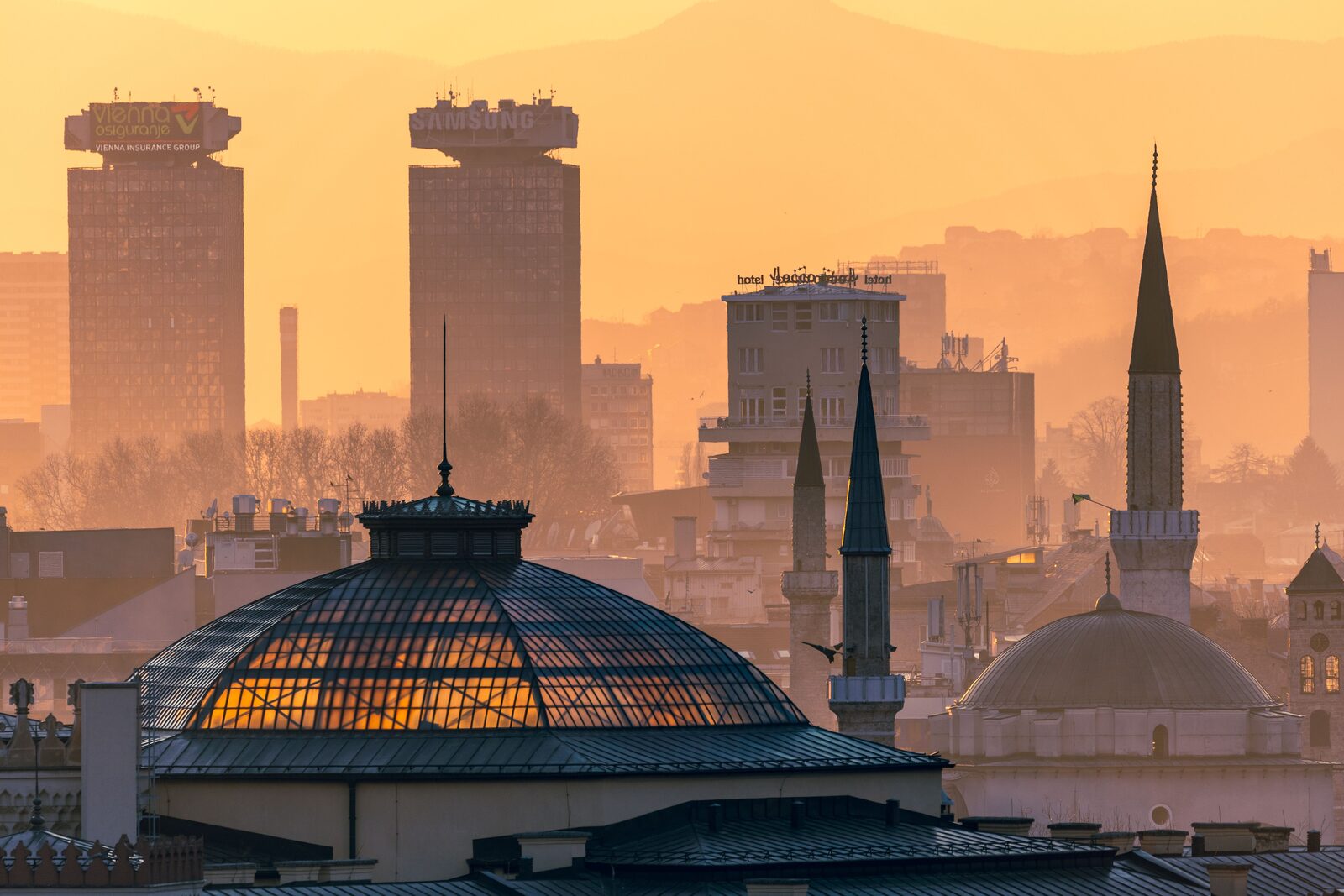
Stop 8 — Latin Bridge · 11:10
Coordinates: 43.8579° N, 18.4288° E. From the cathedral, walk south to the Miljacka river and turn east along the north embankment. About 500 metres brings you to the Latin Bridge, a small 1798 stone Ottoman bridge across the river. On the north bank, at the corner of Zelenih Beretki and Obala Kulina bana, a small plaque marks the spot where Gavrilo Princip shot Archduke Franz Ferdinand on 28 June 1914, the trigger event of the First World War (see our June 28 1914 piece for the fuller version).
The plaque has been rewritten four times over the last hundred years, Habsburg, monarchist Yugoslav, socialist Yugoslav, post-war Bosnian. Each empire wrote the moment differently. Read the current text, look at the bridge, look at the river. The twentieth century started here.
Time here: 15 minutes.
End of the tour — 11:25
You are now about 400 metres from where you started. Cross the Miljacka on the Latin Bridge if you want to see the Museum of Sarajevo 1878–1918 on the south bank (the museum in the corner building covers the assassination, 90 minutes if you have the time). Otherwise walk back along the embankment, past Vijećnica, the striped 1896 Habsburg city hall that later held the National Library and burned in 1992, and back into the bazaar for lunch.
The full loop, if you include Vijećnica, is about 2.2 km and takes an additional 45 minutes.
What to eat when you finish
You are within five minutes of the four canonical ćevapi grills: Željo (Kundurdžiluk), Petica Ferhatović (Bravadžiluk), Mrkva (Bravadžiluk), Hodžić (Bravadžiluk). A ćevapi platter is 8–12 BAM. Pair with a jogurt (drinking yoghurt) or a bosanska kafa to close the tour. Sit outside if the weather is good; sit inside and watch the working charcoal grill if it isn’t.
Doing the tour differently
- In a shorter version: stops 1, 3, 5, 7 only. About 90 minutes.
- On a Sunday: the tour works fine — the buildings, the brass line, and the atmosphere are the point. But you cannot buy souvenirs mid-walk. See the note above.
- In the evening for sunset: start at 17:00, add the Žuta Tabija climb from Vratnik at the end (20 minutes uphill, panoramic view over the whole route). Total 4 hours.
- In winter: same route, but skip the Ministry of Ćejf terrace and sit inside somewhere warm. The whole tour is under two hours in winter because you won’t linger.
- With a professional guide: several Sarajevo operators (Sarajevo Insider, Meet Bosnia, Sarajevo Discovery) offer paid walking tours covering essentially this route with historical context added. €20–35 per person, 2.5 hours. Book online. If you prefer the self-guided version, this page is the free equivalent.
What to do with the tour
Save this page. Walk it once your first morning in Sarajevo. Use it as the frame for the rest of your visit, everything else the site covers (the three-day itinerary, the museums ranking, the sunset viewpoints) sits inside or around this route. If you have decided to come but haven’t yet arrived, the essential travel details and the best time to visit are the next reads.
Three hours. Eight stops. Four hundred years compressed into one and a half kilometres of pavement. If you have three days in the city, this is the walk you take on morning one.
Sources & further reading
Keep reading
More from the guide.

Sarajevo vs. Mostar — why the two-hour bus ride changes everything, and you should not day-trip
Mostar is not a smaller Sarajevo and Sarajevo is not a bigger Mostar. They share Ottoman heritage, a river, and a war,...

Sarajevo — the European capital where halal is the default, not the exception
Is Sarajevo Muslim-friendly? It is a Muslim-majority European capital with more than 120 mosques, five daily calls to prayer from Baščaršija, and...

Sarajevo air pollution — when it's a problem, when it isn't, and what the numbers actually show
Is Sarajevo the most polluted city in Europe? For about ten weeks a year — late December through mid-February — yes, sometimes....