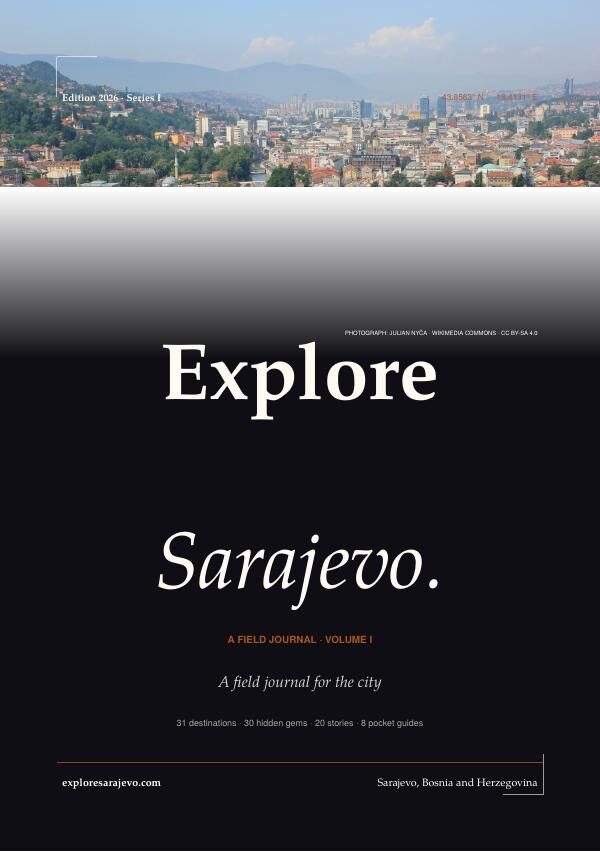
Sarajevo architecture — 1462 to 1913, on foot in one afternoon
From Isa-beg's 1462 Ottoman foundation to Karel Pařík's Habsburg pavilions, a guide to the buildings that make the city legible at street level.
Sarajevo is the only European capital where you can walk for ninety minutes in a straight line and pass through four centuries of architecture. From the Ottoman foundation in 1462 to the end of Habsburg rule in 1918 is a span of 456 years, and the buildings that survived earthquakes, fires, three world wars, and the 1992–1995 siege still stand in something close to their original geography. One street, Ferhadija continuing as Sarači, runs from the Eternal Flame to the Sebilj fountain, and reads as a textbook of the city’s architectural history.
The guide below walks that line, building by building, in the order you encounter them. Two empires built almost everything you see: the Ottoman (1462–1878) and the Austro-Hungarian (1878–1918). A handful of architects, mostly Czech, did most of the Habsburg work. Their names are worth knowing.
The full walk, at a slow pace with stops, runs about two and a half hours. At a brisk pace, eighty minutes. Pick a clear afternoon. Start at the Latin Bridge.
The two empires, in one sentence each
The Ottoman city (1462–1878). Sarajevo was founded by Isa-beg Ishaković, the Ottoman governor of the Bosnian Sanjak. He built five core institutions of an Islamic city on the floodplain of the Miljacka river: a hammam, a mosque, a hostel for travellers, a market, and a bridge. The bazaar Baščaršija grew out from his market, the city outward from the bazaar.
The Habsburg city (1878–1918). After the Congress of Berlin in 1878, Austria-Hungary occupied Bosnia and the city’s population quintupled within forty years. The Habsburg administration, particularly the joint Finance Minister Benjamin von Kállay, built a parallel European city to the west of Baščaršija, separated by a single brass line in the pavement (you will walk across it). The two cities did not merge. They stood side by side.
The buildings below are organised by period and, within each period, by where they sit on the walk.
The Ottoman period (1462–1878)
Gazi Husrev-beg Mosque (1531)
The largest and most architecturally complete Ottoman complex in the western Balkans, built between 1530 and 1531 for Gazi Husrev-beg, the Ottoman governor of Bosnia from 1521 to 1541. The mosque itself sits at the heart of a küllije: a religious-civic complex that included the mosque, a madrasa, a public kitchen for the poor (the imaret), a clock tower, an ablution fountain, the founder’s mausoleum (türbe), and a covered bezistan. Most of it is still intact and functioning. The minaret is 45 metres, and the central dome remains the largest dome anywhere in Bosnia.
The presumed architect was Acem Esir Ali, a builder trained in Istanbul under Mimar Sinan’s circle, though the documentary evidence is thin.
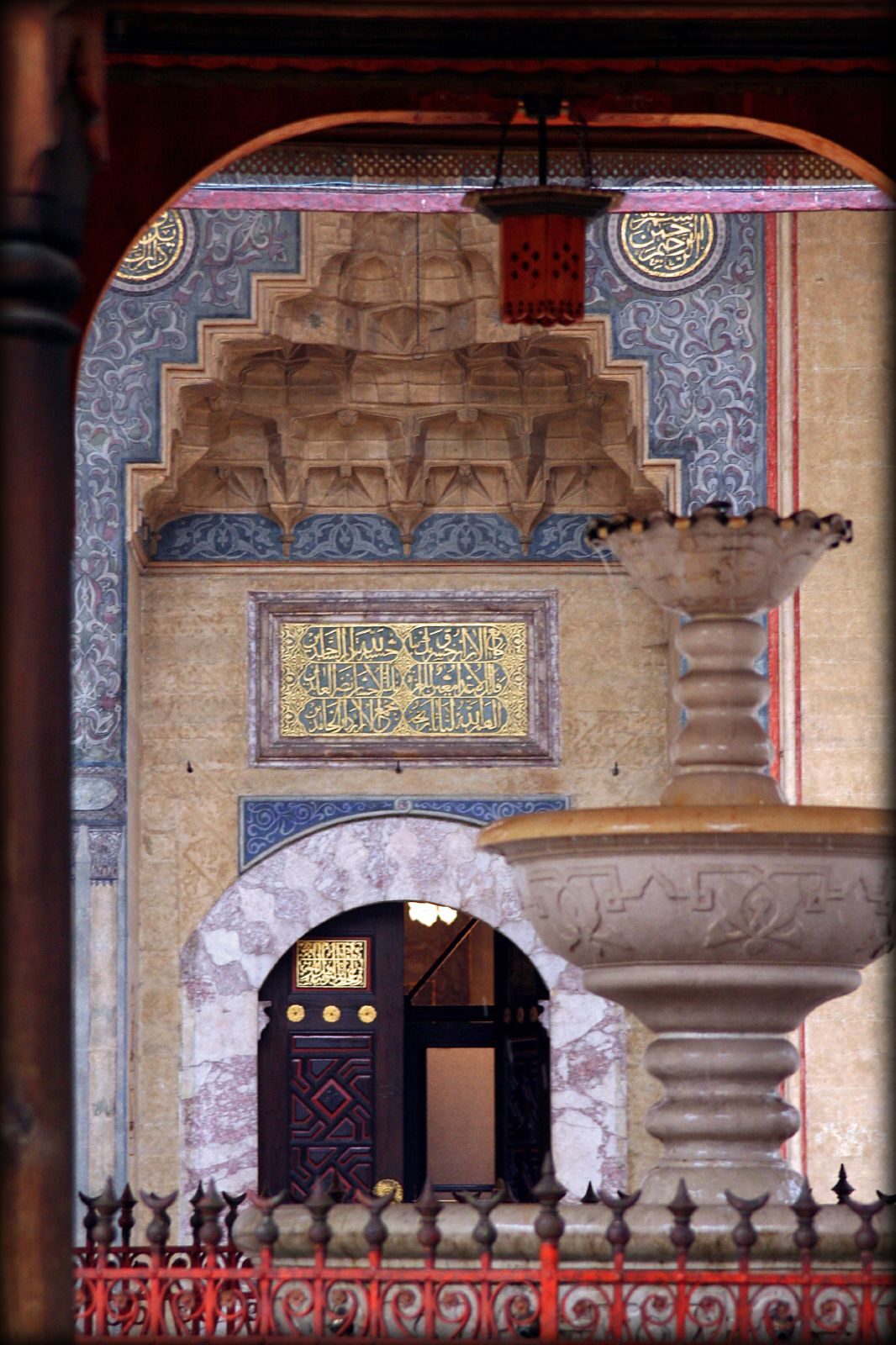
The full destination entry: Gazi Husrev-beg Mosque.
Morića Han (16th century)
A single surviving han (traveller’s inn) of Ottoman Baščaršija, on Sarači street. Hans served as the empire’s road-network infrastructure: a courtyard with stables on the ground floor and lodging for traders on the upper floor, built at one-day’s-march intervals across the Ottoman territories. Sarajevo had several; only Morića Han remains in something close to its original form. Now a café and small shop with the original courtyard intact. The upper floor has been a restaurant for at least two centuries.
The full hidden-gem entry: Morića Han.
Baščaršija (1462 onward)
Not a single building but a continuous urban fabric. The bazaar grew from Isa-beg’s 1462 market and, by the 16th century, contained around 80 different craft streets, each named for its trade: Kazandžiluk (coppersmiths), Sarači (saddle-makers), Kujundžiluk (goldsmiths), Halači (cotton-fluffers), Bravadžiluk (locksmiths), and so on. The street naming is 600 years old and the naming itself is the heritage. A guide to pronouncing them is here.
By the end of the 19th century, after multiple earthquakes and fires (particularly the 1879 fire that destroyed Tašlihan), Baščaršija had shrunk to roughly half its 16th-century footprint. What remains is the densely-built core around the Sebilj.
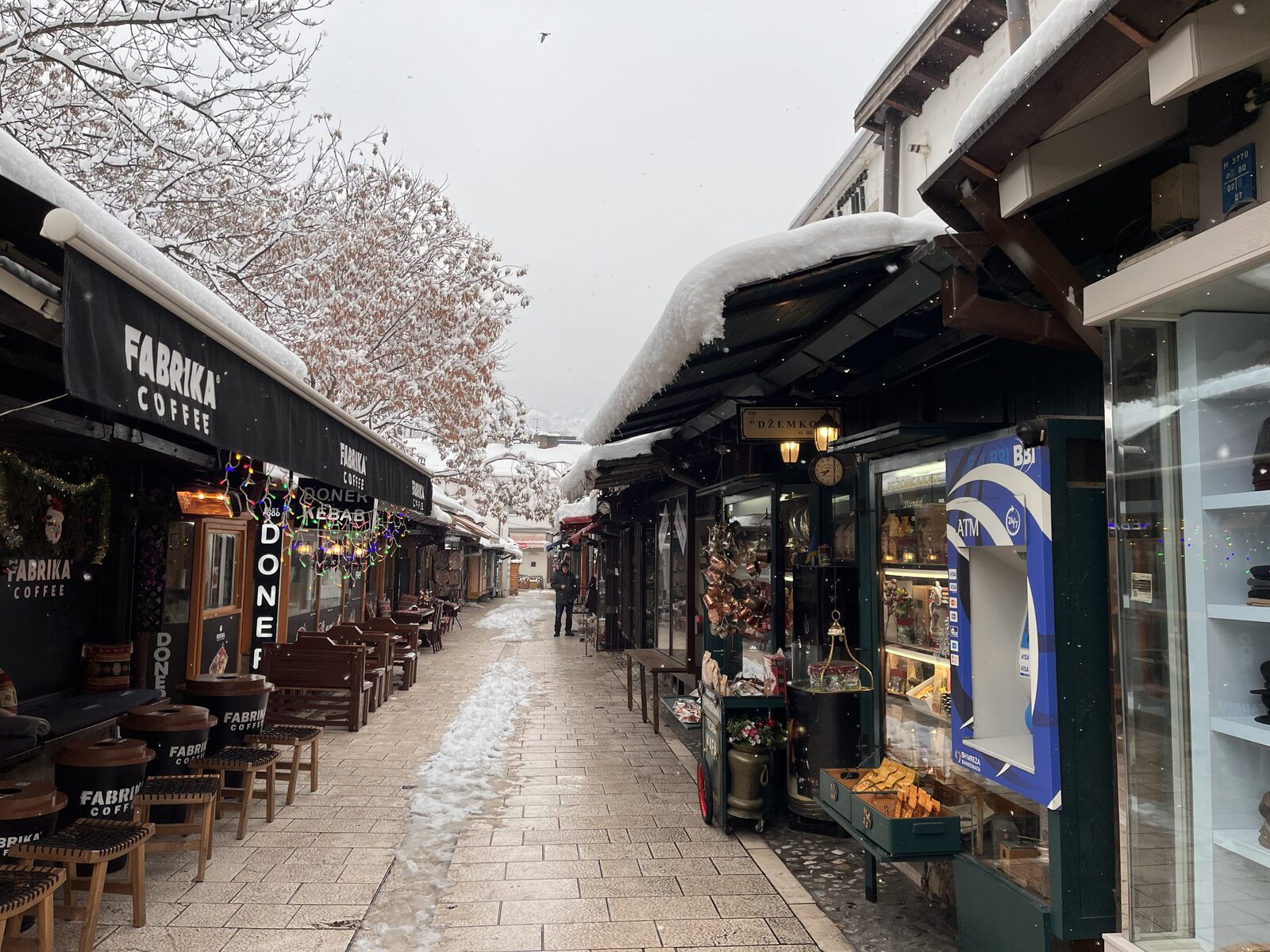

The Sebilj (1753, rebuilt 1891)
The covered wooden fountain at the centre of Baščaršija, built in 1753 by the Ottoman governor Mehmed Paša Kukavica. After the 1879 fire it was destroyed; the current structure was rebuilt in 1891 by the Czech architect Aleksandar Wittek, the same architect who designed Vijećnica. Replicas of the Sebilj have since been built in Belgrade, Sofia, and other Balkan capitals, but the original is here. Feed the pigeons.
The full destination: The Sebilj.
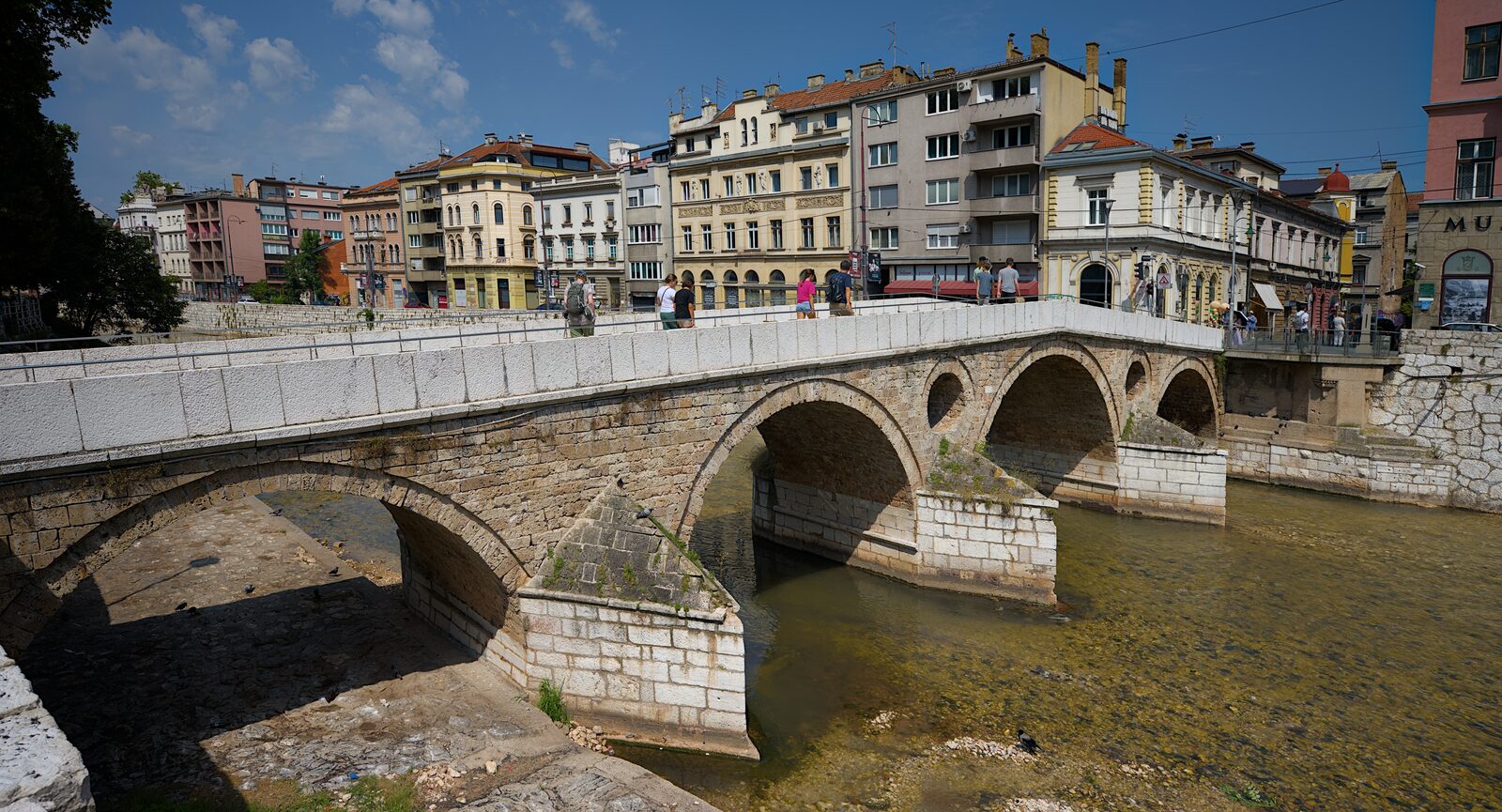
Latin Bridge (1798)
The small four-arch stone bridge over the Miljacka that became, by accident of history, the most-photographed Ottoman structure in Sarajevo. The wooden version dated to 1514; the stone replacement to 1538; the current four-arch form to 1798 after a flood. On 28 June 1914, Gavrilo Princip assassinated Archduke Franz Ferdinand at the north foot of the bridge. The full destination entry: Latin Bridge, and the museum on the corner: Museum of Sarajevo 1878–1918.

Kozija ćuprija (15th–16th century)
A single-arch stone bridge across the Miljacka east of the city, on the road to Pale. Probably 15th-century Ottoman; the engineering is straightforward and the setting is one of the most photographable along the river. The full hidden-gem: Kozija Ćuprija.
The Habsburg period (1878–1918)
The forty years between 1878 and 1918 produced more Sarajevo architecture than the preceding four centuries. The reasons were demographic and ideological. The city grew rapidly. The Habsburg administration set out to make Sarajevo a cultural capital of the empire, modelled on the smaller provincial capitals of Bohemia and Moravia. The architects were almost all Czechs sent south to do the work. Karel Pařík (sometimes spelled Karlo Paržik) alone designed close to 70 public buildings in the city.
Vijećnica — Sarajevo City Hall (1891–1896)
The single most-photographed building in Sarajevo, on the north bank of the Miljacka at the eastern edge of the centre. Built between 1891 and 1896 in the Pseudo-Moorish style the Habsburg administration adopted for civic buildings in Muslim-majority cities. The original concept was by Karel Pařík; the detailed design was completed by Aleksandar Wittek (who died before completion); the final building was supervised by Ćiril Iveković.
The striped sandstone façade, horseshoe arches, and elaborate muqarnas (stalactite vaulting) over the entrance read as Andalusian and North African. The Habsburgs wanted a “Bosnian style” that would be visually legible as Eastern without being specifically Ottoman.
The building functioned as City Hall until 1949, then as the National and University Library of Bosnia and Herzegovina until 25 August 1992, when it was deliberately shelled by Bosnian Serb forces during the siege. Approximately 2 million books burned. The building was rebuilt with EU and Spanish funding and reopened on 17 July 2014.
The full destination: Vijećnica.
Sacred Heart Cathedral (1884–1889)
The largest Catholic cathedral in Bosnia and Herzegovina, designed by Josip Vancaš in the Neo-Gothic style and built between 1884 and 1889. The two towers rise 43.2 metres. The façade is closely modelled on Notre-Dame de Dijon, and the interior is a recognisable late-19th-century Central European Gothic Revival. In a city where Catholic, Orthodox, Jewish, and Muslim religious buildings stand within a few hundred metres of each other, this is the Catholic anchor.
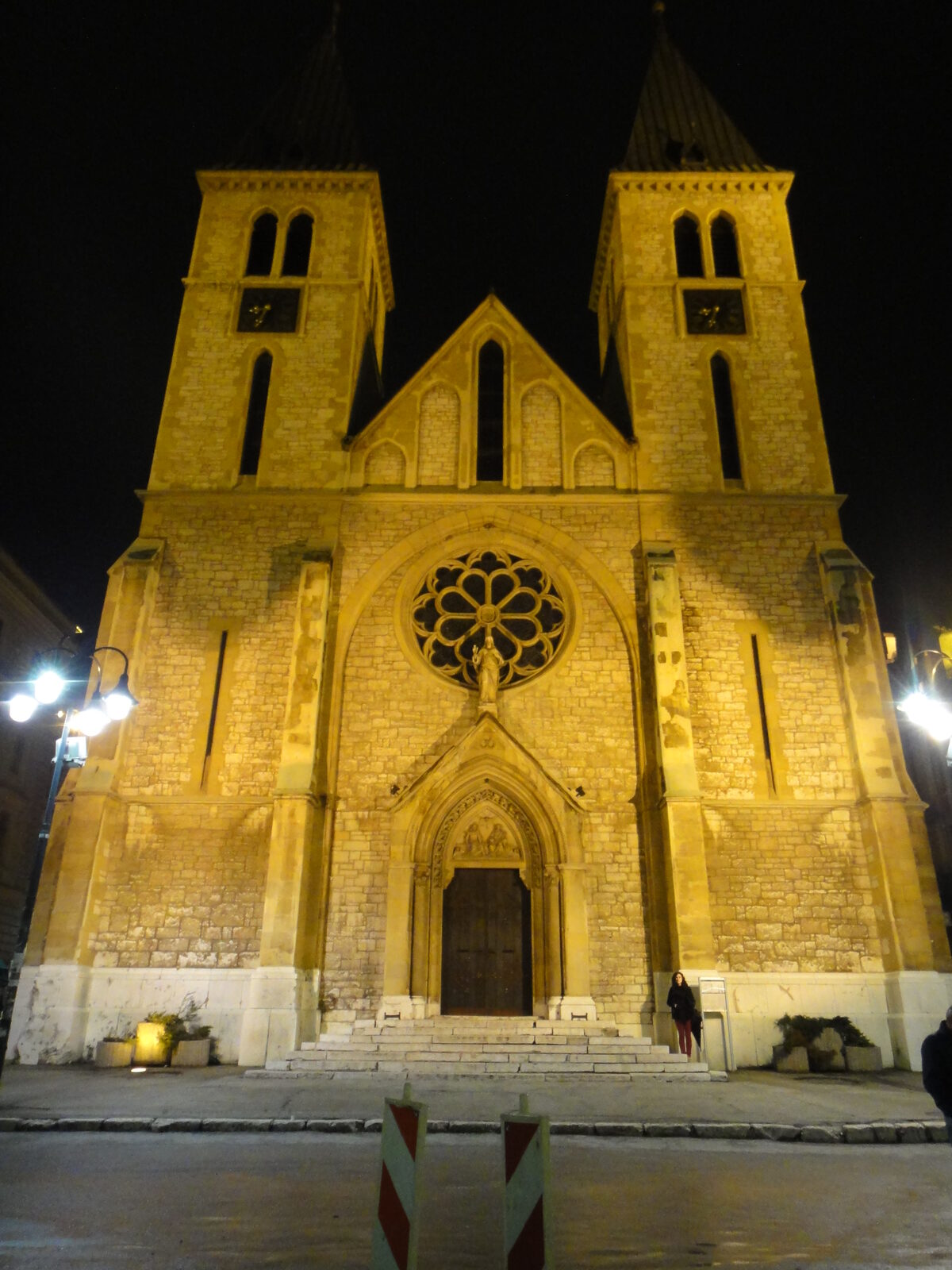

The full destination: Sacred Heart Cathedral.
Ashkenazi Synagogue (1902)
Designed by Karel Pařík in Pseudo-Moorish style, built 1902 on the south bank of the Miljacka. The Ashkenazi Jews who arrived in Sarajevo under Habsburg rule needed their own synagogue. The existing Sephardic synagogues in Baščaršija belonged to the older, longer-established Sephardic community. The choice of Moorish style for an Ashkenazi synagogue was a deliberate gesture: it visually paralleled the older Sephardic tradition by referencing Iberian Jewish architecture.
The synagogue still functions. The largest active synagogue in southeastern Europe and one of the few Sephardic-style synagogues still in use anywhere in the world. The full hidden-gem entry: Ashkenazi Synagogue.
The Main Post Office — Glavna pošta (1907–1913)
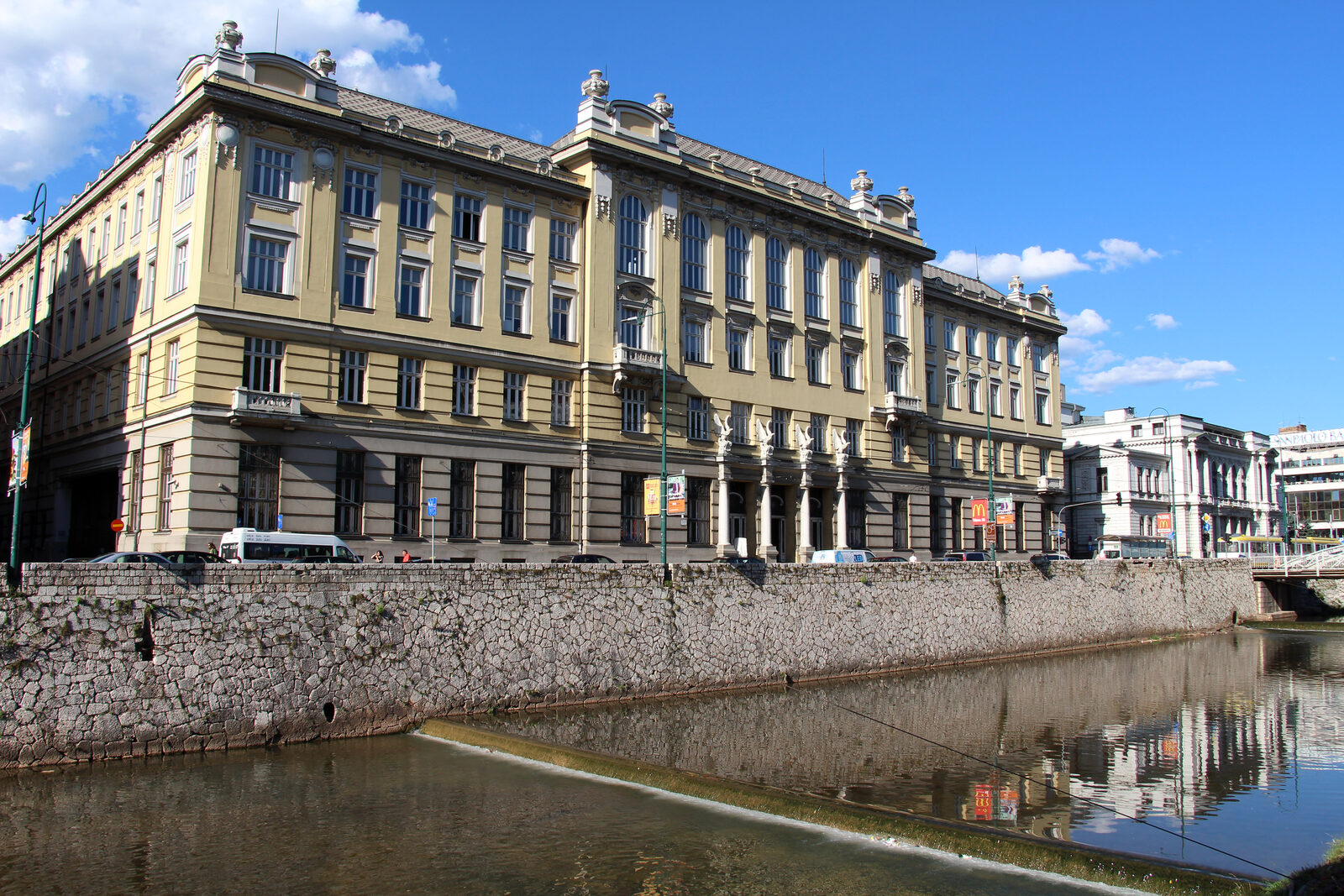
Designed by Josip Vancaš in the Vienna Secession style (the Austro-Hungarian variant of Art Nouveau), completed in 1913. The most explicitly Secession-style major building in Sarajevo. Located on Obala Kulina Bana between the Latin Bridge and the Cumurija Bridge. The interior central hall, with its stained glass and decorative ironwork, is one of the most coherent Secession interiors anywhere in the former Habsburg territories.
Still a working post office, and the central hall opens to the public during operating hours.
.jpg)
National Museum of Bosnia and Herzegovina (1909–1913)
Designed by Karel Pařík and built in Neo-Renaissance style with Classicist elements. Four separate pavilions arranged around a central botanical courtyard, completed in 1913. The deliberate choice of four pavilions, rather than a single monumental block, reflected the museum’s collection: archaeology, ethnology, natural history, and library/manuscripts, each in its own building. The botanical garden between them, planted with indigenous Bosnian species in 1913, is still growing.
The museum houses, in a controlled-light vault on the lower floor, the Sarajevo Haggadah, a 14th-century Sephardic illuminated manuscript that is the country’s single most internationally famous holding.
The full hidden-gem entry: National Museum of BiH.
Palace of Justice (later 19th century)
Designed by Karel Pařík as the Habsburg administrative building for Bosnia, now the Faculty of Law of the University of Sarajevo. On Obala Kulina Bana, west of the Latin Bridge. A more restrained, monumental Neoclassical block than Pařík’s Pseudo-Moorish work. The choice of style indicates the function (law, administration) rather than the cultural context.
National Theatre (1898–1899)
Also by Karel Pařík, built 1898–1899 on Obala Kulina Bana. The theatre still functions in its original use, programming both Bosnian and international productions. The façade is restrained Neo-Renaissance; the interior preserves the original Habsburg-era stage and tiered seating.
The Eternal Flame and the Landesbank Building (1893)
At the western end of Ferhadija stands Trg oslobođenja (“Liberation Square”), with the Eternal Flame (a 1946 monument to the World War II liberation of Sarajevo) set into the wall of the former Landesbank Building, designed by Karel Pařík in 1893. The bank building is now used by other tenants, but the small stone niche with the eternal flame is the symbolic eastern end of Maršala Tita street and the western end of Ferhadija. Cross-link: Ferhadija destination.
Despića House (1780, expanded 1880s)
A single Sarajevan house that visibly spans the transition between the two empires. The ground floor is late-Ottoman, c. 1780; the upper floors are Austro-Hungarian additions from the 1880s. The house belonged to the Despić family, prominent Sarajevan merchants who hosted the first theatrical performance in Bosnia in their upper room in the mid-19th century. It is now a branch museum of the Sarajevo Museum, open to the public.
The two architects who built Habsburg Sarajevo
Karel Pařík (1857–1942)
A Czech architect from Veliš, Bohemia, who came to Sarajevo in 1884 at the age of 27 and stayed for almost fifty years. He designed somewhere between 70 and 200 buildings in the city (sources vary; the number depends on whether you count Pařík’s collaborative projects with his office). The roster includes:
- The Sacred Heart Cathedral concept (later finished by Vancaš)
- The initial design for Vijećnica
- The Ashkenazi Synagogue
- The National Museum
- The Palace of Justice
- The National Theatre
- The Landesbank Building
- The Evangelical Church (now the Academy of Fine Arts)
- The Government Building on Marijin Dvor
Pařík shaped the Pseudo-Moorish style that became, for forty years, the Habsburg administration’s preferred idiom for major public buildings in Sarajevo. The single most influential architect in the city’s history. He died in Sarajevo in 1942 during the Nazi occupation and is buried in the Catholic cemetery in Stup.
Josip Vancaš (1859–1932)
A Slovenian architect, Vienna-trained, who arrived in Sarajevo around the same time as Pařík. Vancaš designed in a wider stylistic range than Pařík: Neo-Gothic (Sacred Heart Cathedral), Vienna Secession (Main Post Office), and Neo-Romanesque in his later residential commissions. He designed around 170 buildings across Bosnia, with about 70 of them in Sarajevo. He returned to Slovenia after Bosnia joined the Kingdom of Yugoslavia in 1918.
The walking sequence
A single afternoon walk ties most of the above together. Start at the Sebilj and go east before turning west:
- The Sebilj (10 minutes) — Ottoman, 1753/1891. Feed the pigeons.
- Sarači (15 minutes), walk west toward the Gazi Husrev-beg Mosque.
- Gazi Husrev-beg Mosque (20 minutes). Ottoman, 1531. Look at the küllije layout; sit by the ablution fountain.
- Morića Han (5 minutes). Ottoman traveller’s inn. Coffee in the courtyard.
- Meeting of Cultures line in the pavement (1 minute). Ottoman becomes Habsburg.
- Ferhadija (15 minutes). Habsburg apartment blocks and café terraces.
- Sacred Heart Cathedral (10 minutes). Vancaš, 1889. Look up at the towers.
- The Eternal Flame and Landesbank Building (5 minutes). Pařík, 1893. Western end of the line of Ferhadija.
- Walk down to the river (5 minutes), south on Maršala Tita.
- The Main Post Office (15 minutes). Vancaš, 1913. Step inside the central hall.
- Walk west along Obala Kulina Bana (10 minutes), past the National Theatre and the Palace of Justice.
- Vijećnica (15 minutes). Pařík/Wittek/Iveković, 1896. Look at the muqarnas over the door, the striped façade, and the rebuilt central atrium.
- Cross the Šeher-Ćehajina Bridge (3 minutes), south side of the river.
- Walk back west along the south bank (15 minutes), to the Ashkenazi Synagogue (Pařík, 1902).
- Cross the Latin Bridge (5 minutes), back to the north bank, with a stop at the Princip plaque.
About two and a half hours at a relaxed pace. A single afternoon ties Sarajevo’s two empires into one walk.
A note on what survived and what didn’t
The most catastrophic loss in the city’s architectural history: the deliberate shelling of Vijećnica on 25–26 August 1992, when an estimated 2 million books and manuscripts from the National Library were destroyed in a fire that burned for three days. Workers rebuilt the building; the collection mostly cannot be. The Tašlihan traveller’s inn, a Pařík restoration target in his early career, had already been lost to the 1879 fire.
Beyond those two losses, most of what the two empires built is still standing. The 1992–1995 siege damaged many buildings (including Vijećnica, the National Museum, the National Theatre, and the Main Post Office), but the structural shells survived. Restoration has been the work of the last thirty years. Most of the buildings on this walk are in better condition in 2026 than they were in 1996.
The architectural legacy is, with allowance for what was lost, mostly intact. Walk it before any of it changes. And if a café owner says bujrum (please, come in) on the way through, take the coffee. The walk is better for the stop.
Further reading
- The Sarajevo Haggadah: a book that has outlived five empires: the 14th-century manuscript in the National Museum’s lower-floor vault.
- Pronouncing the bazaar: a short, mostly painless lesson: the street names, and how to read them out loud without embarrassment.
- Sarajevo’s UNESCO list: four entries, none of them a building: the wider heritage context, including the Tentative-List submission of the city itself.
- Sarajevo’s museums: a reader’s ranking: the museums housed inside many of the buildings above.
Sources & further reading
Keep reading
More from the guide.

Sarajevo Main Post Office — Vancaš copied Otto Wagner's Vienna original, and finished eight months before the assassination
The Sarajevo Main Post Office, designed by Josip Vancaš and opened in 1913, is the largest Vienna Secession building in Sarajevo. Boris...
Sarajevo Ciglane — the Ottoman mahala rebuilt in concrete in 1976
Walk north from central Sarajevo up the Koševo valley and you will see, terraced against the slope, one of the strangest and...

Sarajevo's iron fences — the pheasant on Sime Milutinovića 15, and other pieces you walk past
Push a heavy oak door open in a Habsburg-era palace on Strossmayerova, or Vrazova, or Obala Kulina bana, and look up. The...