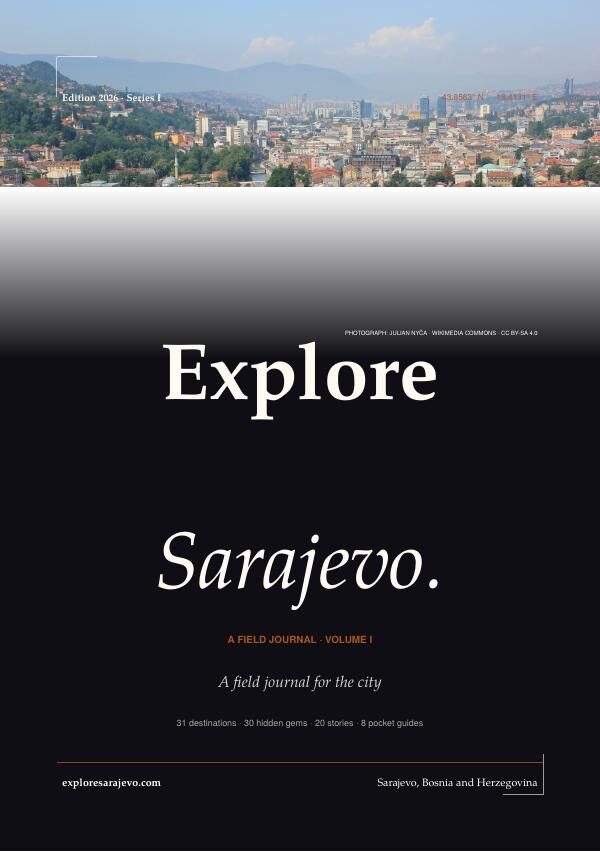
Explore Sarajevo / Destinations / Sarajevo Ferhadija
Destination · Centar · 3 min read
Sarajevo Ferhadija
The Habsburg pedestrian artery that runs west from the bazaar into the modern city — the seam where Ottoman Sarajevo becomes Austro-Hungarian Sarajevo.
- Established
- Restructured 1879–1918 under Habsburg rule
- By
- Various Austro-Hungarian municipal projects


At a glance
Address
Ferhadija street, Centar (from the Bezistan west to Trg oslobođenja)
Hours
Open street
Price
Free
Getting there
Tram 1, 2, 3, 4, 5 to Latinska ćuprija, Drvenija, or Cumurija
Time needed
30 minutes to walk, two hours to walk slowly
Best time
Late afternoon, when the cafés along it are full and the light is good on the Sacred Heart Cathedral
Coordinates
43.8585° N 18.4259° E
Navigate
Ferhadija is the broad pedestrian street that runs west from Baščaršija through the 19th-century Habsburg quarter of Sarajevo, ending at the Eternal Flame monument and the start of the inter-war and socialist downtown. It is the city’s second spine, flatter, wider, more uniform than the Ottoman bazaar streets, lined with Austro-Hungarian apartment blocks and the cafés the lower floors of those blocks have hosted, in some cases, continuously since the 1890s. If Sarači is the Istanbul of the city, Ferhadija is the Vienna.
The transition between the two is one of the more legible architectural seams anywhere in Europe. It is marked, with very little ceremony, by a brass line embedded in the pavement, the Sarajevo Meeting of Cultures marker, carrying the inscription in Bosnian on one side and English on the other. Cross the line and the buildings change. The roofs go from low tile to higher mansard. The shops widen. The street furniture acquires neoclassical mouldings. You have not turned a corner. You have changed empire.
What Ferhadija is
Architecturally, Ferhadija is a working catalogue of late-19th-century Habsburg apartment building as it was deployed across Austria-Hungary’s eastern provinces: four to five storeys, stone-faced ground floors, ornamented upper façades, deep balconies, mansard roofs. The street was widened and regularised between 1879 (the year Austria-Hungary formally took over Bosnia after the Congress of Berlin) and the start of the First World War. Most of the buildings you walk past today date from that period.
Functionally, Ferhadija is the city’s main café-and-shopping pedestrian street. Along its roughly four hundred metres you pass:
- The Bezistan: the 16th-century Ottoman covered market — at the eastern end, just before the Meeting of Cultures line.
- A long row of cafés with terrace seating on both sides. Saturday morning is the canonical time to sit at one.
- Several Habsburg-era department stores and arcades, most of which now house clothing and accessory shops.
- The Sacred Heart Cathedral (1889) on Trg Fra Grge Martića, midway down the street. Its facade is one of Ferhadija’s defining sightlines.
- Galerija 11/07/95: the Srebrenica memorial gallery — at Trg Fra Grge Martića 2. Plan an hour.
- The Eternal Flame (Vječna vatra) at the western end, a 1946 monument to the World War II liberation of Sarajevo, where the city’s pedestrian spine officially becomes Maršala Tita street.
How to walk it
The best Ferhadija walk is in the late afternoon, on a clear day, starting at the Sebilj and walking west. The sequence works editorially as well as geographically:
- The bazaar.
- The Meeting of Cultures line — pause; look at both sides of the brass.
- The Bezistan — duck in briefly.
- Coffee at any of the southern-side cafés. Sit half an hour.
- The Sacred Heart Cathedral square. Look up.
- Galerija 11/07/95. Plan the hour.
- The Eternal Flame. Stand for thirty seconds.
- End at Marijin Dvor, where the Habsburg city gives way to the modern.
The whole walk is about thirty minutes briskly and two hours done slowly. It is the best concentrated introduction to the other Sarajevo, not the Ottoman bazaar that gets all the photographs, but the European-Habsburg city that grew up alongside it and runs the modern centre.
If your time in Sarajevo allows only one street outside Baščaršija, this is the one.
Sources & further reading
More views
From Sarajevo Ferhadija
Photographs: Mark Chorlton · source · CC BY-SA 2.0

_Sarajevo,_Bosnia_%26_Herzegovina.JPG)
Keep wandering
Nearby & related.

Sarajevo Galerija 11/07/95
A small, deliberately unflashy memorial museum to the Srebrenica genocide of July 1995. Founded by photographer Tarik Samarah in 2012,...

Sarajevo Latin Bridge
A small 1798 stone bridge across the Miljacka. The Habsburgs called it Princip’s Bridge after the assassination of Franz Ferdinand...

Sarajevo Markale Market
A working open-air food market on Ferhadija, in the centre of Sarajevo. Locals call it Markale (a Bosnianisation of the...