Explore Sarajevo / Destinations / Sarajevo Vijećnica
Destination · Stari Grad · 5 min read
Sarajevo Vijećnica
The 1896 City Hall in pseudo-Moorish style. National library from 1949, burnt during the siege, reopened 2014. The most beautiful building in Sarajevo.
- Established
- 1896
- By
- Karel Pařík, Alexander Wittek, Ćiril Iveković


At a glance
Address
Obala Kulina Bana 1, Stari Grad
Hours
Typically 09:00 to 19:00. Verify seasonally.
Price
~10 BAM adult; reductions for students
Getting there
Tram 1, 2, 3, 4, 5 to the Vijećnica stop, or 8 minutes' walk east from the Sebilj
Time needed
1.5–2 hours including the small exhibitions
Best time
Late afternoon, when the sandstone glows
Coordinates
43.8592° N 18.4333° E
Navigate
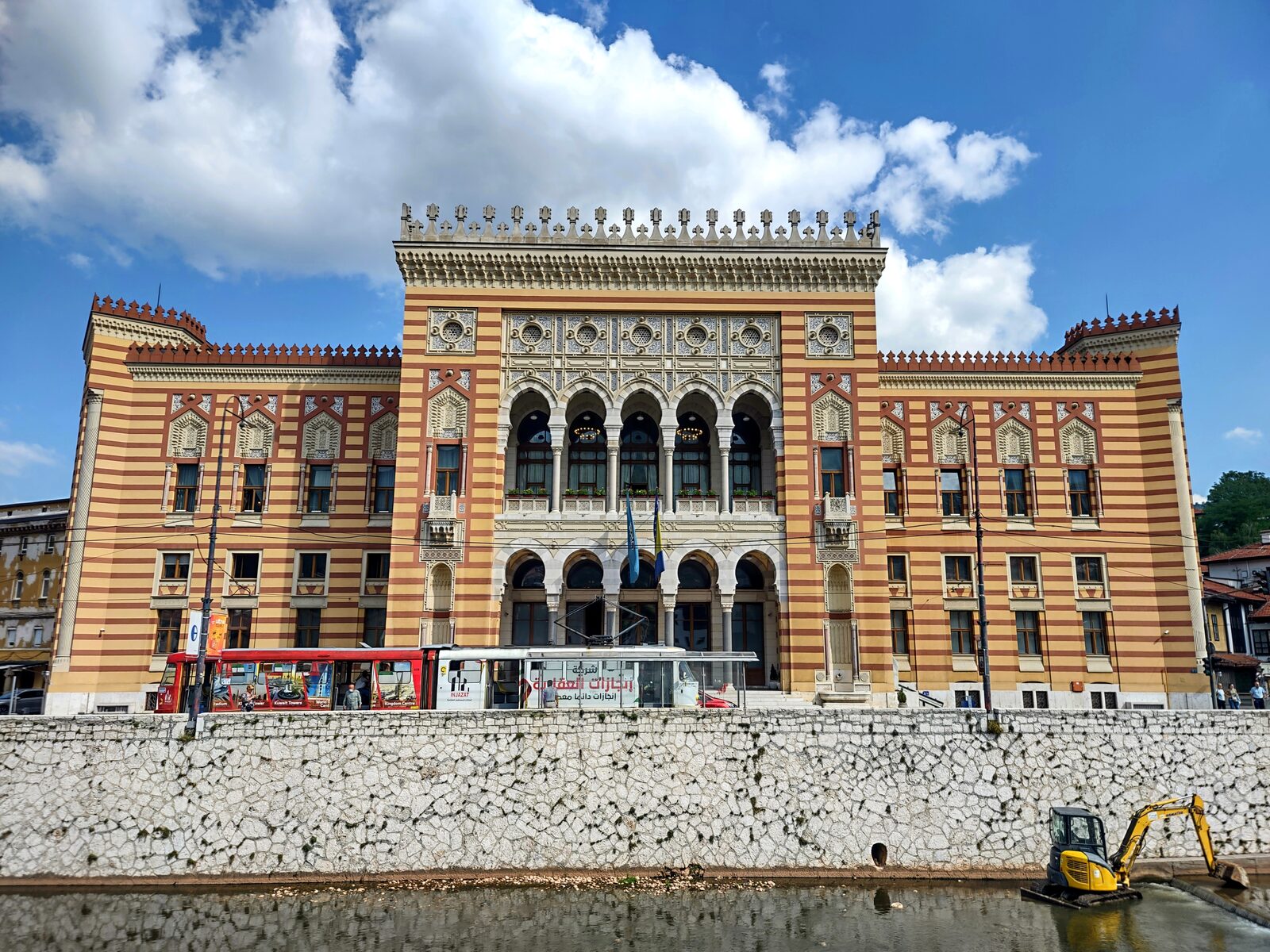
Vijećnica is the long stripey building on the south bank of the Miljacka, at the eastern end of the central pedestrian district, just before the bazaar takes over. It was designed in 1891, built between 1892 and 1894, and formally opened on 20 April 1896. It was, on opening, the largest and most ostentatious building of the Austro-Hungarian period in Sarajevo, and it is still the most photographed.
It has been a city hall, a national library, a ruin, and a city hall again. Each chapter is part of the building.
A Habsburg pseudo-Moorish project
When the Austro-Hungarian Empire took over the administration of Bosnia in 1878, it inherited a city built on Ottoman lines. The new administration’s solution, when it came to its own civic architecture, was to build European buildings in Eastern dress, a deliberate stylistic choice called pseudo-Moorish or Moorish Revival. The thinking: Habsburg buildings that visually nodded to the Ottoman heritage of the place would feel less like an imperial imposition. Whether this argument holds up is debatable. The buildings, however, are real.
Vijećnica is the masterpiece of the style. The original design was by the Czech architect Karel Pařík, who also designed the Ashkenazi Synagogue. Pařík’s project was halted by the minister Béni Kállay, who wanted a more emphatically Moorish character. The work passed to Alexander Wittek (the architect who also designed the rebuilt Sebilj). Wittek, dealing with mental illness, died in 1894 before the building was completed. The project was finished by Ćiril Iveković.
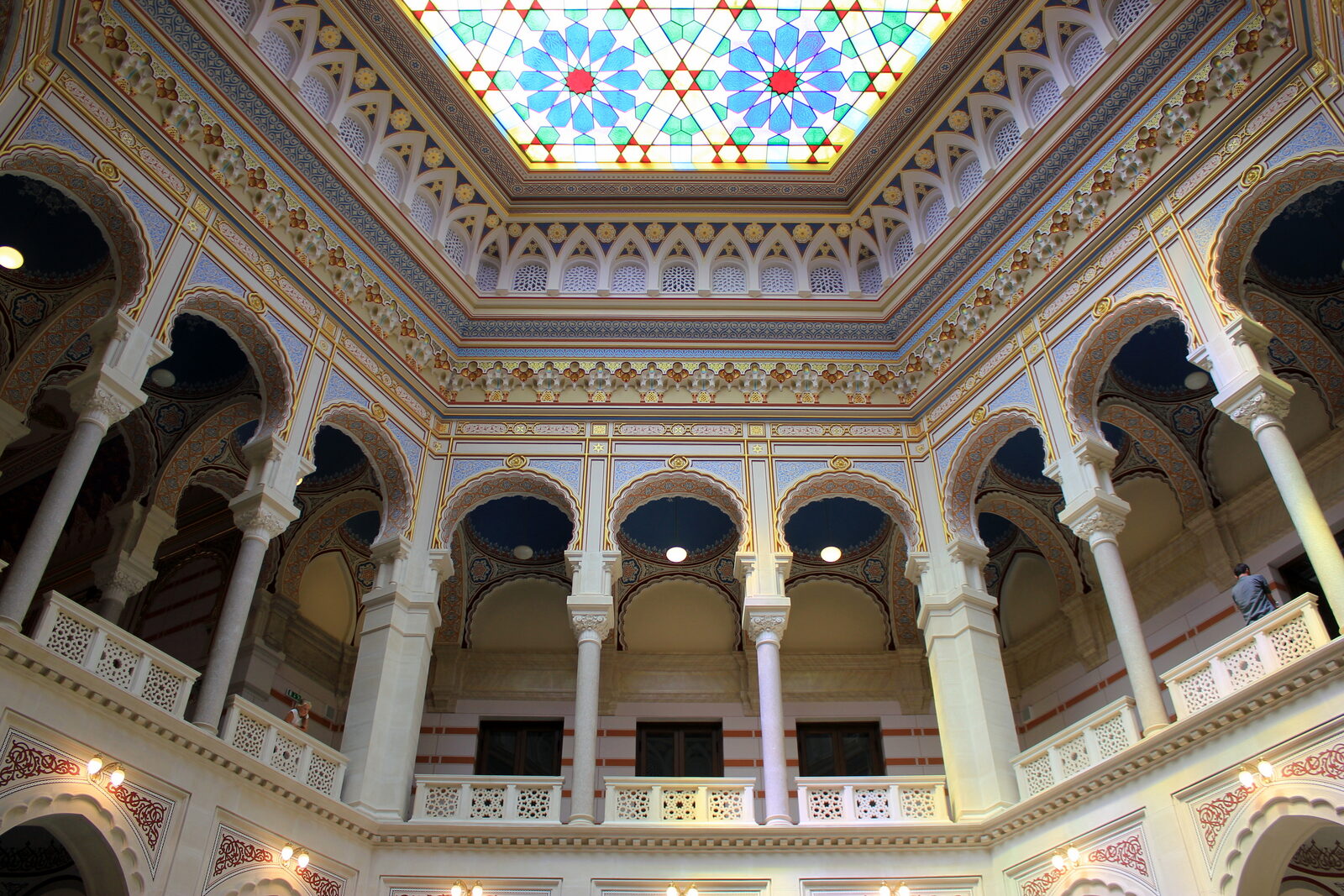
The result: striped sandstone façades, horseshoe arches, an octagonal central hall with stained-glass ceilings, and a riverside profile that has anchored the postcards of Sarajevo for 130 years.
It cost 984,000 crowns, with an additional 32,000 crowns for fixtures and fittings, a vast sum for the period.
Not everyone admired the result. The English writer Rebecca West, passing through in the late 1930s, found the building characteristically Habsburg in the wrong way, “stuffed with beer and sausages down to its toes,” as she put it in Black Lamb and Grey Falcon (1941). The quip has been quoted by every Sarajevan tour guide since, with varying degrees of agreement. Looking at the façade in golden hour, you may decide she was wrong.
A library
The building served as City Hall until 1949, when it was handed over to the National and University Library of Bosnia and Herzegovina. For the next forty-three years it held the country’s principal library collection: more than 2 million volumes, including around 700 manuscripts and incunabula, much of the Bosnian written record from the 16th to the 20th centuries, and unique runs of 19th-century Bosnian periodicals from the era of the national revival.
25 August 1992
On the night of 25 to 26 August 1992, four months into the siege, Serb forces on the surrounding hills shelled the building with incendiary munitions. It burned for three days.
Approximately two million books and documents were destroyed. Most of the manuscript collection was lost. Sarajevans tried to save what they could. Volumes were carried out of the smouldering building under fire by librarians, students, and civilians, sometimes wading through ash. One librarian, Aida Buturović, was shot by a sniper while leaving the building with rescued books. She did not survive.
The fire was widely described, at the time and since, as an act of cultural destruction. The International Criminal Tribunal for the former Yugoslavia later cited the burning of Vijećnica as evidence in the prosecution of the siege of Sarajevo.
A small stone tablet near the main entrance carries the words: Do not forget. Remember and warn. It is one of the most affecting public inscriptions in the city.
The restoration
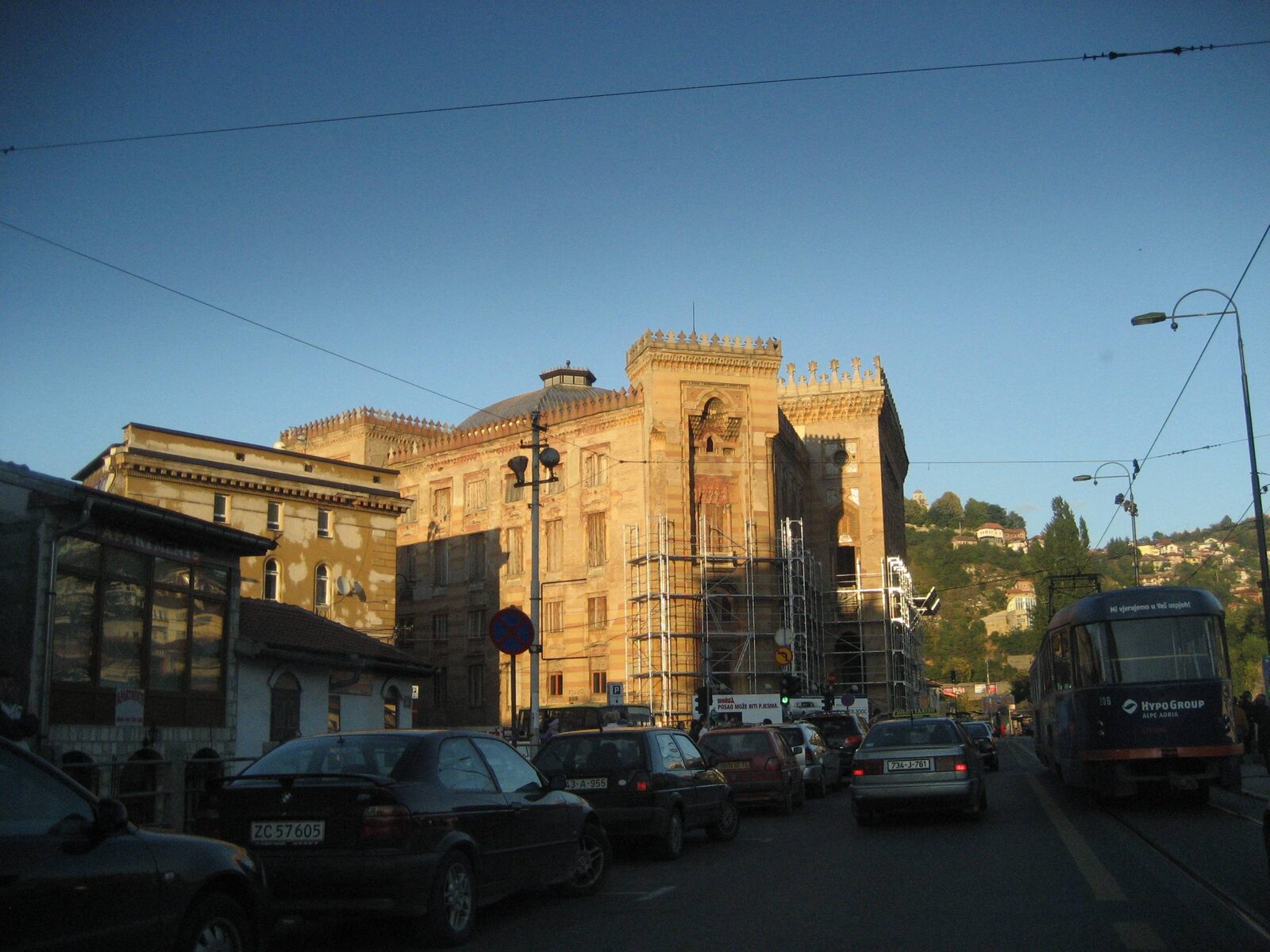
Reconstruction began in 1996, in fragments, as funding became available. The full restoration took eighteen years, with major support from the European Union, Spain, the Czech Republic, Hungary, and Austria. The building was officially reopened on 17 July 2014.
The restoration was, by general agreement, careful and accurate. Original techniques were used where possible. The stained-glass ceiling of the octagonal hall was rebuilt from surviving fragments and archival photographs. The arches and columns were rebuilt in the same Herzegovinian sandstone as the original. The ceremonial staircase and the upper galleries are again open to visitors.
The building now operates again as the city’s ceremonial municipal hall, with the upper floors used for civic events and the lower floors open to the public.
What is inside Vijećnica?
- The octagonal central hall, looking up at the stained-glass ceiling and the surrounding galleries. This is the architectural moment of the building.
- The grand staircase, restored with original red carpet and brass fittings.
- The small permanent exhibition on the ground floor, on the destruction of the library and the saving of what could be saved. Photographs, documents, surviving fragments. Twenty minutes. Essential.
- The seasonal temporary exhibitions in the upper galleries, on Sarajevan history and architecture.
- The riverside terrace café, which is decent for a coffee with a view of the south bank.
How long do you need at Vijećnica?
The building is open most days from morning to early evening. A ticket of around 10 BAM gets you the full interior tour. Combine with Inat Kuća, directly across the Miljacka, the Ottoman house that refused to move when Vijećnica was built, and that now faces the building it once stood in the way of.
Late afternoon is the best light. The sandstone glows. Stand on the bridge across the river, look back at the façade, and read the building from that angle. Two empires, one century of fire, the careful reconstruction of both.
Sources & further reading
More views
From Sarajevo Vijećnica
Photographs: Ladislav Boháč · source · CC0





Keep wandering
Nearby & related.

Sarajevo Baščaršija
The 1462 Ottoman bazaar of Sarajevo, still a working bazaar. Copper workshops on Kazandžiluk, Bosnian coffee at Morića Han, and...

Sarajevo Kazandžiluk
Kazandžiluk is the row of coppersmiths’ shops that runs east from the Sebilj into Baščaršija. The patterns being hammered here...

Sarajevo Kovači Street
A short uphill walk from the Sebilj into the old residential mahala. Coppersmiths and blacksmiths once worked here; today it’s...