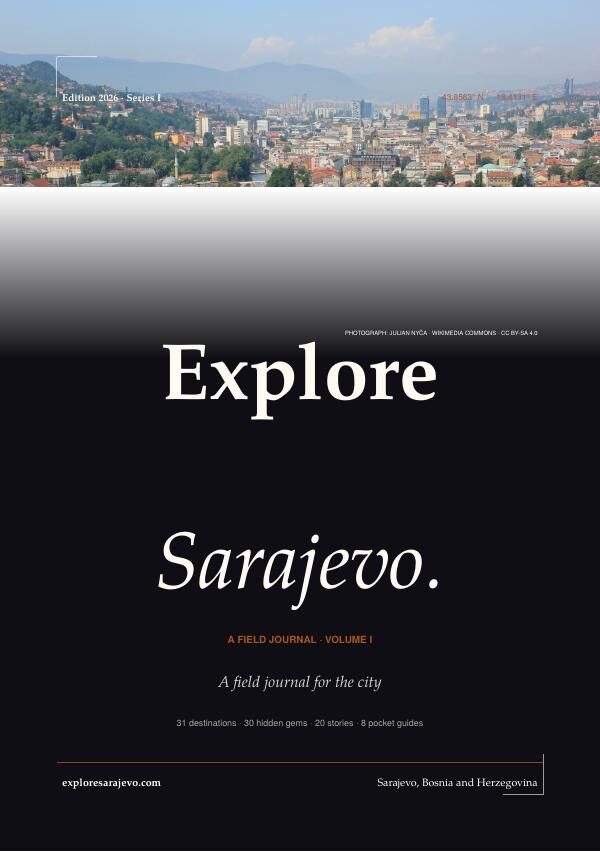

Explore Sarajevo About
About the editor
Nedim Hadzimahmutovic
A travel journal about Sarajevo, written by one person who lives in the valley.
- Editor
- Nedim Hadzimahmutovic
- Based in
- Sarajevo, since 2025
- Byline
- One person, no roster
- Contact
- h.nedim@gmail.com
A city where you could hear the muezzin call to prayer, the church bells, and the synagogue's chant — all from one café table. A pluralistic city, founded on respect for difference.
— Dževad Karahasan, paraphrased from Sarajevo, Exodus of a City (1993)
Why the journal exists
The two camps of Sarajevo writing
Explore Sarajevo exists because most English-language travel writing about the city falls into one of two camps.
The first is the war story. Heavy, well-meaning, often beautifully written, mostly stuck in the 1990s. The siege happened. It still shapes the city in ways visitors should understand. But Sarajevo did not stop existing in February 1996, and a travel journal in 2026 owes the city the rest of the story too.
The second is the listicle. Ten things to do in Sarajevo! You will be told to feed the pigeons at the Sebilj, to walk across the Latin Bridge, and to eat ćevapi at Željo. All three are correct. None of them is half of what you came for.
This is an attempt at the journal in between.
Who writes here
One person, one byline
The site is written and edited by Nedim Hadzimahmutovic. The editorial we you'll find on the site is a voice convention, not a roster.
I lived in Sarajevo for about twenty years and, as a local and a Bosnian, never really bothered to explore the city. In 2019 I moved to Bali, Indonesia, as a digital nomad and stayed about five years. That is where I met my wife. We married, had a kid, and settled in Jakarta. In late 2025 we moved to Sarajevo, and my wife's constant curiosity and her questions about the city made me realise I wanted to explore Sarajevo with her, as a joint adventure. That is how exploresarajevo.com began.
If you have a correction, a tip, or a place worth adding, the email is h.nedim@gmail.com. Replies arrive slowly, but they arrive.
Sourcing
How the journal is researched
- Facts come from publicly verifiable sources — Wikipedia, the Sarajevo Tourism Bureau, museum and institutional pages, the surviving press archives. Pages that lean materially on outside reporting carry a Sources & further reading block at the bottom.
- Photographs are CC-licensed (Wikimedia Commons, Flickr CC) with full attribution to the photographer, source, and licence in every caption.
- Quotations from other writers are short, attributed, and linked.
- Cross-cutting facts — prices, tariffs, hours that change over time — live in a single register (
_data/facts.yml) with averified:date, so a price update happens in one place, not thirty.
Language
A note on Bosnian words
Bosnian words appear across these pages — čaršija, ćejf, sevdah, merak, inat, džezva, fildžan, somun, kajmak, salep, šljivovica. Some of them don't translate, and forcing them into English flattens what they mean. Context usually carries the meaning. When it doesn't, the gloss is in parentheses the first time the word appears.
The bookshelf
Read your way into Bosnia.
Half of this site is built on the shoulders of writers who got there before. If you want to prepare before you come, start here.
-
1945
The Bridge on the Drina
Nobel Prize 1961. The novel on bridges, time, and empires.
-
1966
Death and the Dervish
18th-century Sarajevo as a setting for a meditation on cowardice and conscience.
-
1966
Stone Sleeper
Poems on the stećci, the medieval Bosnian tombstones.
-
1992
Sarajevo Blues
Prose and verse from inside the siege.
-
1994
Sarajevo Marlboro
Short stories from the same period, told slant.
-
1993
Sarajevo, Exodus of a City
A philosophical memoir, written under shellfire.
-
2008
The Lazarus Project
Sarajevo from the diaspora, in English. The essays are essential too.
-
1941
Black Lamb and Grey Falcon
The English writer's 1,100-page Balkan travelogue. Sometimes wrong. Always alive.
Dobrodošli.
Portrait: Self-portrait, 2025 · Used with permission.