Sarajevo Baščaršija — bullets, and the mortar-casing coffee grinders Helen Orr spent a year documenting on Kazandžiluk
The trade in war-debris trinkets — bullet-shell pens, mortar-casing coffee grinders, engraved cartridge cases — has grown quietly along the copper alley of Kazandžiluk since the mid-1990s. What the anthropologist Helen Orr found when she spent a year studying it.
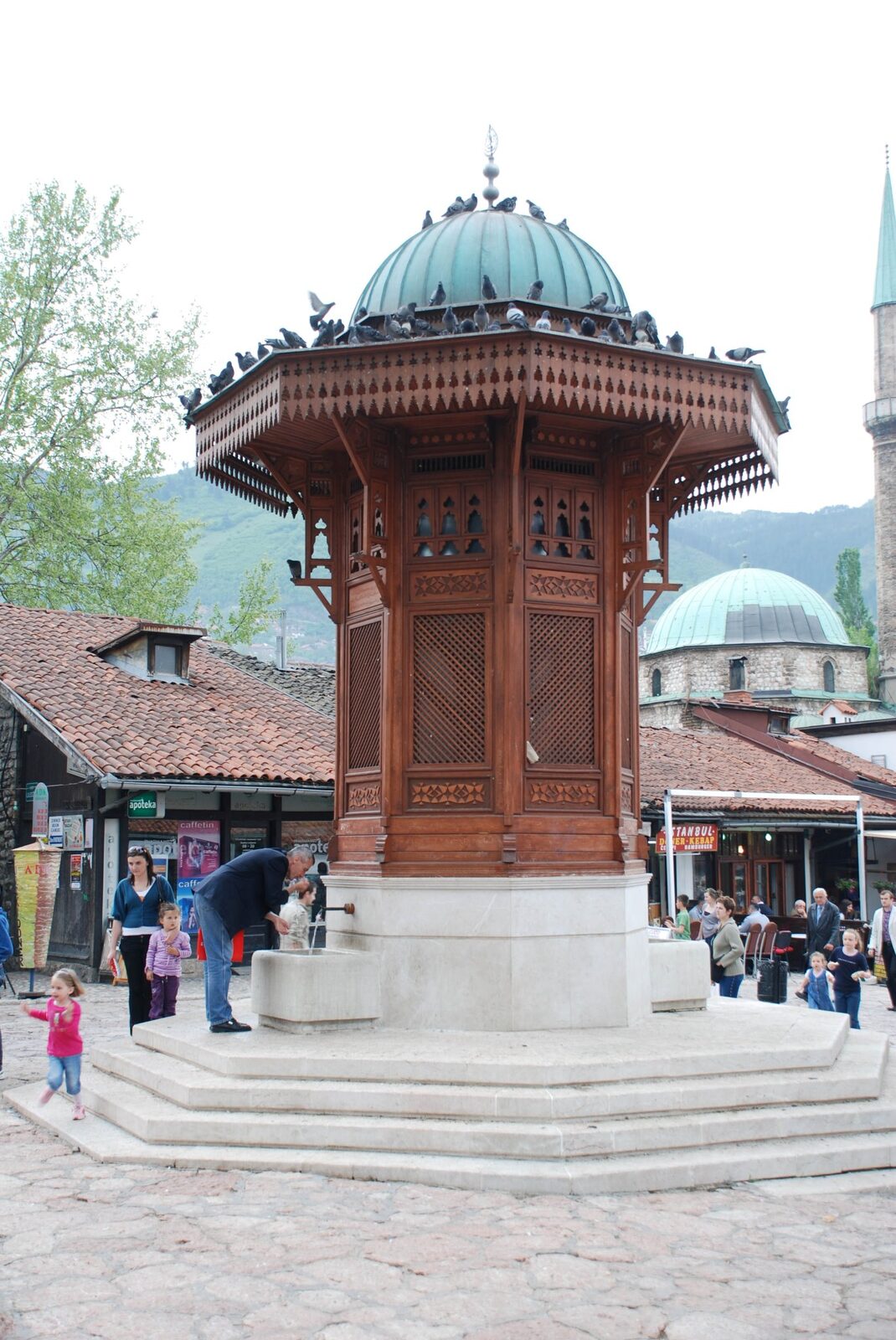
Walk down Kazandžiluk, the copper alley of Baščaršija, on a warm afternoon, and between the džezva coffee pots and the hammered trays, you will see the second inventory. Pens made from 7.62 mm cartridge cases. Coffee grinders forged out of a mortar casing upended on a wooden base. Decorative shell casings engraved with dates: 1992, 1993, 1994, 1995. Miniatures of the Sebilj hammered from the aluminium of downed shells. Bullet-shaped keyrings. Ballpoint pens that were, in a previous life, ammunition.
The trade has been part of Baščaršija since about 1996 and, on the streetside census a walking visitor can do in a single afternoon, is still substantial. It is one of the more legible traces the siege has left in the daily working life of the city, not a memorial, not a museum, but a shop.
The reference is now a PhD dissertation. Helen M. Orr’s Sarajevo and the War: Atrocity, Commodity, and Transgression in Bosnia’s War Tours (University of North Carolina at Chapel Hill, 2019) devotes its opening chapter, “Bullets in Baščaršija: The Social Life of a Post-War Commodity”, to what these objects do and what they mean. The dissertation is 244 pages, based on long-term ethnographic fieldwork, and is available in full through the UNC Carolina Digital Repository. It is the source for everything below that is not a direct observation.
What the objects are, materially
The material inventory of Baščaršija’s war-debris trade is relatively narrow. The most common formats:
- Cartridge-case pens. A spent 7.62 mm brass cartridge case (from the Kalashnikov family) is drilled, threaded, and fitted with a ballpoint refill. The base of the casing, still stamped with the manufacturer’s markings and the year of production, becomes the pen’s cap. A common tourist purchase.
- Bullet keyrings. Whole spent bullets, drilled and looped onto a key ring. Sometimes engraved with SARAJEVO 92–95 or a similar mark.
- Engraved shell casings. Larger casings, anti-aircraft, mortar, kept whole, polished, and engraved with dates, a coat-of-arms, or a fleur-de-lis. Sold as decorative objects, kept on windowsills.
- Mortar-casing coffee grinders. A hollow mortar shell fitted with a hand-crank grinding mechanism at the base. Functional. Occasional.
- Miniature landmarks in shell aluminium. Small Sebiljs, cathedral spires, mosques, hammered out of aluminium recovered from the war.
The metal is real. The bullets are real. The workshops that make them are the same copperworks that have been making džezve on this street for four hundred years. Kazandžiluk means “the coppersmiths’ street”, and the tradition of hammered metalwork here dates to the 1500s. The bullet-pen is, in a strict sense, a continuation of a craft, a change of raw material, not a change of skill.

What the objects do, socially
Orr’s chapter is about what happens when the material of a siege is turned into a portable object of exchange. Two arguments run through her analysis, both worth reporting in her frame rather than paraphrasing loosely:
The first is that these objects are commodities in the strict sense, worked-on materials made to be sold to a stranger. The seller and the buyer do not need to share a history for the exchange to happen. A tourist buys a pen; a worker in Kazandžiluk sold one. The transaction is complete. What the object represents to the tourist (a souvenir of a place they have visited) and what it represents to the seller (a livelihood, a mundane bit of stock) are different, and the object holds both at once without effort.
The second is that these objects are not memorials. A memorial commemorates. A commodity circulates. Orr uses the sociologist Igor Kopytoff’s phrase, “the social life of things”, to trace how a piece of copper starts as ammunition, becomes debris, becomes raw material, becomes a pen, becomes a souvenir on a shelf in another country, and along the way carries different meanings for different people at different points in the chain. The atrocity is not lost. It is not erased. It is folded into the object and pocketed.
Her framing is deliberately uncomfortable. It does not accuse the coppersmiths, and it does not indict the tourists. It sits with the fact that a city that survived a siege now makes part of its living selling the siege’s remains.
Who buys them
The main buyer, on any given afternoon, is a first-time visitor to Sarajevo who has taken a war tour that morning. The tour goes to the Tunnel of Hope, Žuta Tabija, Vraca Memorial Park, and, depending on the operator, the Latin Bridge and Vijećnica. It ends, roughly, in Baščaršija. The visitor has spent three hours listening to the siege being narrated, has looked at the trench lines, has crawled through fifteen metres of the Tunnel. They are then dropped, at about 1 p.m., in the coppersmiths’ alley. The pen is 20 KM. The keyring is 10. Both fit in a coat pocket.
Orr’s dissertation reads the war-tour and the bullet-pen as two ends of the same commercial system. The tour builds the meaning that gives the object its price. The object is the tour’s material residue, portable, giftable.
What locals think
Sarajevans, in Orr’s fieldwork, are largely indifferent to the trade. The war ended in 1995. The pen has been on the street since 1996. It is, in the strictest sense, just what has been there. Occasional articles in the Sarajevan press criticise the trade as “selling the siege”; occasional articles defend it as the free choice of a coppersmith to work with the materials available. Neither position dominates.
The one recurring editorial line, from Orr, and from Bosnian commentary she cites, is that the trade is not the coppersmiths’ invention. It is a response to demand. The market decided that a pen made of siege ammunition was a sellable object; the coppersmith supplied it. Locate the moral question wherever the demand originated.
Where to see them
Every third or fourth workshop on Kazandžiluk will have a small display of them, usually in a lower shelf near the front. They coexist with the fildžani coffee cups, the copper trays, and the small hammered ashtrays that are the street’s canonical output. The bullet-shell items are not marketed. You have to look for them, and if you buy one, the coppersmith will ask no questions.
If you would rather understand them than buy them, read Chapter 1 of the Orr dissertation. It is 30 pages, in English, freely downloadable from the UNC repository, and remains the single most rigorous piece of scholarship on this small strand of the Sarajevo economy.
Sources
- Helen M. Orr, Sarajevo and the War: Atrocity, Commodity, and Transgression in Bosnia’s War Tours, PhD dissertation, University of North Carolina at Chapel Hill, 2019, especially Chapter 1: “Bullets in Baščaršija: The Social Life of a Post-War Commodity”. UNC Carolina Digital Repository
- Igor Kopytoff, “The Cultural Biography of Things: Commoditization as Process”, in Arjun Appadurai (ed.), The Social Life of Things (Cambridge University Press, 1986), the theoretical frame Orr uses.
- Mattijs van der Port, Gypsies, Wars, & Other Instances of the Wild: Civilisation and Its Discontents in a Serbian Town (Amsterdam University Press, 1998), cited by Orr as ethnographic precedent.
Sources & further reading
- Helen M. Orr, Sarajevo and the War: Atrocity, Commodity, and Transgression in Bosnia's War Tours (PhD dissertation, University of North Carolina at Chapel Hill, 2019)
- Mattijs van der Port, Gypsies, Wars, & Other Instances of the Wild: Civilisation and Its Discontents in a Serbian Town (Amsterdam University Press, 1998)
Keep reading
More from the guide.

Sarajevo — half the country's tourists come to one city, and the city knows it can't keep up
More than half the country’s tourists visit one city. The canton’s 2021–2027 development strategy says so plainly: 667,756 tourists in 2019, 54.4%...
Sarajevo — Neidhardt's archive burned in the siege, and MoMA bought what survived in 2021
The Grabrijan and Neidhardt story tells you how the two Yugoslav architects wrote the 1957 book that redefined Bosnian modernism. What it...

Sarajevo has five urban rooms — the small courtyards the city depends on
The Sarajevan public spaces you can name, the Sebilj square, Ferhadija, the Miljacka embankment, are the tip of a much larger inventory....