Sarajevo east meets west — the brass line on Ferhadija where the Ottoman city becomes Habsburg in one step
One brass line in the pavement. Three empires layered on top of each other. The walk that lets you read it all in an hour.
Cities everywhere have layers. Sarajevo just makes the layers easy to see.
If you stand on the brass plate set into the pavement of Ferhadija street at the junction with Sarači and look east, the city you see was built by the Ottoman Empire between 1462 and 1878, low Ottoman shopfronts, narrow lanes, a bazaar called Baščaršija, copper workshops still hammering on Kazandžiluk, the Gazi Husrev-beg Mosque at the centre. Turn west and the city you see was built by Austria-Hungary between 1878 and 1918, tall Habsburg façades, broad boulevards, the Sacred Heart Cathedral two minutes up the street, neo-Renaissance commercial blocks, the late-19th-century European grid. The brass plate is at the seam.

The walk
The whole thing takes about an hour. Less if you don’t stop. The route works in either direction; we’ll walk it east to west, starting from the Sebilj.
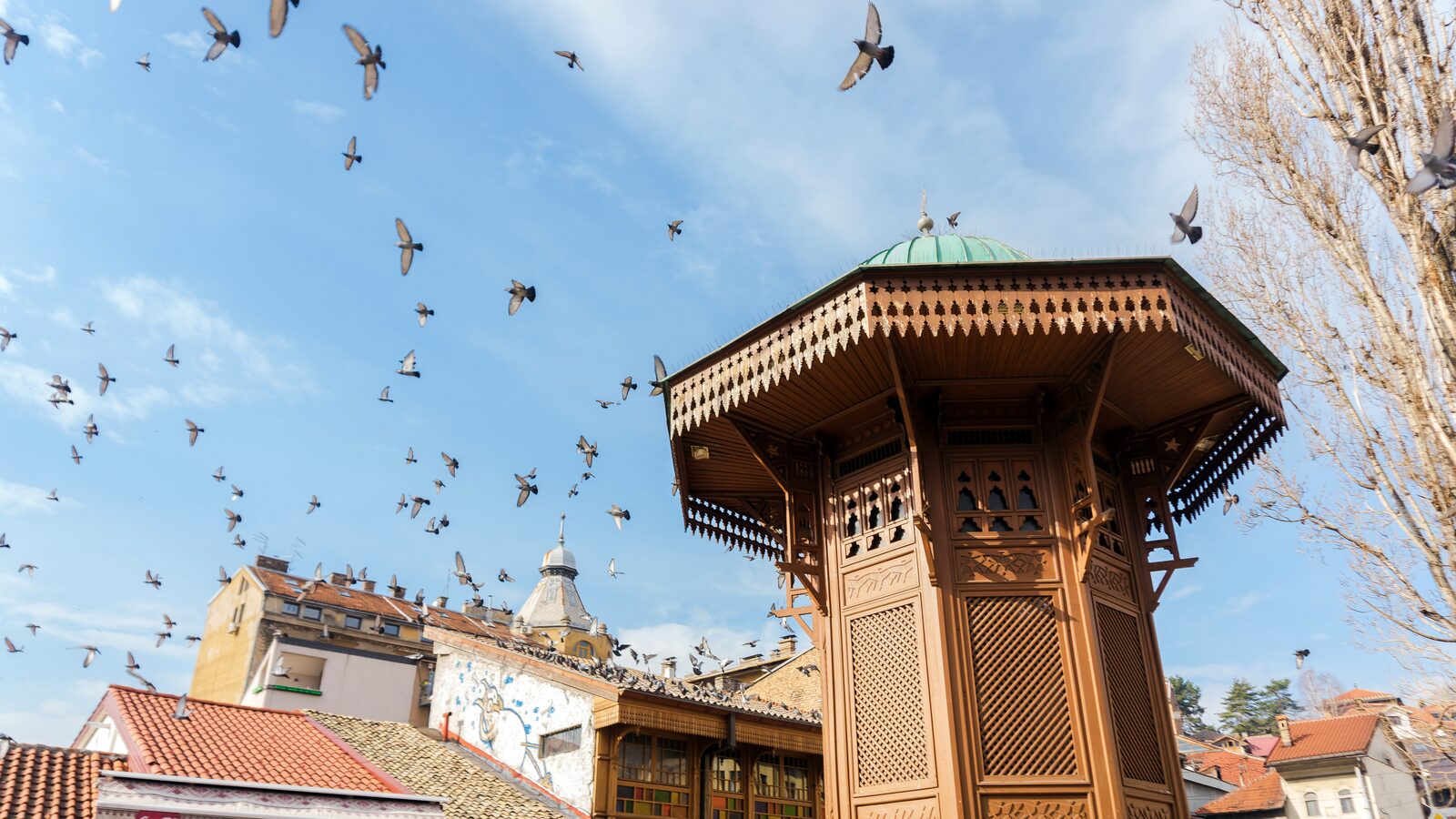
00:00, The Sebilj. The wooden fountain at the centre of Baščaršija, built in 1753, rebuilt in pseudo-Moorish style under Habsburg rule in the 1890s by the Czech architect Alexander Wittek. The first object on the walk is already a mixed inheritance.
00:15, Gazi Husrev-beg’s mosque, clock tower, library, bezistan. All of this was funded by Gazi Husrev-beg’s vakuf, the religious endowment he left to the city in 1541. The clock tower next to the mosque is one of the few public clocks in the world still kept on à la turca time, counting backwards from sunset.
00:30, The brass plate. Sarajevo Meeting of Cultures. Our page on it tells you what the plate is for. Stand on it, look both ways.
00:35, Ferhadija street. The pedestrian artery of Habsburg Sarajevo. Cafés, bookshops, the Sacred Heart Cathedral on the right, the Eternal Flame at the western end. The architecture changes street by street: neo-Romanesque, neo-Gothic, neo-Renaissance, neo-Moorish, depending on which empire’s architect was on call that decade.
00:50, The Orthodox Cathedral is two minutes south. Older than the Catholic one, consecrated in 1872, the last great religious construction of the Ottoman period.
01:00, The Ashkenazi Synagogue is two minutes south across the river. Built in 1902 in pseudo-Moorish style by Karel Pařík, for the Ashkenazi Jewish community that had arrived from central Europe after 1878.
Four working faith communities. Four hundred metres. One walk. No other European capital lays itself out quite like this.
At noon
There is a particular twenty-second window worth standing for. Around midday, the muezzin of the Gazi Husrev-beg Mosque begins the call to prayer. Within seconds, the bells of the Sacred Heart Cathedral start. If the wind is right, the bells of the Orthodox cathedral join from further south. Sarajevans call it zvuk Sarajeva, the sound of Sarajevo. The phrase travels easily as “three faiths in conversation”, though it is closer to the truth to say three faiths doing their own thing, side by side, at the same time.
The brass plate is two minutes away in either direction. You can hear all three from the plate.
Why this works
The Habsburgs took over Bosnia in 1878 with the explicit understanding that they were inheriting an Ottoman administrative system that had built a functioning, mixed-faith capital. Vienna’s first decision was to build outward from the Ottoman city, not through it. The result is the architectural seam you now walk across at the brass plate: the Habsburgs added their grid to the east-west edge of the bazaar without demolishing what was there. Most other European cities under empire-change in the 19th century did not preserve the predecessor city this carefully.
The reason east-meets-west in Sarajevo is so legible is not, in the end, a tourism slogan. It is a deliberate planning decision that two empires made, a hundred and fifty years apart, to leave each other’s work standing.
The writer Ellis Veen put the feeling cleanly in an April 2025 essay on her travel blog Backpack Adventures: “It’s this friendly and multicultural atmosphere that makes Sarajevo such a unique place.” That is the postcard version of what the brass plate, the mosque, the cathedral, the synagogue, and the bazaar are all separately saying.
Walk it once. You will read the city differently afterwards. The locals call the neighbourhood you’ll cross a mahala, half-neighbourhood, half-extended family. Five mahala, four faiths, one brass line in the pavement.
Sources & further reading
- Ellis Veen, “The Best Things to do in Sarajevo, Bosnia Herzegovina”, Backpack Adventures, April 2025 — a broader traveller’s account of Sarajevo’s east-meets-west character; useful complement to this short walk.
- Our existing pages: Meeting of Cultures, Baščaršija, Sacred Heart Cathedral, Orthodox Cathedral, Gazi Husrev-beg Mosque, Ashkenazi Synagogue.
- Photograph: Stechshotme, Wikimedia Commons, CC BY-SA 4.0.
Sources & further reading
Keep reading
More from the guide.

Sarajevo Kovači climb — from the river to the fortress, 120 metres up and four centuries back
A 45-minute linear walk uphill from the bazaar to the Yellow Fortress. Start at Čajdžinica Džirlo, climb through Kovači Cemetery, pass Ministry...

Sarajevo Baščaršija — a slow walk through the 1462 bazaar the modernists called sick lungs in 1942
A pigeon-soundtracked, coffee-paced wander through Sarajevo’s 1462 Ottoman bazaar. The places locals love and the ones travellers usually miss.

Sarajevo Baščaršija loop — 90 minutes, 1462 to 1914, and every faith within five minutes
A 90-minute circular walk through Sarajevo’s old bazaar. Start at the Sebilj, cross into the coppersmiths’ alley, pass the Gazi Husrev-beg Mosque,...