Explore Sarajevo / Hidden Gems / Sarajevo Museum 1878–1918
Hidden Gem · Centar · 6 min read
Sarajevo Museum 1878–1918
The small museum on the corner where Gavrilo Princip shot Archduke Franz Ferdinand on 28 June 1914 — the spark that started the First World War.
- Established
- 28 June 1953


At a glance
Address
Zelenih beretki 1, Centar (north foot of the Latin Bridge)
Hours
Typically 10:00–18:00 daily; closed some major holidays. Verify on arrival.
Price
~3 BAM (~€1.50). Cash preferred.
Getting there
Tram 1, 2, 3, 4 or 5 to Latinska ćuprija. The museum is twenty seconds' walk from the tram stop on the Miljacka side of the bridge.
Time needed
30–45 minutes for the museum, plus ten minutes outside on the corner with the plaque.
Best time
A weekday morning, before 11:00. The corner gets crowded with tour groups after that, and the museum's two rooms are small.
Coordinates
43.8579° N 18.4289° E
Navigate
The Museum of Sarajevo 1878–1918 (Muzej Sarajeva 1878–1918) is a small ground-floor museum at the north foot of the Latin Bridge, on the corner of Zelenih beretki and Obala Kulina Bana, in central Sarajevo. The building’s ground floor in 1914 was Moritz Schiller’s Delicatessen, a Habsburg-era food shop. The pavement immediately outside the shop is the spot where Gavrilo Princip fired the two shots that killed Archduke Franz Ferdinand of Austria and his wife Sophie Chotek on the morning of Sunday, 28 June 1914.
The shots set in motion the diplomatic crisis that became the First World War within five weeks. The museum opened on the 39th anniversary of the assassination, 28 June 1953, in the same building, and has been documenting the Austro-Hungarian period in Sarajevo from this room ever since.
What happened, in two paragraphs
Franz Ferdinand was the heir presumptive to the Austro-Hungarian throne. He had come to Sarajevo to observe Austro-Hungarian army manoeuvres and to mark the anniversary of the 1389 Battle of Kosovo, a piece of imperial theatre that Bosnian Serb nationalists read, correctly, as a provocation. A cell of six young assassins from the secret society Mlada Bosna (Young Bosnia), trained and armed by the Black Hand in Belgrade, positioned themselves along the Archduke’s planned route along the Appel Quay (today’s Obala Kulina Bana).
The first attempt, a bomb thrown by Nedeljko Čabrinović at about 10:15, bounced off the Archduke’s car and exploded under the following vehicle, wounding officers. The Archduke continued his programme. About an hour later, en route from the City Hall to visit the wounded at the military hospital, the driver of his open Gräf & Stift took a wrong turn into Franz-Joseph-Strasse and stopped to reverse, directly in front of Schiller’s Delicatessen, where Gavrilo Princip happened to be standing. He stepped to the running board and fired two shots from a Browning M1910. Franz Ferdinand was hit in the neck. Sophie was hit in the abdomen. Both died within the hour at the Konak.
Austria-Hungary delivered an ultimatum to Serbia three weeks later. Within five weeks, the European powers were at war.
What’s in the museum
A collection in two ground-floor rooms. The arrangement is thematic, not strictly chronological, it covers the Austro-Hungarian period in Sarajevo (1878–1918) as a whole: the urban transformation of the city under Habsburg rule, the new institutions (cathedral, post office, theatre, hotels), the resistance movements that grew up against Austro-Hungarian administration, and the assassination itself as the period’s closing event.
Most visitors come to see the replica of Princip’s Browning M1910 pistol. The original is held by the Heeresgeschichtliches Museum in Vienna, where it has been since 1914. The replica is presented in a small case with the photograph of the open Gräf & Stift, taken at the City Hall stop about thirty minutes before the shots.
Other items worth pausing for: the photograph of Schiller’s Delicatessen as it was in 1914, with the shop signage; an early commemorative photograph of the assassination corner from the 1916 Austro-Hungarian period (the first plaque on the building was Habsburg-issued, framing Princip as a criminal); and the chronology of the political response, the July Ultimatum to Serbia, the Austro-Hungarian declaration of war on 28 July, and the cascading European mobilisations of the following week.
Captions are in both Bosnian and English. The voice is restrained. The argument the museum makes is essentially: here is what happened, here is what it looked like, here is what came after. No monument-style narration.
The corner outside
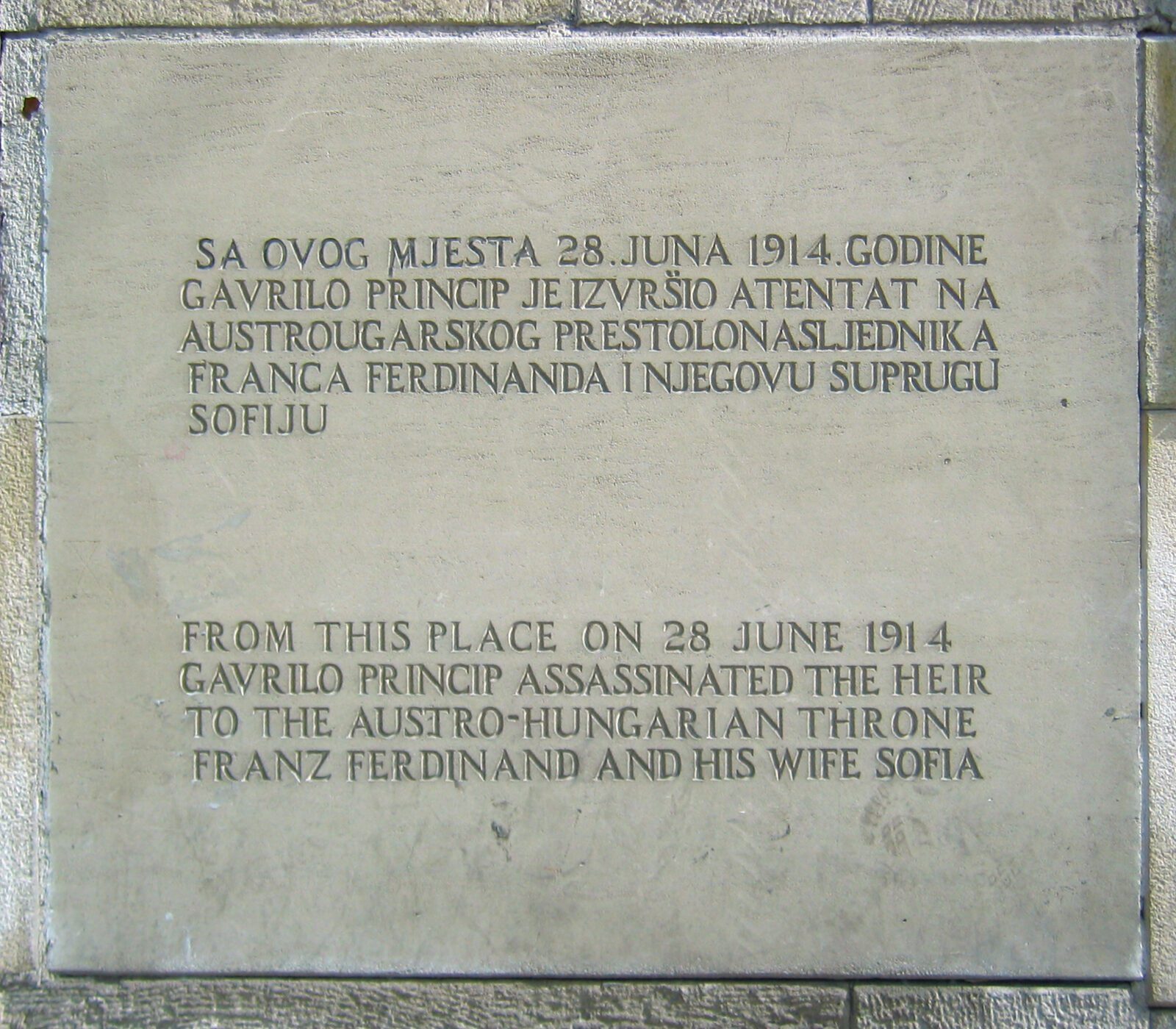
The more affecting half of the visit is on the pavement, not inside the museum. The corner where Princip stood is marked by a small plaque on the wall, mounted approximately at shoulder height, with the bilingual text:
“From this place on 28 June 1914 Gavrilo Princip assassinated the heir to the Austro-Hungarian throne Franz Ferdinand and his wife Sofia.”
The current plaque is a 1990s replacement, the third or fourth in the spot’s history. The 1916 Habsburg plaque named Princip as a criminal. A 1930s Yugoslav-era plaque framed him as a national hero. A 1953 Yugoslav plaque (installed at the same ceremony as the museum’s opening) framed him as a freedom fighter. That 1953 plaque was removed in the early 1990s during the dissolution of Yugoslavia, when the framing became politically contested. The current plaque, in place since the late 1990s, is deliberately neutral, it names the event and the actors without editorial verdict.
In the pavement at the corner there used to be a pair of embedded footprints, a 1953 sculpture marking where Princip stood. Those were removed in the war. A replica is set into the pavement today, in a slightly different position, and is one of the most-photographed details of central Sarajevo. Treat the placement as commemorative rather than forensic.
How to use this visit
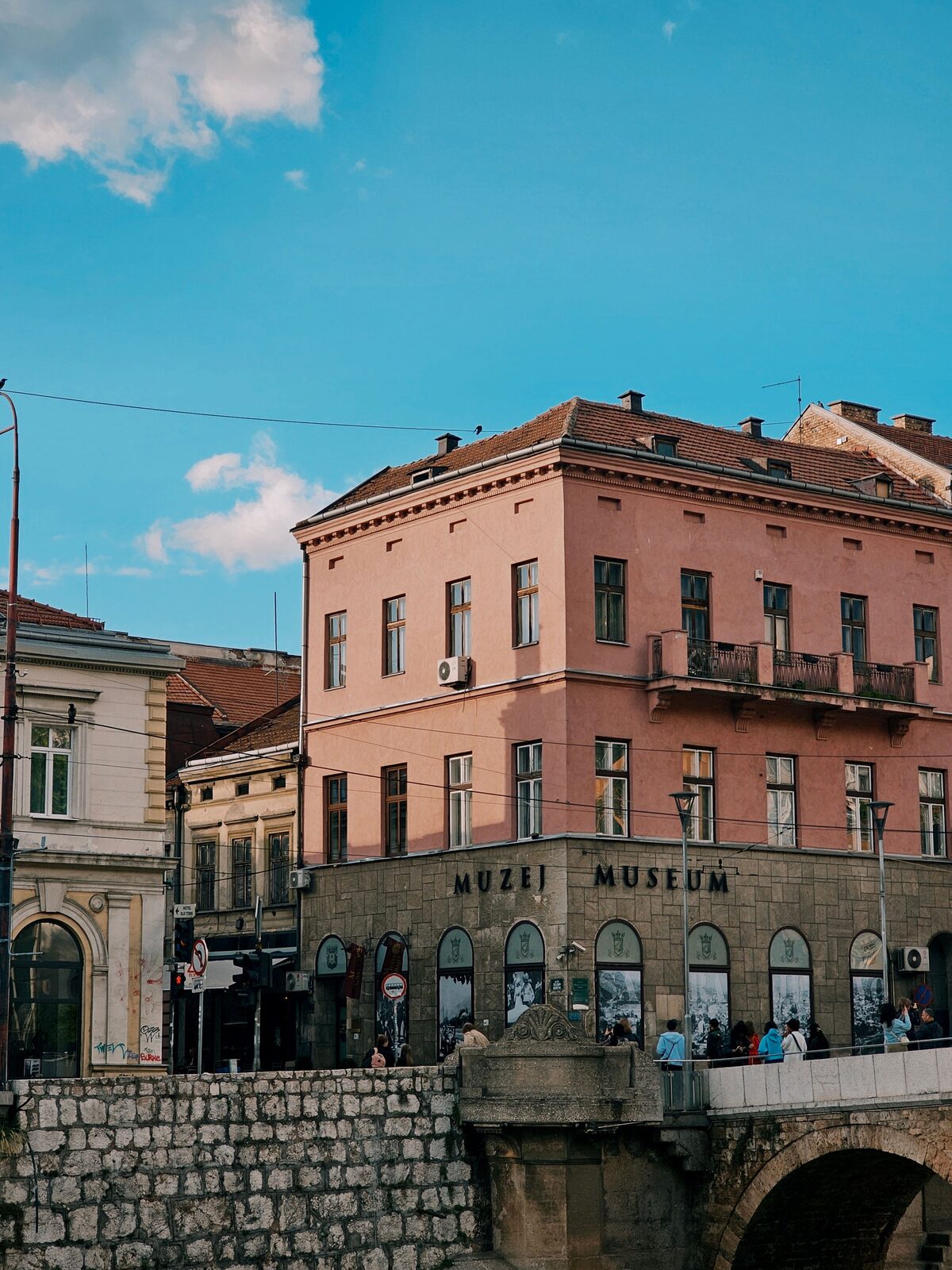
If you are in Baščaršija and want to see the Princip corner, the walk is straightforward. From the Sebilj, walk south to the Miljacka, then west along the river (Obala Kulina Bana) for about six minutes. The Latin Bridge appears on your left; the museum is the corner building on your right at the foot of the bridge. Total walk from the Sebilj is about half a kilometre.
A reasonable sequence for the morning:
- Latin Bridge (five minutes) — stand on the bridge itself. Look back at the corner. The geometry of the Archduke’s wrong turn is visible from the bridge.
- The plaque on the corner (five minutes) — read the inscription. Look at the wall. The shop on the ground floor today sells postcards.
- The Museum of Sarajevo 1878–1918 (30–45 minutes) — go in, look at the replica pistol, read the chronology, leave through the same door Princip almost certainly didn’t enter.
- The river walk west to Ferhadija (five minutes) — the Habsburg city centre starts a hundred metres along.
The whole sequence runs about an hour from leaving the Sebilj to crossing onto Ferhadija. It is the most concentrated way to see the moment of 1914 the city is known for.
A small editorial note
The morning of 28 June 1914 was warm and clear. Sophie Chotek did not have to be in the car, protocol normally separated the Archduke from his wife in public processions, but Franz Ferdinand had insisted she join him because the previous evening’s reception at the Hotel Bosna had gone, by all accounts, well. They had been married for fourteen years, and Sophie’s children had not yet had breakfast with their parents back in Konopiště. The Archduke’s last recorded words, to his wife, after she had been hit in the car: “Sopherl, Sopherl, sterbe nicht. Bleib am Leben für unsere Kinder”, Sophie, Sophie, don’t die. Stay alive for our children. He died about twenty minutes later, at the Konak.
She had died first.
A small plaque marks the corner where Princip stood. Children kick footballs against the parapet. The river goes on. That is enough.
Sources & further reading
More views
From Sarajevo Museum 1878–1918
Photographs: CeeGee · source · CC BY-SA 4.0

Keep wandering
Nearby & related.

Sarajevo Ferhadija
Ferhadija is the broad pedestrian street that begins at the Sarači–Sarači transition (marked by the Meeting of Cultures line in...

Sarajevo Galerija 11/07/95
A small, deliberately unflashy memorial museum to the Srebrenica genocide of July 1995. Founded by photographer Tarik Samarah in 2012,...

Sarajevo Latin Bridge
A small 1798 stone bridge across the Miljacka. The Habsburgs called it Princip’s Bridge after the assassination of Franz Ferdinand...