
Sarajevo vs. Bar — two čaršijas split by the same 1878 treaty
The Congress of Berlin handed Bar to Montenegro and Bosnia to Vienna in the same summer of 1878. Stari Bar's čaršija only took its present shape after that; Sarajevo's was cut in half. A century later, a Bosnian identity card is still enough to reach Bar's beaches.


Stari Bar is the Ottoman hill town above the port of Bar in Montenegro, 324 km south of Sarajevo by road. It and Baščaršija have more in common than a clock tower and a cobbled market street. Both lost Ottoman rule in 1878, and both were assigned their new masters by the same document: the Congress of Berlin gave Bar to the Principality of Montenegro (Wikipedia) and authorised Austria-Hungary to occupy Bosnia that same summer.
What happened next is the reason to put the two side by side. Bar’s čaršija (the market street) only took its present shape after 1878. Sarajevo’s was cut in half. A hundred years later an earthquake emptied one of them, and the other is still selling coffee pots on Kazandžiluk. And Bar, as it happens, is where a large number of Bosnians go when they want the sea.
Two sieges, one summer
Bar came to the Ottomans in 1571, from Venice, and by one local account without a fight or a demolition (eKapija). It went the hard way. Montenegrin forces under Mašo Vrbica besieged the walled town from 13 November 1877, bombarding it for more than seven weeks. On 5 January 1878 they set off 225 kg of explosive inside the aqueduct to cut the town’s water. Ibrahim Bey surrendered on 9 January (Wikipedia).
Sarajevo’s turn came that August. On 19 August 1878 Habsburg troops entered the city, five weeks after the treaty was signed, and the Kállay era that followed spent twenty-one years rebuilding it to a Viennese plan. The two čaršijas went into the new era under very different owners.
The same čaršija, built differently
Walk both and the family resemblance is plain: a single shopping spine of small trade and craft premises, a mosque within a few steps, a sahat kula (clock tower) standing over the roofs.
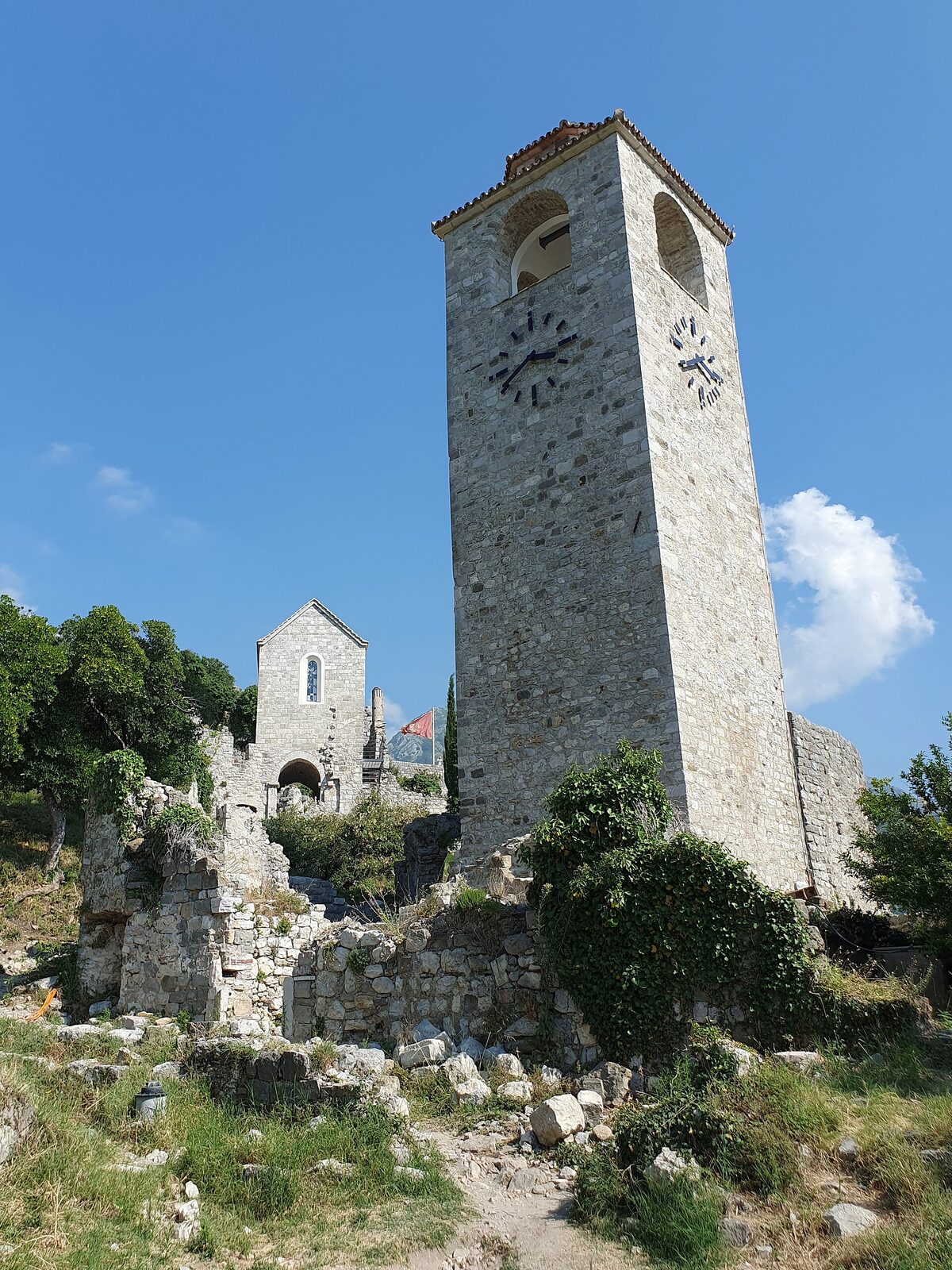

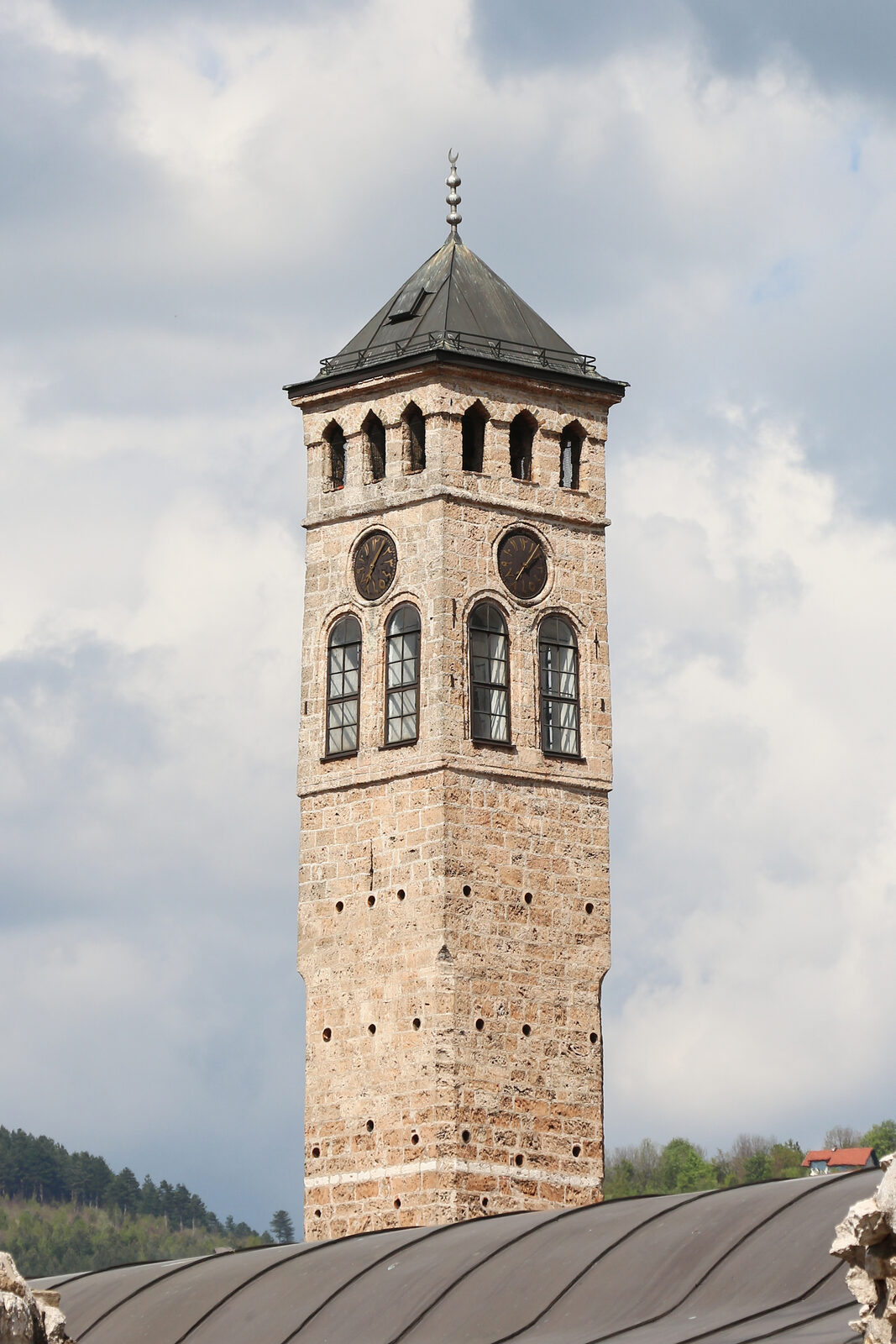
The clock tower in Stari Bar is an endowment of Jahija-aga, who rebuilt it in 1753. It was badly damaged in the 1877 bombardment and restored in 1984 (eKapija). The Omerbašić mosque nearby dates from 1662 (Lonely Planet). Sarajevo’s Sahat Kula, beside the Gazi Husrev-beg mosque, still keeps alaturka time, set by sunset rather than noon.

The differences are in the section, not the plan. Bar’s čaršija climbs. Its main street winds up a steep slope as cascading cobbles, and its oldest buildings are two storeys: a craft or trade shop on the ground floor, the family living above it (BARinfo, 2019). Baščaršija sits flat on the valley floor, its shops on Sarači and Kazandžiluk low wooden units, with the residential mahalas (neighbourhoods) climbing the hillsides around it. The Fejzićs write of the čaršija and its organic surroundings, the mahalas, as two parts of one system; the mahala story explains how the Habsburgs later dissolved it with a map.
After 1878: one filled in, one was cut
In Bar, the walled town on the rock lost its people after 1878. Life moved down into the podgrađe, the settlement under the walls, and the čaršija there took its present form, with new houses of stone and brick (BARinfo). The 1878 war made the market street, rather than destroying it.
In Sarajevo the Habsburg administration did the opposite. Around 1893–1896 it cut a straight road, Nova testa (today Telali), through the tightest part of the bazaar. Emir and Irma Fejzić call that cut a trigger for sixty years of demolitions in Baščaršija (Fejzić and Fejzić, Faculty of Architecture, University of Sarajevo, 2018). Sarajevo’s čaršija survived as a working market, with the gaps still visible.
The earthquake, and the aqueduct that came back
On 15 April 1979 an earthquake struck the Montenegrin coast. It destroyed the Bar aqueduct completely, and Stari Bar was abandoned; the new town grew on the coast instead (Wikipedia). The ruins inside the walls cover about four hectares, where close to 250 houses, churches, public buildings and fortifications have been identified (CdM).
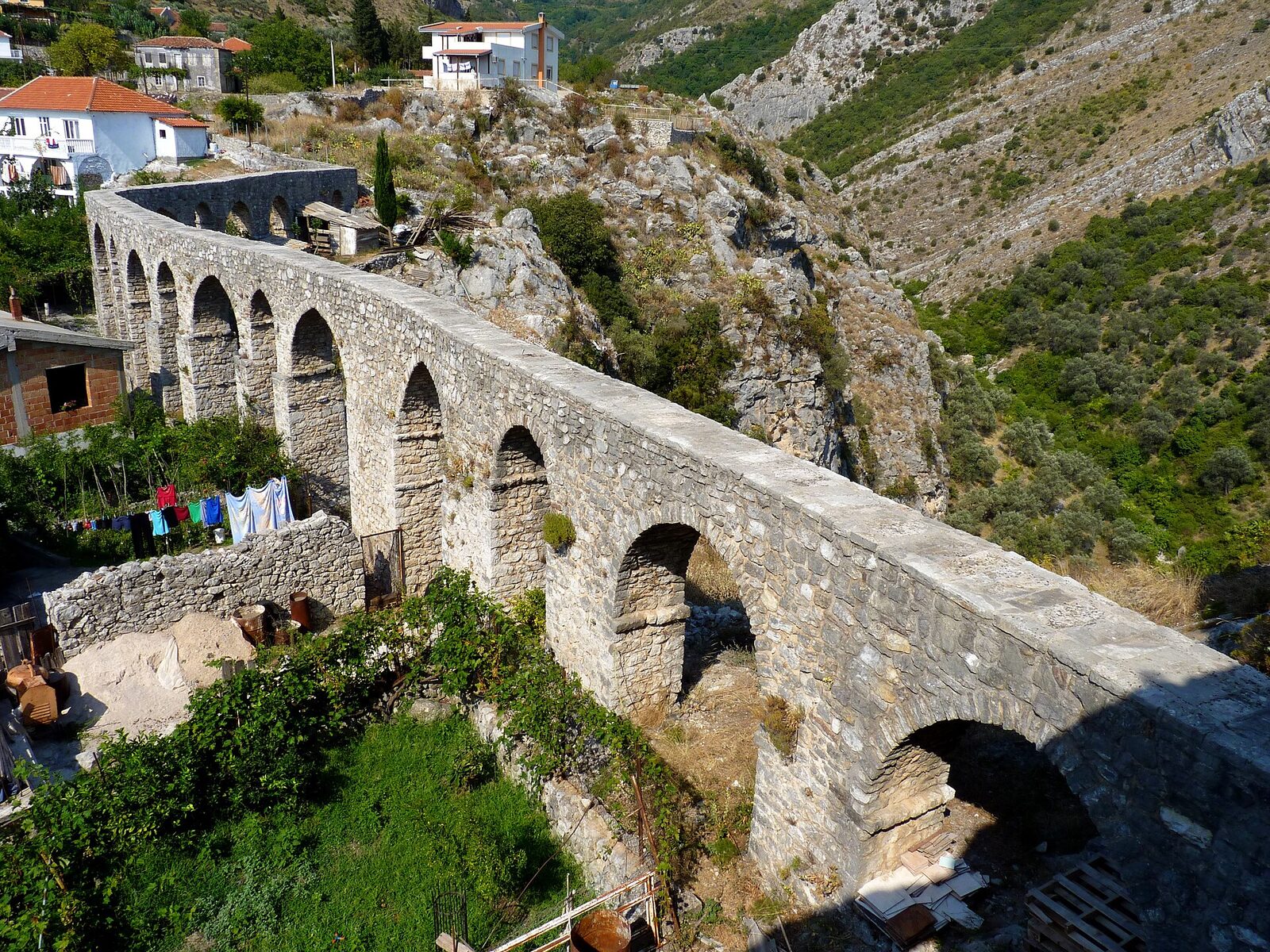

The aqueduct has since been rebuilt in full: seventeen arches on eighteen piers, carrying water from a spring on Mount Rumija about 3 km away. It is the only aqueduct left in Montenegro. After it was restored, people began moving back into the old town, and the čaršija below the gate now runs cafés, small restaurants and craft shops again.
Why Bosnians go to Bar
Montenegro counted 200,788 arrivals from Bosnia and Herzegovina in 2025, staying 1,185,746 nights. That is 8.1% of all foreign nights, behind only Serbia (23.4%) and Russia (16.4%) (Monstat). Bar municipality took 2,217,381 nights of the country’s 15.4 million, or 14.4%. Divide Monstat’s figures and the average guest in Bar stays 8.5 nights, against 5.6 for Montenegro as a whole. Bar is where families come for a week or more.
Three plain reasons explain most of it.
The identity card. BiH citizens can enter Montenegro on their identity card and stay up to 30 days (Paragraf, 2024). Croatia joined Schengen in January 2023, and since then a Bosnian needs a biometric passport to reach Makarska or Dubrovnik (Gaga.ba, 2026). For a family where not everyone holds a valid passport, Montenegro is the nearest sea with no paperwork. (Check the BiH Border Police page before you go; the rules have shifted before.)
Price. In summer 2025 a full set of sunbeds in Šušanj cost €20, an espresso €1.60, apartments started around €50 a night and hotel half-board around €30 a person (Nova.rs, 13 July 2025).
Habit. In the 1980s a summer in Montenegro meant Šušanj for a lot of inland Yugoslav families: private rooms, campsites, youth work brigades, and the Belgrade–Bar railway bringing the interior to the coast (Nova.rs). The habit outlived the country.
Šušanj: the beach under the pines
Šušanj is a suburb about a kilometre north of Bar’s centre (Wikipedia). Its beach is Žukotrlica, named after the Spanish broom (žukva) that grows on the slope. The draw has always been the pine wood that runs down to the water, natural shade in the decades when a parasol was not something every family owned. Rumija’s forested slopes shelter the bay, so the sea warms up earlier here than elsewhere on the coast.
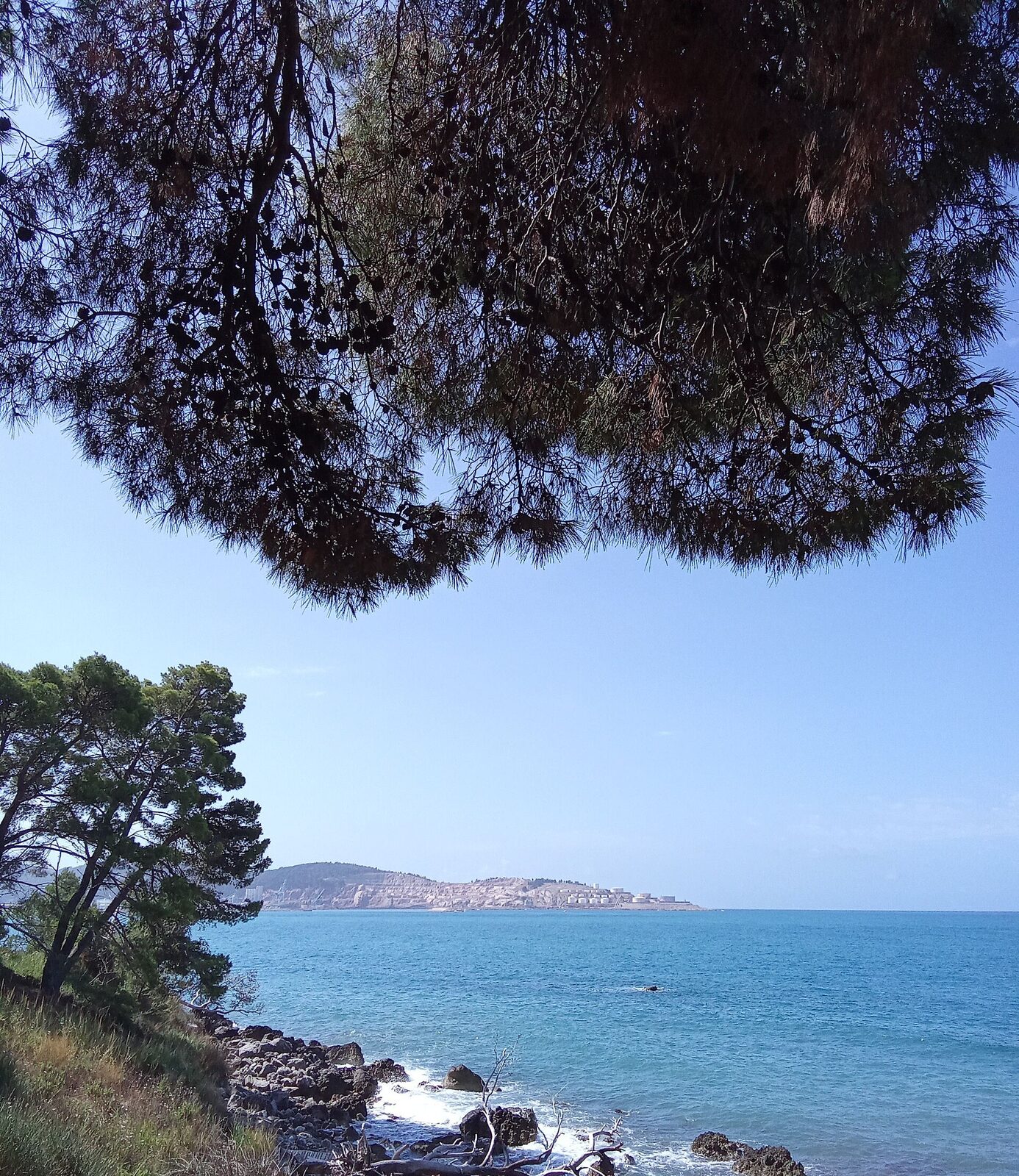

It is a family beach, not a party one. Bar’s centre is a walk along the promenade.
Getting there from Sarajevo
| Sarajevo → Bar | |
|---|---|
| By car | 324 km, about 6½ hours via Foča and Nikšić |
| By bus | about 8½–10 hours direct; some services change in Kotor (12Go) |
| By train | no direct service |
| Documents | BiH identity card is enough for BiH citizens; others check visa rules |
| Stari Bar entry | about €5; open 8:00–20:00 in summer (2026 visitor report; check at the gate) |
| Stari Bar from the coast | about 4 km inland from the town of Bar |
Bar is not a day trip from Sarajevo, any more than Mostar is. Give it a week, the way the Monstat numbers say everyone else does. For the Croatian side of the same coast, read Sarajevo vs. Dubrovnik.
Walk both čaršijas in the same month
Walk Baščaršija in the morning, before the shops open, and notice what is missing: the straight cut of Telali, the gaps where the Habsburg planners took shops out. Then, on the coast, go up to Stari Bar late in the afternoon, when the heat comes off the stones. Climb the cobbles past the clock tower to the gate. The čaršija the 1878 war made is open again, and the aqueduct the same war blew up is carrying water.
Sources & further reading
- Monstat — Dolasci i noćenja turista, ukupno, 2025. godina
- BARinfo — Čaršija i podgrađe, XV–XIX vijek, Stari Bar (2019)
- Wikipedia — Stari Bar
- Fejzić and Fejzić — Sarajevska čaršija: Od Mustaj-pašinog mejdana do Telala (Faculty of Architecture, University of Sarajevo, 2018)
- Nova.rs — Šušanj letovanje 2025: cene ležaljki i smeštaja (13 July 2025)
Keep reading
More from the guide.

Sarajevo — where to eat, from ćevapi counters to hilltop lamb
Where to eat in Sarajevo? The city eats well at every price point. Four ćevapi grills on Bravadžiluk serve the best grilled...

Sarajevo tap water — safe to drink, and the story behind why it tastes so good
Is Sarajevo tap water safe to drink? Yes. Sarajevo’s water comes from a karst aquifer under the Sarajevsko polje plain, filtered through...

Sarajevo airport to city centre — taxi, shuttle, tram, or the Moj Taxi app
How do you get from Sarajevo Airport to the city centre? Uber, Bolt, and Yandex Go do NOT operate in Bosnia, anyone...