

Sarajevo Ashkenazi Synagogue
Sarajevo’s working synagogue, built in 1902 in pseudo-Moorish style by the Austro-Hungarian administration for the Jewish community that had grown rapidly after...
Explore Sarajevo Destinations
The cobbled climb out of Baščaršija toward Vratnik — once the blacksmiths' quarter, now the spine of the city's café row and the path to the Kovači war cemetery.
Photograph: Bernard Gagnon · CC BY-SA 4.0
The rest of the catalogue
Filter by neighbourhood ↓
Sarajevo’s working synagogue, built in 1902 in pseudo-Moorish style by the Austro-Hungarian administration for the Jewish community that had grown rapidly after...

The Avaz Twist Tower is Sarajevo’s tallest building (142 metres, completed 2008). A small public observation deck on the 35th floor costs...

Built for the 1984 Sarajevo Winter Games and last raced for the 1991 World Cup, the bobsled and luge track on Mount...

Ferhadija is the broad pedestrian street that begins at the Sarači–Sarači transition (marked by the Meeting of Cultures line in the pavement)...

A small, deliberately unflashy memorial museum to the Srebrenica genocide of July 1995. Founded by photographer Tarik Samarah in 2012, on a...

Founded in 1882 to a design by Karel Pařík, Hotel Europe (Hotel Evropa) was the first purpose-built hotel of the Austro-Hungarian period...

When the Austro-Hungarians built the City Hall in 1894, one stubborn Sarajevan refused to sell his Ottoman house on the chosen site....

Founded by Isa-beg Ishaković around 1462, the same year he founded the city, the Isa-Begov Hamam is the oldest hammam in Sarajevo...

Kazandžiluk is the row of coppersmiths’ shops that runs east from the Sebilj into Baščaršija. The patterns being hammered here today are...

The Martyrs’ Cemetery on the slopes above Vratnik, holding more than a thousand defenders killed during the siege. Alija Izetbegović, first president...

A working open-air food market on Ferhadija, in the centre of Sarajevo. Locals call it Markale (a Bosnianisation of the Austro-Hungarian Markthalle)....

A 16th-century Ottoman han (traveller’s inn) on Sarači, the spine street of Baščaršija. Now home to one of the oldest active coffeehouses...

Sarajevo’s Old Jewish Cemetery, on the slopes of Trebević above Grbavica. Founded 1630. Around 3,800 tombstones in distinctive Sephardic sarcophagus form. One...

Sarači is the long pedestrian street that bisects Baščaršija from the Sebilj fountain west to the great Friday mosque. It was the...

Sarajevo Roses are the impact craters of the 1992–1996 siege, filled with red resin and preserved in the streets where civilians were...

The Šeher-Ćehaja Bridge (Šeher-ćehajina ćuprija) is the easternmost of Sarajevo’s surviving Ottoman bridges, completed in 1585/86 and named after the city governor...

Svrzo’s House is a preserved 18th-century Ottoman town house at the top of Kovači, run by the Museum of Sarajevo. Four houses,...

A 1981 spomenik memorial to the Sarajevan partisans of the Second World War. Damaged in the 1990s when its hilltop was front...

The Juan Antonio Samaranch Olympic Hall, locally known as Zetra, was the figure-skating, short-track and ice-hockey venue of the 1984 Sarajevo Winter...

The 1462 Ottoman bazaar of Sarajevo, still a working bazaar. Copper workshops on Kazandžiluk, Bosnian coffee at Morića Han, and a marker...

A small 1798 stone bridge across the Miljacka. The Habsburgs called it Princip’s Bridge after the assassination of Franz Ferdinand on 28...

The mountain ridge that closes Sarajevo to the south. Nine-minute cable car from Bistrik to 1,164 metres, with the abandoned 1984 Olympic...

Where the Bosna river begins. Cold pools welling up from under Mount Igman, surrounded by a 19th-century Habsburg park. Take tram 3...

An 18th-century Ottoman bastion on the hill of Jekovac, above the bazaar. During Ramadan a small cannon fires here at sundown to...

A tunnel dug by hand under the Sarajevo airport runway between March and July 1993. Food, fuel, ammunition, 1 million people. The...

The most important Ottoman mosque in the Balkans, built in 1531 at the centre of Baščaršija by the Ottoman governor Gazi Husrev-beg....

Sarajevo’s Roman Catholic cathedral, built between 1884 and 1889 by the Austro-Hungarian administration in a neo-Gothic style. The seat of the archbishop...

Sarajevo’s main Serbian Orthodox cathedral, consecrated in 1872, the older of the two cathedrals on opposite sides of central Sarajevo. Byzantine-revival exterior,...

The Trebević cable car runs from the Bistrik neighbourhood up the mountain to 1,160 metres in under nine minutes. Opened 3 May...
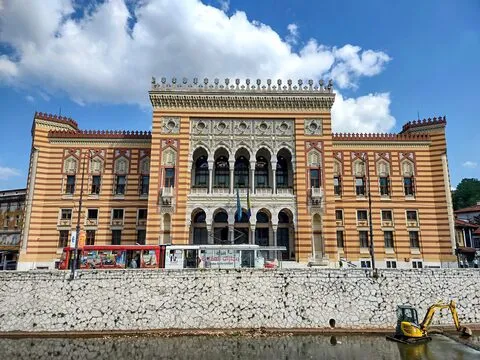
Sarajevo’s 1896 City Hall, designed by three Czech architects in stripey pseudo-Moorish style. Held the National and University Library from 1949 until...

The Sebilj is the kiosked drinking fountain at the centre of Baščaršija, built in 1753 by the Ottoman vizier Hadži-Mehmed paša Kukavica...