Explore Sarajevo / Destinations / Sarajevo Cable Car
Destination · Bistrik (lower station) · 12 min read
Sarajevo Cable Car
The Trebević line — opened 1959, closed 1989, destroyed in the siege, and rebuilt on a €3.5 million donation from a Dutch nuclear physicist whose wife is Sarajevan.
- Established
- 3 May 1959; closed November 1989; destroyed 1992–95; reopened 6 April 2018
- Altitude
- 583 m (base) to 1,160 m (top)
- Length
- 2,158 metres (inclined)

At a glance
Address
Hrvatin 92, Bistrik (lower station)
Hours
Summer (roughly May–Sept) Tue–Sun 09:00–21:00, Mon 12:00–21:00; winter shorter, last car down at 17:00. Verify at zicara.ba before you go.
Price
Foreigners 30 BAM return / 20 BAM one-way (~€15/€10). BiH citizens with valid ID 6 BAM return / 4 BAM one-way. Children under 6 free with a paying adult; student discount with ISIC.
Getting there
There is no Bistrik tram stop — the tram runs on the north bank of the Miljacka. Take tram 3 to the Vijećnica stop, cross the Šeher-Ćehaja bridge, and walk 10 minutes uphill; or trolleybus 103 to Trg Austrije and 10 minutes east up Bistrik. Taxi to Sarajevska Pivara (the brewery) and then 5 minutes straight ahead and up the stairs is the simplest option.
Time needed
30 minutes for the ride alone; half a day for the mountain
Best time
Hour before sunset for the light. Weekday mornings for the shortest queues.
Coordinates
43.8554° N 18.4348° E
Navigate
The Sarajevo Cable Car, the Trebević line, runs from the Bistrik neighbourhood to 1,160 metres on the ridge in under nine minutes. A return ticket for foreign visitors is 30 BAM (~€15); a one-way is 20 BAM (~€10). BiH citizens with a valid ID pay a subsidised 6 BAM return / 4 BAM one-way, the two-tier pricing is transparent at the counter and both options are offered without hassle. Children under six ride free with a paying adult, ISIC students get a reduction, and tickets are sold at the lower-station kiosk with cards accepted.
Summer hours (roughly May–September) are Tuesday–Sunday 09:00–21:00 and Monday 12:00–21:00. Winter hours are much shorter and the last car down leaves at 17:00 in autumn and winter. Check zicara.ba on the day of your visit. Occasional Monday–Wednesday closures for maintenance are posted on the website; if unsure, ring +387 33 246 573.
The easiest approach on foot is a taxi to the Sarajevska Pivara (the brewery), then five minutes straight ahead and up the stairs. There is no Bistrik tram stop — the tram runs on the north bank of the Miljacka. On public transport the two viable routes are tram 3 to Vijećnica (cross the Šeher-Ćehaja bridge, then 10 minutes uphill), or trolleybus 103 to Trg Austrije (10 minutes east up Bistrik).
Every first-time visitor to Sarajevo should ride the cable car. It is the most efficient piece of urban infrastructure the city has, and one of the most quietly emotional.
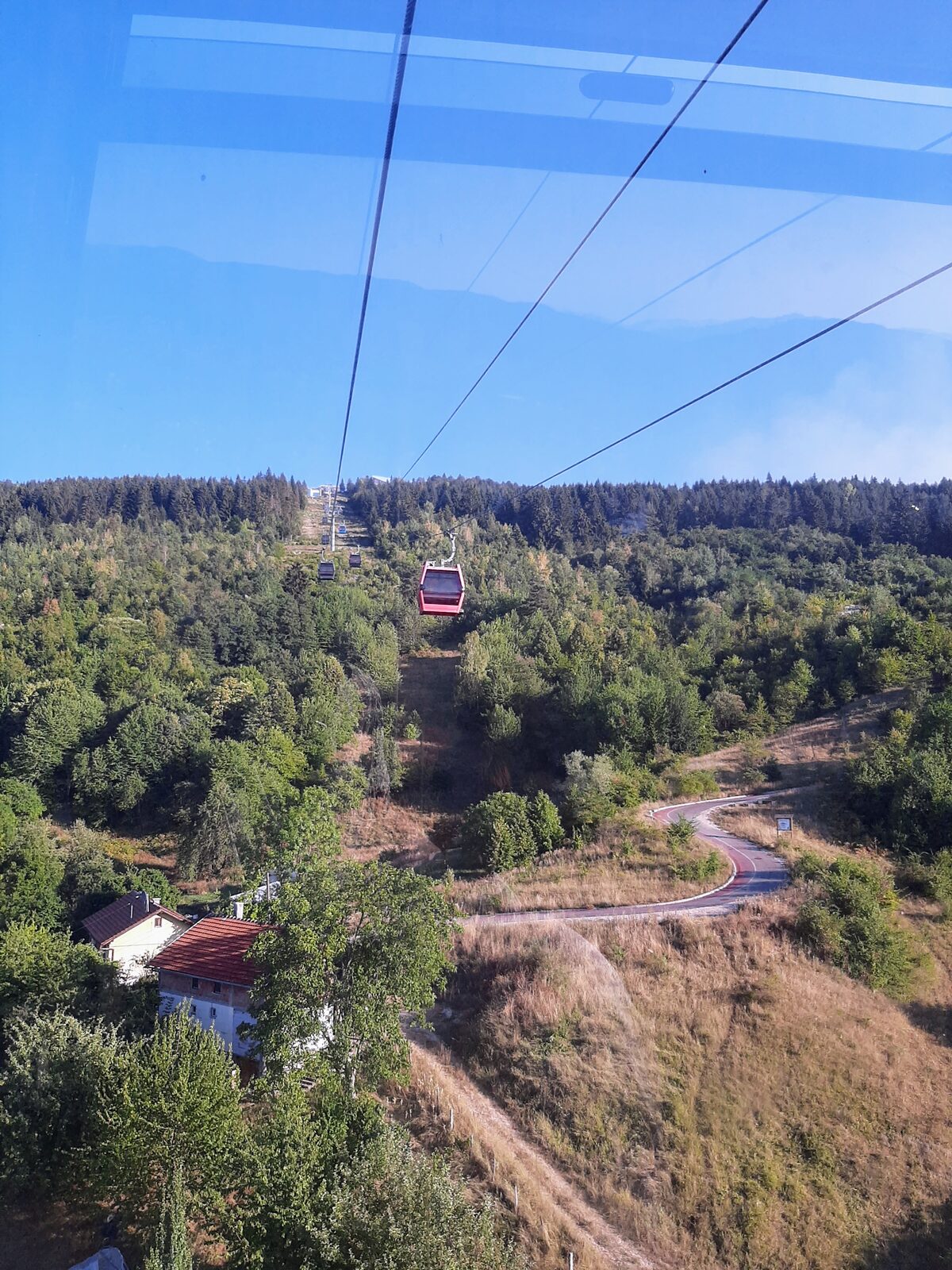
Under nine minutes. 2,158 metres of inclined line. From the lower station at 583 metres to the upper station at 1,160 metres. Bistrik to the ridge. The bazaar is on your left as you climb. The minarets fall away. The pine starts. You arrive in a different climate.
Travel time
7:15min
Technical; under nine is what the operator quotes.
Line length
2,158m
Inclined. 10 towers.
Cabins
33
10 passengers each. 1,200 riders/hour/direction.
Reopened
6 Apr'18
Day of the City. 26 years after the siege.
The line, in four dates
- 1959 Opened
- 1989 Closed
- 1992 Destroyed
- 2018 Reopened
The 1959 version
The original Trebević cable car opened on 3 May 1959. It was one of the longest aerial tramways in Yugoslavia at the time, and within a few years had become a piece of civic infrastructure Sarajevans grew up on. Families took it on Sundays. Schoolchildren rode it for end-of-year trips. In winter it carried skiers to the upper slopes. The lower station, with its modernist concrete canopy, became a small architectural landmark of its own. In February 1984, during the Winter Olympics, it carried spectators to the events on Trebević.
It did not run without interruption. Operational suspensions in 1977, 1982, and 1987, for financial reasons, per Balkan Diskurs, punctuated its second half. In November 1989 it was closed altogether; the operator could no longer cover running costs. The plan was to modernise and restart it. Then the war came.
The siege
On 5 April 1992, Serb forces opened fire on a peace demonstration in central Sarajevo, killing the first two victims of the siege; the next morning, 6 April — the day the city marks as its own — the sustained bombardment of the city began. By the end of the week, the city was surrounded. The hills above Trebević, including the upper station of the cable car, were now front-line territory. Over the following months and years of the siege, the cable car was destroyed: cabins broken, cables cut, pylons damaged, the lower station shelled.
For the next twenty-six years the pylons stood rusting in the forest. The lower station was boarded up. A piece of pre-war life that did not come back when the war ended. Generations of children who grew up in Sarajevo never rode it.
The 2018 reopening
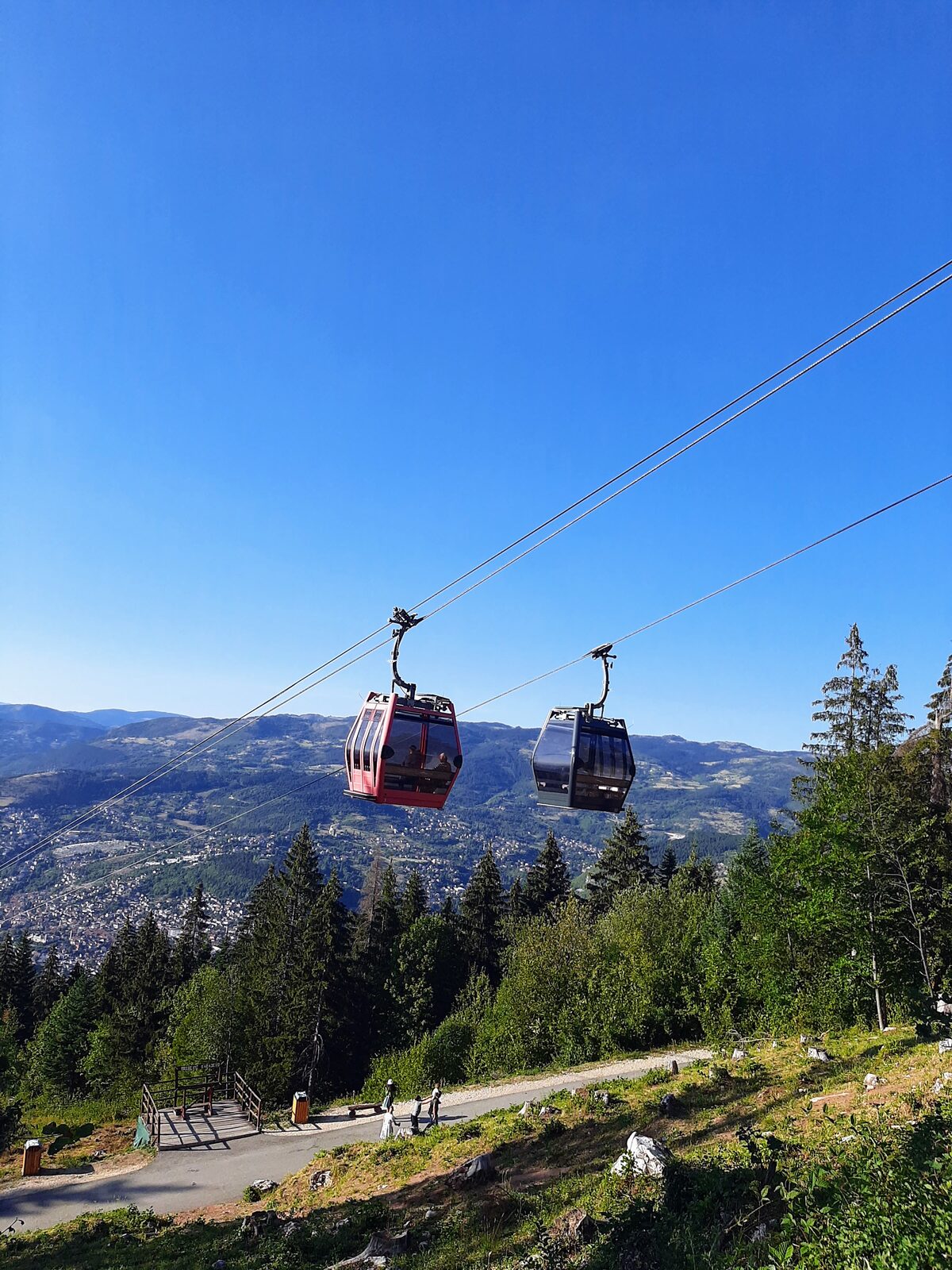
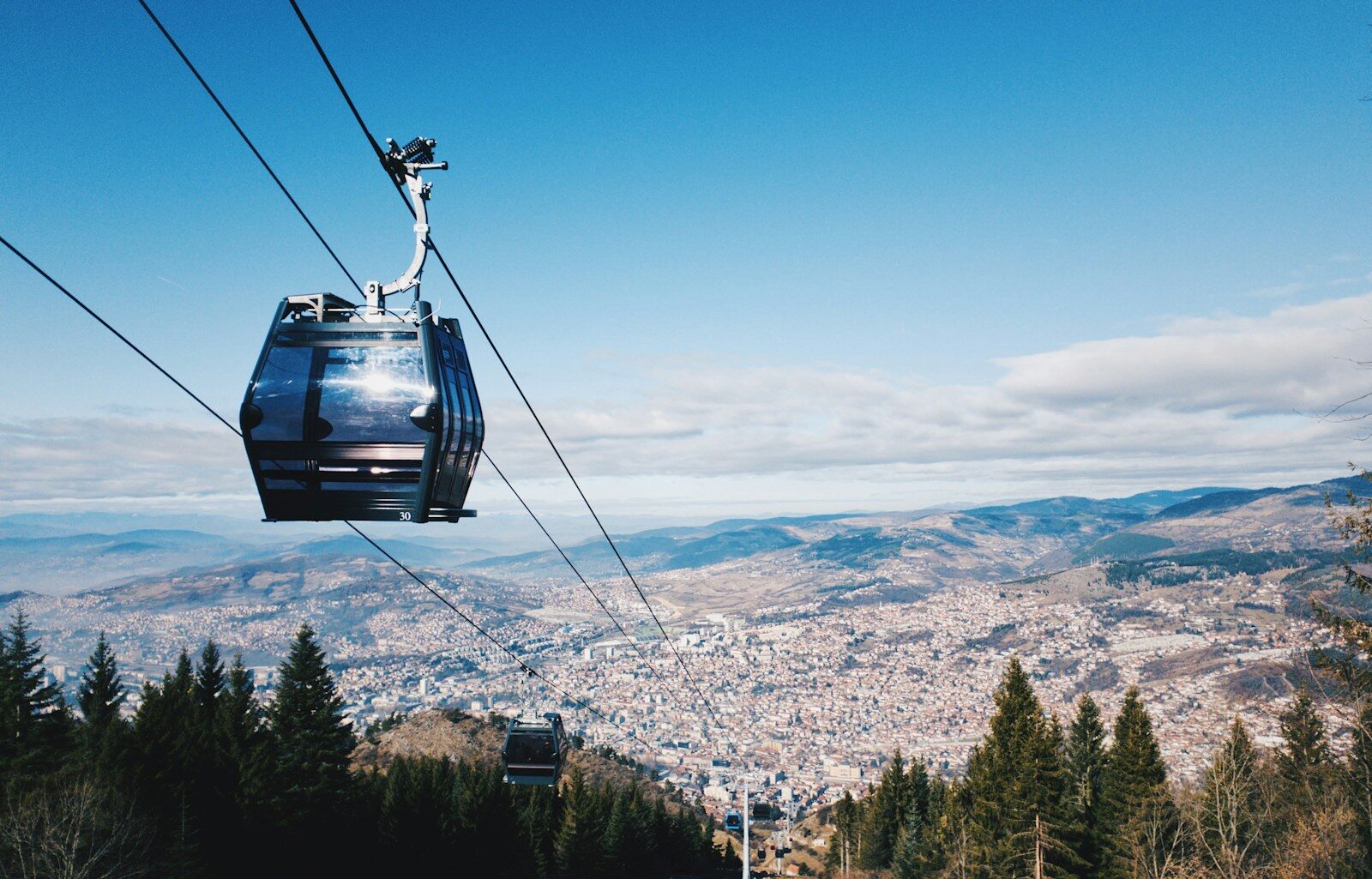
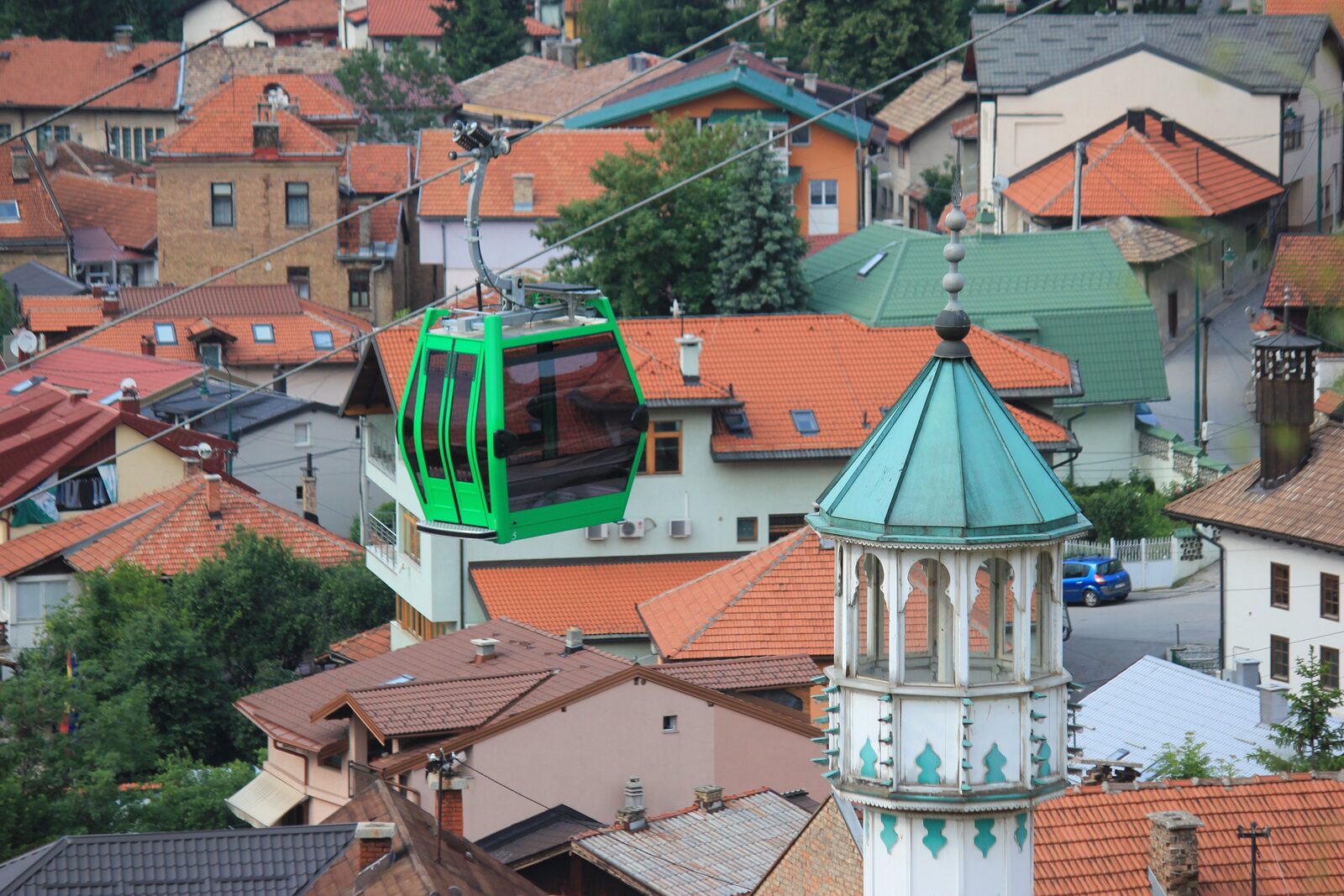
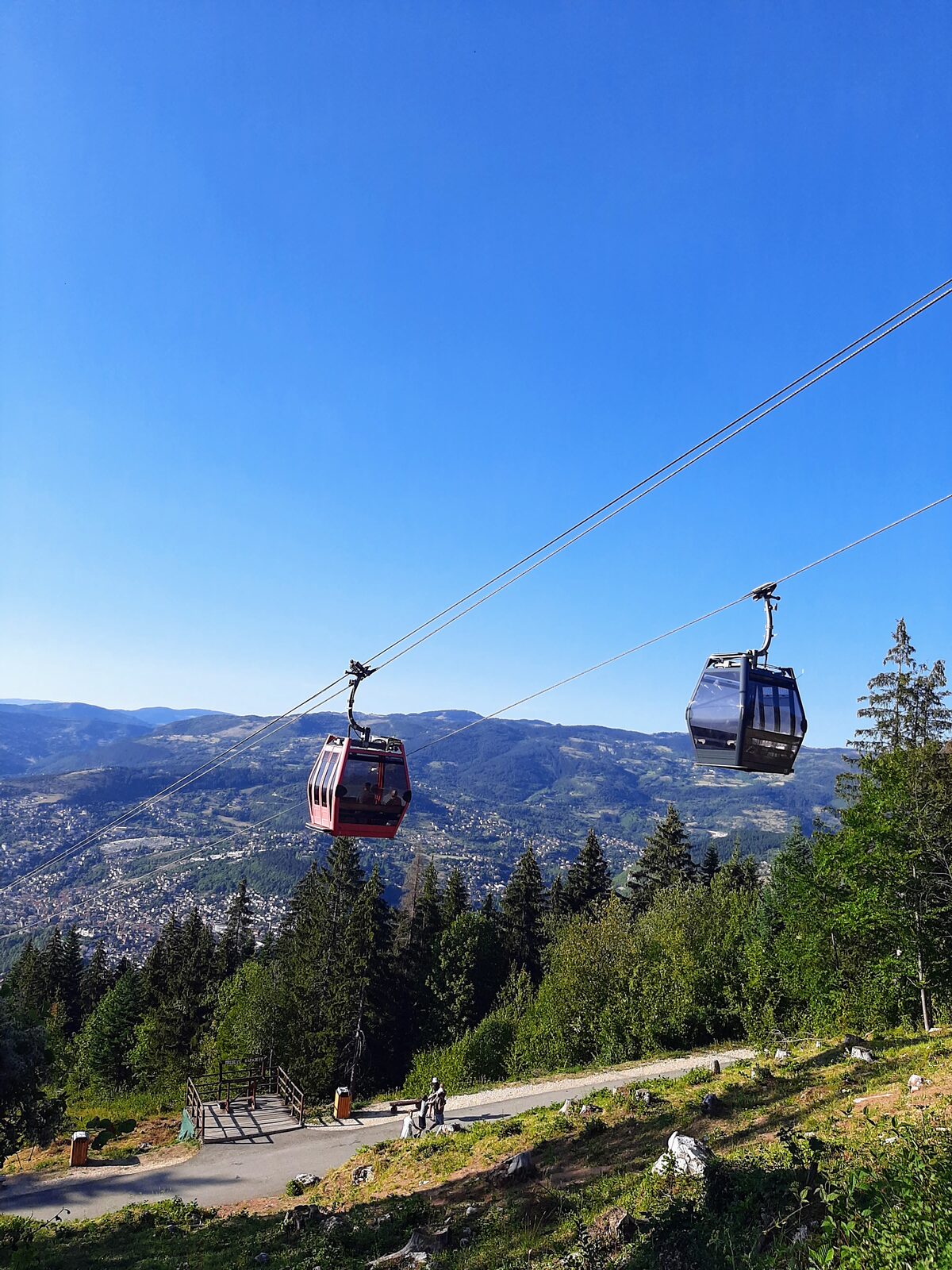
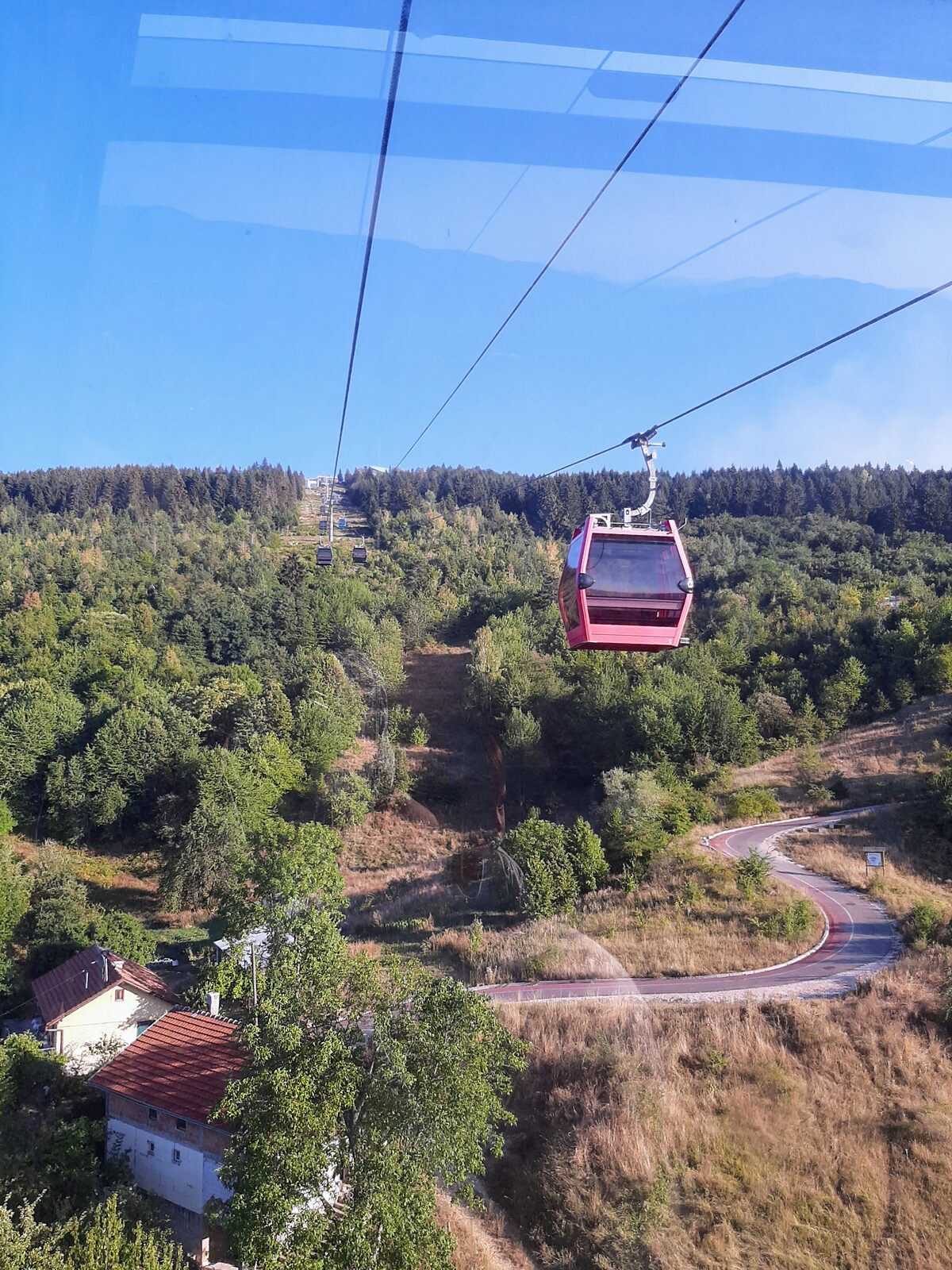
Reconstruction began in 2017. The contractor was Leitner Ropeways, the Austrian aerial-tramway firm, building a DirectDrive system with 33 ten-passenger cabins running on 10 towers over 2,158 metres of inclined line. Five of the cabins are painted in the colours of the Olympic rings (blue, red, yellow, green, black). One carries the flag of Bosnia and Herzegovina. The rest are black. Capacity: 1,200 passengers per hour, per direction.
The reconstruction cost roughly €11 million. About €3.5 million of that came from a single private donation, from Edmond “Eddy” Offerman, a Dutch nuclear physicist and businessman married to a Sarajevan (family name Serdarević). Offerman also runs Saastal Bergbahnen, the cable car operator at Saas Fee in Switzerland. Mayor Abdulah Skaka thanked the Offermans at the ceremony. Per The Gondola Project, the reopening date also coincided with the anniversary of when the Offermans had first met in Sarajevo, but that piece of family history is a side note. The load-bearing date is civic.
The cable car reopened on 6 April 2018.
6 April is the officially observed Day of the City of Sarajevo, the anniversary of the city’s liberation from Nazi occupation in 1945. It is also the anniversary of the day the siege’s bombardment began in 1992, the day after the first casualties: forty-seven years to the day after the liberation. Reopening the line on 6 April 2018 stacked another date onto an already-saturated one, liberation, siege, return, and the crowd that morning knew it. The line has run continuously since.
The ride
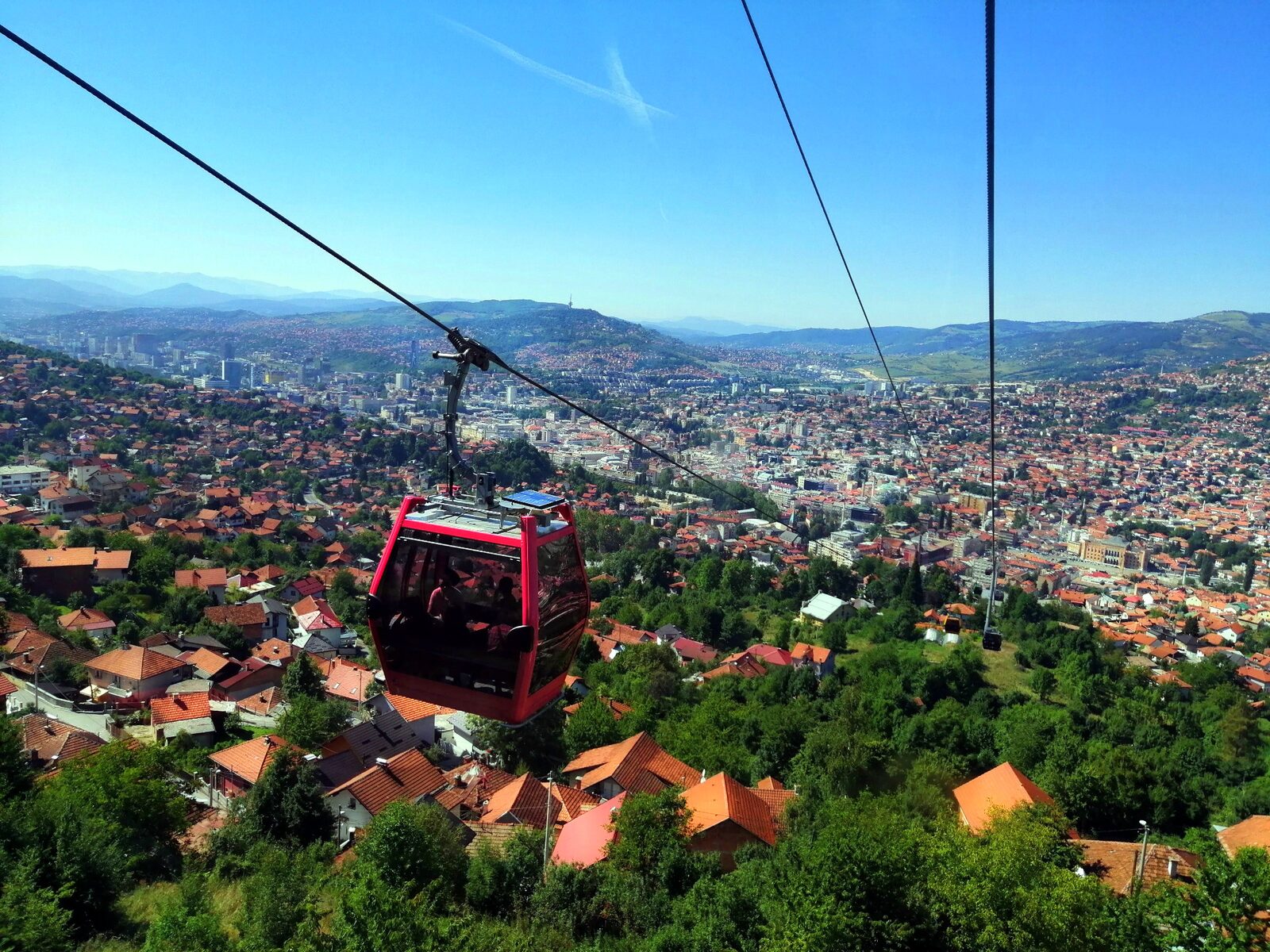
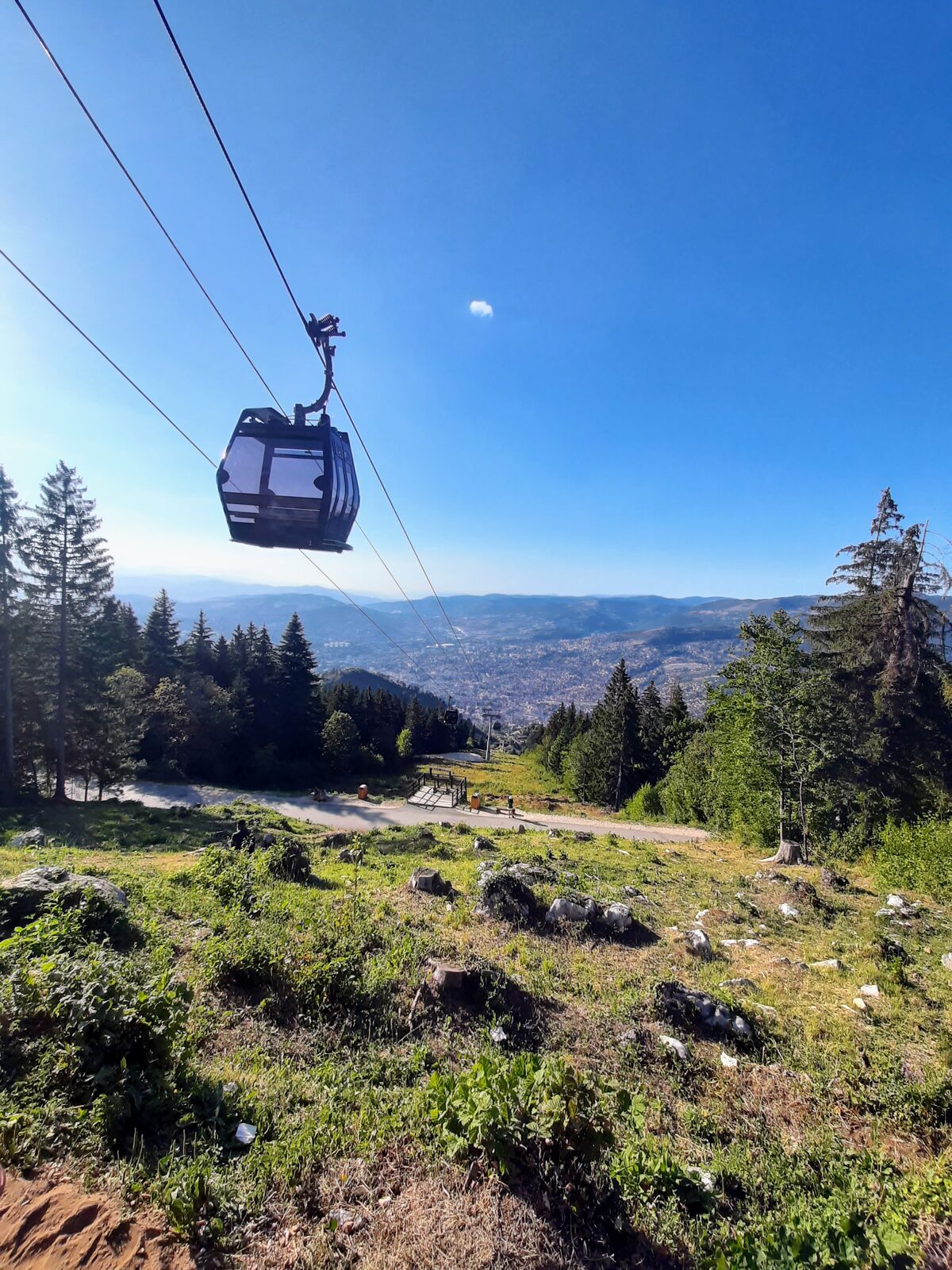
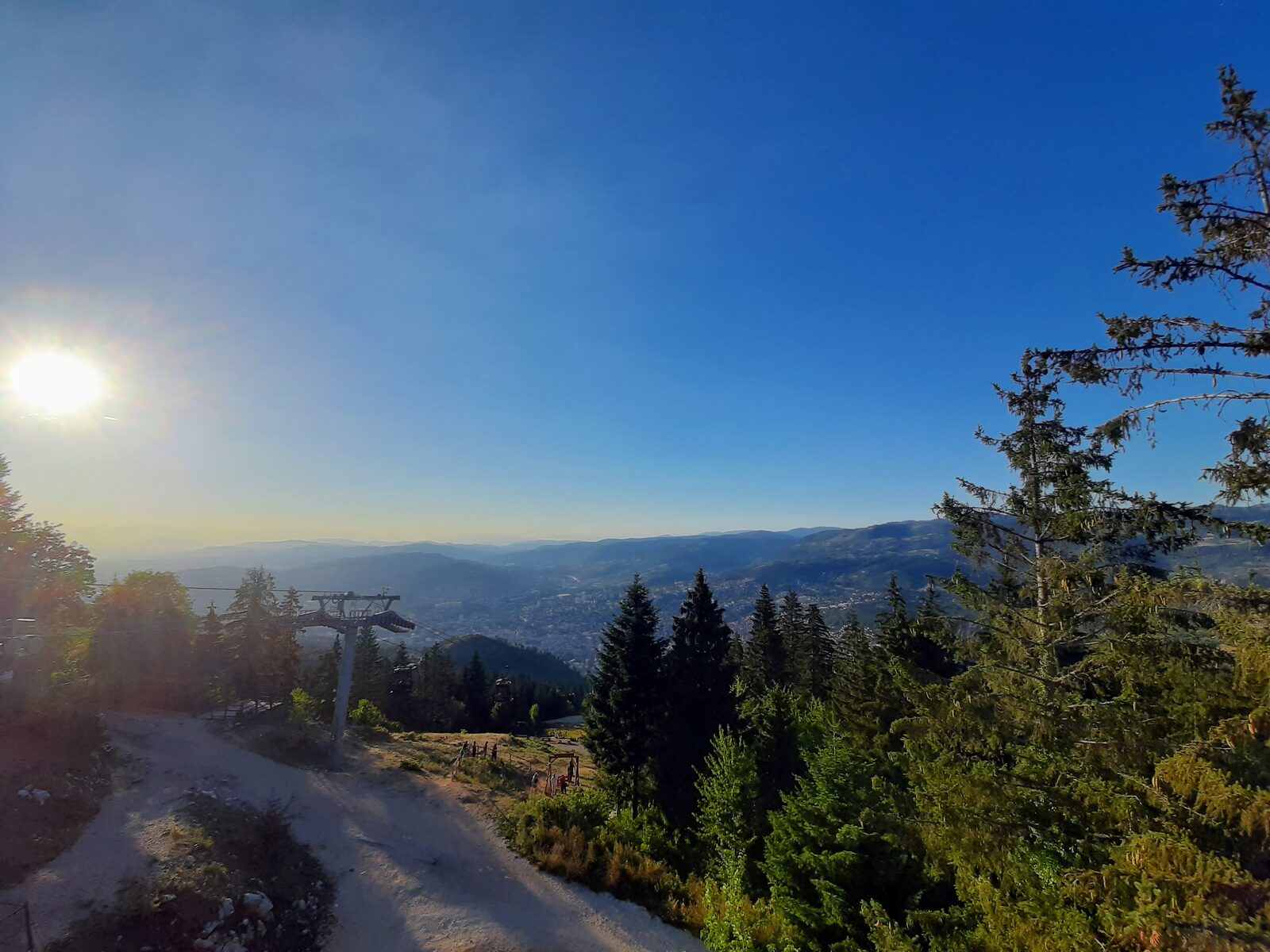
The cabins carry ten passengers each. The cable hums. Seven minutes and fifteen seconds is the technical travel time; under nine is the version most riders and the operator quote. The lower station sits in the residential Bistrik neighbourhood. The easiest way there is a taxi to Sarajevska Pivara (the brewery), then five minutes on foot straight ahead and up the stairs. On public transport, tram 3 to Vijećnica and across the Šeher-Ćehaja bridge, or trolleybus 103 to Trg Austrije, then ten minutes east up Bistrik. The cabins climb the south face of the valley at a steepening angle. About halfway up, the city below resolves into its full geometry: the bazaar, the bridges, the river, the Habsburg grid, the airport in the distance, the western suburbs, and on a clear day the great mountains of Bjelašnica and Igman on the horizon.
At the upper station, you step out into pine air at 1,160 metres. The temperature drops noticeably. There is a small café, a viewing platform, the marked trail toward the summit, and the path that descends past the abandoned 1984 Olympic bobsled track.
Ridership
In 2024, roughly 340,000 people rode the line, the figure Balkan Diskurs reported in April 2025, citing the operator. January 2025 alone brought 20,350 riders. The numbers rise year on year. There is a small BiH-resident discount on the return ticket (roughly six BAM off), so it helps to buy at the counter with a local ID if you have one.
How to do it well
- Buy a return ticket at the lower station. 30 BAM for foreign visitors, 6 BAM if you have a BiH ID. Cards accepted. Reductions for children under six (free) and ISIC students.
- Time your ride to arrive at the top about an hour before sunset. This is the most rewarding window in any season.
- Stay at the top for at least an hour. Walk to the Vidikovac viewpoint. Sit. Wait for the light to do its work.
- Take the same cable car back down before the last departure of the day — 21:00 in summer, 17:00 in autumn and winter. Miss it and you’re walking down.
The full circuit, from leaving central Sarajevo to returning, takes about three hours if you do it minimally and half a day if you do it properly. Even at the foreign-visitor rate, the cost is less than a cinema ticket. Few urban experiences anywhere in Europe deliver this much for this little.
Approach by car — the free route
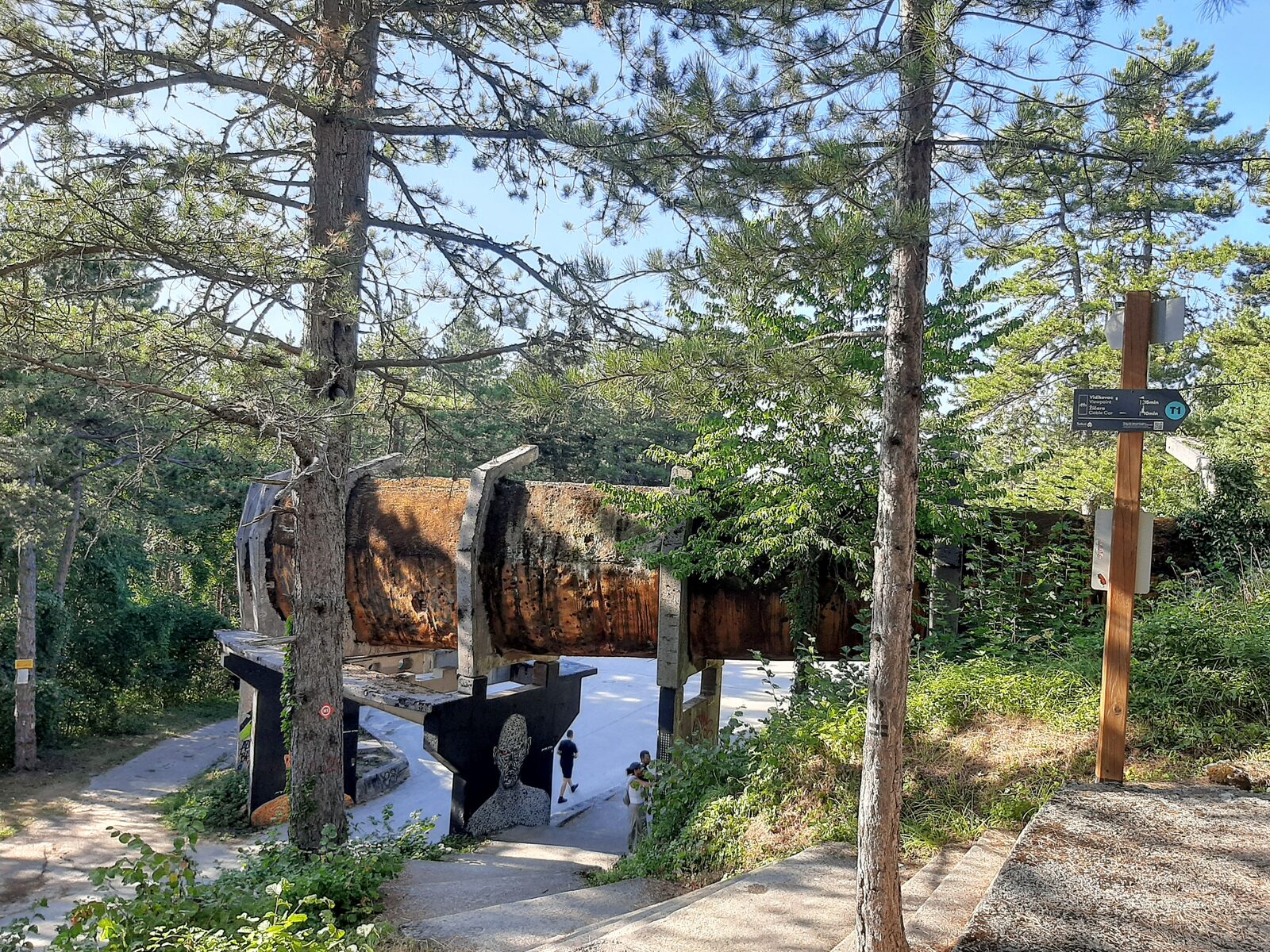
If you have a car, there is an alternative that skips the ticket queue entirely. Drive up to Trebević and park on the mountain — parking is free. From the parking area it is about a fifteen-minute walk along the marked forest path to the abandoned 1984 Olympic bobsled track. Walk the track (or climb up it — the concrete channel is walkable in both directions) and you arrive at the cable-car upper station on foot. From there, ride the cable car down to Bistrik for the view — a one-way ticket is 20 BAM at the foreign-visitor rate, 4 BAM with a BiH ID — or turn back to the car and walk out the way you came. Either way, no parking fee.
What to do at the top
The upper station opens onto a small plateau at 1,160 metres. There is enough to keep a first-time visitor busy for two hours and a serious walker for a full day.
- The viewing platform immediately outside the upper station gives the postcard view — the bazaar directly below, the Miljacka as a thin line, the Habsburg quarter west of that, Marijin Dvor and the Avaz tower, and, on a clear day, Bjelašnica and Igman across the far horizon.
- The Vidikovac viewpoint is a five-minute walk east along the ridge, past the mountain café. Better light in the late afternoon. Benches, picnic space, no railings.
- The abandoned 1984 Olympic bobsled track is a 10–20 minute walk downhill from the upper station along a marked forest path. Concrete serpent, dense graffiti, no fences, no fee. Take photos, walk the length of the run, watch cyclists come down it in summer. See the bobsled track page for the fuller story.
- The upper-station café serves coffee, Bosnian coffee, hot chocolate, cold drinks, and baked goods (burek, štrudla, biscuits). It does not serve full meals. A food truck outside sells simple hot food — ćevapi, sausage, chips — most days in season. For a proper mountain lunch, walk 10 minutes further along the ridge to the restaurants around Trebević vidikovac; Restaurant Vidikovac is the standard local pick, and Borova Tanja is a longer walk but has been repeatedly recommended by visitors this season. Pino Hotel serves coffee and cake on a panoramic terrace.
- Sunnyland Alpine Coaster: a family-friendly downhill toboggan run — is a five-minute drive from the upper station (there is no taxi rank at the top; arrange a return with your driver, or Moj Taxi with data signal). Season roughly April–October.
- Hiking. Marked trails from the upper station lead to the summit of Trebević (1,627 m — a solid 90 minutes each way) and, in the other direction, back down to Sarajevo on foot (a three-hour descent to Bistrik, avoiding the cable car return fare and thoroughly satisfying).
Practical things worth knowing
Is the cable car wheelchair accessible?
Yes. The cabins are modern Leitner Ropeways units with level-boarding on both stations. Passengers with mobility restrictions can board with staff assistance. The upper station platform and immediate viewing area are wheelchair-navigable; the bobsled-track walk and Vidikovac path are not (rough forest track).Can I bring a bike?
Yes. Bikes are carried in dedicated slots at a small extra fee. Popular with cyclists who ride down the switchback road from the upper station. Confirm at the counter for peak-season weekend limits.Can I bring a dog?
Small dogs in carriers, yes. Large dogs are at the operator's discretion; check at the lower-station counter before queuing.Is it worth it in winter?
Yes, on a clear day. The valley below often sits under an inversion cloud (see [our air-pollution piece](/stories/2026/06/sarajevo-air-pollution/)); riding above the cloud into clean cold air is one of the more striking short experiences the city offers. **Wear layers.** The temperature at the ridge in January can be −15°C.Do I need to book online?
No. Tickets at the lower-station kiosk are almost always available. The only exception is high summer weekends 14:00–17:00, when queues can reach 30 minutes. If you want the sunset window on a Saturday in July, arrive by 17:30 to catch the queue at its shorter side.Can I leave luggage at the station?
Yes. The lower-station counter accepts short-term luggage storage, useful if you're arriving from the airport or catching a bus later and want to ride the mountain in between.Is it safe?
Yes. The 2018-installed Leitner Ropeways system is a modern DirectDrive design with full technical certification, standard European aerial-tramway maintenance protocols, and thirty-three cabins each with its own emergency reserve. There has been no significant incident since reopening in 2018.What if the cable car is closed?
In rare Monday–Wednesday maintenance windows or during heavy winds (occasionally in winter), the line is suspended. The notice is posted on [zicara.ba/en/service-info](https://www.zicara.ba/en/service-info) and on the Sarajevo Cable Car Facebook page. If you're already at Bistrik and it's closed, walk twenty minutes uphill to the [Sarajevska Pivara](/hidden-gems/sarajevska-pivara/) brewery for coffee or the Historical Museum of the National Liberation Struggle nearby.A small ride into the recent past
The cable car is more than a piece of transport. It is a small civic recovery, restored on a deliberate date, and used daily by people who remember when it was not there. Riding it is a quiet way of joining the city’s longest-running conversation with itself: about what was lost, what came back, and what to do with the time between.
Nine minutes. Worth all of them.
Related
The cable car sits inside a small cluster of Trebević-mountain places worth pairing on the same visit:
- The Trebević bobsled track — the 1,300-metre abandoned 1984 Olympic bobsled and luge track, walkable on foot from the upper cable-car station. The “Approach by car” route above threads through it.
- Mount Trebević — the mountain itself, the summit ridge at 1,627 m, the wider trails and viewpoints. The cable car is the fastest way onto it; the free-parking approach is the cheapest.
- Zetra Olympic Hall — the paired 1984 Olympic venue down in the valley, where the figure skating and ice hockey were held. Read the two together to see the whole Olympics narrative — the mountain venue that became a front line, the valley venue that became a morgue and came back.
Sources & further reading
- Žičara Trebević — official website
- Sarajevo cable car — Wikipedia
- Ilma Garankić, 'The Sarajevo Cable Car: Back and Forth, Tirelessly, for a Better Tomorrow' — Balkan Diskurs, 6 April 2025
- 'LEITNER Ropeways Builds New Trebević Cable Car in Sarajevo' — The Gondola Project, 25 April 2018
- 'Sinno: Sarajevo was simply incomplete without the Trebevic Cable Car' — Sarajevo Times
More views
The line, above and below
Photographs: Nedim Hadzimahmutovic · source · Original photograph



.jpg)


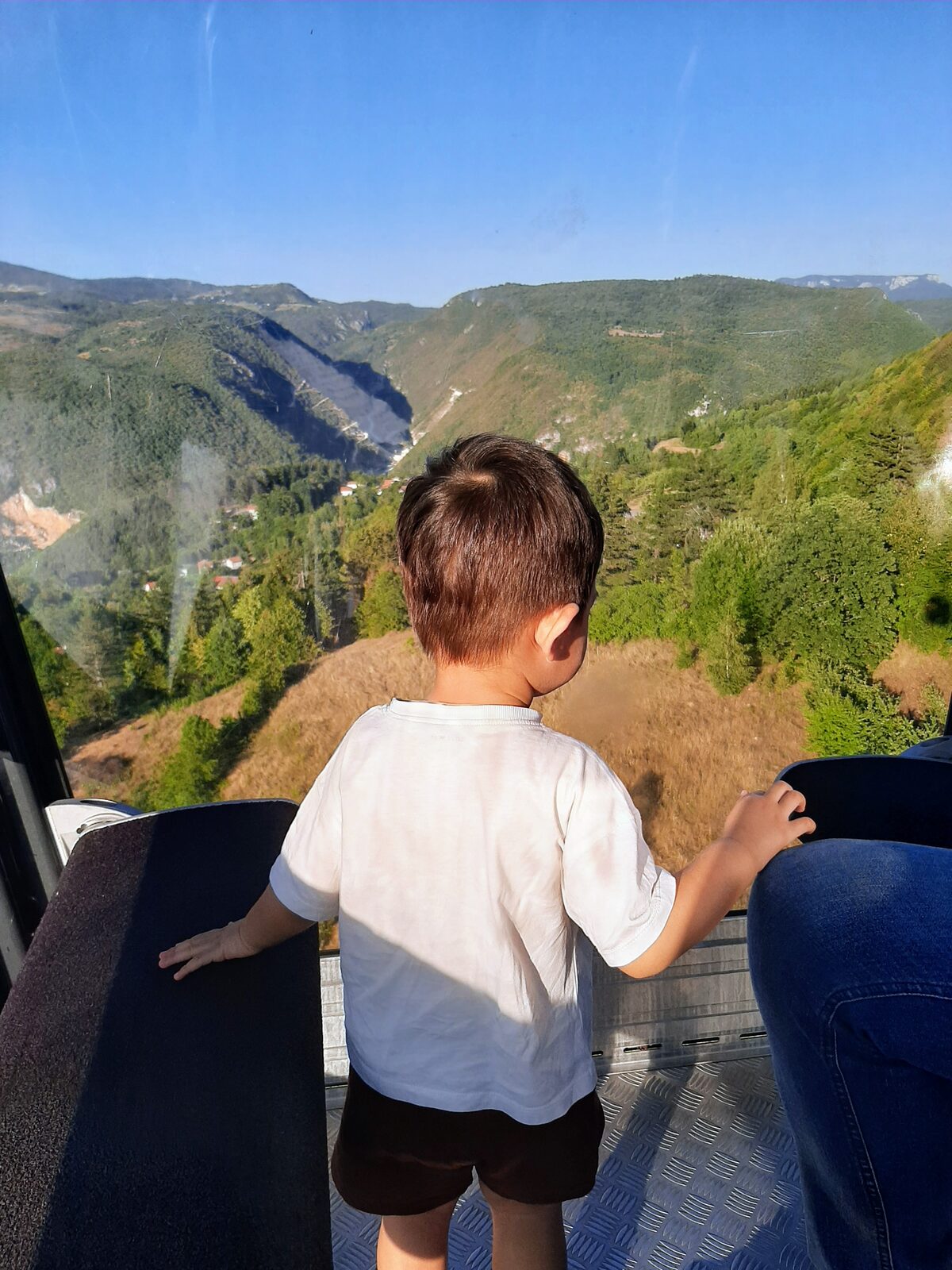
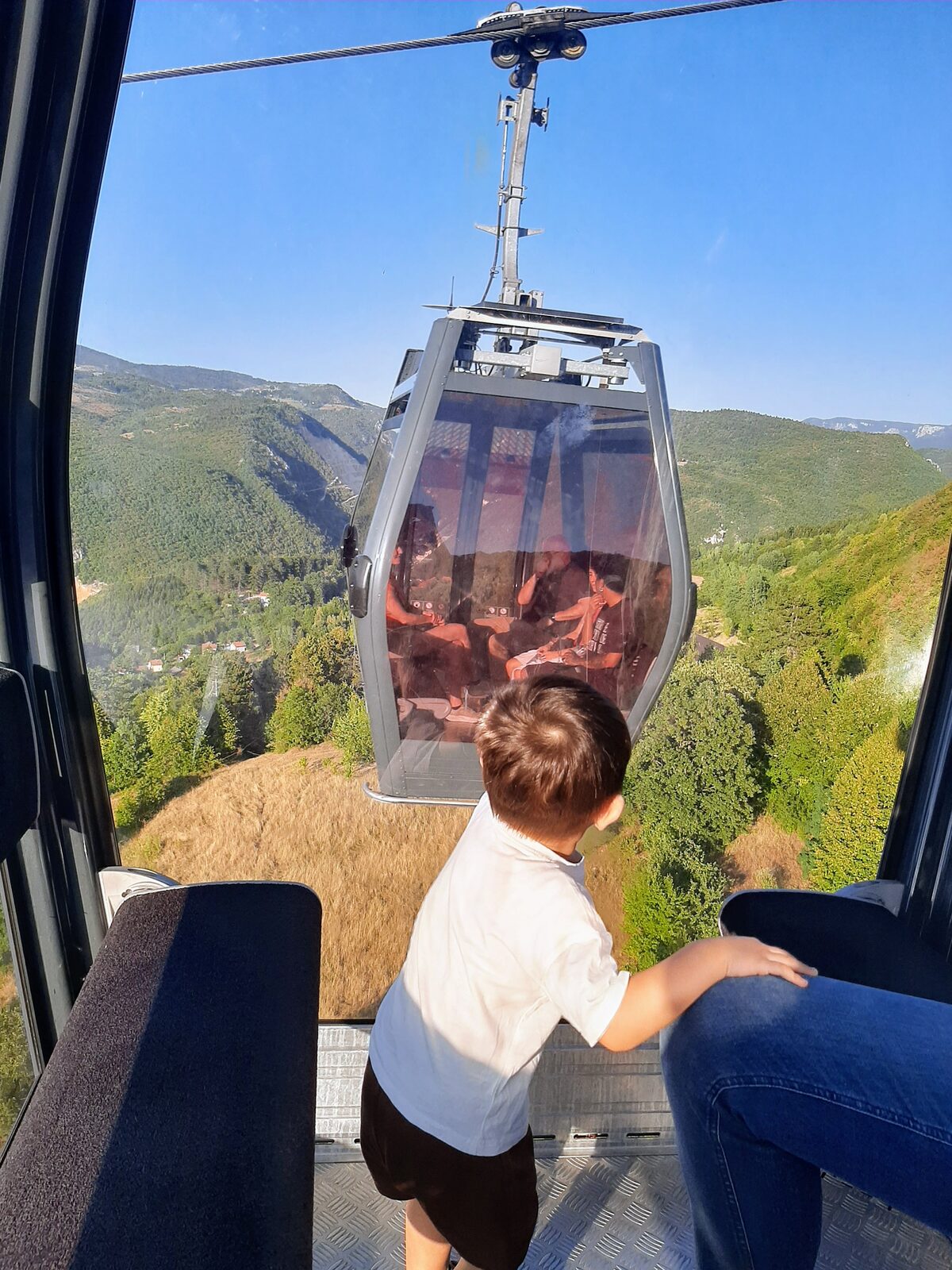
From the visit
The ride — August 2026
Photographs: Nedim Hadzimahmutovic · source · Original photographs
Keep wandering
Nearby & related.

Sarajevo Ashkenazi Synagogue
Sarajevo’s working synagogue, built in 1902 in pseudo-Moorish style by the Austro-Hungarian administration for the Jewish community that had grown...

Sarajevo Avaz Twist Tower
The Avaz Twist Tower is Sarajevo’s tallest building (142 metres, completed 2008). A small public observation deck on the 35th...

Sarajevo Baščaršija
The 1462 Ottoman bazaar of Sarajevo, still a working bazaar. Copper workshops on Kazandžiluk, Bosnian coffee at Morića Han, and...