Explore Sarajevo / Destinations / Sarajevo Hotel Europe
Destination · Centar (just behind the Sebilj) · 4 min read
Sarajevo Hotel Europe
The 1882 Karel Pařík hotel where Habsburg Sarajevo first staged itself as a European capital — burned in 1914, rebuilt twice, currently the city's grand-old-hotel address.
- Established
- 1882; restored 2008
- By
- Karel Pařík (1882); restoration by ARH Studio, Sarajevo (2005–2008)

.jpg)
At a glance
Address
Vladislava Skarića 5, Centar
Hours
Open year-round. The lobby café is open daily ~08:00–23:00; verify on arrival.
Price
Rooms ~€120 and up. Lobby café Bosnian coffee ~3 BAM; espresso ~2.50 BAM.
Getting there
Tram 1, 2, 3, 4 or 5 to Latinska Ćuprija; the hotel is two minutes' walk north into the Habsburg quarter, just behind the Sebilj.
Time needed
An hour for a coffee in the lobby; an overnight stay if you can afford the rate.
Best time
Late afternoon. The lobby café gets warm light through the front windows and reads as a working business hotel rather than a tourist attraction.
Coordinates
43.8595° N 18.4313° E
Navigate
Hotel Europe (Hotel Evropa) is the grand-old hotel of Habsburg Sarajevo. It was built in 1882, three years after the Austro-Hungarian administration took over from the Ottoman, to a design by Karel Pařík, the Czech architect who, in the same decade, was designing the Sacred Heart Cathedral and the Ashkenazi Synagogue and most of the Habsburg public buildings in central Sarajevo. The hotel sits at the geographical seam of the two cities: behind the Sebilj, on the Habsburg side of the Meeting of Cultures brass line in the pavement, on a small block where Pařík’s apartment blocks meet the older Ottoman lanes.
When it opened, Hotel Europe was the first purpose-built hotel of the Habsburg period in Sarajevo, and the most explicit architectural statement the new administration made about the city’s intended European future. It hosted Austro-Hungarian officials, Habsburg royalty on tour, the first generation of European journalists who came south to see what the empire had acquired, and, over the next half-century, most of the named guests who passed through Sarajevo. The hotel’s old guest registers are still in the hotel’s archive, and the ones from 1882 to 1914 are an unusually clean documentary of who was passing through the city.
Three destructions, three restorations
The hotel has been substantially damaged three times and rebuilt three times.
1914, In the days after the assassination of Archduke Franz Ferdinand on 28 June 1914, anti-Serb riots broke out in Sarajevo. The mob, encouraged by the Austro-Hungarian administration, targeted Serbian-owned shops and businesses. The hotel, which had Serbian ownership in part, was set on fire on 29 June 1914 and gutted. It was rebuilt over the following two years.
1939–1945, The hotel survived the Second World War as a working hotel, though its function was militarised at various points. The structural damage was limited; the interior was reorganised.
1992–1995, During the siege of Sarajevo, the hotel sat near the front line and was repeatedly shelled. The roof was destroyed; the upper floors were rendered unusable; the lobby took heavy damage. After the war the building stood largely unrestored for over a decade.
2005–2008, The current restoration was undertaken by ARH Studio of Sarajevo, with funding from the hotel’s owners. The work followed the building’s 1882–1914 proportions as far as the surviving photographic and architectural records allowed; some interior detail was reconstructed from period photographs. The hotel reopened in June 2008.
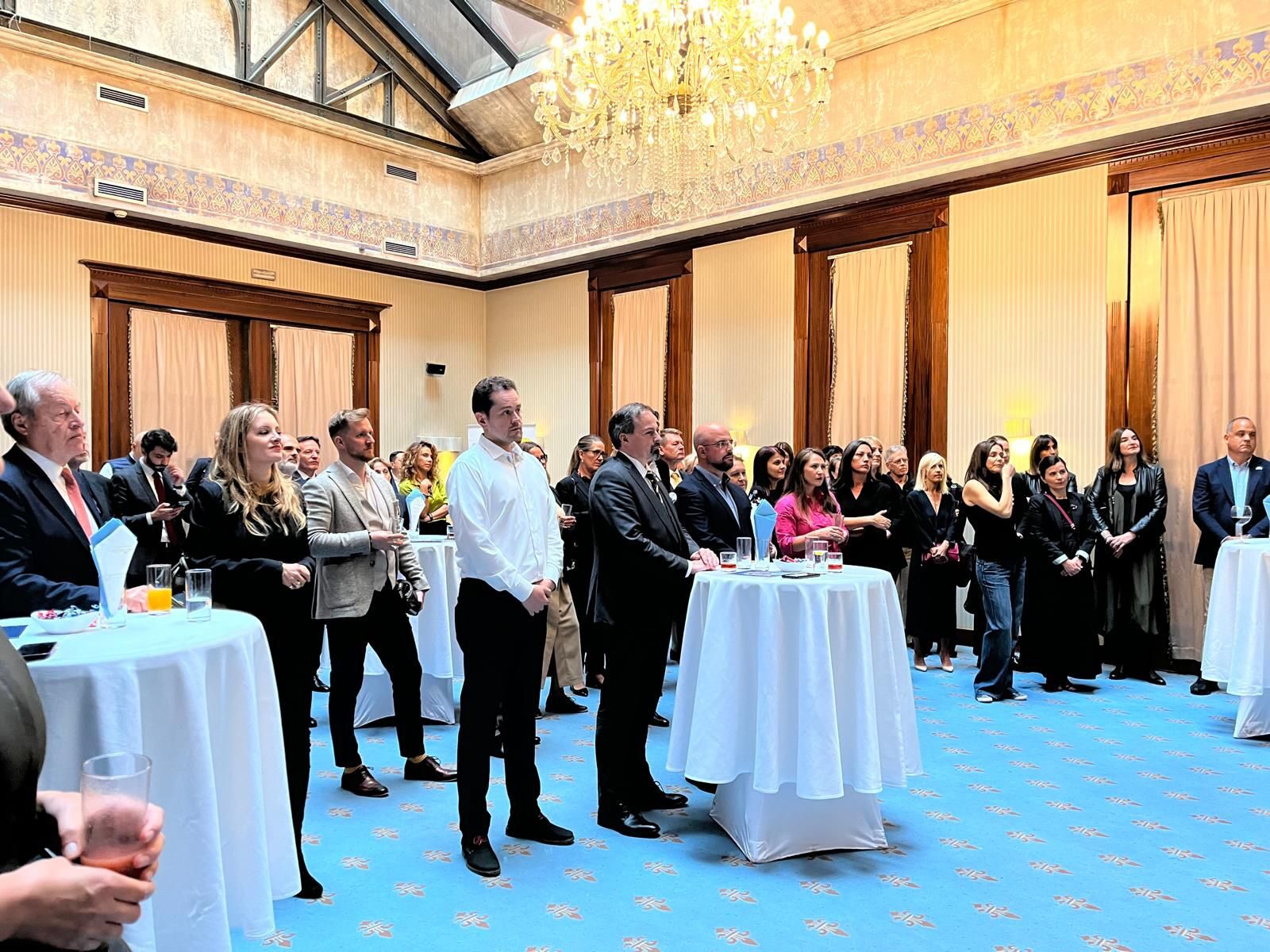

What you see today is the 2008 restoration of the 1882 building, with surviving fragments of the original 1882 brass, tile, and stone work preserved in the lobby and the public corridor.

Why visit (even if you are not staying)
A few practical reasons to stop:
- The lobby café. Bosnian coffee or espresso, served at the marble counter, with the lobby’s restored period detail around you. The cheapest way to use the hotel: about three BAM for a coffee.
- The corridor exhibit. A small permanent display in the corridor between the lobby and the dining room shows period photographs of the 1882 hotel, the 1914 fire, the 1995 destruction, and the 2008 restoration. The before-and-after pairings are unusually clear.
- The architectural seam. The hotel sits exactly on the boundary between Baščaršija and the Habsburg city. Step out the front door and you are in Habsburg Sarajevo (Šenoa street, the National Theatre, the Cathedral). Step out the back door and you are in Ottoman Sarajevo (Sebilj, Sarači, Kazandžiluk).
For an overnight stay, the rooms are well-restored and in the price range of a four-star European business hotel, the rate currently runs from about €120 in low season to €200 in summer. Book the front rooms for the corner-position views; the rear rooms face an internal courtyard and are quieter but less interesting.
A short note on what the hotel is not
Hotel Europe is not the Holiday Inn, the bright-yellow socialist-era hotel three minutes west on Zmaja od Bosne, built for the 1984 Winter Olympics, famous for hosting the international press corps during the 1992–95 siege. The two hotels are sometimes confused. They are different generations, different architectures, and different stories. Hotel Europe is the 1882 Habsburg one; the Holiday Inn is the 1983 Yugoslav one. Both are worth knowing about; only Hotel Europe is worth a coffee.
Further reading
- Two empires that built Sarajevo: a walking architecture guide: the wider context, including Karel Pařík’s other Sarajevo buildings.
- Latin Bridge: three minutes’ walk south; the 1914 assassination corner that caused the hotel’s first burning.
- Sebilj: two minutes’ walk east; the Ottoman public square the hotel faces.
Sources & further reading
Keep wandering
Nearby & related.

Sarajevo Ashkenazi Synagogue
Sarajevo’s working synagogue, built in 1902 in pseudo-Moorish style by the Austro-Hungarian administration for the Jewish community that had grown...

Sarajevo Avaz Twist Tower
The Avaz Twist Tower is Sarajevo’s tallest building (142 metres, completed 2008). A small public observation deck on the 35th...

Sarajevo Baščaršija
The 1462 Ottoman bazaar of Sarajevo, still a working bazaar. Copper workshops on Kazandžiluk, Bosnian coffee at Morića Han, and...