Explore Sarajevo / Destinations / Sarajevo Cathedral of the Nativity of the Theotokos
Destination · Centar · 5 min read
Sarajevo Cathedral of the Nativity of the Theotokos
The largest Serbian Orthodox church in Bosnia, finished in 1872. Three minutes south of the Meeting of Cultures line.
- Established
- 1872
- By
- Andrija Damjanov (attributed)


At a glance
Address
Trg oslobođenja - Alija Izetbegović, Centar
Hours
Open to visitors outside services — typically 09:00 to 18:00
Price
Free; small donation welcomed
Getting there
3 minutes south of Ferhadija; 2 minutes from the Sacred Heart Cathedral
Time needed
30 minutes
Best time
Mid-morning weekday
Coordinates
43.8582° N 18.4252° E
Navigate
Three minutes south of the Sacred Heart Cathedral, in the square that is officially named Trg oslobođenja – Alija Izetbegović but which everyone calls the square in front of the Orthodox cathedral, stands the Cathedral of the Nativity of the Theotokos, Saborna crkva Rođenja Presvete Bogorodice. It is the largest Serbian Orthodox church in Bosnia and Herzegovina and one of the largest Orthodox churches in the Balkans.
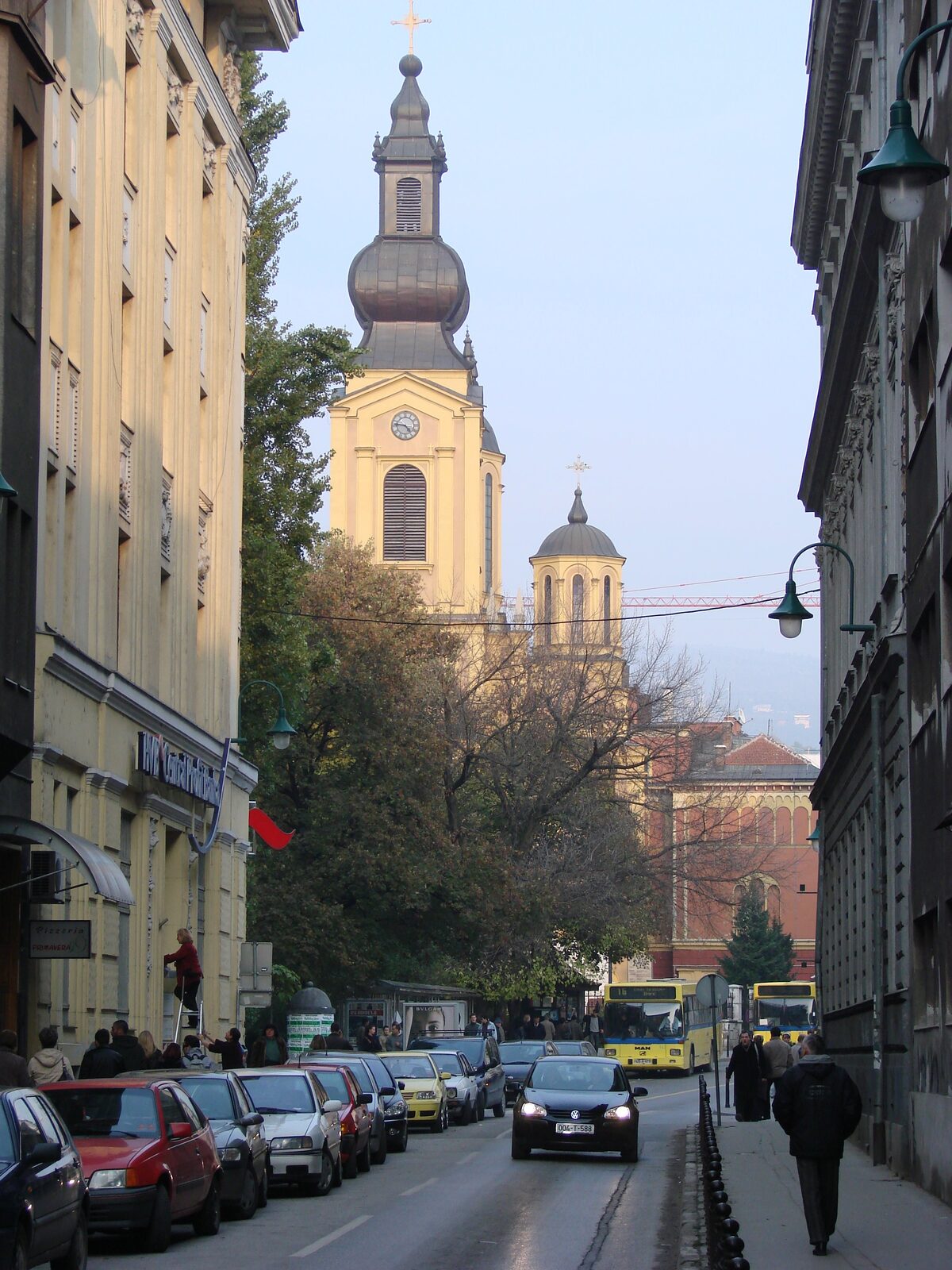
It is also older than its Catholic neighbour up the street. Consecrated in 1872, six years before the Habsburg arrival, the Orthodox cathedral was built during the last decades of Ottoman rule, when the empire had moved toward greater tolerance for non-Muslim religious construction and the Serbian Orthodox community of Sarajevo had grown wealthy enough to commission a church on this scale.
A Byzantine-revival cathedral, built in the Ottoman city
The cathedral was built between 1863 and 1872. The architect is credited as Andrija Damjanov (1813–1878), a Macedonian master builder from the town of Veles, part of the famous Damjanov family of neimari (master masons) and zografi (fresco painters), who worked across the Balkans during the Ottoman period and designed several of the most important Orthodox churches of the era. The style here is Byzantine-revival with Central European elements: three central domes, a wide nave, semicircular apses, and a dominant Baroque-style belfry. Zahra Kadkani-Schmitt (Framing Bosnia, UC Berkeley PhD, 2017, Ch. 3) argues that Damjanov’s work was specifically shaped by the neoclassical and Byzantine-Romanesque teachings of the Vienna Ringstrasse architect Theophil von Hansen, which is the reason the cathedral reads as more Central European than the older Orthodox churches of the Bosnian countryside.
At almost the same time, and for a very different client, Damjanov designed the large Ottoman Medžidija barracks (Kršla) on the south bank of the Miljacka, commissioned by the Bosnian vizier Topal Šerif Osman Pasha. That building was demolished in the late 1890s to make way for the Habsburg-era Franz Josef Barracks; the Serbian Orthodox Cathedral of Sarajevo is therefore the only surviving Damjanov building in the city. The story of the two commissions is covered in the site’s story “One man built the Orthodox Cathedral and the Ottoman barracks”.
Funding for the cathedral came from the local Serbian Orthodox community and from Russia, which by the mid-19th century had taken on the role of protector of Orthodox Christians within the Ottoman Empire. Tsar Alexander II personally donated some of the original icons and liturgical objects.
What you see inside
The interior is, by some distance, the most visually rich religious interior in central Sarajevo.
- The iconostasis: the great screen of icons that separates the nave from the sanctuary — is gilded and four levels high, with icons painted in the late 19th century by masters from across the Orthodox world.
- The frescoes along the nave walls and in the apse were painted in stages over the century after consecration, with the most recent restorations completed in the 2000s.
- The candle stand near the entrance is the right place to light a candle for the living (lower tier) or the dead (upper tier). The small donations fund the cathedral’s maintenance.
- The bishop’s throne to the right of the iconostasis is original 19th-century work.
The cathedral was damaged during the 1992–1995 siege, shrapnel scarring on the exterior, some interior damage from concussion blasts, and underwent restoration in the late 1990s and 2000s.
The square outside
The square in front of the cathedral was rebuilt in the 2000s and is one of the more pleasant small public spaces in the centre. Benches, plane trees, a small monument to Bosnian president Alija Izetbegović, and frequent informal markets in summer. It is a popular meeting point for residents of the neighbourhood. There is a small chess corner where older men play in good weather.
A small Orthodox church museum sits in the adjacent building and is occasionally open to visitors; check at the cathedral door.
How to visit
The cathedral is open daily, typically morning to early evening, outside services. Sunday liturgy runs from around 09:00 and lasts about two hours. Dress respectfully. Cover shoulders. Women are not required to cover the head as visitors, but a scarf is welcomed during services.
A candle at the door costs around 1 BAM. Buy one if you want to participate in the small ritual of lighting it in the candle stand.
Why it matters
Sarajevo’s reputation as a multi-faith city, sometimes called the Jerusalem of Europe — a label that does the city few favours but has real 16th-century Sephardic origins — rests on the density of working religious infrastructure in its central streets. The Orthodox cathedral is one of the four points of that geometry, alongside the Gazi Husrev-beg Mosque, the Sacred Heart Cathedral, and the Ashkenazi Synagogue. All four sit within a four-hundred-metre radius. All four are active. All four are open.
Walking between them in a single afternoon is one of the most useful things a thoughtful visitor can do here. Start at the Sebilj, walk west to the brass line on Ferhadija, then south to this cathedral, then four minutes more to the synagogue across the river, then back north to the Catholic cathedral. Two hours. Four faiths. One city.
Sources & further reading
More views
From Sarajevo Cathedral of the Nativity of the Theotokos
Photographs: Michael Goodine · source · CC BY 2.0

Keep wandering
Nearby & related.

Sarajevo Ferhadija
Ferhadija is the broad pedestrian street that begins at the Sarači–Sarači transition (marked by the Meeting of Cultures line in...

Sarajevo Galerija 11/07/95
A small, deliberately unflashy memorial museum to the Srebrenica genocide of July 1995. Founded by photographer Tarik Samarah in 2012,...

Sarajevo Latin Bridge
A small 1798 stone bridge across the Miljacka. The Habsburgs called it Princip’s Bridge after the assassination of Franz Ferdinand...