Sarajevo — is it worth visiting? A local editor's honest answer
Yes, and for a specific list of reasons that are not the ones most travel sites give. A local answer, and what to skip.
Yes. Sarajevo is worth visiting. The local editor of this site, answering the question first-time visitors ask most often, the way we’d answer a friend.
A useful qualifier: worth visiting for what? The city is small (population ~275,000), inexpensive, and specifically shaped by four hundred years of Ottoman rule, forty years of Habsburg administration, forty-five years of socialist Yugoslavia, and the 1425-day siege of the 1990s. Any traveller who cares about living history at street level, food culture, mountain access from a city centre, or reading the twentieth century from a single valley will get more out of Sarajevo than they expect. Any traveller looking for beaches, nightlife on the Ibiza scale, or five-star luxury will be under-served.
Here is what makes the honest case, and what makes the case for skipping it.
What Sarajevo has that no other European capital has
The site keeps a longer version of this list, but the short version is five items:
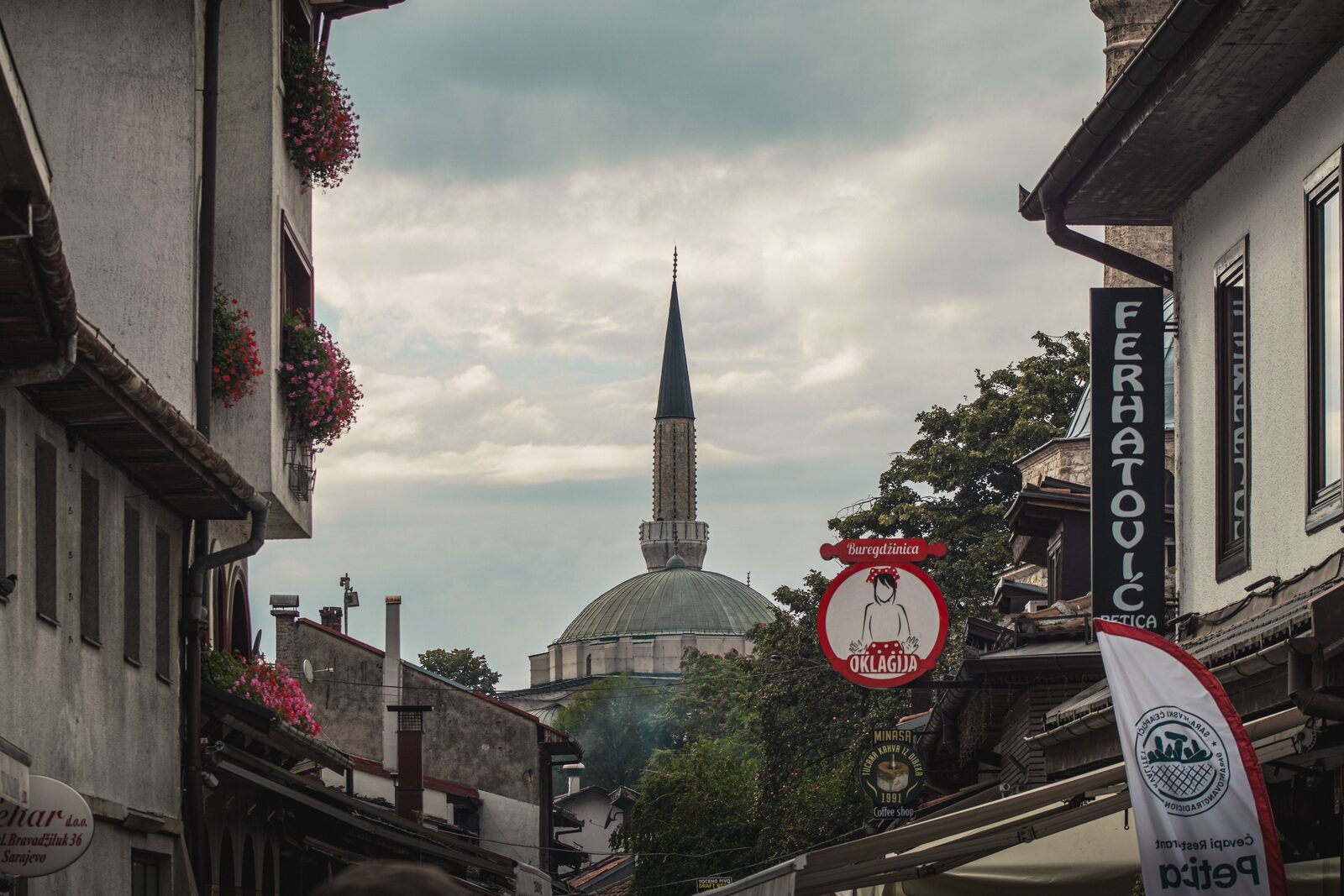
- The Ottoman bazaar and the Habsburg quarter meet on one street, in the middle of the city. A brass line in the pavement of Ferhadija marks the seam. Ottoman on one side, Habsburg on the other, six paces between empires. No other European capital has this so cleanly.
- A nine-minute cable car from the city centre to the top of a mountain. Trebević closes the valley to the south. The cable car opened on 3 May 1959, closed in 1989, was destroyed in the siege, and reopened on 6 April 2018. From the top you can see the entire city, the abandoned 1984 Olympic bobsled track, and the treeline the artillery fired from.
- The Tunnel of Hope museum. A tunnel dug by hand under the Sarajevo airport runway between March and July 1993. It kept the city alive during the siege — food, fuel, ammunition, one million passages. Twenty-five metres of the original tunnel are preserved.
- Bosnian coffee, taken slowly. Not Turkish coffee. Not espresso. A specific ritual involving a copper džezva, a porcelain fildžan, a sugar cube held in the teeth, and about an hour of time. Cafés on Kovači and inside the bazaar have been serving it in the same way for centuries.
- Ćevapi at the source. Bosnia’s national dish, at its best in Sarajevo, at five grills within a hundred metres of each other. One has been running since 1957.
Any traveller who reads that list and thinks “yes, that’s what I want a trip for”, Sarajevo is worth their time.
What surprises first-time visitors, in a good way
How safe it is. Sarajevo is one of the safer European capitals to walk in at night. Violent crime is very low. The scam-and-pickpocket tax you pay in Rome or Barcelona is almost absent here. Women travelling alone report feeling comfortable in Baščaršija after dark. The 1990s war is thirty years past; the city is not the war.
How affordable. A bowl of ćevapi with somun and onions: around 8 BAM (~€4). A Bosnian coffee in a bazaar café: 2–3 BAM (~€1.50). A cable-car return to Trebević: 30 BAM for foreign visitors (~€15), 6 BAM for BiH residents. A hotel room in a decent central place: €60–90 a night. A tram ride: 2.20 BAM. Sarajevo is roughly one-third the daily cost of Vienna and about half of Belgrade.
How multilingual. Most Sarajevans under fifty speak workable English. Most under thirty speak fluent English. German is the second European language of the city. You will not be stuck on the language. A few Bosnian phrases (dobar dan, hvala, molim, dvije kafe molim) are appreciated but not required.
How small the walking city is. The historic centre, from the Sebilj fountain to the Sacred Heart Cathedral, is about eight hundred metres end to end. You can see most of what draws visitors on foot in a single day.
What surprises first-time visitors, in a less good way
The siege presence is not curated away. Sarajevo Roses, red-resin marks in the pavement where mortar shells killed civilians, are still visible on Ferhadija, at Markale market, and elsewhere in the centre. Bullet holes remain in Habsburg-era facades. Not a museum treatment — the working surface of a city that lived through the siege and chose to keep the marks. Visitors sensitive to war memory should know they will not be given an option to skip it.
Public transport is functional but not extensive. The tram network is one of the oldest in Europe, horse-drawn service opened on 1 January 1885, and electric traction followed in 1895, running the main east–west corridor. Since December 2023 the fleet has been modernised with 25 new Stadler Tango NF3 low-floor trams, air-conditioned, with USB ports, free Wi-Fi, and digital passenger information, replacing the old Czech-era stock most first-time visitors read about in older guides. A new tram extension to Hrasnica (12.96 km, 20 new stations, EBRD-funded) is under construction, originally scheduled for the first quarter of 2026 and now more realistically expected late 2026 or into 2027, Sarajevo infrastructure schedules almost always slip, and October 2026 is a general-election month. Buses reach the rest. Uber, Bolt, and Yandex Go do not operate in Bosnia, the local dispatch app is Moj Taxi, which calls a metered car from one of the registered associations. Taxis are inexpensive. There is no metro. Bring walking shoes.
Indoor smoking is now mostly banned. Bosnia was for years one of the last European countries with legal indoor smoking. In June 2025 the Federation of Bosnia and Herzegovina (which includes Sarajevo) implemented a ban in catering venues serving food and drink under 50 square metres, meaning most restaurants and larger cafés are now smoke-free indoors. Larger venues may operate enclosed and separately ventilated smoking rooms, and small drinks-only cafés can register as smoking establishments (no minors allowed). In practice, most bazaar cafés and restaurants are now non-smoking indoors, with smoking on outdoor terraces. If you specifically want a smoking-permitted space, ask before sitting down, some smaller bars still qualify.
A day trip to Mostar is a mistake. The bus is three hours each way. You get four hours at the Old Bridge. Do not do it as a day trip, go to Mostar for its own overnight, or skip it and see more of Sarajevo. The site’s longer treatment of ćevapi comparisons covers this indirectly.
Who should skip Sarajevo
Honestly: three groups.
- First-time European travellers on a two-week Grand Tour. Sarajevo needs three days of attention and works best when it’s not the fifth city in ten days. If Barcelona-Paris-Amsterdam is the trip, Sarajevo is the wrong add-on — too different in register to switch into for 48 hours.
- Beach travellers. The Adriatic is four hours by car. Split, Dubrovnik, and Kotor are that direction. Sarajevo is an inland mountain valley. Beaches are not the trip.
- Travellers who do not want to think about the 1990s. The city is at peace, safe, and welcoming. But its history is written on its walls, and honesty is one of the site’s cardinal rules. If you want a European city break with no historical weight, choose Ljubljana instead.
Everyone else, come.
The case for coming now
Tourism is growing but is still on a much smaller base than Prague, Budapest, or Zagreb. In the first five months of 2026, Sarajevo received about 286,000 tourists, up 3.6 per cent year on year. Prague, in the same window, received over three million. The city is not overrun. Baščaršija is busy in July and August but not choked. The bazaar’s copper workshops are still working workshops, not tourist props. The cafés are still where locals sit.
The window in which Sarajevo is small enough to feel like a city rather than a destination is closing. Direct flights now serve 39 international routes, including new Wizz Air and Ryanair connections from Western Europe. In five years, the city will be busier. Now is the honest recommendation.
What to do with the answer
If you have decided to come, the site’s pocket guide to a perfect day and the essential travel details are the two next reads. If you want the walking spine, take Baščaršija to Trebević as your first afternoon and the Habsburg architecture walk as your second. Give the city three days. Two if the trip is short. Never one.
The people who leave Sarajevo underwhelmed are almost always the ones who gave it one day. The people who leave Sarajevo already planning to come back are the ones who gave it three.
The legend says a sip from the Sebilj fountain in the middle of the bazaar brings you back to the city. The evidence, from the number of our readers who write back to say they returned, is that the legend is doing something. Have the sip.
Sources & further reading
Keep reading
More from the guide.

Sarajevo at night — the bazaar after dark, sunset viewpoints, sevdah rooms, and one club worth staying up for
What is there to do in Sarajevo at night? More than most travel guides suggest. The bazaar stays alive until 02:00 on...

Sarajevo layover — the airport is 12 km from Baščaršija, so it depends how long you have
Sarajevo Airport is unusually close to the centre. If your gap is three hours or more, you can leave the airport and...

Sarajevo walking tour — three hours, four centuries, one brass line in the pavement
A self-guided Sarajevo walking tour that a first-time visitor can complete in three hours. Eight stops, from the 1462 Ottoman bazaar to...