Sarajevo — three Habsburg firsts you didn't know about: an 1885 horse tram, an 1899 postcard, and a pelican in Ilidža
Sarajevo had the first tram in the Balkans (1 January 1885). It had one of the earliest recorded travel postcards, dated 24 April 1899, printed by Daniel A. Kajon. And it had — briefly, in a Habsburg pleasure garden three tram stops from Baščaršija — a captive pelican.
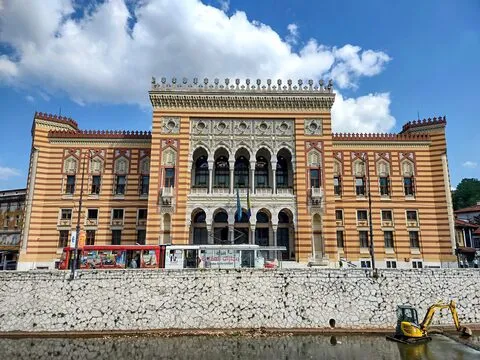
If you read enough about Habsburg Sarajevo, you’ll come out with a familiar list of civic firsts the administration produced between 1878 and 1918. First cadastral map (see our cadastral survey piece). First European-standard hotel (Hotel Europa, 1882, our piece). First city hall in the Pseudo-Moorish style (Vijećnica, 1892–1896). First Habsburg mosque — the Ashkenazi Synagogue, sort of, in the same style (1902).
The list is long and mostly serious. But there are three Habsburg-era Sarajevo firsts that are absent from most accounts, and they’re worth naming: the first tram in the Balkans, an early travel postcard, and — this is not a joke — a captive pelican in a Habsburg pleasure garden at Ilidža.
The source for all three is a 2024 peer-reviewed paper by Amra Banda et al. at the University of Sarajevo’s Faculty of Science, drawing on the Gazi Husrev-beg Library’s collection of 1,154 catalogued period postcards and on nineteenth-century Sarajevo newspapers.
First 1: The Balkans’ first tram, 1 January 1885, 10 a.m.
Sarajevo had the first tram in the entire Balkan peninsula and Central Europe. This is not folklore. It is a documented, dated, verifiable fact.
The first horse-drawn tram left the corner of what is now Trg oslobođenja at 10:00 on the morning of 1 January 1885. The route ran 3.1 kilometres, from the current Faculty of Economics through Ferhadija along the main city street (then Franz Joseph, now Maršala Tita) over Marijin Dvor to a narrow-gauge railway station in the western suburbs. The first driver was named Johann Hanke. The fare was 5 kreuzers.
Sarajevo had a tram before every other city in the Balkans. Belgrade got its first tram in 1892. Sofia in 1901. Zagreb in 1891. Ljubljana in 1901. Bucharest had a horse-drawn tram from 1872, but is (and remains) controversial as to whether it counts as “Balkan” depending on how you draw the line.
Ten years later, on the same original route, the network got upgraded. On 1 May 1895, the first electric tram in Sarajevo — and one of the earliest electric tram systems anywhere in Europe — ran between the Tobacco Factory and the Latin Bridge. This was the first electric tram in the entire Habsburg Empire. Vienna’s first electric line opened later that same year. Sarajevo’s electric-tram operation, on this measure, is one of the earliest anywhere on the continent.
The electric-tram lines running today — the modernised Stadler Tango NF3 fleet — follow, in broad outline, the same route that Johann Hanke drove on New Year’s Day 1885.
141 years of a single tram route. In one city. On a road that runs across the Miljacka valley from Baščaršija to Marijin Dvor.
First 2: The oldest known Sarajevo travel postcard, 24 April 1899
The oldest known Sarajevo travel postcard in a catalogued collection is dated 24 April 1899. It was sent from Sarajevo to Gradačac, a town in northern Bosnia, carrying a handwritten message on the reverse and a lithographed image of pre-regulation central Sarajevo on the front.
The image on the postcard shows the Miljacka before the 1896–1897 river-regulation project that straightened the channel and demolished several older Ottoman bridges. Two bridges visible in the image — the Emperor’s Bridge (Careva ćuprija) and the Drvenija Bridge — were both destroyed in the regulation works within months of the postcard being sent. The card is, in effect, a document of a Sarajevo urban topography that had already ceased to exist by the time it reached its recipient.
The first printer of Sarajevo postcards was Daniel A. Kajon — a Sarajevo entrepreneur who opened a printing house in the city in 1892. Kajon printed a substantial share of the German-language Sarajevo postcards that were sent by Habsburg administrators, travellers, and Habsburg soldiers to correspondents across the Monarchy in the years before the First World War. His Kajon Verlag imprint is now, in the archival record, one way to date early Habsburg Sarajevo material.
Sarajevo, in the years 1892–1914, was a working point on the German-language postcard economy of central Europe. The Habsburg administration had, roughly, three tourism-promotion tools: hotels (see our Hotel Europa piece), tourist club publications (see next section), and postcards. The 1,154 catalogued Kajon-and-others postcards at the Gazi Husrev-beg Library are the archival trace of how the third tool worked.
Two organised tourist clubs by 1894 — the Bosnian-Herzegovinian Tourist Club (1892) and the Kružok Kluba Czech Tourists (Sarajevo branch, 1894). Both published German-language tourist guides. The claim that Sarajevo has been a tourist destination since before the twentieth century opened is, at the archival level, correct.
First 3: A pelican in Ilidža
This is the one you probably didn’t have.
In the 1890s, the Habsburg administration built a small zoological garden — the Zvjerinjak — inside Veliki park in Ilidža, at the western end of the valley. Ilidža was, in the Habsburg logic, the city’s principal spa resort (see our Aquae Sulphurae piece), and the zoo was one of the attractions for the Habsburg elite who took the waters there.
The Zvjerinjak was, per period newspapers Banda et al. cite, home to a menagerie:
- Bears (native to Bosnia).
- Deer (also native).
- Wild boars (native).
- Swans and ducks (imported for pond decoration).
- Herons (also native, semi-captive).
- And — this is what nobody thinks of when they think of Sarajevo in 1893 — a pelican.
A pelican, in a Habsburg pleasure garden, three tram stops from Baščaršija, in the 1890s.
The pelican was not native. It had, per one Bosanska pošta article from the period, been imported — the origin of the bird is unclear, but Egyptian shipments to Habsburg zoological collections were a well-documented practice at the time, and Ilidža’s Habsburg administrators could plausibly have taken delivery via the Danube-Adriatic route.
There is no photograph. There is no individual name recorded for the bird. It survived, per the fragmentary period record, for several years. What happened to it — whether it died in captivity, was moved to another Monarchy collection, or was released — is unrecorded.
But for a window in the 1890s, Sarajevo had a pelican. In Ilidža. Three tram stops from the Baščaršija Sebilj, in the direction of the springs where the Bosna river surfaces at Vrelo Bosne.
What to do with this
If you take the tram 3 from central Sarajevo west to Ilidža, you are riding, in modernised form, the route that opened in 1885 as the first tram line in the Balkans. If you get off at Ilidža and walk to Veliki park, you are walking through the ground where a Habsburg pleasure garden with a small zoo (and a pelican) stood in the 1890s. If you buy a postcard at any of the Baščaršija souvenir shops, you are participating in a commercial tradition that started in 1892 with Daniel A. Kajon and is, at the archival level, older than most people would guess.
None of these firsts is a big story on its own. They are small dense facts that improve the granularity of what you know about the city. Combined, they tell you that Habsburg-era Sarajevo was not, as most casual accounts describe it, a peripheral eastern outpost. It was one of the early cities in the Empire — sometimes the very first — for the municipal technologies of European modernity: the tram, the postcard, the zoo.
Read Banda et al. for the archival detail. And when you’re riding the electric tram down Ferhadija, remember that the first person to do it was a driver called Johann Hanke, and the date was 1 May 1895 — one year before Marconi filed his first radio patent, and one year after Nikola Tesla first demonstrated a working polyphase AC system in New York.
Sarajevo was on the map that year. Somebody in Ilidža was feeding the pelican.
Sources & further reading
- Amra Banda, Muniba Osmanović, Belma Durmišević, Amra Čaušević, Tena Božović, 'Sarajevo through the Lens of the Austrian-Hungarian Period: The Significance of Postcards in Tourism Promotion' — Faculty of Science, University of Sarajevo (2024)
- Related on this site: Two empires built Sarajevo — a walking architecture guide
Keep reading
More from the guide.
Sarajevo 1912 — the Bosnian Parliament the Habsburgs planned across the river from Vijećnica, and the First World War stopped
Directly across the Miljacka from Vijećnica, on the south embankment near the Cumurija bridge, there was once supposed to be a big...

Sarajevo Sebilj — a wooden copy of Mimar Sinan's stone fountain in Istanbul
The most photographed object in Sarajevo is the wooden kiosked fountain in the middle of Baščaršija. Everyone assumes it’s Ottoman. It isn’t...

Sarajevo National Museum — four buildings pretending to be one, and the Haggadah has been inside since 1894
The Sarajevo National Museum, Zemaljski muzej Bosne i Hercegovine, is a four-pavilion complex on Zmaja od Bosne designed by Karel Pařík and...