Sarajevo — Zetra opened in 1983, hosted Torvill and Dean, was a morgue in 1994, and now runs hockey practice on Tuesdays
Zetra opened in 1983 in time for the 1984 Sarajevo Winter Games. Torvill and Dean won figure-skating gold there with Boléro. The wooden roof burned in the 1992–95 siege. The floor was pulled up to make coffins for the dead. IOC and international funding rebuilt it 1996–1999, and it is once again the city's working ice arena. Ice hockey on weekday evenings.
Zetra opened in 1983. The 1984 Sarajevo Winter Olympics were nine months out, the ice-hockey and figure-skating events had to have a venue, and the Yugoslav state was in a hurry. The architects Lidumil Alikalfić and Dušan Đapa produced a low-slung arena in the wooded Koševo park north of the centre — curved metal roof, wooden interior fittings, capacity around 12,000 including standing room. It went up fast, opened on time, and worked.
Torvill and Dean skated on it on 14 February 1984. Ravel’s Boléro. All six technical judges gave them 5.9; all nine artistic judges gave them 6.0. Highest scores in Olympic figure-skating history. Gold. The whole world watched.
Ten years later, on the same rink, they were sawing up the wooden floorboards to make coffins.
What happened between the two Februaries
Sarajevo hosted the Winter Games in 1984. Sixteen days, forty-nine gold medals, television broadcast to a billion people. Zetra was one of six competition venues — the bobsled and luge track on Trebević was another, Bjelašnica and Jahorina were the alpine slopes, the Skenderija hall did the second ice rink, the Asim Ferhatović Hase stadium next door to Zetra did the opening and closing ceremonies. It was the first Winter Olympics held in a socialist country, and it was, by all accounts, a well-run Games.
Eight years later, on 6 April 1992, Serb forces began the siege of Sarajevo from the surrounding hills. The Koševo neighbourhood, where Zetra sits, was on the west side of the front line. The stadium and the arena were within artillery range of Serb positions on the ridge above. They got hit.
The wooden roof of Zetra burned to charcoal at some point in 1992 — the exact date the fire started is not clear in the sources this site has drawn on. What is clear is that by mid-siege the arena’s roof was gone, most of the interior had been destroyed by fire and shelling, and the building was structurally unusable. The city, which was running out of everything, needed wood for coffins. They took it from the parquet floor of the ice rink.
The Yugoslav-era brochures had described Zetra as “the pride of Sarajevan winter sport.” The word that came to be used for the wartime function was “morgue.”
What was rebuilt
The 1992–95 siege ended with the Dayton Accords in December 1995. In 1996 the IOC — which had built Zetra for the 1984 Games and considered it international sporting property — committed to funding a rebuild. Juan Antonio Samaranch, then IOC president, personally championed the project. The construction firm ARH Group handled the work between 1996 and 1999. When Zetra reopened in 1999, it was renamed the Juan Antonio Samaranch Olympic Hall in honour of the man who had pushed the funding through.
Everyone in Sarajevo still calls it Zetra.
The rebuild kept the original 1983 footprint and the original curved-roof form. The materials changed — steel roof structure instead of wood, tougher interior finishes, updated seating. Capacity is now around 8,500 seated. The ice-hockey rink is a full-size international sheet; the local HK Sarajevo and HK Bosna play home games there. The Sarajevo figure-skating club trains there. The building also hosts concerts — Nick Cave played it in the mid-2000s — and larger convention events.
The Olympic Museum, originally housed in a nineteenth-century Habsburg building in Marijin Dvor that was destroyed in the siege, is being relocated to the Zetra campus. When you visit — if you visit — check the current status. It’s been a slow move.
What’s still there from 1984
Not much of the interior. All the wooden fittings, the original seats, the wooden roof — all gone. What survives is the shell: the curved concrete substructure that Alikalfić and Đapa drew in 1982, the surrounding park, the walk from Koševo tram stop through the trees.
The Vučko statue is at the entrance. Vučko was the wolf mascot of the 1984 Games, a design by the Slovenian artist Jože Trobec. The statue is small, mostly bronze, and easy to miss. Children like it.
The Olympic memorial plaque near the entrance names the fourteen Bosnian athletes who competed at the 1984 Games. Nobody won a medal that year for the host country. That is, the medal count for Yugoslavia was 1 (a silver in the men’s giant slalom, won by the Slovenian Jure Franko at Bjelašnica), and Franko was ethnic Slovenian, not Bosnian. But the fourteen names on the plaque are the Sarajevan ones.
If you sit in the arena for a hockey game — cheap tickets, weekday evenings, HK Sarajevo versus HK Bosna is the local derby — the shell of the building around you is the shell that watched Boléro in 1984. The ice is new. The building is the same building. Sixty-nine minutes of continuous play, a Zamboni resurfacing between periods, a couple of hundred locals in the stands, and the roof no longer wooden but still curved.
Not the same as 1984. Not the same as 1994. Which is more or less what you want a rebuilt Olympic arena to be.
Sources & further reading
Keep reading
More from the guide.

Sarajevo Old Jewish Cemetery — 3,850 Sephardic tombstones, second-largest in Europe
Above Kovačići, on the south slope over the Miljacka, sits a cemetery of about 3,850 stone tombstones on 31,160 square metres. It...
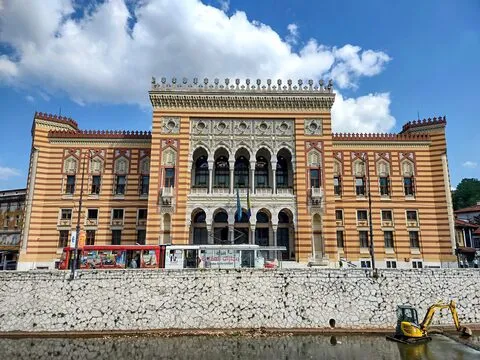
Sarajevo Vijećnica — has five siblings
The Sarajevo Vijećnica is treated as unique, a one-off Pseudo-Moorish city hall built by the Habsburgs to signal welcome to Sarajevo’s Muslim...

Sarajevo has been on UNESCO's Tentative List for 30 years — and still isn't inscribed
The 1997 Bosnian submission of Sarajevo to UNESCO’s Tentative World Heritage List is one of the more misread documents in the city’s...