
Sarajevo Ottoman bridges — four still cross the Miljacka, and one of them is Roman
Sarajevo has four surviving stone bridges that pre-date the Habsburg occupation: the Seher-Ćehaja (1585), the Latin (1798, rebuilt), the Kozija Ćuprija (16th century, upstream), and the Rimski most in Ilidža — which the name calls Roman but which recent scholarship dates to Ottoman rebuilding on Roman foundations. All four were built under the same engineering tradition that produced Mehmed Paša Sokolović's famous bridge over the Drina at Višegrad. A field guide to the four bridges, their dates, and the twentieth-century assassin who stood on one of them.
Sarajevo had at least seven Ottoman stone bridges in its 16th-century prime, when it was one of the largest cities in the Ottoman Balkans. Four survive. Three of them are in central Sarajevo, all four are walkable in a single long afternoon. The bridges that didn’t survive (the Emperor’s Bridge, Careva ćuprija, the Rustem Pasha Bridge, and others) were either swept away by the 1791 flood, demolished during the late-19th-century riverbed regulation under Austria-Hungary, or replaced in the Yugoslav period.
Of the four surviving bridges, three sit on the Miljacka in the central city, and one sits on the Bosna river in Ilidža, twelve kilometres west. The chronological order, with the most reliable construction dates:
- The Roman Bridge (Rimski most) in Ilidža — first half of the 16th century
- Kozija Ćuprija (the Goat Bridge), second half of the 16th century
- Šeher-Ćehaja Bridge, 1585 or 1586
- Latin Bridge (Latinska ćuprija), 1798 reconstruction of an earlier 16th-century crossing
All four are built in the same Ottoman engineering tradition that produced the Stari Most in Mostar (1566), the Mehmed Paša Sokolović Bridge in Višegrad (1577), and the bridge at Konjic (1682). The Sarajevo bridges are smaller than the famous regional examples, but the engineering vocabulary is identical: pointed-cutwater piers, semicircular or low-segmented arches, circular flood-relief openings above the spandrels, local limestone, lime-mortar bedding.
What follows is a guide to the four, in order of construction.
1. The Roman Bridge (Rimski most), Ilidža — early 16th century
The westernmost and probably the oldest of the four. 52 metres long, multi-arched, crossing the Bosna river in Ilidža, twelve kilometres west of central Sarajevo. The name Rimski most (“Roman bridge”) is a misnomer: the bridge is Ottoman, not Roman, but it was built on the route of an older Roman road, and Roman stone from the nearby settlement of Aquae S… was reused in the masonry. The popular name stuck.
The exact builder is contested. Three Ottoman grand viziers of the 16th century are credited in different sources: Rustem Pasha (grand vizier 1544–1553 and 1555–1561), Semiz Ali Pasha (1561–1565), and Gazi Ali Pasha (in Bosnia around the same period). The construction date is generally given as the first half of the 16th century. The Islamic Arts Magazine source notes that the bridge “demonstrates an extraordinary synergy between architecture and natural environment” (a fair description: the bridge sits low to the water in a wide green meadow at the eastern end of the Velika Aleja plane-tree avenue, and the setting itself is one of the more photographed in Bosnia).
The bridge is preserved and walkable. It carries pedestrian traffic only. It is the visual focal point of the walk from Ilidža to the Vrelo Bosne springs and back. The full hidden-gem entry: Rimski most.
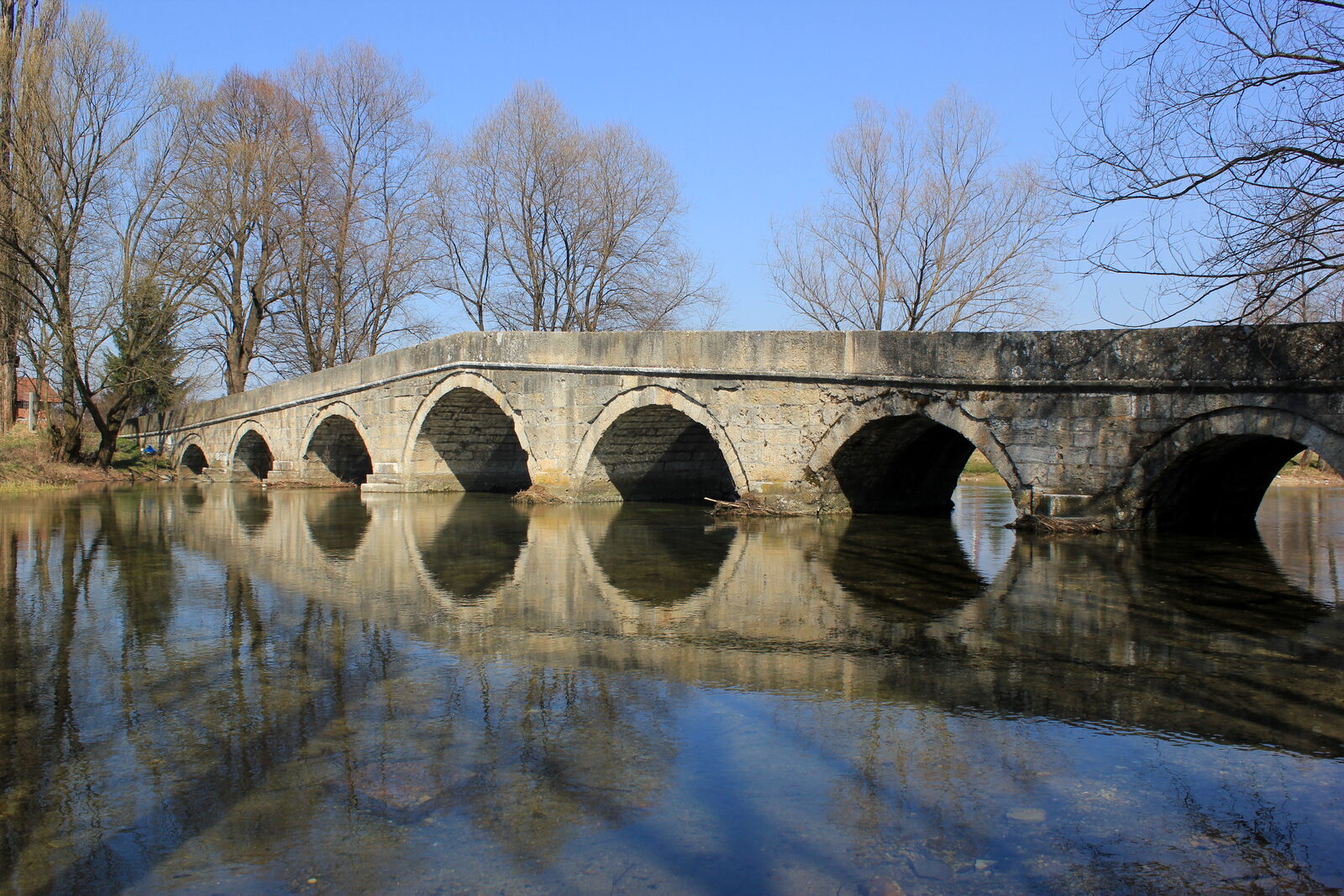

2. Kozija Ćuprija (the Goat Bridge) — second half of the 16th century
A single high stone arch across the Miljacka, about a kilometre east of central Sarajevo on the road that historically ran out to Pale and to Constantinople. 42 metres in length, one large semicircular arch flanked by two distinctive circular openings in the spandrel above the main arch, both structural (they relieve flood pressure) and ornamental (they’re the bridge’s signature visual feature).
The patron is probably Mehmed Paša Sokolović, the grand vizier (1565–1579) who, in the same decades, built the great bridge across the Drina at Višegrad: the bridge that won Ivo Andrić the Nobel Prize. The Sarajevo Kozija Ćuprija is smaller and quieter, but the engineering family is the same.
The name Kozja ćuprija (“Goat Bridge”) is the popular nickname; one tradition has it that the bridge marked the point where shepherds crossed the river with their flocks on the way to the eastern pastures. The bridge is unaltered by modern traffic; it carries pedestrians only. The setting is wooded slopes rising on both sides of the Miljacka, the river running through a shallow gorge: one of the prettiest within walking distance of the city centre. Allow forty minutes from the Sebilj on foot, mostly along the south bank.
The full hidden-gem entry: Kozija Ćuprija.
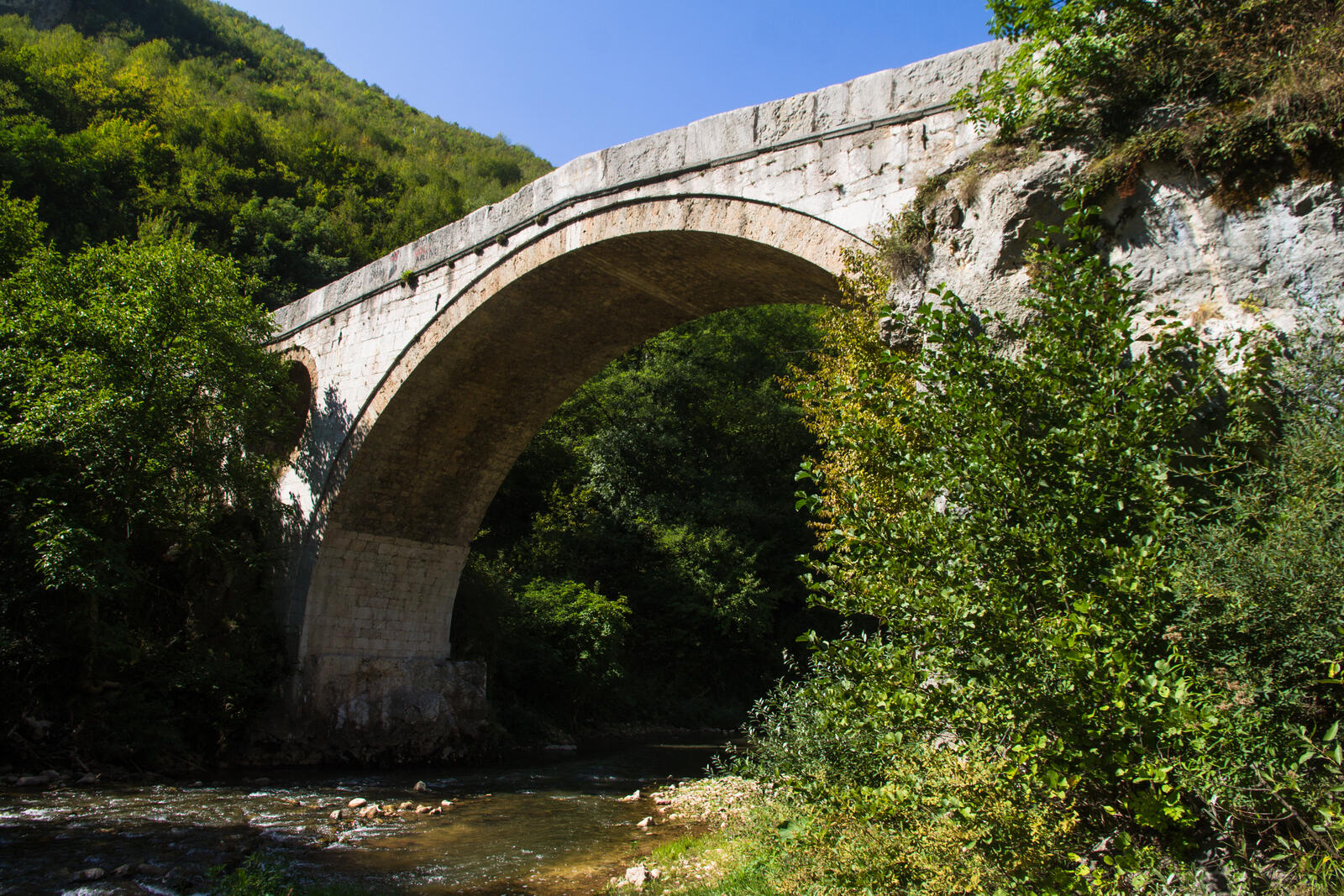

3. Šeher-Ćehaja Bridge — 1585/86
The bridge at the eastern threshold of Baščaršija, where the bazaar grid meets the climb into Vratnik. Built in 1585 or 1586, in the late reign of Sultan Murad III, and named after a šeher-čehaja (the senior municipal officer of the Ottoman city, a kind of governor). The patron’s full identity is uncertain; sources name a Mehmed-ćehaja and a Sinanudin-ćehaja, both serving in the 1580s.
Originally five arches spanning roughly 40 metres. The fifth arch, at the southern end, was buried in the late 19th century, during the Austro-Hungarian regulation of the Miljacka. The bridge as you see it today shows four visible arches and a slight asymmetry where the buried arch used to be. The pier shapes are pointed on the upstream side, squared on the downstream, in the classic Ottoman bridge geometry. Above the arches, in the masonry of the spandrel, the same circular flood-relief openings appear as on Kozija Ćuprija.
The bridge is small, quiet, and still a working commuter crossing. Local foot traffic and the occasional cyclist, no tour groups. The full destination entry: Šeher-Ćehaja Bridge.
4. Latin Bridge (Latinska ćuprija) — 1798 reconstruction
The most famous of the four, and the most photographed, for entirely non-architectural reasons.
The original Ottoman wooden bridge on this site dated to 1514. A stone replacement was built in 1538, the four-arch form that the current bridge inherited. A flood in 1791 damaged it severely; the current stone bridge was rebuilt in 1798, funded by a charitable bequest from a Sarajevo merchant named Abdullah Briga, who left the funds in his vakuf (Islamic charitable endowment) specifically for the bridge.
The bridge is named after the Latin mahala (quarter), the small district on the south bank where the city’s Roman Catholic merchants, mostly from Dubrovnik and the Italian peninsula, settled in the Ottoman period. Latin in Ottoman Sarajevo meant Roman Catholic or Italian, not classical Latin. The neighbourhood is gone; the bridge name survives.
Four visible arches today; the original 1538 version may have had five (the historiography is uncertain). It is the most-photographed Ottoman bridge in Sarajevo because Gavrilo Princip assassinated Archduke Franz Ferdinand at the north foot of the bridge on 28 June 1914. For a hundred years afterwards the bridge was variously renamed “Princip Bridge” (Yugoslav era) and back to “Latin Bridge” (post-1990s). The full destination entry: Latin Bridge, and the museum on the corner: Museum of Sarajevo 1878–1918.
Engineering, in one paragraph
All four bridges share a small set of construction techniques:
- Local limestone quarried within walking distance, set in lime mortar.
- Pointed-cutwater piers on the upstream side, squared on the downstream, to deflect flood water and ice.
- Semicircular or low-segmented arches, the proportions varying with the span.
- Circular flood-relief openings in the spandrel above the arches, structural and ornamental at once.
- Low parapet: Ottoman bridges were built for pedestrians and pack animals, not for modern motor traffic.
The engineering vocabulary travelled from Istanbul down the Bosnian rivers, was implemented by a generation of imperial architects whose names are mostly lost, and produced bridges that mostly outlasted the empire that built them.
The walk, in one afternoon
The three central-city bridges can be done as a single walk; the Roman Bridge in Ilidža is a separate half-day. The recommended sequence for the three:
- Latin Bridge (5 minutes) — start at the Sebilj, walk five minutes south to the river. Stand on the bridge; cross to the south bank.
- Šeher-Ćehaja Bridge (15 minutes east along south bank), walk east on the south bank of the Miljacka, past the Inat Kuća, to the bridge at the foot of the Vratnik climb. Cross to the north bank.
- Kozija Ćuprija (25 minutes east along north bank, through Bentbaša), continue east, leaving the city’s central grid, into the small gorge where the Miljacka narrows. The setting changes from urban to almost rural. The bridge appears around a bend.
Total: about 75 minutes of walking, plus stops. Two hours if you take your time on each bridge.
For the Roman Bridge in Ilidža, plan a separate half-day. Take tram 3 to the end of the line (Ilidža), walk the Velika Aleja, the kilometre-long plane-tree avenue, to the Vrelo Bosne springs at the western end, and pick up the Roman Bridge near the start of the avenue. The full destination: Vrelo Bosne.
What was lost
Of the seven or more Ottoman stone bridges that the city held in its 16th-century prime, the four above are what remain. The losses, with what we know about them:
- Careva ćuprija (Emperor’s Bridge): built in 1510, named for the early Ottoman sultans whose images decorated the original stonework. Destroyed twice by floods (1791 most catastrophically), reconstructed in iron during the Habsburg period, and finally replaced with the current modern bridge that carries the name.
- The Rustem Pasha Bridge: date uncertain, 16th century, lost in the Austro-Hungarian riverbed regulation.
- Additional smaller crossings that linked the south bank Latin and Catholic quarters to the city’s mosque-dense north bank.
The 1791 flood was the single most catastrophic event in the bridges’ history. It damaged or destroyed almost every Ottoman stone bridge in central Sarajevo, including the Latin Bridge, which had to be reconstructed in 1798. The Šeher-Ćehaja, Kozija Ćuprija, and Roman Bridge survived 1791 with damage but stood.
The 1992–1995 siege damaged the central bridges with mortar and small-arms fire but did not destroy any of them. The structural integrity of all four surviving bridges has been intact since the 18th century. Vala, the Ottoman engineers built for floods, sieges, and 21st-century traffic. Not bad for the 1530s.
Further reading
- Latin Bridge: the 1798 reconstruction, with the assassination corner.
- Šeher-Ćehaja Bridge: 1585/86, the eastern threshold of Baščaršija.
- Kozija Ćuprija: late 16th century, probably Mehmed Paša Sokolović.
- Rimski most: early 16th century, in Ilidža.
- Two empires that built Sarajevo: the wider architecture story.
Sources & further reading
Keep reading
More from the guide.
Sarajevo Vijećnica — has five siblings
The Sarajevo Vijećnica is treated as unique, a one-off Pseudo-Moorish city hall built by the Habsburgs to signal welcome to Sarajevo’s Muslim...
Sarajevo — the Vijećnica reopened on 17 July 2014, twenty-two years after Serb shells burned it, and the new façade is a very careful copy
The Vijećnica opened in 1896 as the Habsburg-era City Hall of Sarajevo. From 1949 it held the National and University Library. On...

Sarajevo 1957 — the year they published the big book and burned the big han
1957 is remembered in Sarajevo as the year of the modernist manifesto — the Grabrijan-Neidhardt book Le Corbusier prefaced, published in Ljubljana...