Sarajevo Haggadah — a book that has outlived five empires
A 14th-century Sephardic Passover manuscript made in Northern Spain, carried east after the Alhambra Decree, in Sarajevo since the late Ottoman period — and twice rescued from destruction by museum staff in living memory.


The most important object in Sarajevo is a book that almost did not survive the 20th century.
The Sarajevo Haggadah is a Sephardic Hebrew illuminated manuscript made in Northern Spain in the second half of the 14th century, around 1350, in the kingdom of Aragon. The conventional sub-attribution, supported by two heraldic crests in the manuscript itself, is Barcelona, where it was probably made as a wedding gift for two Jewish families: the Shoshan and Elzar households, whose coats of arms appear in the codex next to the arms of the city of Barcelona.
A Haggadah is the small book read aloud at the Passover Seder, the family meal that opens the Jewish festival of Pesach. The text is fixed (the questions of the youngest child, the narrative of the Exodus from Egypt, the songs at the end of the meal), and Jewish communities across the world have produced their own copies for the same evening for more than a thousand years. What makes this one stand apart is the survival: of the codex itself, of the script and decoration, and, twice in living memory, of the manuscript as a physical object during European wars that destroyed almost everything around it.
The manuscript has lived in Sarajevo since at least the late Ottoman period. The National Museum of Bosnia and Herzegovina (Zemaljski muzej) acquired it in 1894, the year of the museum’s founding under Austria-Hungary, and has held it without interruption ever since. UNESCO inscribed it on the Memory of the World International Register in 2017.
The codex itself
The Sarajevo Haggadah is a small book (A5-ish, on bleached calfskin vellum) written in square Hebrew letters in the Sephardic style typical of medieval Spain, fully punctuated and ruled. It runs to about a hundred surviving folios, structured in two parts.
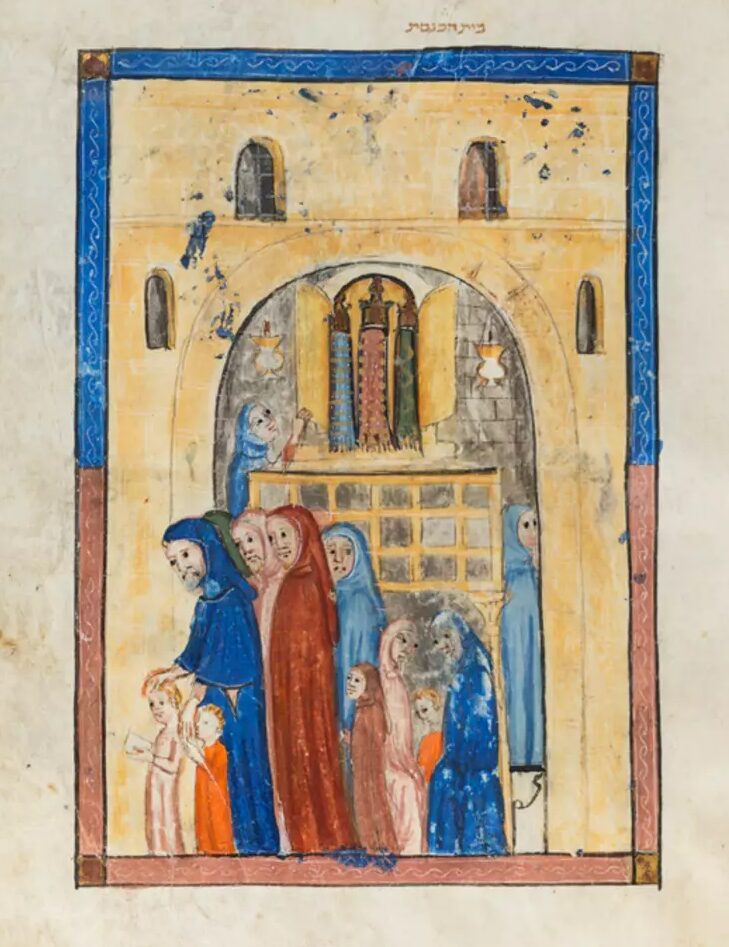
The first part is illuminated: 34 folios carrying 69 miniatures on their inner faces, with the outer faces left blank. The miniatures run through the Pentateuch: the seven days of Creation, Cain and Abel, the story of Lot, the binding of Isaac, the Exodus from Egypt, the parting of the Red Sea, the Blessing of Moses. The Joseph cycle is given particular emphasis. The figures are painted in clear, intense pigments with gold leaf still bright; the architectural settings are recognisably Catalan Gothic.
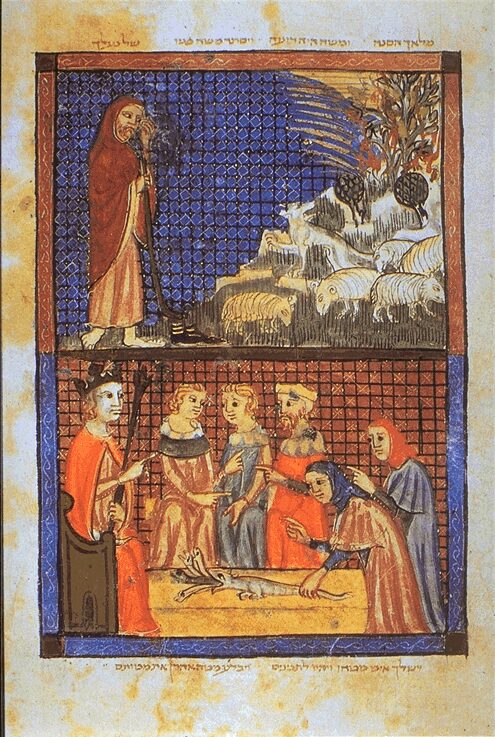

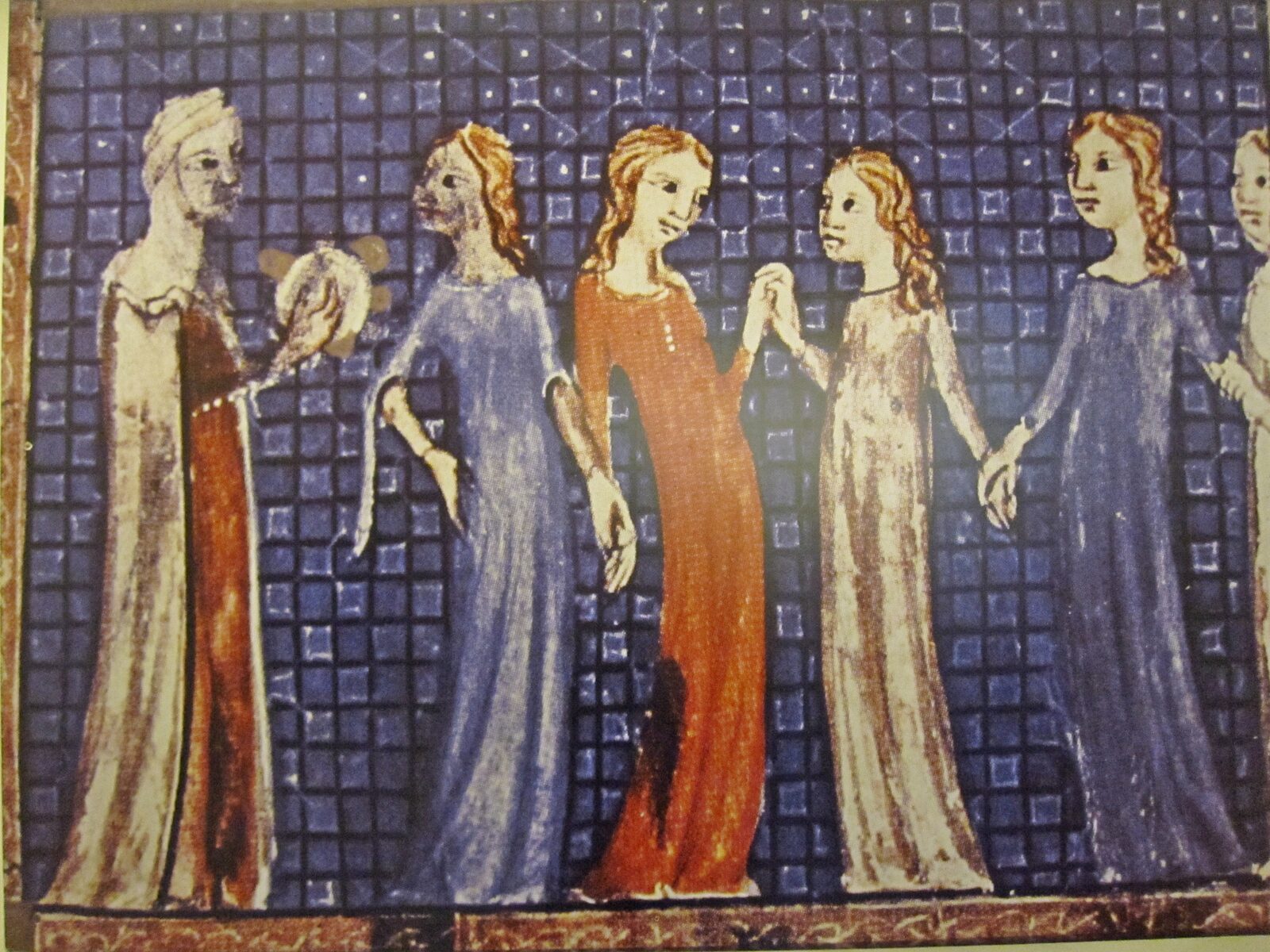
The second part is the text section: 50 folios containing the Passover liturgy itself, plus a selection of lyrical poems from the Golden Age of Jewish-Arabic culture in al-Andalus (10th–13th centuries), and instructions for the Ma’ariv, the Jewish evening prayer, on the eve of Passover. The choice of poems is itself an editorial statement: at the time the codex was made, the Andalusi tradition of bilingual Jewish-Arabic poetry was barely a century gone, and the families who commissioned the Haggadah were carrying that tradition forward into a Christian kingdom that was, increasingly, less hospitable to them.
One detail gives the manuscript away as a working family object, not a display piece for a library: the parchment carries old wine stains. The book was read at Passover Seders, year after year, in someone’s home. The wine was passed around, and some of it spilled.
Out of Spain
In 1492, the Catholic Monarchs Ferdinand and Isabella issued the Alhambra Decree, expelling the Jewish population of the Iberian Peninsula. The Sephardim (Sefarad is the Hebrew name for Spain) left in waves over the following decade, carrying what they could. The Sarajevo Haggadah went with them.
The first documentary trace of the codex after the expulsion appears in 16th-century Italy, where marginal notes in the manuscript record changes of ownership. From Italy, the trail goes quiet for a long stretch. By the mid-19th century the manuscript was in Sarajevo, in the possession of a Sephardic family named Koen (sometimes written Cohen).
In 1894, the Koen family sold the manuscript to the newly founded Zemaljski muzej, the National Museum of Bosnia and Herzegovina, which had opened its doors six years earlier. The acquisition record names the seller as Joseph Koen. The sum involved is not, as far as I can find, documented in any source available outside the museum’s own archive.
The manuscript has lived in the museum ever since. The fact of where it has lived has changed three times in the 20th century, twice under threat.

The first rescue: Korkut, 1942
In April 1941, the Kingdom of Yugoslavia collapsed under the German invasion. Sarajevo came under the Independent State of Croatia (NDH), the Ustasha puppet regime, and within months its Jewish population was being rounded up for deportation to concentration camps. The Nazi Einsatzstab Reichsleiter Rosenberg, the Reichsleiter Rosenberg Task Force, made it part of its work to identify and confiscate Jewish books and ritual objects across occupied Europe.
In 1942, a German officer (variously identified in different accounts; the name is not consistently recorded) arrived at the National Museum and asked for the Sarajevo Haggadah by name.
The chief librarian of the museum at the time was Derviš Korkut, a Muslim scholar in his late forties, an expert in Islamic manuscripts and one of the museum’s senior staff. According to the museum’s own records and to Yad Vashem’s later citation, Korkut understood what the request meant. He told the officer the manuscript had already been collected by another German official, and that he did not know where it had gone. While the officer was in his office, Korkut had taken the manuscript out of its case and concealed it under his coat.
He carried it home that evening, and shortly afterwards it was taken to a mosque on the slopes of Bjelašnica mountain, south-west of Sarajevo, where it was kept, with the cooperation of the village’s imam and Korkut’s friends in the local community, for the duration of the German and Ustasha occupation. It is not certain exactly where on Bjelašnica it was kept; the most widely cited account is that it was sheltered in the mosque’s collection of religious books, where a single additional codex would not have attracted attention.
After the war the Haggadah returned to the National Museum. Korkut and his wife Servet were later credited with rescuing other Jewish lives during the occupation. A young Jewish woman, Mira Papo, was sheltered in their home for months in 1942. Korkut was recognised by Yad Vashem as Righteous Among the Nations in 1994.
The second rescue: Imamović and Čebo, 1992
In April 1992, the Siege of Sarajevo began. The National Museum sat near the front line on Zmaja od Bosne (the road between the city and the airport) and was repeatedly shelled. By the second year of the siege the museum’s basement was flooding, the building was unheated, and rumours had begun to circulate, both in Sarajevo and in the foreign press, that the Sarajevo Haggadah had been sold abroad to fund the city’s arms imports.
The Haggadah had not been sold. Early in the siege, Professor Enver Imamović, an archaeologist on the museum’s staff, and Police Inspector Fahrudin Čebo had worked together to move the manuscript out of its damaged display case and transported it across the besieged city to the underground vault of the National Bank of Bosnia and Herzegovina (then the Central Bank). The vault was a hardened structure, climate-controlled even during the siege, and inaccessible to anyone outside the small group of officials who knew the manuscript was there.
The Haggadah stayed in the bank vault for the duration of the war.
To counter the rumours of its sale, the President of the Republic of Bosnia and Herzegovina, Alija Izetbegović, took the manuscript to the community Passover Seder in Sarajevo in April 1995 (the city was still under siege) and presented it publicly to the assembled congregation. There are no published photographs of the moment that I am aware of, but it was widely reported in the local press and in the foreign correspondents’ coverage of the siege.
After the war ended in 1995, the Haggadah returned, again, to the National Museum.


Recognition arrives
Formal recognition arrived slowly, in three stages, over the fifteen years after the war.
In December 2002, with assistance from the United Nations (specifically from Jacques Paul Klein, then Special Representative of the UN Secretary-General to Bosnia and Herzegovina, working with Dr Jakob Finci, head of the Sarajevo Jewish Community), the museum opened a dedicated, climate-controlled vault room for the Haggadah on the museum’s lower floor. The room was designed to display the manuscript permanently and safely. To make a point about the city, the room was also dedicated to displaying, alongside the Haggadah, a Catholic missal, an Orthodox Gospel book, and an Islamic Qur’an manuscript from the museum’s collection, four religious traditions, four manuscript cultures, one room.
In January 2003, the Commission to Preserve National Monuments of Bosnia and Herzegovina (KONS) designated the Sarajevo Haggadah a movable national monument, the highest level of cultural protection available under domestic law.
In 2012 the National Museum closed, for funding reasons; it reopened in 2015. In 2018 the vault room was reopened after a renovation funded by France.
In 2017, fifteen years after the vault opened, UNESCO inscribed the Sarajevo Haggadah on the Memory of the World International Register. The inscription document was prepared in 2016 and accepted in 2017. Audrey Azoulay, Director-General of UNESCO at the time, described the manuscript in the press materials as “a silent witness to history and survivor of the many turbulent moments in the story of the region, Europe and the world”.

Three Lives of the Sarajevo Haggadah
To mark the museum’s 131st anniversary on 1 February 2019, the museum opened a permanent exhibition titled Three Lives of the Sarajevo Haggadah, curated by Aleksandra Bunčić and Mirsad Sijarić of the National Museum. The exhibition follows the manuscript through its three historical lives: the Aragon life of the 14th-century commissioning families, the Ottoman and Habsburg life of the codex’s first centuries in the museum, and the contemporary life of the manuscript as a designated heritage object. The museum also released, that night, a new printed reprint edition of the Haggadah. The exhibition was supported by UNESCO and the United States Embassy in Bosnia and Herzegovina.
The exhibition is still open. The Haggadah is in its case in the next room.
How to see it
The Sarajevo Haggadah lives at the National Museum of Bosnia and Herzegovina, on Zmaja od Bosne 3, in the Marijin Dvor neighbourhood about ten minutes’ walk west of the Eternal Flame. Tram lines 1, 3 and 5 stop directly in front. The museum’s standard opening hours are roughly 10:00–19:00 Tuesday to Friday and 10:00–14:00 weekends; verify on the museum’s site before going, as the schedule changes seasonally.
A few practical notes:
- The Haggadah is displayed in a controlled-light vault room on the museum’s lower floor. The vault is open at specific hours within the museum’s day, not continuously. Viewing is typically a brief window. Ask at the front desk on arrival.
- Photography in the vault is not permitted. Photographs of the manuscript circulate because the museum has issued reproductions to scholarly publications and to UNESCO; the originals on display are not photographed by visitors.
- The Three Lives exhibition runs through several rooms on the same floor; it gives the historical context you need to read the codex itself. Allocate at least an hour for the museum.
- Adult ticket is currently 5 BAM (~€2.50). Children under 7 free. Verify on arrival.
- The wider museum holds a substantial archaeological collection, a botanical garden, and an ethnological wing. A morning is reasonable for the lot; an afternoon for the Haggadah specifically.
The room around the manuscript is dim, the case is reinforced, and the codex itself is opened to a different folio every quarter so the binding doesn’t develop a habitual fold. The miniatures shift, slowly, year by year. The same wine stains that the unknown Sephardic families left on the parchment in 14th-century Aragon are still there. The book has outlived five empires and two rescuers. Vala, that is enough.
Further reading
- Sarajevo’s UNESCO list: four entries, none of them a building: the wider context of UNESCO recognition for Sarajevo.
- Old Jewish Cemetery: the hillside where Sarajevo’s Sephardic community has buried its dead since around 1630.
- The Sarajevo Roses: the city’s other resin-coloured artefact of the 1992–95 siege.
Sources & further reading
Keep reading
More from the guide.

Sarajevo's Svrzo House has a country cousin — the čardaklija, catalogued as proto-modern bioclimatic architecture
In the villages of the mountain regions around Sarajevo, Vareš, Ilijaš, Olovo, Konjic, Gornji Vakuf, the Zvijezda and Konjuh chains, a specific...

Sarajevo has five Vienna twins
The Habsburg architects who rebuilt Sarajevo between 1878 and 1918 mostly trained in Vienna. They knew the same textbooks, drew from the...

Sarajevo — one Ottoman governor built the religious core in 1531
Gazi Husrev-beg was Ottoman governor of Bosnia in the 1520s and 1530s. Between 1531 and 1541 he founded, endowed, and paid for...