Sarajevo Kállay era — twenty-one years that built the Sarajevo you walk, run from a desk in Vienna
Between 1882 and his death on 13 July 1903, the Hungarian aristocrat Béni Kállay ran Bosnia-Herzegovina from Vienna as Common Minister of Finance. He rarely visited Sarajevo. He also, in those twenty-one years, commissioned essentially the entire Habsburg architectural fabric of the city and built the political scaffolding of an invented Bosnian nationality — bošnjaštvo — meant to prevent Serb and Croat national movements from taking hold. The nationality project failed. The buildings did not.
Béni Kállay von Nagy-Kálló was a Hungarian aristocrat, born 22 December 1839 in Buda to a family of the old Reformed gentry. He was educated in Pest and, at twenty-seven, translated John Stuart Mill’s On Liberty into Hungarian (1867), a detail that says most of what needs to be said about how he thought of the enterprise of governing subject peoples. He served as Consul General in Belgrade between 1868 and 1875, learned Serbo-Croatian in office, and wrote a well-regarded Geschichte der Serben (History of the Serbs) in Hungarian in 1877, published in German translation in Vienna in 1878. In June 1882, aged forty-two, he was appointed Common Minister of Finance of Austria-Hungary. He held the position for twenty-one years, until his death on 13 July 1903. It was the longest ministerial tenure of the late Habsburg monarchy.
The Common Ministry of Finance was, on paper, one of only three joint ministries that both Austria and Hungary shared under the 1867 Compromise. In practice, one of Kállay’s duties was running the province of Bosnia-Herzegovina, which the Berlin Treaty of 1878 had assigned to the Habsburg monarchy to occupy but which, awkwardly, neither Austria nor Hungary formally claimed. The Common Ministry of Finance in Vienna administered Bosnia. The Common Minister of Finance was, effectively, the governor of Bosnia. Kállay held that role for twenty-one years.
He rarely came to see it. Kállay ran Bosnia from a desk on the Ballhausplatz in Vienna. Kadkani-Schmitt’s 2017 dissertation notes only a handful of documented visits to Sarajevo across the whole tenure, mostly for ceremonial openings. He read reports, signed budgets, approved façades, and dictated policy through the Landesregierung (the provincial civil administration in Sarajevo, headed successively by three governors under his instruction). Everything Habsburg-built in Sarajevo between the 1889 Sacred Heart Cathedral and the 1913 National Museum passed, directly or indirectly, across his Vienna desk. The Sarajevo you walk today was ordered by post.
The two Sarajevos Kállay inherited in 1882
When Kállay took the post, Sarajevo had been under Habsburg military rule for four years. The August 1878 street fighting and the subsequent quartering of Austro-Hungarian troops in Ottoman-era commercial buildings had physically damaged the city. The Ottoman administrative apparatus had collapsed but nothing working had replaced it. The population, around 21,000 in 1879, was majority Muslim (per the 1879 census: roughly 63 percent Muslim, 15 percent Serbian Orthodox, 9 percent Jewish, and about 3 percent Catholic; see our seven-censuses story).
Physically, Kállay inherited two overlapping Sarajevos. The Ottoman city, Baščaršija, the mahalas of Bistrik, Vratnik, Kovači, and Alifakovac, the several dozen Ottoman mosques, sat on the eastern half of the valley, largely intact. The early Habsburg military encampment, barracks, provisional administrative buildings, warehouses, sat on the western half, close to what would become Marijin Dvor. The two had almost no shared urban logic.
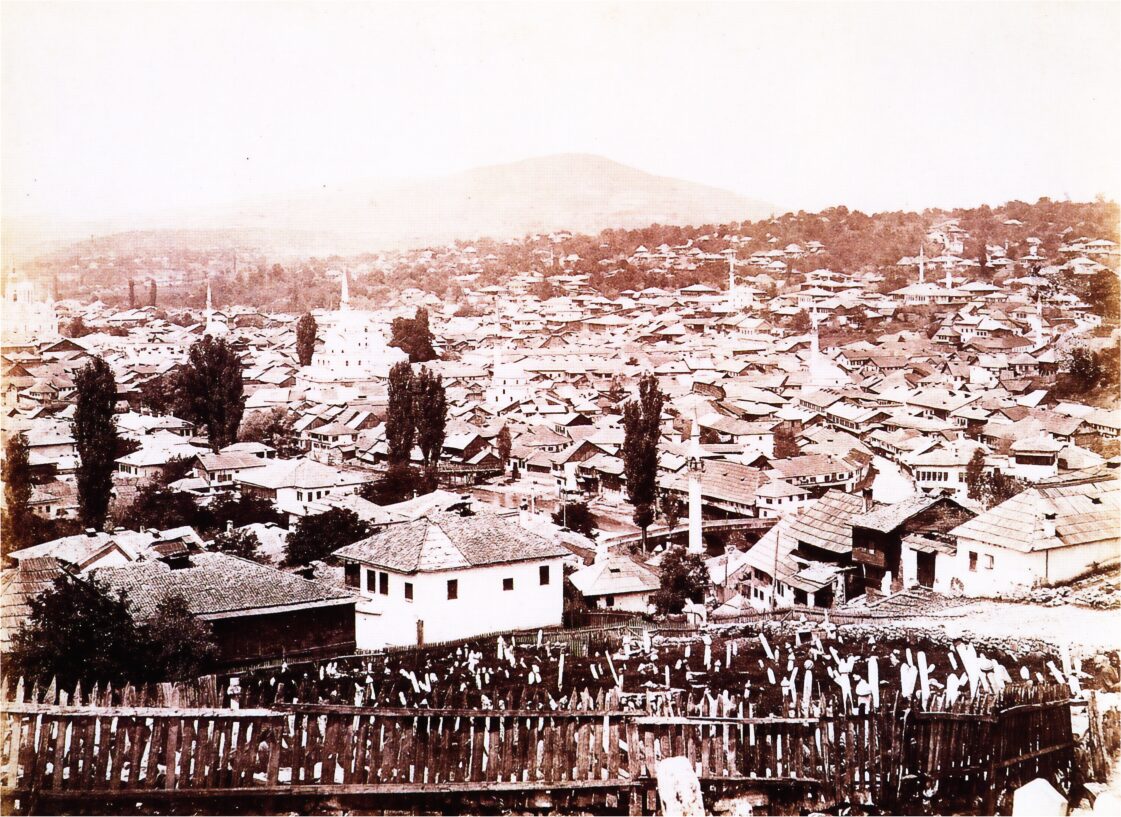

Kállay’s twenty-one-year plan was, in the broadest sense, to build a Habsburg civic core between the two and to link them into a single legible city.

What the plan was, in his own words
Kállay wrote and published throughout his tenure, more articulate about his own project than most Habsburg administrators. The recent scholarly treatment of his ideology is Zahra Kadkani-Schmitt’s 2017 UC Berkeley PhD, which reads Kállay’s speeches and administrative memoranda closely. Her frame: Kállay’s Bosnia policy had three pillars.
Cultural mission (Kulturmission). Bosnia would be brought into “European culture” through civilising efforts, not violent means (the phrase Kállay borrowed from Schweiger-Lerchenfeld’s 1878 book; see our previous story). Concretely: schools, roads, railways, hospitals, and, most visibly, public architecture. Kállay’s Bosnia budget consistently allocated a much higher share to buildings than the equivalent civil administration in Austrian Galicia or Habsburg Bukovina. Sarajevo got most of it.
Bosniakism (Bošnjaštvo). Kállay’s most contested policy. He argued that Bosnia should be governed as a supra-national territory whose residents (Muslim, Orthodox, Catholic, Jewish) would identify not as Serbs or Croats or Ottomans but as Bosnians. A deliberate attempt to prevent the emergence of Serbian and Croatian nationalisms in the province. It failed politically (see Robin Okey’s 2007 book Taming Balkan Nationalism for the fuller account) but left concrete traces in Kállay’s institutional design.
The institutional tools he built for it, in order:
- 1882 — the rijaset. In October 1882 Kállay’s administration installed Mustafa Hilmi Hadžiomerović as the first reisu-l-ulema, the head of an autonomous Bosnian Muslim religious authority based in Sarajevo, formally independent of the Ottoman şeyhülislâm in Istanbul. The office has continued, uninterrupted, to the present day.
- 1884 — the Bosanska početnica. A primary-school reader written in the “Bosnian language” and printed at the government press, Zemaljska štamparija, for use across the province’s newly-standardised schools.
- 1888 — the Zemaljski muzej (National Museum), founded to hold a specifically Bosnian archaeological, ethnographic, and natural-history collection, not Serbian, not Croatian, not Ottoman.
- 1890 — Frano Vuletić’s Gramatika bosanskoga jezika, the first codified grammar of the “Bosnian language” as Kállay wished it to be taught in schools. Vuletić was a Sarajevo philologist working directly to the administration’s brief.
- 1891 — Bošnjak, a Sarajevo weekly newspaper edited by the poet Mehmed-beg Kapetanović Ljubušak, subsidised by Kállay’s ministry and pitched at Bosnian Muslim readers as the vehicle of the supra-national Bosnian identity. It ran until the First World War.
- The coat of arms and flag. A specifically Bosnian heraldic device, the crossed golden arm holding a scimitar on a blue-and-yellow field, was reintroduced in 1888 and became the province’s official emblem until 1918. It reappeared as the Republic’s coat of arms between 1992 and 1998, and elements of it survive in the current Federation crest.
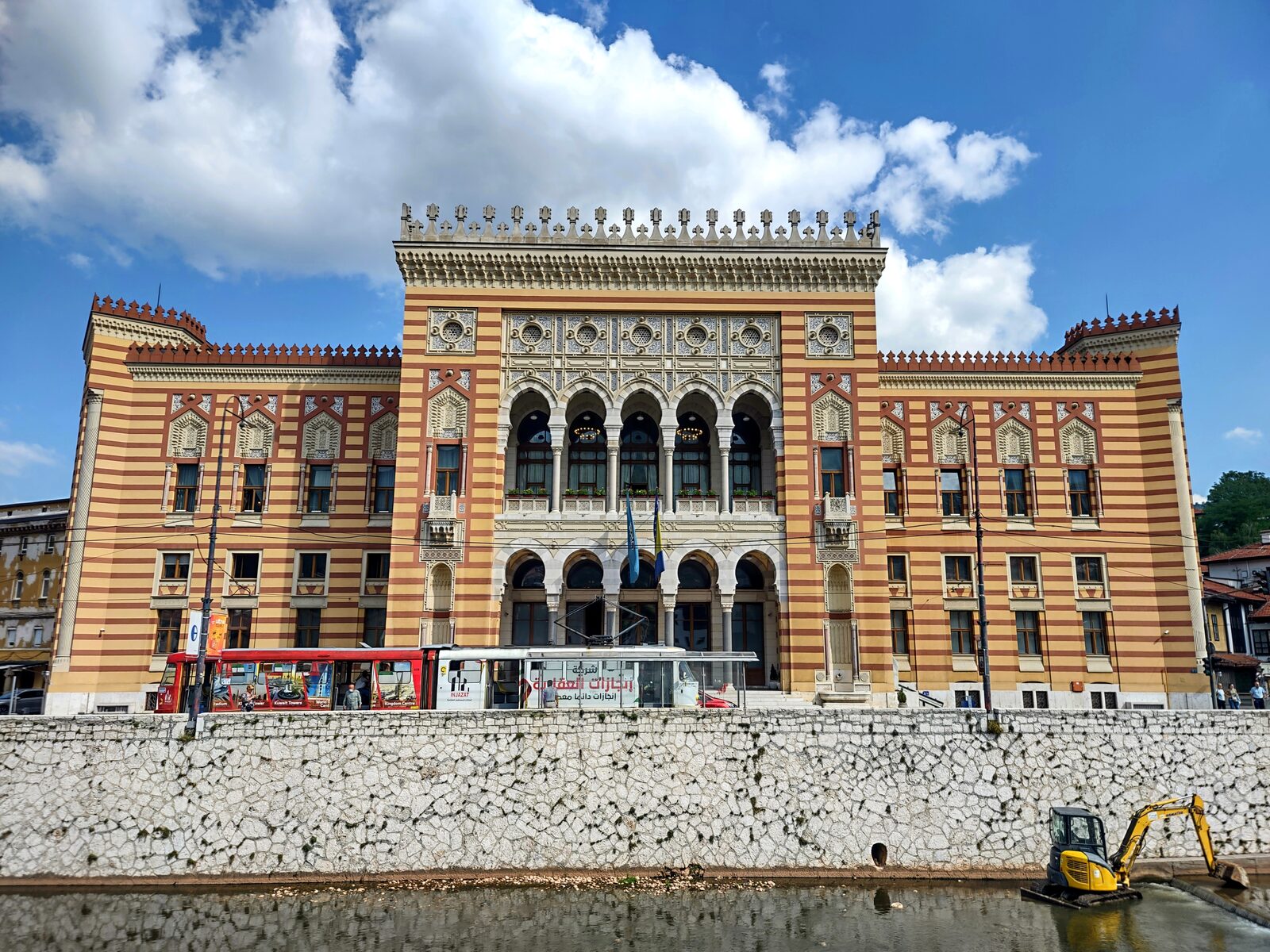
- The Vijećnica, built 1892–96 in a Pseudo-Moorish style, meant to read as neither Christian nor Muslim exclusively, the civic-Bosnian style visible on foot.
Isolation from Belgrade and Istanbul. Kállay’s tenure at the Belgrade consulate in the 1870s had convinced him that pan-South-Slavic sentiment was the single biggest threat to Habsburg rule in Bosnia. His administration systematically restricted contact between Bosnian Serbs and Serbia, censored Belgrade publications, replaced Serbian-language schools with Habsburg curricula, and monitored Sarajevo’s Orthodox community through informers. In the Muslim community he pursued the parallel logic already sketched above: the rijaset answered to Sarajevo, not to Istanbul.
The buildings
The Sarajevo you walk in today is, to a first approximation, Kállay’s building programme. What went up on his watch, chronologically:
- 1889: Sacred Heart Cathedral, Neo-Gothic, arch. Josip Vancaš. Kállay’s opening commission. Stands, restored after 1992–95 damage.
- 1891: Sarajevo Officers’ Club (Oficirski dom), Neo-Renaissance, arch. Karel Pařík. Stands.
- 1893: Marienhof residential palace on Ferhadija, Neo-Baroque, arch. Josip Vancaš (see Sarajevo’s Vienna twins). Stands; ground-floor use has changed several times.
- 1894–96: Vijećnica, Pseudo-Moorish, initial design Alexander Wittek, completed by Ćiril Iveković with Pařík supervision. The showpiece. Burned 27 August 1992; fully restored, reopened 17 July 2014.
- 1902: Ashkenazi Synagogue on Obala Kulina bana, Neo-Moorish, Karel Pařík. The Sephardic and Ashkenazi communities were treated as institutionally distinct. Stands; the only synagogue in Sarajevo still holding services.
- 1903: Kállay dies on 13 July, on the Ballhausplatz. The Post Office (Vancaš) and the National Museum (Pařík) are already in design.
- 1907: the Bau-Ordnung is under review by his successor’s administration; the yellow-plaster Historicist façade is by then established as the de facto standard for Sarajevo civic streets.
- 1913: Main Post Office (Vancaš), Secessionist. National Museum four-pavilion complex (Pařík), Neo-Renaissance. Both completed a decade after Kállay’s death but designed under his budget. Both stand today.
Behind the individual buildings sat the Bau-Ordnung, the ordinance first codified in 1880 and repeatedly extended through Kállay’s tenure. It dictated building heights, materials, roof pitches, and façade specifications for the entire Habsburg-planned central grid, Kállay’s administrative machinery for producing a consistent street elevation. The Bau-Ordnung is the reason Ferhadija, Sarači, Zelenih Beretki, and Titova have the yellow-plaster Historicist look they still have. Individual buildings are by individual architects. The consistency across the four streets is Kállay’s Bau-Ordnung.
Building survivorship, at a glance. Of the twelve Kállay-era commissions named on this page, eleven still stand, some in their original state, some heavily restored after 1992–95. Only the interior of the Vijećnica was fully lost and rebuilt. The Ashkenazi Synagogue, the Sacred Heart Cathedral, and the Post Office all took shell damage during the siege but structurally survived. Walk the axis and you are walking a building programme that has weathered two world wars, a monarchy collapse, four states, and a modern siege, with a 92 percent physical-survival rate. That is unusually high for a Central European civic core.
Kállay’s failures
Kállay did not achieve Bosniakism. When he died in 1903, most Bosnian Serbs already identified as Serbs, most Bosnian Croats as Croats, and Bosnian Muslim political life was actively resisting the Sarajevo rijaset’s subordination to Vienna. The 1908 annexation crisis, which formally incorporated Bosnia into Austria-Hungary five years after Kállay’s death, was in part a response to the failure of the supra-national identity project. The 1914 assassination of Franz Ferdinand at the Latin Bridge by a young Bosnian Serb was, in the longer historical arc, evidence of exactly the failure Kállay had spent twenty-one years trying to prevent.
Kállay also did not reconcile with Bosnia’s Muslim majority. His institutional reforms were competent but paternalistic. The Muslim community’s autonomous religious authority shrank progressively. Muslim landholders saw their traditional prerogatives circumscribed. Emigration to the Ottoman Empire continued through his tenure and beyond. Kadkani-Schmitt argues that Kállay’s civilising mission was, from the perspective of the population it was aimed at, essentially the same as the harder colonial administrations elsewhere in Europe. It just used gentler language.
Kállay died in Vienna on 13 July 1903, still in office, aged 63. He lies in the family plot in Hungary, not in the city he built. His successor as Common Minister of Finance, István Burián von Rajecz, continued the Bosnian building programme for another nine years but without the same coherent theoretical frame. Burián was administrator to Kállay’s ideologue. The Bosniakism project as a supra-national identity was abandoned in stages after 1903; the 1908 annexation crisis buried it as policy. The buildings continued to go up.
What he did leave
Sarajevo. Physically, unambiguously. The Habsburg quarter of Sarajevo is the largest concentration of coherently-planned late-Historicist and Secessionist Central-European architecture south of Vienna, sitting on top of a still-intact Ottoman core, ten minutes’ walk from Marijin Dvor to Baščaršija. That layered arrangement, Ottoman east, Habsburg west, both walkable in a single afternoon, is unique to Sarajevo among European capital-adjacent cities. Prague has Habsburg buildings but not an Ottoman quarter. Istanbul has Ottoman buildings but not a coherent Habsburg civic centre. Sarajevo has both because Kállay chose to build both, side by side, as part of the same political programme.
He also left the National Museum, an institution that, whatever its 1888 political motivation, is now the working archive of Bosnian archaeology, ethnography, and natural history. If you want to see the Sarajevo Haggadah, or the Butmir Neolithic pottery, or Guest Milutin’s stećak, you visit the museum Kállay commissioned. The politics of its founding has been argued about for a century. The collection is real.
Where to walk it
I have walked this route with my wife the way most Sarajevans walk it, slowly, with two coffee stops and a small argument about which style is worse, Neo-Baroque or Historicism (she thinks Baroque). Below is the route, west-to-east, roughly 900 metres of Habsburg civic axis and about 20 minutes on foot without stops, or a comfortable three hours with stops for coffee and photographs. No stairs. The gradient is almost flat.
Start: Sacred Heart Cathedral, Trg fra Grge Martića 2. Tram 1, 2, 3, 4 or 5 to Katedrala, the stop is on the axis; the fare is 2 KM cash from the driver (he does not always give change from a 20). Look at the west façade first. Vancaš borrowed the Notre-Dame-de-Dijon rose-window design and shrank it to fit; the shrink shows in the proportions. Then walk east.
- Ferhadija at Marienhof (1893). Vancaš, Neo-Baroque. The residential palace runs along the north side of the street for roughly 60 metres. Ground floor is now cafés and a phone-repair shop. The stucco garlands on the upper storeys are the tell.
- Zelenih Beretki turns off south. Look right down the street: the coherence Kállay was after — same eaves-line, same window rhythm, same yellow-plaster tone — is legible in one glance.
- Ashkenazi Synagogue at Obala Kulina bana. Pařík, Neo-Moorish, 1902. Cross the Miljacka once at the small footbridge for the best long view of the north façade; then re-cross and keep going east.
- Sarači takes over from Ferhadija around the Vječna vatra. This is where the Habsburg grid tightens into the Ottoman bazaar. Sarači 8 is the Gazi Husrev-beg Mosque courtyard, the pre-Kállay Sarajevo, three minutes’ walk from what he built.
- End: Vijećnica (1894–96). Pařík–Iveković–Wittek. Pseudo-Moorish. You have just walked the walkable version of Kállay’s twenty-one years.
Off the axis but still walkable in the same afternoon:
- The Main Post Office on Obala Kulina bana (1913). Vancaš. Secessionist. Three minutes west of the cathedral along the river. Still a working post office; buy a stamp if you want to say you posted one from the room Vancaš designed.
- The National Museum on Zmaja od Bosne (1913). Pařík. Neo-Renaissance. Fifteen minutes’ walk west of the cathedral, or one tram stop.
- The Presidency of Bosnia and Herzegovina on Titova (formerly Marijin Dvor). Pařík. Working government building; photograph the exterior only.
Coffee stops. I start at Kod Muje on Ferhadija (Bosnian coffee, quiet in the mornings, 2 KM) and end at Čajdžinica Džirlo in Baščaršija (linden tea, 3 KM). If you can only pick one, pick Džirlo: it faces east into the bazaar, which is the Ottoman city Kállay preserved by choosing not to demolish.
Take Kadkani-Schmitt or Kállay’s own speeches, if you can find them, and read one paragraph at each building. The intended civic effect is legible on foot. Kállay never walked this route himself. He signed the plans that made it possible. That is the argument of this piece.
Sources
- Zahra Kadkani-Schmitt, Framing Bosnia: The Politics of Architecture and City Building in the Austro-Hungarian Administration of Bosnia and Hercegovina, 1878–1903, PhD dissertation, UC Berkeley, 2017. eScholarship.
- Robin Okey, Taming Balkan Nationalism: The Habsburg Civilising Mission in Bosnia, 1878–1914 (Oxford: Oxford University Press, 2007). The book-length treatment of Kállay’s programme and its long-run consequences.
- Béni Kállay, Geschichte der Serben (Wien, 1878). Kállay’s own historical study, written before he took the Bosnia portfolio.
- Robert Donia, Islam Under the Double Eagle: The Muslims of Bosnia and Hercegovina, 1878–1914 (New York: Columbia University Press, 1981).
- Boris Trapara, From Vienna to Sarajevo, role models and replicas in the architecture of Austro-Hungarian period, joint PhD, INALCO Paris and IBU Sarajevo, 2019. HAL.
- Peter Sugar, The Industrialization of Bosnia-Hercegovina, 1878–1918 (University of Washington Press, 1963). The economic-history complement.
- Ibrahim Krzović, Arhitektura Bosne i Hercegovine 1878–1918 (Sarajevo: Umjetnička galerija BiH, 1987). The Bosnian-language reference on the wider period.
Sources & further reading
- Zahra Kadkani-Schmitt, 'Framing Bosnia: The Politics of Architecture and City Building in the Austro-Hungarian Administration of Bosnia and Hercegovina, 1878–1903', PhD dissertation, UC Berkeley, 2017
- Robin Okey, 'Taming Balkan Nationalism: The Habsburg Civilising Mission in Bosnia, 1878–1914' (Oxford: OUP, 2007)
- Béni Kállay, 'Geschichte der Serben' (Budapest, 1878; German edition Wien 1878)
- Boris Trapara, 'From Vienna to Sarajevo, role models and replicas in the architecture of Austro-Hungarian period' (joint PhD, INALCO Paris and IBU Sarajevo, 2019)
Keep reading
More from the guide.

Sarajevo 1901 — Topič shot eleven panoramas, the government published one, and the best one sat in a drawer
Our earlier post treats the Schädler-Topič pairing as one photograph twenty-two years apart. Kadkani-Schmitt’s Chapter 4 epilogue is sharper. Topič made eleven...

Sarajevo — how Henri Moser sold it to Victorian Britain
Before 1914, upper-class British tourists visited Bosnia, not despite its ‘Oriental’ character but because of it. The country was branded to them...
Sarajevo — the Habsburgs killed the mahala with a map, not a decree, and Sarajevans still ask which one you're from
Sarajevo’s 1841 tax survey lists 96 mahalas by name. It does not list a single street. That was the Ottoman city, the...