
Sarajevo — the city had a name before the Ottomans: Vrh-Bosna, 1263
Every guidebook says Isa-beg Ishaković founded Sarajevo in 1462. He did — he founded Sarajevo. But the valley he built in was not empty. A Slavic citadel called Vrh-Bosna had existed there since at least 1263, part of the medieval Bosnian Kingdom. The Ottomans conquered it in 1429. Isa-beg renamed it thirty-three years later, after his own palace — saray. The city before the city is 200 years older than the name everyone uses.
Every guidebook, every Wikipedia article, every tourism brochure says the same thing: Sarajevo was founded by Isa-beg Ishaković in 1462.
This is true. Isa-beg founded Sarajevo. He built a mosque, a public bath, a hostel, a bridge over the Miljacka, and a closed marketplace. He named the settlement after his palace, saray, the Turkish word for palace, giving the city Saray ovası (“the field below the palace”), which became Sarajevo.
But the valley was not empty when he arrived.
The city before the city
Before there was Sarajevo, there was Vrh-Bosna.
A Slavic citadel, traceable in the historical record to 1263. Part of the medieval Bosnian Kingdom, the state ruled by the Kotromanić dynasty, whose most prominent member, Tvrtko I (r. 1353-1391), crowned himself King of Bosnia and Serbia. Vrh-Bosna was a fortified position in the upper Miljacka valley, the vrh (peak, summit) of Bosna (the region). The Ottomans conquered it in 1429. 33 years passed. Then Isa-beg built his city downstream.
The name “Vrh-Bosna” is gone. The valley is not.
The timeline
- 5100-4500 BCE — the Butmir Neolithic settlement at Ilidža. People have been in this valley for 7,000 years.
- 9 AD — Roman emperor Tiberius defeats the Illyrians. The valley becomes part of the province of Dalmatia.
- 7th century — Slavs arrive. They build the settlement that becomes Vrh-Bosna.
- 1263 — earliest traceable reference to Vrh-Bosna.
- 1429 — the Ottomans conquer it.
- 1462 — Isa-beg founds Sarajevo, 33 years later, on the same river.
33 years between the conquest and the founding. During those three decades the valley was under Ottoman control but had not yet received the mosque, the market, and the bath that would define it as a city. Isa-beg’s endowment is the founding act. But the ground he built on was already old.
What this means for the walk
None of this diminishes Isa-beg. He built the city — the institutional, architectural, commercial city — that you walk through today. The Ottoman foundation is the founding.
But the next time someone says Sarajevo was “created from nothing” in 1462 (and you will hear this, the standard opening of the standard tour), you now know it was not nothing. It was Vrh-Bosna. A Slavic fortified settlement, 200 years older than the name everyone uses. And beneath that, the Butmir potters, six and a half millennia deeper.
The city was named in 1462. The valley has been lived in for at least 7,000 years. That is not nothing. That is the deepest address book in the Balkans.
Sources
- Miruna Troncotă, “Sarajevo — a border city caught between its multicultural past, the Bosnian war and a European future,” Eurolimes, 19, 2015, pp. 119-138, p. 124.
- Noel Malcolm, Bosnia: A Short History (New York: New York University Press, 1996), p. 12.
- Robert J. Donia and John V.A. Fine Jr., Bosnia and Hercegovina: A Tradition Betrayed (London: C Hurst & Co, 1997), pp. 13-35.
- Related on this site: Sarajevo — the capital of Bosnia, Butmir — Sarajevo’s Neolithic settlement, Vrelo Bosne.
Sources & further reading
- Miruna Troncotă, 'Sarajevo — a border city caught between its multicultural past, the Bosnian war and a European future,' Eurolimes, 19, 2015, pp. 119-138, p. 124
- Noel Malcolm, 'Bosnia: A Short History' (New York: New York University Press, 1996), p. 12
- Robert J. Donia and John V.A. Fine Jr., 'Bosnia and Hercegovina: A Tradition Betrayed' (London: C Hurst & Co, 1997), pp. 13-35
- Related on this site: Sarajevo — the capital of Bosnia
Keep reading
More from the guide.

Sarajevo Christmas Eve/12/24 — the Trans-Siberian Orchestra hit whose 'white-haired cellist' was 36
Trans-Siberian Orchestra’s Christmas Eve/Sarajevo 12/24 is a six-minute rock instrumental combining God Rest Ye Merry, Gentlemen with Carol of the Bells. Originally...
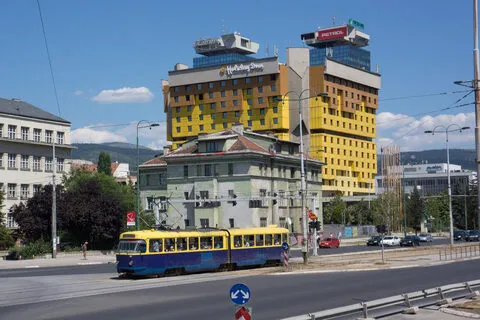
Sarajevo Holiday Inn — Karadžić's own hotel was the sniper platform, then the press base for 1,425 days
The Ivan Štraus building opened in 1983 as the Olympic showcase, launched two opposing political parties in 1990–91, briefly served as Radovan...

Sarajevo Kállay era — twenty-one years that built the Sarajevo you walk, run from a desk in Vienna
Béni Kállay ran Bosnia-Herzegovina from a desk in Vienna between 1882 and 1903. His twenty-one-year tenure as Common Minister of Finance overlapped...