
Sarajevo — the corner where the twentieth century started, 28 June 1914
On the corner of what is now Zelenih Beretki and Obala Kulina bana, at 10:55 a.m. on Sunday 28 June 1914, a nineteen-year-old Bosnian Serb named Gavrilo Princip fired two shots at a Habsburg archduke and his wife. Both died within the hour. Six weeks later Europe was at war. The corner, the minute, the twenty metres of pavement are still there, and a small brass plaque marks it. What happened at the Latin Bridge that morning, and what to notice when you visit.
At approximately 10:55 a.m. on Sunday 28 June 1914, on the corner of what is now Zelenih Beretki and Obala Kulina bana, twenty metres north of the Latin Bridge, a nineteen-year-old Bosnian Serb named Gavrilo Princip fired two shots from a 9 mm Belgian FN Model 1910 semi-automatic pistol at a slow-moving open touring car. The first shot hit Sophie, Duchess of Hohenberg, wife of Archduke Franz Ferdinand of Austria, in the abdomen. The second shot hit Archduke Franz Ferdinand himself in the neck.
Sophie died at approximately 11:15 a.m., inside the car, on the way to the Governor’s Residence at Konak. Franz Ferdinand died at approximately 11:30 a.m., in the Governor’s Residence, of the neck wound. He was fifty years old. Sophie was forty-six.
Six weeks and one day later, on 28 July 1914, Austria-Hungary declared war on Serbia. Within the following week, the alliance system pulled Germany, Russia, France, Britain, the Ottoman Empire, and eventually the United States into what became the First World War. Between 1914 and 1918, approximately twenty million people died in that war, and approximately twenty million more in its immediate epidemiological and political aftermath (the 1918 influenza pandemic, the Russian civil war, the Anatolian population exchanges, the postwar famines).
Almost every historian who has written on the origins of the First World War treats the 28 June 1914 shooting at the Latin Bridge as the triggering event of the whole cascade. The corner is still there. The pavement is walkable. A small brass plaque marks it. This piece is a short guide to what happened at that corner, that morning, and how to visit it now.
The morning
Franz Ferdinand had come to Sarajevo to observe Austro-Hungarian military manoeuvres in the mountains west of the city. He was travelling with Sophie, a Czech noblewoman whose marriage to him had been controversial in Vienna because she was not of royal blood, and who therefore did not have the full rights of a Habsburg consort. The Sarajevo trip was one of the few state occasions where Sophie could appear alongside her husband with full ceremonial honours. It was, in that sense, an anniversary trip: 28 June was their fourteenth wedding anniversary.
The date was politically overdetermined. It was St. Vitus Day (Vidovdan), the Serbian national commemoration of the 1389 Battle of Kosovo, where medieval Serbian forces were defeated by the Ottomans. For Bosnian Serb nationalists, having the Habsburg heir apparent visit Sarajevo on Vidovdan was, in the pattern of nationalist symbolic thinking, a deliberate provocation.
The party’s schedule for the morning:
- ~09:00: Arrival at the Sarajevo railway station by special train from the mountain manoeuvres site.
- ~09:30: Reception at the Sarajevo City Hall (the Vijećnica). Formal municipal welcome. Franz Ferdinand and Sophie’s motorcade departed the Vijećnica at approximately 10:10 a.m. for the drive west along the Miljacka to the Governor’s Residence at Konak. The route was known and had been published in the Sarajevo press days in advance.

The first attempt
At approximately 10:10 a.m., forty-five minutes before the successful shooting, the same motorcade had come under attack. As the archducal car crossed the Ćumurija bridge, a young Bosnian Serb named Nedeljko Čabrinović threw a grenade at Franz Ferdinand’s car. Čabrinović was, like Princip, a member of the underground nationalist group Mlada Bosna (Young Bosnia).
The grenade bounced off the folded roof of the archduke’s car, rolled onto the pavement, and detonated under the next car in the motorcade. Two of Franz Ferdinand’s aides and about a dozen bystanders were wounded. Nobody was killed.
Čabrinović swallowed a cyanide capsule and jumped into the Miljacka to escape. The cyanide was old and did not kill him; the Miljacka was shallow and he was pulled out. He was arrested at the scene.
The archducal party proceeded to the Vijećnica for the formal reception. Franz Ferdinand, according to multiple witness accounts, was visibly angry at the failed security arrangements but insisted on continuing his schedule. Sarajevo Mayor Fehim Ćurčić gave his prepared welcome speech; Franz Ferdinand gave his in return. After the reception, Franz Ferdinand told his staff he wanted to visit the two wounded aides at the Sarajevo Garrison Hospital before proceeding to Konak. His route was adjusted accordingly.
The corner
The adjusted route from the Vijećnica went west along the north embankment of the Miljacka, along what was then the Appel Quay (now Obala Kulina bana). At the corner of Appel Quay and Franz Josef Street (now Zelenih Beretki), the motorcade was to turn right, north, into Franz Josef Street and continue to the hospital.
The lead car in the motorcade turned right into Franz Josef Street as planned. Franz Ferdinand’s car, driven by Leopold Lojka, followed. Somebody, the accounts disagree about who, realised at that point that the archduke had changed his plans and no longer intended to visit the hospital. Governor Oskar Potiorek, seated behind Franz Ferdinand, gave the order to change the route. Lojka stopped the car and prepared to reverse.
At exactly this moment, 10:55 a.m., stationary car, three metres of pavement between the car and the corner of the building at Franz Josef 5, Gavrilo Princip stepped out from the corner of Schiller’s delicatessen. He was there because his own attempt earlier that morning at another point along the route had failed to materialise (the motorcade had passed too quickly and at the wrong angle). He had, per his subsequent court testimony, given up and gone to Schiller’s for a sandwich.
He drew the FN Model 1910 pistol. He fired two shots at a range of approximately three metres. The first shot hit Sophie. The second shot hit Franz Ferdinand. He tried to fire a third at himself and failed; he attempted to swallow cyanide, and it did not kill him either. He was arrested at the corner.
The car reversed. Blood soaked through Sophie’s white dress. Franz Ferdinand’s neck wound bled onto the upholstery. Sophie died within about fifteen minutes, cradled by her husband. Franz Ferdinand died within about thirty. Both were dead by 11:30 a.m.
Why Princip
Gavrilo Princip was born in 1894 in the Bosnian village of Obljaj, in the western Krajina region. He was a Bosnian Serb, from a peasant family, and was in Sarajevo in the summer of 1914 finishing secondary school at the First Gymnasium. He had spent time in Belgrade the previous year and had, through contacts there, made contact with the network that supplied the Belgrade-based conspirator group Црна рука (Crna Ruka, the Black Hand), a nationalist paramilitary organisation with links to Serbian military intelligence.
The Black Hand supplied Princip’s group with the pistols, the grenades, and the cyanide capsules used in the 28 June operation. The seven Mlada Bosna conspirators positioned along the archduke’s route were: Princip, Čabrinović, Muhamed Mehmedbašić, Vaso Čubrilović, Cvjetko Popović, Trifko Grabež, and Danilo Ilić. Six of them were Serb; Mehmedbašić was Bosniak. Their ages ranged from seventeen (Čubrilović) to twenty-seven (Ilić). Princip at nineteen was in the middle.
At his trial in October 1914, Princip stated that his motivation was to eliminate Franz Ferdinand as the Habsburg political figure whose planned reforms would, in his view, undermine the Serbian nationalist project of a unified South Slav state under Belgrade. The so-called United States of Greater Austria proposal would have given South Slavs autonomous federal status within the empire. This is what Princip said. Whether it fully captures his motivation is a question historians have argued about for a century. He was too young, in the strict Austro-Hungarian legal sense, to receive the death penalty. He was sentenced to twenty years’ hard labour. He died of tuberculosis at Theresienstadt (Terezín) prison, in Bohemia, on 28 April 1918. He was twenty-three.
The corner today
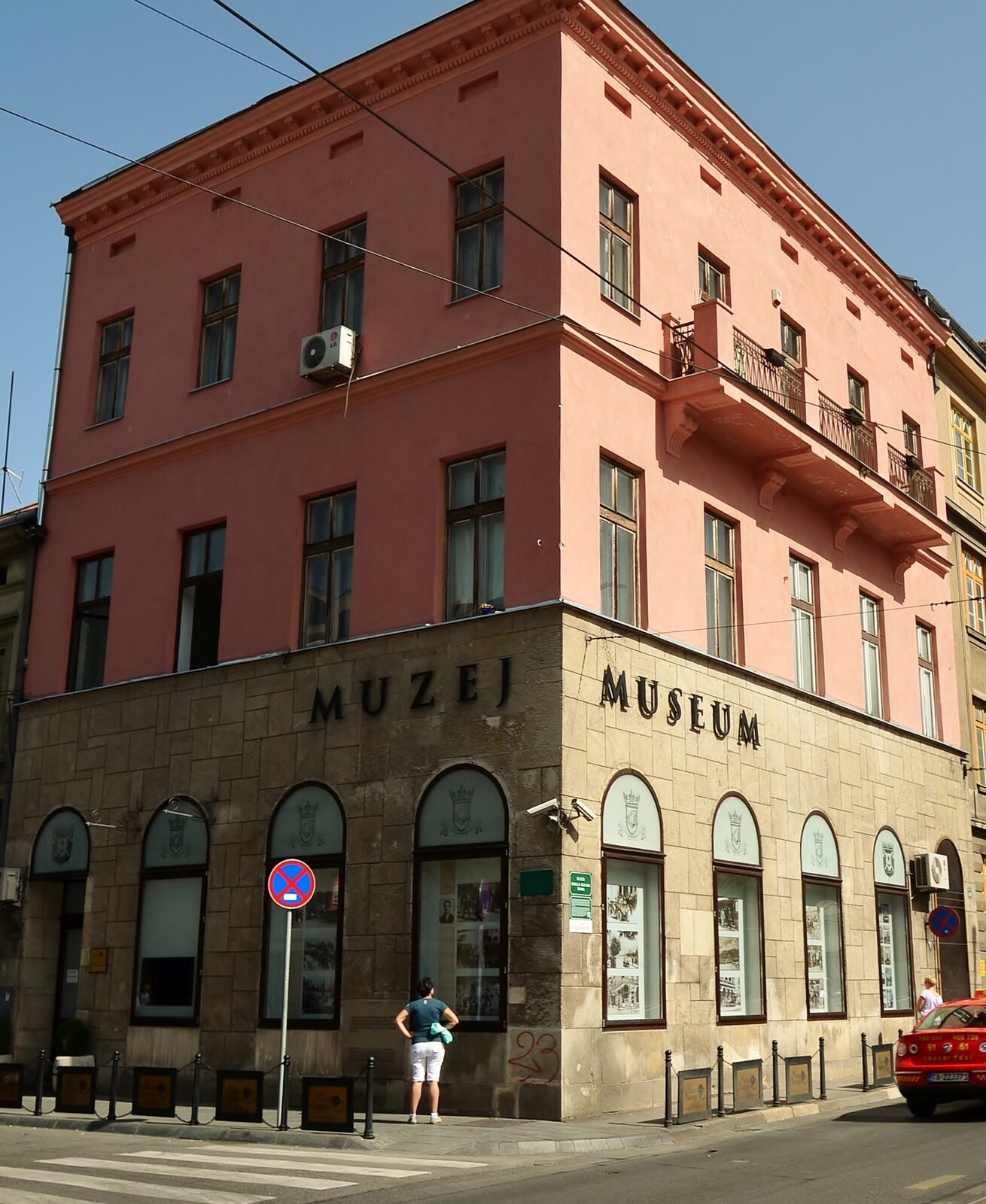
The corner where Princip fired the shots is now the Museum of Sarajevo, Latin Bridge branch. The physical corner of the building that was Schiller’s delicatessen is preserved. A small brass plaque on the outside wall reads (in Bosnian): “From this place on 28 June 1914 Gavrilo Princip assassinated the heir to the Austro-Hungarian throne Franz Ferdinand and his wife Sophie.”
The plaque is understated. Its wording has been rewritten multiple times across the twentieth century: from the original 1914 Austro-Hungarian marker (which described Princip as a murderer), to the Yugoslav-era plaque (which described him as a hero of Yugoslav national liberation), to the postwar Bosnian-state plaque installed after 1992 (which is deliberately neutral: it names the event without valorising or condemning it). The current text is a compromise document, and the compromise is worth reading in situ.
Inside the museum branch, small and worth about half an hour, there are:
- The FN Model 1910 pistol: a replica; the original is at the Vienna Heeresgeschichtliches Museum.
- Photographs of Franz Ferdinand and Sophie, of Princip, of the other conspirators, of the aftermath.
- The archducal touring car: a replica; the original is at the Vienna military-history museum.
- The route map with the corner, the failed grenade attempt, and the successful shooting marked.
- Sarajevo newspaper front pages from 29 June 1914 in Bosnian, German, and English (all of which had different framings of what had just happened).
- Court records from Princip’s October 1914 trial.
The museum is quiet. It does not attempt to reproduce the noise or drama of the event. It presents the documentary evidence at ordinary museum scale.
The Latin Bridge itself
The Latin Bridge (the four-arch Ottoman stone bridge across the Miljacka twenty metres south of the corner) has stood on the same spot since the sixteenth century. It was rebuilt in 1798 after a flood, but the Ottoman stone core has survived. During the Yugoslav period the bridge was called Princip Bridge (Principov most), a Yugoslav-era political naming that celebrated Princip as a national-liberation hero. In 1992 the Sarajevo City Council reverted the name to Latin Bridge (Latinska Ćuprija, the Ottoman-era name), removing the Yugoslav political marker. That renaming is itself a piece of contemporary political history.
The bridge is used daily by pedestrians. You can cross it in about thirty seconds. Standing on the middle of the bridge and looking north, you see the exact corner where the shooting happened, the museum entrance, the plaque, and the small crowd of visitors that always gathers.
Why we visit
The corner at the Latin Bridge is one of the strangest visitor sites in Europe. It commemorates an event that is generally understood as the trigger for the deadliest war in human history to that point. But the commemoration itself is quiet: a brass plaque, a small museum, no monumental sculpture, no formal ceremony.
Sarajevo’s own relationship to the site has been complicated for a century. From 1914 to 1918 the corner was a place of Habsburg mourning. From 1918 to 1941 it was a site of Yugoslav-royal ambivalence. From 1945 to 1992 it was a Yugoslav-socialist site of national-liberation commemoration. From 1992 onward it has been treated by the sovereign Bosnian state as a historical marker, without valorising or condemning what happened there.
That institutional neutrality is worth thinking about when you visit. The plaque does not tell you what to feel. The museum presents the evidence and leaves the interpretation to you. You are welcome to stand at the corner and consider: what happened here, what came from it, what one nineteen-year-old with a pistol did with two shots in the summer of 1914.
Then walk on. Baščaršija is a hundred metres east. The Vijećnica is another two hundred metres beyond. Kovači, the Sebilj, the Gazi Husrev-beg mosque, all within a fifteen-minute pedestrian arc. The city is still working. The century that started at the corner ended twenty-six years ago. What comes after is being written now, by everyone who walks the same streets.
Practical
- Museum of Sarajevo: Latin Bridge branch. Zelenih Beretki 1, corner of Obala Kulina bana. Ten minutes’ walk from the Sebilj.
- Entry: ~5 KM adult. Roughly half an hour to see everything.
- Hours: 10:00–18:00 daily in summer; 10:00–16:00 in winter. Closed on 1 January and on Bajram.
- Best time to visit: early afternoon on a weekday. Weekends can be crowded.
- What to notice: the position of the corner relative to the bridge; the plaque wording (multiple rewrites across a century); the archducal car layout on the display; the newspaper front pages; the photograph of Princip taken on the morning of his arrest.
Sources
- Robert J. Donia, Sarajevo: A Biography (Ann Arbor: University of Michigan Press, 2006). The English-language standard reference on Sarajevo’s twentieth-century history; substantial treatment of the June 1914 events.
- Vladimir Dedijer, The Road to Sarajevo (New York: Simon and Schuster, 1966). The classical Yugoslav-era treatment of the assassination; still substantial for the documentary evidence.
- Christopher Clark, The Sleepwalkers: How Europe Went to War in 1914 (London: Allen Lane, 2012). The recent revisionist account of the 1914 crisis; substantial coverage of the Sarajevo events.
- Sarajevo City Museum (Muzej Sarajeva), permanent exhibition at the Latin Bridge branch.
- Vienna Heeresgeschichtliches Museum, permanent exhibition on the June 1914 events, including the original FN Model 1910 pistol and the archducal touring car.
- Court records of the 1914 Sarajevo assassination trial, held at the Sarajevo Historical Archive and (in transcript) at the Vienna State Archive.
Sources & further reading
Keep reading
More from the guide.

Sarajevo — Europe's first public toilet with running water was built here in 1529, and nobody puts it on the brochure
In 1529, Sarajevo had a public toilet with running water and a working sewage system. London’s Great Stink was 329 years later....
Sarajevo — the largest book-burning in history was one night in August 1992
Everyone knows the Nazis burned books. What most people don’t know is that the single largest book-burning in recorded history happened in...

Sarajevo Nadrealisti 1991 — the sketch that predicted Dayton by month
Not all Top Lista Nadrealista sketches were equally prophetic. But ‘Sarajevski zid’ (The Sarajevo Wall) from the 1991 third season predicted things...