
Sarajevo — the biggest book-burning in history took 90 minutes, and the shells landed on the fire brigade too
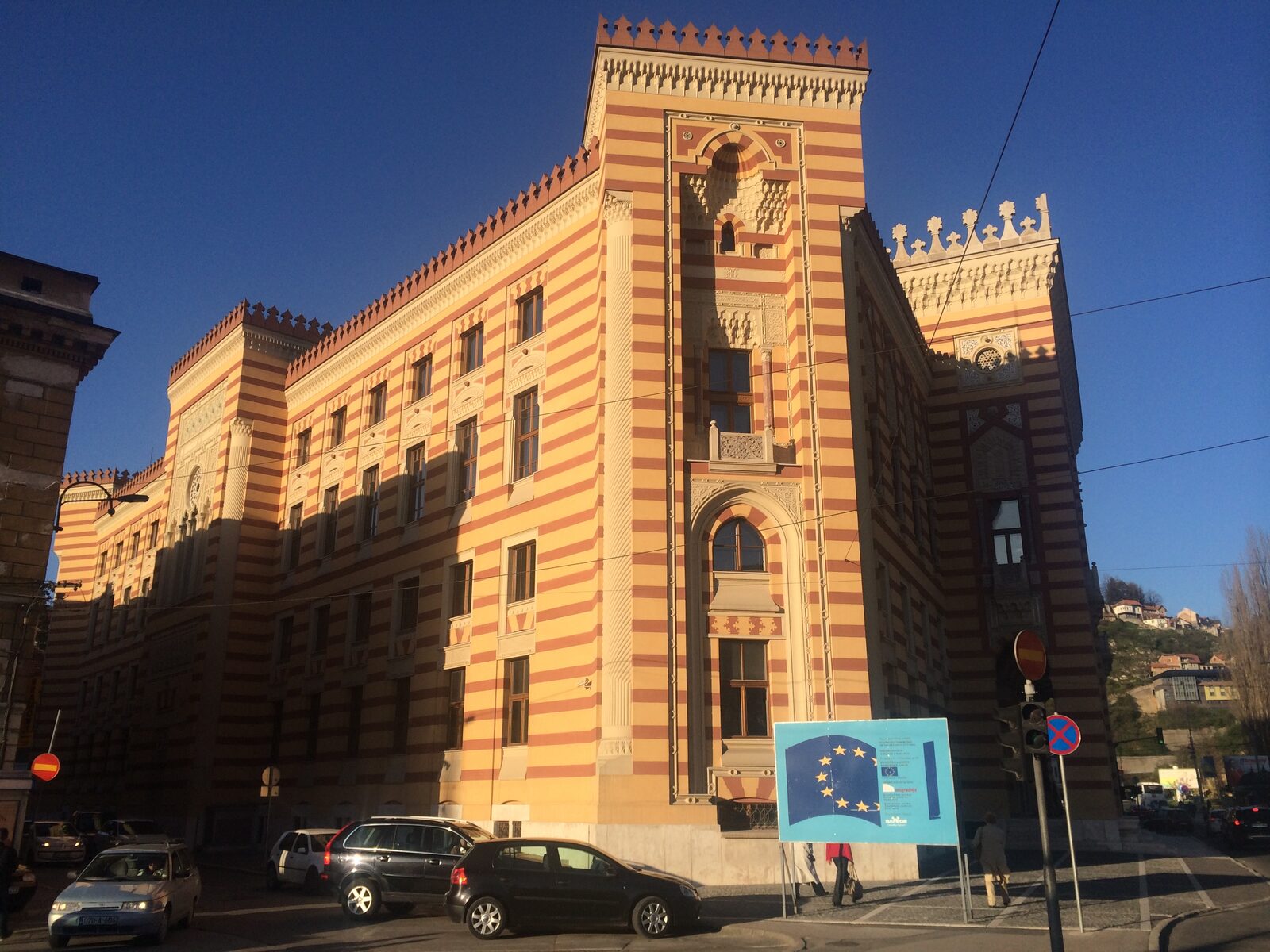
Bakaršić's 1994 essay walks the tape. 25 incendiary mortars on the Vijećnica from four coordinated hill positions. Another 40 conventional rounds on the streets around it, to keep the fire brigade off. Sarajevo's water district had been cut a month earlier — the fire brigade couldn't have fought the fire either way. The blocking barrage wasn't tactical. It was a statement.
The book-burning post tells you the outcome: 1.25 million volumes destroyed in one night on 25–26 August 1992 at Vijećnica. The largest single library destruction in recorded history. All correct.
Bakaršić’s 1994 essay, written by the chief librarian of the National Museum who lived through the siege, describes something more precise. The Vijećnica fire was not a fire in the ordinary sense. It was a coordinated attack methodology, executed with tactical precision, over a 90-minute window.
Here’s the tape.
The attack
At around 22:30 on 25 August 1992, Bosnian Serb positions on the hills opened fire on the Vijećnica. Drawing on the Sarajevo fire brigade log and the later ICTY investigation reports, Bakaršić catalogues:
Shell count. About 25 incendiary mortar rounds landed on the Vijećnica itself, over about 90 minutes (22:30 to 24:00).
Firing positions. The mortars were fired from four distinct hill positions, Trebević (south), Grbavica ridge (south-east), Vraca (south), and the Pale road ridge (east). Four positions in coordinated bracket-fire, with fire correction between positions to concentrate rounds on the target.
Munition type. The rounds were phosphorus-based incendiary. Conventional high-explosive would have damaged the building without necessarily setting it on fire. Incendiary was chosen deliberately.
The building’s fire vulnerability, wooden roof, wooden interior floors, wooden bookshelves holding two million paper volumes, was known. The Habsburg-era construction records had been publicly available since 1897.
The blocking barrage
While the incendiary rounds fell on Vijećnica, a second barrage fell on the streets around it. The streets targeted:
- Obala Kulina bana: the Miljacka embankment approach from the west.
- Ulica Kelemedžina: the eastern approach from Baščaršija.
- The Šeher-Ćehaja Bridge: the crossing over the Miljacka.
- The Latin and Ćumurija Bridges: the western crossings.
About 40 conventional high-explosive rounds fell on these approach routes during the same 90 minutes. The tactical purpose: block the Sarajevo fire brigade.
This was an atrocity rather than an act of war. The Sarajevo municipal water district had been cut on 25 July 1992, a month before the Vijećnica attack, by Bosnian Serb forces controlling the Bačevo pumping station. The fire brigade would have had no water pressure to fight the Vijećnica fire even if the trucks had reached it.
The blocking barrage was tactically pointless. The attackers knew the fire brigade couldn’t fight the fire. They shelled the approach routes anyway.
Bakaršić reads the blocking barrage as a statement. The choice to shell the streets around a burning library — when everyone involved knew the library couldn’t be saved — was a gesture, a demonstration that the destruction was to be complete and public.
The fire brigade
Fire chief Kenan Slinić deployed three tenders from the Kobilja Glava station at around 23:00. Two were destroyed by artillery on the approach, one on Obala Kulina bana west of the National Theatre, one at the corner of Ćumurija bridge.
The third tender reached the vicinity of Vijećnica at around 23:45 with no water pressure. The fire chief and his men, under continuing artillery fire, worked instead to help the librarians and civilian volunteers who were carrying books out of the building by hand.
Aida Buturović, the National Library staff librarian, was shot by sniper fire on the pavement outside the burning Vijećnica at around 01:20 on 26 August 1992. She was 32.
Why this is a technique, not a fire
Bakaršić’s 1994 essay draws the line precisely. A fire is what happens when a building catches fire, through accident, through an incidental military engagement. A technique is when an attack methodology is designed to produce a chosen destructive outcome.
The Vijećnica attack was a technique. The components:
- Advance intelligence — knowledge of the building’s structural fire vulnerability.
- Specialised munitions — phosphorus incendiary, not conventional high explosive.
- Coordinated firing positions — four positions in bracket-fire.
- Blocking barrage — parallel shelling of approach routes.
- Preceding infrastructure attacks — cutting the municipal water a month earlier.
The pattern is documented in the ICTY judgments against Karadžić and Mladić. It’s treated in the tribunal record as evidence of the crime of destruction of cultural property under the 1954 Hague Convention.
The same technique had been used against the Oriental Institute on 17 May 1992, three months earlier, at a smaller scale. Vijećnica was the mature version.
The scale
Bakaršić’s comparison: the Nazi book-burnings of May 1933. Over the week of 6–10 May 1933, coordinated burnings in about 45 German university cities. Total volumes destroyed: 25,000 to 100,000 across all sites combined.
The Vijećnica fire destroyed about 1.5 million volumes (Bakaršić’s estimate combining the two-million pre-siege holdings with the ~500,000 volumes recovered during the fire).
On the count of volumes destroyed in one coordinated attack, in one building, in one time window, Vijećnica is the largest single book-burning in recorded history. Larger than the entire 1933 Nazi campaign combined. Larger than the library losses at Warsaw and Dresden. Larger than the Alexandria burnings of Late Antiquity, though those are harder to compare.

What to do with this
Read Bakaršić’s essay. It’s public, free, and the primary source.
Walk to the Vijećnica. Read the plaque. It names the crime and gives the total. It does not describe the attack methodology. This post, and Bakaršić’s essay, do that.
The reason to know the technique isn’t to compound the horror. It’s to name the historical fact accurately. On the night of 25–26 August 1992, in one Habsburg-era building on the Miljacka embankment, a coordinated military operation destroyed the largest concentration of books ever destroyed in a single tactical event in the recorded history of human warfare.
Sources
- Kemal Bakaršić, The Libraries of Sarajevo and the Book That Saved Our Lives, The New Combat (Autumn 1994).
- András Riedlmayer, Convivencia under Fire, in Rebecca Knuth, Libricide (Praeger, 2003).
- ICTY judgments — Karadžić (IT-95-5/18-T), Mladić (IT-09-92).
- Sarajevo fire brigade log, 25–26 August 1992.
Sources & further reading
Keep reading
More from the guide.

Sarajevo Historical Archive — 14,000 Ottoman units, a 1631 dictionary, and a siege-war fund the staff actively collected while under shelling
The Historical Archive of Sarajevo, Istorijski arhiv Sarajeva, was founded on 3 May 1948 by the National Committee of Sarajevo. It began...

Sarajevo Kállay era — twenty-one years that built the Sarajevo you walk, run from a desk in Vienna
Béni Kállay ran Bosnia-Herzegovina from a desk in Vienna between 1882 and 1903. His twenty-one-year tenure as Common Minister of Finance overlapped...

Sarajevo 1901 — Topič shot eleven panoramas, the best sat in a drawer
Our earlier post treats the Schädler-Topič pairing as one photograph twenty-two years apart. Kadkani-Schmitt’s Chapter 4 epilogue is sharper. Topič made eleven...