Sarajevo 1878 — a Habsburg officer wrote the playbook for how to civilise Bosnia, and Vienna followed it for thirty years
A month after Austro-Hungarian troops entered Sarajevo, a Habsburg military officer named Armand Schweiger-Lerchenfeld published in Vienna a 245-page ethnographic study of the newly-occupied lands. Islam was, he wrote, incapable of reform. Bosnia had to be brought into European culture 'through civilising efforts, not violent means.' Sarajevo was to be the showpiece. Zahra Kadkani-Schmitt's 2017 UC Berkeley PhD makes the case that this specific book, more than any other single document, framed how Vienna would build Sarajevo for the next thirty years.
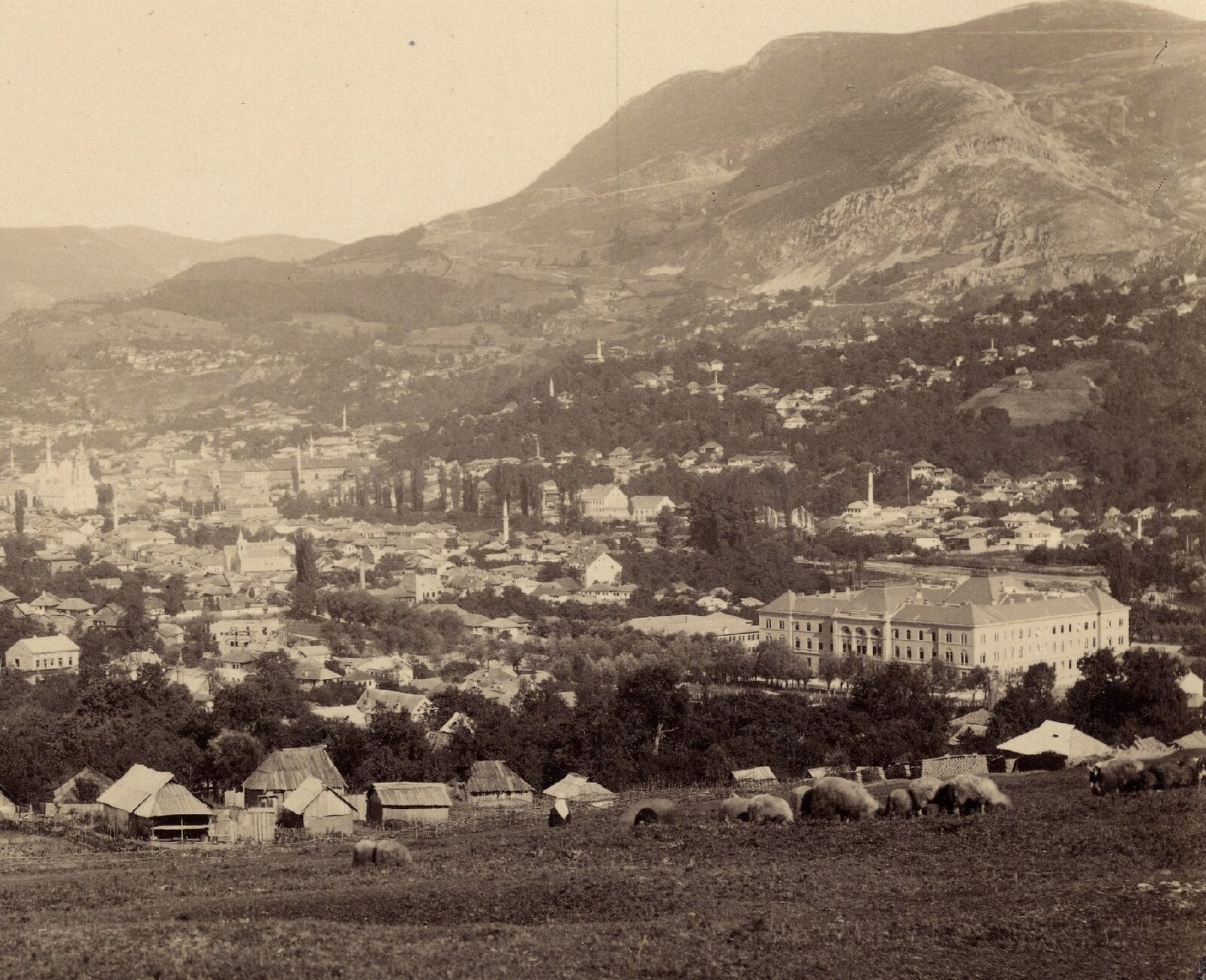
On 19 August 1878, four weeks after the Congress of Berlin authorised Austria-Hungary to occupy Bosnia and Herzegovina, Habsburg troops entered Sarajevo. The occupation was resisted street by street, most bitterly at the Magribija Mosque on the west edge of the city, where a battle was fought and later commemorated in a series of paintings by Theodor Breitwieser. By early September the resistance was broken. The city was under Austro-Hungarian control. It would remain so for the next forty years.
Somewhere between the entry into Sarajevo in August and the pacification of the countryside that autumn, a Habsburg military officer named Armand Schweiger-Lerchenfeld finished writing a 245-page ethnographic book about Bosnia. He published it in Vienna the same year: Bosnien, Das Land und seine Bewohner. Geschichtlich, Geographisch, Ethnographisch und Social-Politisch, the Land and its Inhabitants: Historical, Geographical, Ethnographic, and Socio-political. The publisher was L.C. Zamarski. The first edition sold out. Reprinted 1879.
Schweiger-Lerchenfeld’s book was one of the founding intellectual documents of what the Habsburg administration would spend the next thirty years doing to Sarajevo. The recent scholarly treatment is Zahra Kadkani-Schmitt’s 2017 PhD dissertation at UC Berkeley, Framing Bosnia: The Politics of Architecture and City Building in the Austro-Hungarian Administration of Bosnia and Hercegovina, 1878–1903. Her introduction reads Schweiger-Lerchenfeld carefully. What follows draws on that reading, oriented to Sarajevo.
What Schweiger-Lerchenfeld actually argued
The book is written in the tone of a serious ethnographic study for a Vienna reading audience. Its central concern is one question, put in Schweiger-Lerchenfeld’s own words (translation Kadkani-Schmitt’s):
“Will the Mohammedan element in Bosnia accommodate itself to a Western system of government, and is a modification that could make it more flexible towards general civilising efforts to be expected in its Bosnian representatives?”
Schweiger-Lerchenfeld’s answer, in principle, was no. Islam was, he argued, “inherently incapable of reform.” The same held for what he called “the Bosnian Mohammedans.”
Today that reads as straightforward Orientalist racism. But it was only the setup for the actual argument. Because Bosnia was geographically in Europe, the crucial fact for Schweiger-Lerchenfeld, the Habsburg administration could not simply relegate the Muslim population to colonial-periphery status the way British India or French Algeria did. Bosnia was going to be part of the empire. Bosnian Muslims were going to be Habsburg subjects. Some kind of accommodation had to happen.
His prescription is worth quoting in full because everything Vienna did in Sarajevo for the next thirty years derives, in some form, from it:
“The task of European culture as such, however, can only be to get rid of all conditions and institutions that resist it, whether they are of a religious or a social nature, not through violent means but with civilising efforts.”
Translated: the empire would not massacre or expel Bosnian Muslims. It would, instead, build them out of existence, through schools, roads, railways, administrative reforms, and buildings that would gradually make the older Islamic institutions functionally irrelevant. Civilising effort, not violent means.

The two objectives
Kadkani-Schmitt names the two political objectives underlying the whole 1878 Habsburg project in Bosnia. Both derive from Schweiger-Lerchenfeld’s framing:
Isolate Bosnia from its neighbours. Dissipate pan-Slavic aspirations that would link Bosnia to Serbia or Russia. Disengage Bosnian Muslims from the Sultan and the clergy in Istanbul. The two decades before the occupation had seen the emergence of Serbian and Croatian nationalism, and Bosnia sat at the geographic intersection. The Habsburgs did not want Bosnia to become the pivot of a South Slavic anti-imperial alliance. Cutting the political and religious lines to Belgrade and Istanbul was the first task.
Build an imperial bond between Bosnia and Vienna. Make the newly-acquired lands feel, over time, like part of the monarchy. This is the constructive side of the project. It required not just administrative integration but a cultural project, what the Habsburg administrators called Kulturarbeit, cultural development, or Kulturmission, cultural mission, that would give Bosnians (particularly urban Bosnian Muslims) a sense of belonging to Central Europe rather than to the Ottoman world they had known for four centuries.
Kadkani-Schmitt’s argument, which she develops across four chapters of her dissertation, is that the Habsburg administration’s primary tool for the second objective was architecture. Not law. Not education. Not police. Buildings. Big, visible, deliberate, expensive buildings, most of them concentrated in Sarajevo.
Sarajevo as the showpiece
Kadkani-Schmitt’s central move is to place Sarajevo at the centre of the whole enterprise. She writes, in her own words:
“Throughout the discussion, the focus of the analysis remains on Sarajevo, which the new authorities considered the capital city of the occupied lands and planned its development as a showpiece for their socioeconomic and cultural achievements in Bosnia-Herzegovina.”
The word she uses is showpiece. It is deliberate. The Habsburg administration was not just building Sarajevo for Sarajevans. It was building Sarajevo for Vienna to be able to point to, for the Empire’s political class in Budapest, for European tourists (see our Thomas Cook story), for foreign diplomats, for future historians. Every single Habsburg-era public building in Sarajevo can be read as showpiece work: the Vijećnica in Pseudo-Moorish (1894), the National Museum in Neo-Renaissance (1913), the Sacred Heart Cathedral in Neo-Gothic (1889), the Main Post Office in Secession (1913). None of these buildings would have been necessary for a normal provincial capital. All of them were built because Vienna wanted the world to see what it had done in Bosnia.
The thirty-year budget for Habsburg construction in Sarajevo, per Kadkani-Schmitt’s cataloguing, is disproportionate to the city’s population and economic weight in 1878. Sarajevo in 1878 was a mid-sized Ottoman provincial capital of perhaps 21,000 people. Sarajevo in 1908, the year of formal annexation, had a fully-built Habsburg civic centre with roughly the same architectural density as a small Vienna district. The imperial money went where the imperial argument needed to be made most visibly. That was Sarajevo.
The paradox in the argument
Kadkani-Schmitt is careful about a contradiction in the whole Habsburg project, one worth naming because it explains why Sarajevo’s Habsburg quarter looks the way it does.
The civilising mission required that Bosnia become European. But the tourism argument, and the propaganda argument to the wider empire (see our Oriental Holiday story), required that Bosnia remain visibly Oriental. If Sarajevo became fully European, there would be nothing distinctive about it. If it stayed fully Ottoman, the civilising mission would look like a failure.
The Habsburg administration’s solution, particularly under Béni Kállay (Common Minister of Finance 1882–1903, and the political figure who supervised most of the Sarajevo building programme), was to build new buildings in an Orientalising style. The Vijećnica is the canonical example. Pseudo-Moorish decorative vocabulary, Vienna-Historicist structural logic, entirely European engineering. Kadkani-Schmitt calls this pattern staging the East: Vienna produced a specific European visual representation of Oriental Bosnia that European tourists would recognise as Ottoman even though it was in fact a Habsburg confection.
The tension between the two positions, Europeanize Bosnia versus stage its Ottoman-ness, was never resolved. It structured every major architectural decision in Sarajevo between 1878 and 1918.
Why Schweiger-Lerchenfeld matters
Schweiger-Lerchenfeld’s book was not the only ethnographic study of Bosnia in 1878, and not the only intellectual grounding for the Habsburg administration’s policy. Joseph Alexander Helfert’s Bosnisches (1879), a shorter, more polemical book that framed the occupation as “a work of humanity, a civilisation mission”, was arguably more read at the political level.
But Schweiger-Lerchenfeld’s book is the one that gave the administration its practical vocabulary. The formulation civilising efforts, not violent means recurs in Kállay’s speeches. The two objectives, isolation of Bosnia from its neighbours, and imperial bond with Vienna, organised the administrative decisions of the 1880s and 1890s. And the reduction of Bosnian Muslims to a population to be gradually and painlessly cultivated out of their prior identity is what produced, over thirty years, both the physical Sarajevo we walk in today and the political conditions the twentieth century would inherit.
The book is available online: Bosnien, Das Land und seine Bewohner at Archive.org, in the original German. Worth a slow read even if you do not read German fluently — the images, the maps, the ethnographic illustrations, the plates of costume, are self-explanatory. What Habsburg Vienna thought Bosnia was in 1878 is on those pages.
What survives
Read the buildings in the light of the book. The Vijećnica (1894, Pařík, restored 2014) is Kállay’s civilising mission in Pseudo-Moorish stone. The Sacred Heart Cathedral (1889, Vancaš) is the isolation-from-Istanbul argument in Neo-Gothic. The Main Post Office (1913, Vancaš) is the imperial bond made in Secession. The National Museum (1913, Pařík) is the Kulturarbeit institutionalised into four pavilions.
They are all beautiful buildings. Their beauty is real. Their argument, once you know what argument they were making, is also real. Walking Sarajevo’s Habsburg quarter with Schweiger-Lerchenfeld in mind is not the only way to walk it. It is a way that adds a layer.
Sources
- Zahra Kadkani-Schmitt, Framing Bosnia: The Politics of Architecture and City Building in the Austro-Hungarian Administration of Bosnia and Hercegovina, 1878–1903, PhD dissertation, University of California, Berkeley, 2017. Committee chair: Nezar AlSayyad. eScholarship.
- Armand Schweiger-Lerchenfeld, Bosnien, Das Land und seine Bewohner. Geschichtlich, Geographisch, Ethnographisch und Social-Politisch (Wien: L.C. Zamarski, 1878).
- Joseph Alexander Helfert, Bosnisches (Wien: Manz, 1879).
- Robin Okey, Taming Balkan Nationalism: The Habsburg Civilising Mission in Bosnia, 1878–1914 (Oxford: Oxford University Press, 2007) — the book-length treatment of the Kállay programme.
- Robert Donia, Islam Under the Double Eagle: The Muslims of Bosnia and Hercegovina, 1878–1914 (New York: Columbia University Press, 1981).
- Peter Sugar, The Industrialization of Bosnia-Hercegovina, 1878–1918 (University of Washington Press, 1963) — the economic-history complement.
- Wolfgang Müller-Funk, Kakanien Revisited: Über das Verhältnis von Herrschaft und Kultur (Tübingen: Francke, 2001) — the theoretical framework Kadkani-Schmitt uses for culture as spatial demarcation.
Sources & further reading
- Zahra Kadkani-Schmitt, 'Framing Bosnia: The Politics of Architecture and City Building in the Austro-Hungarian Administration of Bosnia and Hercegovina, 1878–1903', PhD dissertation, UC Berkeley, 2017
- Armand Schweiger-Lerchenfeld, 'Bosnien, Das Land und seine Bewohner. Geschichtlich, Geographisch, Ethnographisch und Social-Politisch' (Wien: L.C. Zamarski, 1878)
- Joseph Alexander Helfert, 'Bosnisches' (Wien: Manz, 1879)
- Robin Okey, 'Taming Balkan Nationalism: The Habsburg Civilising Mission in Bosnia, 1878–1914' (Oxford: Oxford University Press, 2007)
Keep reading
More from the guide.

Sarajevo — the Muslim family that hid a Jewish family from the Nazis in 1941, and were saved by them fifty years later
There is one Sarajevo story that everyone in the city knows, but that most guidebooks skip, and that fewer non-Sarajevans know than...

Sarajevo — in 1885 Trebević stopped being a mountain and became Waldgemeinde Nr. 1401, and the household firewood bill tripled
The Habsburg transformation of Sarajevo is usually told as a story about buildings, Vijećnica, Sacred Heart, National Museum. Kadkani-Schmitt’s Chapter 3 is...

Sarajevo — the library that burned three months before Vijećnica, and lost 5,263 manuscripts nobody had a copy of
The book-burning post tells you about Vijećnica on 25 August 1992. The Oriental Institute burned first, three months and eight days earlier....