
Sarajevo 1884 — a journalist scored the city one-eighth changed, three-eighths different in spirit
In January 1884, a writer at the Bosnische Post — the German-language paper the Habsburg administration had set up in Sarajevo — sat down to compare the city he saw with the city that had existed five years earlier. He decided Sarajevo was now a 'half-European city'. Then he did something odd. He counted the transformation in fractions: one-eighth of the change was visual, three-eighths was the life of the community. The feuilleton, unsigned, is preserved in the Arhiv Bosne i Hercegovine. One of the sharpest first-person observations of Sarajevo in the fifth year of Austro-Hungarian rule.
Sometime in the first week of January 1884, a writer for the Bosnische Post, the German-language paper the Habsburg administration had established in Sarajevo in 1884 as a channel for the new regime’s views on the two occupied provinces, decided to write a feuilleton comparing the Sarajevo he was living in with the Sarajevo of five years earlier.
The piece ran in issue Nr. 6 of Bosnische Post I (1884) under the title Sarajevo 1879 und 1884. It was unsigned. It is preserved today in the Arhiv Bosne i Hercegovine in Sarajevo, and it is one of the primary sources that grounds the Habsburg-Sarajevo chapters of Zahra Kadkani-Schmitt’s 2017 Berkeley dissertation Framing Bosnia.
What the writer saw
The writer’s central claim was that Sarajevo, after five years of Austro-Hungarian rule, had stopped being an Oriental city and started being a European one. He did not put it that plainly. He wrote it with the diplomat’s caution of a man employed by a paper the administration was sponsoring. But the observation was direct.
Up to the Habsburg army’s arrival in 1878, Sarajevo had been an “outright Oriental city” (eine ausgesprochen orientalische Stadt). Now, in year six of the new administration, “distinct traces of transformation processes demonstrate that the city, culturally speaking, can already be conceived of as a half-European city” (eine halb-europäische Stadt).
Then he did the maths.
He argued that of the “half” of the transformation Sarajevo had achieved, one-eighth belonged to the visible spatial changes, the new buildings, the new streets, the new bridges, the new light, and three-eighths belonged to the alteration of the city’s life and community. The remaining half belonged to what had not yet changed.
The fractions are odd. The writer offered no arithmetic justification for them. Kadkani-Schmitt reads them as a way of insisting that the important change was not the physical one but the deeper one: the habitus of the population.
Habitus — the word the writer reached for
The German noun habitus, in the sense used in the feuilleton, means roughly the settled disposition of a community, the way people dress, eat, live, and expect their neighbours to live. The writer used it several times. Sarajevo’s habitus, he wrote, had been “interrupted” by the Habsburg arrival.
His concrete observations included:
- “Many of the locals now put on European costumes (Tracht), and their women choose to appear in Parisian style, no matter how insecurely they might feel in it.”
- Rows of new modern apartment blocks had risen along the Franz Josef Park embankment, built to the specifications of the new Bau-Ordnung: the building ordinance the administration had issued to regulate the height, façade, and setback of new construction in the central district.
- The new Catholic Church at the western end of the newly opened axis (later to be joined by the Sacred Heart Cathedral, consecrated 1889) marked the western skyline. The eastern skyline was still marked by the minaret of the Begova džamija.
The feuilleton was the first published Sarajevo-based reflection on the habitus concept as applied to the city. It ran a decade before the concept became fashionable in German-language sociology.
The 1879 fire — the accidental clearing
.jpg)
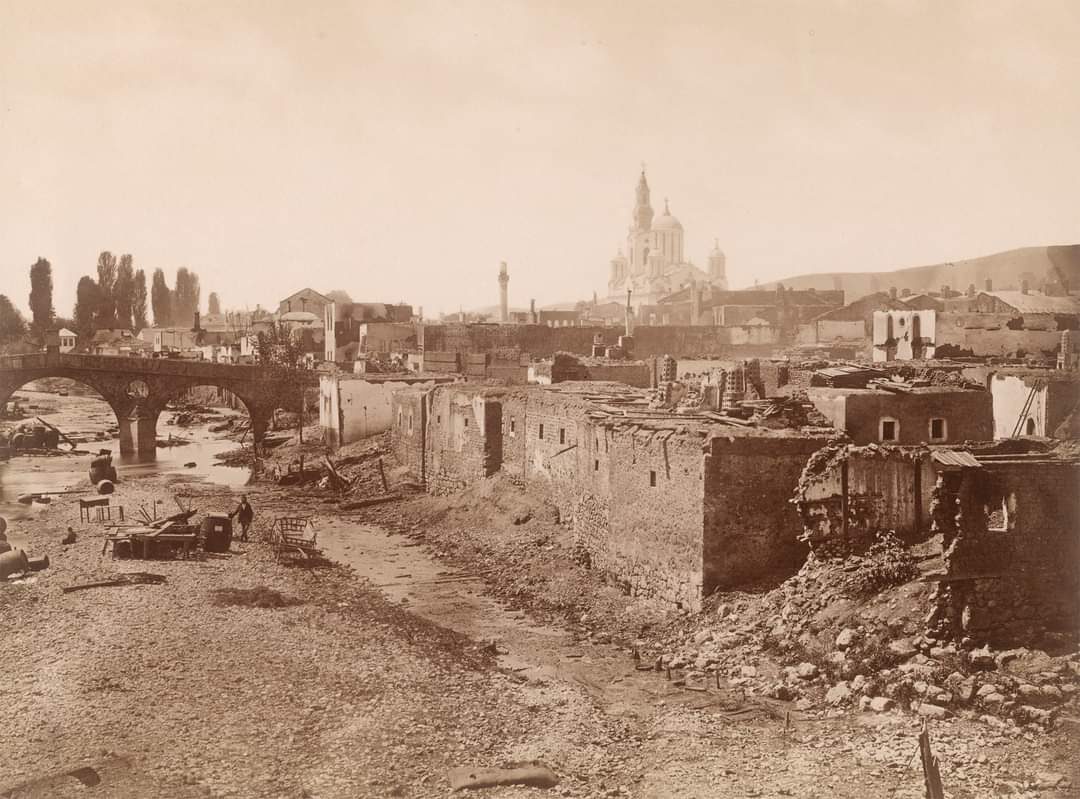
One reason the transformation had been so fast was that a fire in August 1879 had burned through a substantial part of the central čaršija a year after the occupation began. The military administration used the emptied ground as the site for the first Bau-Ordnung-compliant apartment blocks, and by 1884 the writer of the feuilleton could point at those blocks as physical evidence of what the new regime intended.
The fire was not planned. Not everyone welcomed it. But for the incoming administration it functioned as an unexpected clearing of exactly the site they most wanted to redesign, the central district south of the čaršija where the new civil government wanted to build the offices, banks, and public spaces that would demonstrate imperial arrival.
What Kadkani-Schmitt does with the feuilleton
In Framing Bosnia, Chapter 4, Kadkani-Schmitt reads the 1884 feuilleton as evidence of a claim the administration in Vienna was making about itself: that the Habsburg civilising mission in Bosnia was working, that it was working fast, and that the fastest evidence of its working was the change in the daily life of Sarajevo.
She notes that the feuilleton’s confidence was premature. The writer had underestimated how much of Sarajevo, its neighbourhoods, its worship, its family structure, its labour, had not changed. The visible one-eighth was easier to count than the invisible seven-eighths.
But she also notes that the writer had detected something real. The Bau-Ordnung was being enforced. The new apartment blocks were rising. The height of the new civic buildings was beginning to surpass, in a small number of sightlines, the height of the minarets that had defined the Sarajevo skyline for four hundred years.
She reads this as the moment the administration realised its architectural programme was working, and doubled down on it. The next twenty years, 1884 through 1903, saw the building of the National Museum, the Vijećnica, the Main Post Office, the Officers’ Casino, the Sarajevska pivara complex, the Land Bank, the Ashkenazi Synagogue, the Sacred Heart Cathedral, and dozens of smaller buildings that would consolidate what the 1884 feuilleton was already announcing.
The follow-up in 1885
A year later, in July 1885, the Bosnische Post returned to the subject in an article titled Bauten und Bauordnung in Sarajevo. That piece was less cautious. Its claim was blunt: “Sarajevo has more or less lost its Oriental character. So much has happened, wherever we look there are new bridges, new roads and streets, new churches and schools, new sophisticated routes — but, above all, if we have the younger generation in mind: new people.”
The 1885 article, preserved in the Österreichische Nationalbibliothek, is the sequel to the 1884 feuilleton, and it dropped the fractions.
By 1885, the Bosnische Post did not need to count the change in eighths any more. It could just say that the change was here.
For readers today
The 1884 feuilleton is not on public display. It exists as a bound periodical volume in the Arhiv Bosne i Hercegovine on Reisa Džemaludina Čauševića, and it is available to researchers by appointment. Kadkani-Schmitt is the one recent scholar who has cited the specific piece by number, date, and archive location.
If you walk Ferhadija today, from the western end where the Sacred Heart Cathedral was consecrated in 1889 back east through the newly-built Habsburg apartment blocks to the point where the pavement changes and the čaršija begins, you are walking the exact axis the 1884 writer was describing. The one-eighth that had visibly transformed by year five is still there. What was under it, and what has come after it, is the seven-eighths the writer did not know how to count.
Sources
- Zahra Kadkani-Schmitt, Framing Bosnia: The Politics of Architecture and City Building in the Austro-Hungarian Administration of Bosnia and Hercegovina, 1878–1903, PhD dissertation, University of California, Berkeley, 2017, Chapter 4 (pages 181–189 in the eScholarship edition). Berkeley eScholarship.
- Feuilleton: Sarajevo 1879 und 1884, unsigned, Bosnische Post, Sarajevo I, 1884, Nr. 6. Arhiv Bosne i Hercegovine (Arhiv BiH).
- Bauten und Bauordnung in Sarajevo, Bosnische Post, Sarajevo II, 1885, 26.VII, Nr. 60. Österreichische Nationalbibliothek.
- Related pieces on this site: Schweiger von Lerchenfeld’s 1878 report, The Kállay Era, Karel Pařík, Josip Vancaš, Alexander Wittek.
Sources & further reading
- Zahra Kadkani-Schmitt, 'Framing Bosnia: The Politics of Architecture and City Building in the Austro-Hungarian Administration of Bosnia and Hercegovina, 1878–1903' (PhD dissertation, UC Berkeley, 2017), Chapter 4
- 'Feuilleton: Sarajevo 1879 und 1884', Bosnische Post, Sarajevo I, 1884, Nr. 6, Arhiv Bosne i Hercegovine
- 'Bauten und Bauordnung in Sarajevo', Bosnische Post, Sarajevo II, 1885, Nr. 60, Österreichische Nationalbibliothek
Keep reading
More from the guide.

Sarajevo — the Muslim family that hid a Jewish family from the Nazis in 1941, and were saved by them fifty years later
There is one Sarajevo story that everyone in the city knows, but that most guidebooks skip, and that fewer non-Sarajevans know than...

Sarajevo — the city had a name before the Ottomans: Vrh-Bosna, 1263
Sarajevo was founded in 1462. The valley it sits in was settled at least 200 years earlier. The Slavic citadel of Vrh-Bosna...

Sarajevo — the 1957 book that turned the Ottoman house into modernism
After Austria-Hungary occupied Bosnia in 1878, the Ottoman legacy became, for the majority Christian-Slav Balkan imagination, a stigma to be shed. Ottoman...