
Sarajevo National Museum — four buildings pretending to be one, and the Haggadah has been inside since 1894
On Zmaja od Bosne in central Sarajevo, five minutes' walk east of the Holiday Inn, sits a four-pavilion complex that opened in 1913 as the Zemaljski muzej Bosne i Hercegovine — the National Museum of Bosnia and Herzegovina. It was designed by the Czech architect Karel Pařík, who had by then been in Sarajevo for twenty-nine years and had drawn roughly seventy other Habsburg-era buildings. Boris Trapara's 2019 joint PhD identifies the building as the Vienna-Sarajevo pair for the Künstlerhaus (1868) and Musikverein (1870) at Karlsplatz — the same Ringstrasse civic vocabulary, pavilion massing, mansard roofs, tall arched fenestration, that Vienna had used for its cultural pavilions a generation earlier, compressed into a four-in-one Sarajevo museum. The four wings — archaeology (which holds the Sarajevo Haggadah), ethnology, natural history, and administration — sit around a central botanical garden. The building was severely damaged in the 1992–95 siege. It closed multiple times between 2012 and 2015. It reopened as a permanent institution in September 2015 through international donor support. The Ringstrasse vocabulary Pařík translated into Sarajevo is still legible in the fabric.
If you walk east from the Holiday Inn along Zmaja od Bosne for approximately five minutes, past the American Embassy fence and the row of chestnut trees at the edge of Marijin Dvor park, you arrive at a four-pavilion complex arranged around a central botanical garden. This is the Zemaljski muzej Bosne i Hercegovine, the National Museum of Bosnia and Herzegovina. It opened in 1913 and has been the principal museum of Bosnia ever since.
The building was designed by the Czech architect Karel Pařík, who by 1909 (when construction began) had been in Sarajevo for twenty-six years and would draw in total roughly seventy Habsburg-era buildings across the city. The four-pavilion composition Pařík chose for the museum was, per Boris Trapara’s 2019 joint PhD From Vienna to Sarajevo (INALCO Paris + Burch University Sarajevo), a direct pair to the Vienna Künstlerhaus (August Weber, 1868) and Musikverein (Theophil Hansen, 1870) at Karlsplatz.
Trapara’s reading is not that Pařík copied the Vienna buildings. He used the same Vienna Ringstrasse civic vocabulary — the pavilion massing, the mansard roofs, the tall arched fenestration, the formal entrance in the central axis — that Vienna had used a generation earlier for its own cultural pavilions. The Sarajevo museum is, in Trapara’s phrase, a compressed four-in-one Ringstrasse: what Vienna had spread across the Karlsplatz corner in the 1860s and 1870s, Pařík assembled into a single Sarajevo museum in the 1910s.
The four pavilions
The four-pavilion composition follows a functional programme. Each wing houses a department:
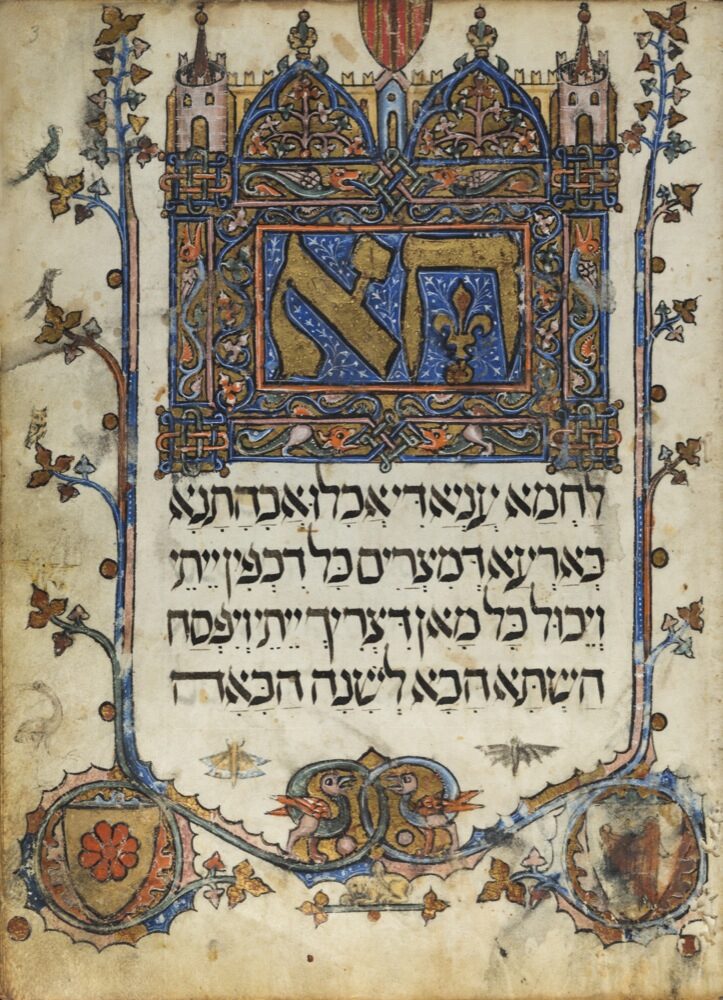
- Archaeology: the wing holding the museum’s most-cited object, the Sarajevo Haggadah, the 14th-century Sephardic illuminated manuscript that has been in the collection since 1894 and was inscribed on UNESCO’s Memory of the World International Register in 2017. The archaeological collection also holds Roman-era finds from Bosnia, medieval Bosnian coins and jewellery, and the Butmir Neolithic collection (see our piece on Butmir).
- Ethnology: the wing holding pre-modern Bosnian textiles, jewellery, agricultural implements, and documentary materials of Bosnian rural life. The socialist Yugoslav administration substantially expanded this wing.
- Natural history: the taxonomic collections of Bosnian flora and fauna, the mineralogical collections, and paleontological materials. The botanical garden between the four pavilions is administratively part of this wing.
- Administration: the offices, research library, and curatorial workshops. The smallest of the four.
The botanical garden at the centre of the composition is what makes the four-pavilion arrangement work. Each wing looks inward toward the garden. The garden contains the stećak collection — medieval Bosnian tombstones assembled from various sites across Bosnia and displayed as an outdoor exhibition since the 1920s (see our piece on the botanical garden stećaks).
What the Vienna twin argument means
Trapara’s argument about the Vienna-Sarajevo pair deserves a closer reading. The case for the pair rests on three elements.
First, the formal vocabulary. The Ringstrasse civic pavilion type that Vienna established in the 1860s and 1870s had clear features: a rectangular footprint with corner pavilions; a mansard roof; a tall arched central entrance flanked by paired columns or pilasters; a horizontal cornice line at the roof spring; decorative rustication at the ground floor; a programmed relationship between the exterior facade and the interior circulation. All these elements appear in the Sarajevo museum’s four pavilions.
Second, the institutional programme. The Vienna Künstlerhaus was designed to house the Association of Austrian Artists (Gesellschaft bildender Künstler Österreichs), a bourgeois-cultural institution. The Musikverein was designed to house the musical society of Vienna. The Sarajevo Zemaljski muzej was designed to house the comprehensive natural-historical-cultural collection of Bosnia and Herzegovina. All three are late-nineteenth-century civic-cultural institutions using the same architectural vocabulary.
Third, the imperial-provincial relationship. Vienna was the metropole. Sarajevo was the peripheral provincial capital. The Ringstrasse civic vocabulary was, in Habsburg architectural practice, the expression of imperial civic modernity. Applying it to a peripheral provincial capital — compressing it into the four-in-one Sarajevo museum — made Sarajevo legible as an imperial provincial capital.
The building compressed one generation of Ringstrasse civic architecture into a Bosnian institutional package.
The 1913 opening and its meaning
The opening of the Zemaljski muzej in 1913 came at a critical moment in Habsburg-Bosnian history. Five years earlier, in 1908, Austria-Hungary had formally annexed Bosnia and Herzegovina, converting the 1878 military occupation into a permanent territorial acquisition. The 1908 annexation had provoked an international crisis of the same year and had contributed to the tensions leading up to the June 1914 Sarajevo assassination.
The museum opening in 1913 was, in that context, a consolidating gesture. The museum institutionalised Habsburg cultural presence in Bosnia at the moment when the Habsburg political presence was being made permanent. The four-pavilion Ringstrasse-vocabulary building was a visible statement about who ran Bosnia, and in what cultural terms.
Nine months after the museum opened, in June 1914, Gavrilo Princip fired the two shots that would end the Habsburg administration of Bosnia within four years.

The interwar and Yugoslav periods
Between 1918 and 1941, the Zemaljski muzej continued to operate under the new administration of the Kingdom of Serbs, Croats and Slovenes (later Yugoslavia). The institutional structure held. The collections continued to grow.
During the Second World War (1941–1945), German-Ustaša occupation forces controlled the museum. Museum librarian Derviš Korkut and director Jozo Petrović hid the Sarajevo Haggadah in a mountain village to prevent Nazi looting. Yad Vashem recognised Korkut as Righteous Among the Nations in 1994 for that act.
The socialist Yugoslav period (1945–1992) brought institutional consolidation. New curators joined the staff, socialist-era acquisitions expanded the collections, and the scholarly output grew more systematic. The published catalogues, the journal Glasnik Zemaljskog muzeja (published since 1889), and the research programmes shaped mainstream Bosnian archaeology and ethnology of the socialist period.
The siege damage and the 2012–2015 closures
Between April 1992 and February 1996, the siege severely damaged the Zemaljski muzej. Multiple direct shell impacts hit the building. The glazing shattered. The interior finishes and mechanical systems broke down. But curators largely preserved the collections — they worked through the war years to protect the objects, moving vulnerable pieces to secure storage, cataloguing damaged pieces for later restoration.
The Sarajevo Haggadah stayed in the museum throughout the siege, protected in the climate-controlled vault installed during the 1980s. Nobody evacuated it. The staff preserved it in place.
After the 1996 end of the siege, the museum operated on a diminished basis for over a decade. Building repairs were partial. State funding was inconsistent. The institutional structure — the Zemaljski muzej is a federal institution rather than a cantonal one — got caught in post-Dayton political disputes about who should pay for it.
In October 2012, the museum closed to the public, the first time in its history. The closure was caused by unpaid staff salaries and unresolved federal-cantonal funding disputes. The museum reopened briefly in 2014 through emergency funding, then closed again.
On 15 September 2015, the museum reopened permanently through international donor support and renewed federal commitment. The opening ceremony marked what the museum’s director characterised as “the second opening” of the Zemaljski muzej — a second inauguration one hundred and two years after the 1913 first opening.
What survives in the building today
The four-pavilion complex Pařík designed in 1909–1913 is still there. The Ringstrasse civic vocabulary is still legible in the mansard roofs, the arched fenestration, the rustication, the formal entrance sequence.
The botanical garden at the centre, with the stećak collection, is still open. The four wings still house archaeology, ethnology, natural history, and administrative functions. The Sarajevo Haggadah is on display in the archaeological wing, in a climate-controlled vault that is opened to visitors on scheduled days of the week.
Contemporary visitors can see, in the fabric of the building, the traces of the siege damage. The pockmarks on the exterior facades from shell fragments. The patched interior finishes. The mechanical systems installed during the 2015 reopening reconstruction.
For visitors
The Zemaljski muzej Bosne i Hercegovine is open Tuesday through Sunday (closed Monday). Opening hours are typically 10:00–19:00 in summer, 10:00–14:00 on weekends in winter. Admission is a modest ticket — verify current pricing on the museum website.
- Address: Zmaja od Bosne 3, Sarajevo.
- Coordinates: approximately 43.8548° N, 18.4067° E.
- Access: Tram 3 to the Museum stop.
- What to see: the Sarajevo Haggadah (in the archaeological wing); the stećak collection in the botanical garden; the ethnological displays of Bosnian traditional textiles; the building itself as the Vienna-Ringstrasse-in-Sarajevo architectural object.
Sources
- Boris Trapara, From Vienna to Sarajevo, role models and replicas in the architecture of Austro-Hungarian period (joint PhD dissertation, INALCO Paris and International Burch University Sarajevo, 2019), Chapter 4 specifically on the National Museum ↔ Künstlerhaus and Musikverein pair. HAL archive.
- Zahra Kadkani-Schmitt, Framing Bosnia: The Politics of Architecture and City Building in the Austro-Hungarian Administration of Bosnia and Hercegovina, 1878–1903, PhD dissertation, University of California, Berkeley, 2017 — for the wider intellectual context of the Habsburg civic architectural programme.
- Zemaljski muzej Bosne i Hercegovine, official history and collections at zemaljskimuzej.ba.
- Ibrahim Krzović, Arhitektura Bosne i Hercegovine 1878–1918 (Sarajevo: Umjetnička Galerija BiH, 1987) — the standard Bosnian-language account of the Habsburg-period architecture including the Pařík museum.
- UNESCO Memory of the World International Register — the 2017 inscription of the Sarajevo Haggadah (see our piece on the Haggadah for the inscription details).
- Related pieces on this site: Karel Pařík, Sarajevo’s Vienna twins, The Sarajevo Haggadah, The stećaks in the botanical garden, Butmir Neolithic, The Kállay era, Alexander Wittek.
Sources & further reading
- Boris Trapara, 'From Vienna to Sarajevo, role models and replicas in the architecture of Austro-Hungarian period' (joint PhD dissertation, INALCO Paris and International Burch University Sarajevo, 2019), Chapter 4
- Zahra Kadkani-Schmitt, 'Framing Bosnia: The Politics of Architecture and City Building in the Austro-Hungarian Administration of Bosnia and Hercegovina, 1878–1903' (PhD dissertation, UC Berkeley, 2017)
- Zemaljski muzej Bosne i Hercegovine — official history and collections
- Ibrahim Krzović, 'Arhitektura Bosne i Hercegovine 1878–1918' (Sarajevo: Umjetnička Galerija BiH, 1987)
Keep reading
More from the guide.

Sarajevo Main Post Office — Vancaš copied Otto Wagner's Vienna original, and finished eight months before the assassination
The Sarajevo Main Post Office, designed by Josip Vancaš and opened in 1913, is the largest Vienna Secession building in Sarajevo. Boris...

Sarajevo — the 1882 revolt that made the Habsburgs build for thirty years
The Berlin Treaty of 1878 gave Austria-Hungary the right to occupy Bosnia and Herzegovina. Four years later, in January 1882, the administration...

Sarajevo — the first European hotel in Bosnia opened in 1882 on the ashes of a han that had burned three years earlier
Tašlihan burned in the 1879 fire. Three years later, on the same ground, Karel Pařík designed Hotel Europa — the first European...