Sarajevo National Museum — Wikipedia names the building but misses the Vienna twin
English Wikipedia now names Karel Pařík as the architect of the National Museum's 1913 quadrangle. What it still does not tell is the architectural genealogy: Trapara's 2019 dissertation pairs Pařík's four-pavilion design with the Vienna Ringstrasse complex. The encyclopaedia has the name but not the argument.


Pull up the English Wikipedia article on the National Museum of Bosnia and Herzegovina. The article now runs to several thousand words and names Karel Pařík as the architect of the 1913 expansion — a significant improvement over earlier versions. It describes the four symmetric pavilions and the Italian Renaissance Revival style. What it still does not contain is the architectural genealogy: that Pařík’s quadrangle has a documented twin on the Vienna Ringstrasse, and that the museum’s compositional logic was a deliberate provincial translation of the Ringstrasse institutional grammar.
Boris Trapara’s 2019 doctoral dissertation, From Vienna to Sarajevo, jointly supervised by INALCO Paris and International Burch University Sarajevo, open-access at the French national HAL archive, devotes a full chapter to this pairing. The scholarship is there. The encyclopaedia has named the architect but not yet told the architectural argument.
The twin
Trapara’s Chapter 4 pairs five Sarajevo buildings with five Vienna originals. The National Museum is one of the five. His argument: Karel Pařík designed the current museum complex between 1909 and 1913 as a four-pavilion quadrangle, four wings around a central botanical garden, and the compositional model was the Kunsthistorisches Museum and the Naturhistorisches Museum on Vienna’s Maria-Theresien-Platz, plus the broader Ringstrasse ensemble of monumental public buildings arranged symmetrically around gardens and open space.
The parallel is not vague. Pařík studied at the Vienna Academy during the years the Ringstrasse museums were completing. The quadrangle plan — symmetrical pavilions flanking a central green — is the Ringstrasse’s institutional grammar scaled down to a provincial capital. Trapara’s dissertation reads the proportional relationships, the pavilion massing, and the garden-courtyard axis as direct translations. Not copies in the photographic sense; translations in the architectural sense — the same sentence structure, adapted to a smaller vocabulary.
Kadkani-Schmitt’s 2017 UC Berkeley dissertation reinforces the point from the administrative side. The National Museum was part of the broader Habsburg civic-building programme in Bosnia: architecture as political tool, designed to make a provincial capital feel like part of the empire’s institutional world. A Sarajevan walking into the museum quadrangle was meant to recognise the grammar of Vienna’s public buildings without needing to have been to Vienna.
What the Wikipedia article misses
Three gaps:
No architect. The article does not name Karel Pařík. He is the architect of the 1909–1913 quadrangle, the building the visitor walks into today. He is also the architect who supervised the Vijećnica construction and designed the National Theatre. The most prolific architect of Habsburg Sarajevo is absent from the English Wikipedia article on his most important museum building.
No architectural description. The article describes the museum’s collections (natural history, archaeology, ethnology, the Haggadah) but says nothing about the building itself, its four-pavilion plan, its Neo-Renaissance façades, its central botanical garden, or its relationship to the Habsburg civic programme. A reader finishes the article knowing what is inside the museum but not what the museum looks like or why it looks that way.
No Vienna connection. The Sarajevo-to-Vienna architectural genealogy is documented in a freely available English-language dissertation. Trapara’s pairing of the National Museum with the Ringstrasse complex is one of the clearest examples of the Habsburg provincial-replica pattern, the same pattern that produced the Vijećnica (from the Ringstrasse Rathaus grammar), the National Theatre (from Hansen’s Stock Exchange), and the Presidency building (from the Museum of Applied Arts). None of this has reached the English-language encyclopedia.
Why the gap costs the reader
The National Museum houses the Sarajevo Haggadah — the most-cited cultural object in Bosnia and Herzegovina, inscribed on UNESCO’s Memory of the World register in 2017. A significant number of English-language readers arrive at the Wikipedia article because they are looking for the Haggadah. They leave without knowing that the building holding it is itself a designed object with an architectural argument: a late-Habsburg quadrangle modelled on the Vienna Ringstrasse, built by a Czech architect who had been in Sarajevo for twenty-five years by the time the plans were drawn.
The building is part of the story. The building is the reason the Haggadah is there at all, the museum acquired the manuscript in 1894, and the quadrangle was built to house a growing collection that included it. Pařík’s quadrangle and the Haggadah’s survival are the same institutional story.
The correction is sitting in the open
Trapara’s dissertation is at theses.hal.science/tel-02992615v1. Kadkani-Schmitt’s is at escholarship.org/uc/item/8p48885f. Both are in English. Both are open-access. Both name the architect, describe the building, and trace the Vienna connection with archival evidence. The correction is not a matter of opinion or interpretation, it is documented scholarship that has not yet been transcribed into the reference the most readers will reach first. That is a normal state of affairs for a volunteer encyclopaedia, and it is correctable.
By Nedim Hadzimahmutovic · last updated 14 July 2026
Sources & further reading
Keep reading
More from the guide.

Sarajevo modernism began with 15,000 letters from Le Corbusier's Paris studio
Between 1933 and 1941 the Slovenian architect Dušan Grabrijan taught at the Secondary Technical School in Sarajevo, and between the same years...
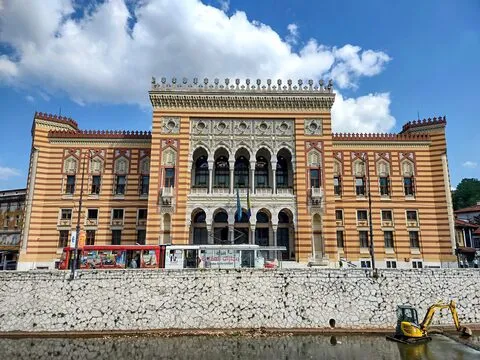
Sarajevo Vijećnica — Wikipedia now names Pařík, but still does not tell his story
Wikipedia’s English article on Vijećnica credits Alexander Wittek (design) and Ćiril Iveković (completion). It does not mention Karel Pařík, the Czech architect...
Sarajevo Vijećnica — Pařík drew it in August 1892, Kállay personally rejected it, then Wittek re-dressed it
The stock story of Sarajevo Vijećnica names Alexander Wittek as the architect, Iveković as his completer, Pařík as the site supervisor. Nedžad...