Sarajevo — the Jerusalem of Europe, and why the phrase is older than tourism marketing
Sarajevo is sometimes called the Jerusalem of Europe. Most people who hear the phrase assume it's tourism-board copywriting — but it isn't. The nickname is older than modern tourism by four centuries. It began in the 16th century as *Mali Jeruzalem* (Little Jerusalem), the name the Sephardic Jews expelled from Spain in 1492 gave to the young Ottoman city they had made their new centre. A second layer — the four faiths within a 400-metre radius — was added under Habsburg rule between 1878 and 1918. A short honest account of both.
Sarajevo is sometimes called the Jerusalem of Europe. If you have opened a travel brochure about Bosnia in the last twenty years, or read a piece in the Guardian travel section, or seen the tourism board’s own promotional material, you have almost certainly met the phrase. Most people who meet it assume it is modern tourism copywriting — a plausible-sounding line invented in an office in Sarajevo or Vienna to sell a nice weekend break.
It isn’t. The nickname is roughly five hundred years old. It comes from the same century the city was founded, and it started as a name the Sephardic Jewish community gave the city themselves.
Here is where the phrase actually comes from, in two layers.
The first layer — Mali Jeruzalem, 16th century onward
In 1492, Catholic Spain issued the Alhambra Decree, expelling its Jews — the Sephardim, the largest and most cohesive Jewish community in western Europe at the time. Tens of thousands were forced out. Most travelled east.
The Ottoman Empire — under Sultan Bayezid II (r. 1481–1512) — opened its borders to the refugees. The line often attributed to Bayezid, that Ferdinand of Spain had “impoverished his own country to enrich the Ottoman lands”, comes from a 17th-century chronicler (Immanuel Aboab) rather than a contemporary source, and is best treated as tradition rather than verbatim history. The policy is real, though. The Ottoman state took in the Sephardic refugees; they settled across the empire, and a substantial community made its way to Sarajevo.
Sarajevo, at that point, was thirty years old — founded around 1462 by Isa-beg Ishaković. It was a young Ottoman regional capital being built from the ground up, and a Jewish community with capital, skills, literacy, and trade networks was welcome. The Sephardim built a synagogue and a residential quarter (the Čifuthana or Il Cortijo, the Great Courtyard) inside the bazaar. They brought their language — Ladino, or Judeo-Spanish — with them, and it continued to be spoken in the city for four hundred years.
By the 16th and 17th centuries, Sarajevo had become one of the small but real centres of Sephardic culture in the Ottoman world. There was a Ladino printing press, a scholarly tradition, working synagogues, and the manuscript that would later be known as the Sarajevo Haggadah — a 14th-century Spanish illuminated codex that had travelled east with a Sephardic family and been kept in the city ever since. To the wider Jewish world, Sarajevo was known as Mali Jeruzalem — Little Jerusalem.
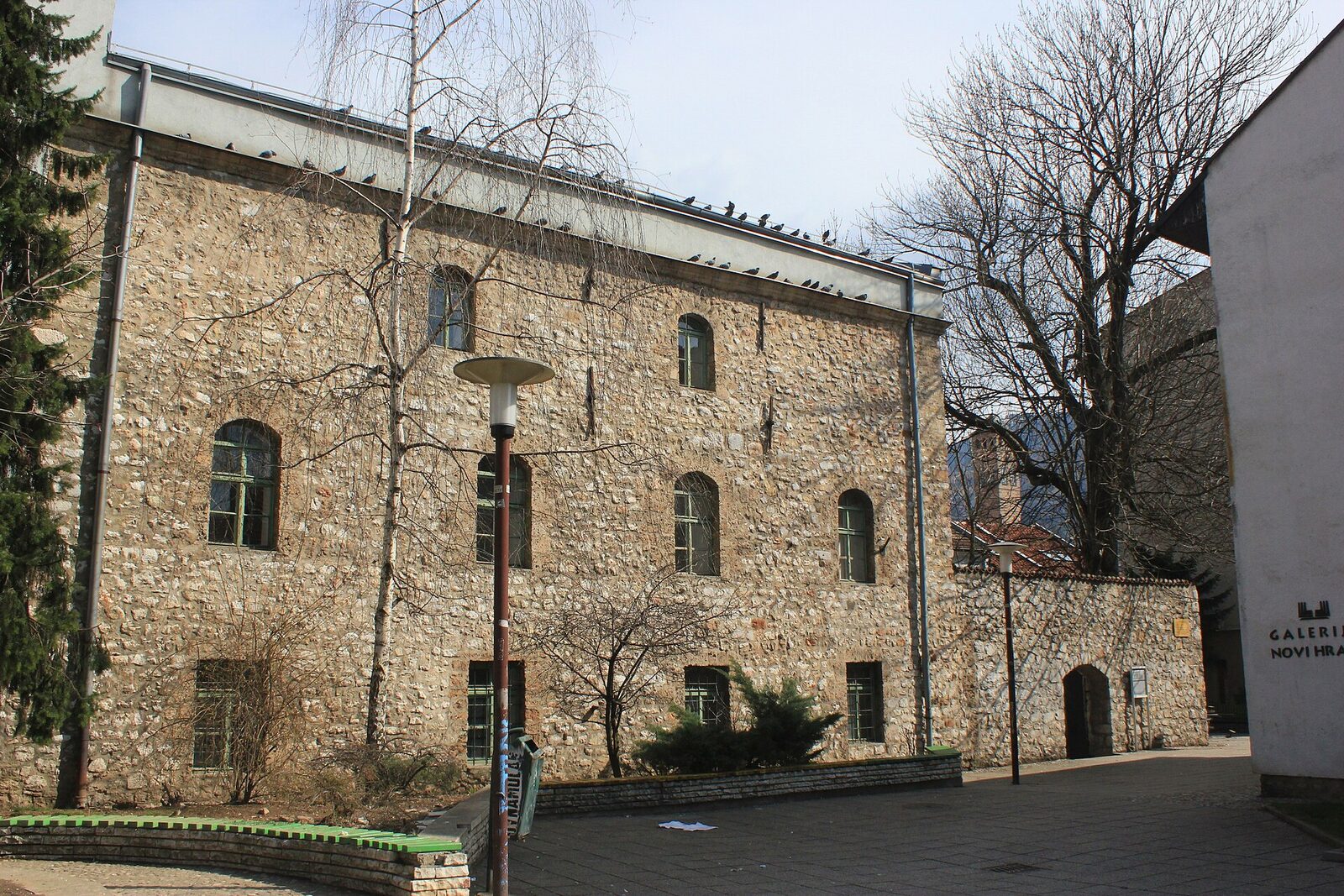

That is the original nickname. The Bosnian Mali Jeruzalem and the Ladino Kal Grande (the Great Community) both refer to the same fact: this was a real Sephardic centre, small compared with Salonica or Istanbul, but culturally serious.
The current English phrase, “the Jerusalem of Europe”, is a 20th-century inheritance of that older name — a translation, essentially, retooled for a European audience once the Sephardic community itself was no longer the primary carrier of the label.
The second layer — the four faiths in 400 metres
The English phrase held on into the 20th century for a second reason, which was added under Habsburg rule.
Between 1878 and 1918, the Austro-Hungarian administration reshaped Sarajevo as a modern imperial provincial capital. Among other things, it built the central places of worship for the three faith communities that did not yet have monumental buildings in the city: the Orthodox Cathedral of the Nativity of the Theotokos (1868, actually late-Ottoman but on the Habsburg trajectory), the Sacred Heart Catholic Cathedral (consecrated 14 September 1889), and the Ashkenazi Synagogue (1902). The Gazi Husrev-beg Mosque (1531) had been the Muslim community’s central place since the 16th century.
The result was a geometric fact that no other European capital could match: the central place of worship for four different faith communities within a 400-metre radius of each other, all still active, all still open. Five minutes’ walk between any two of them. Two hours to visit all four.
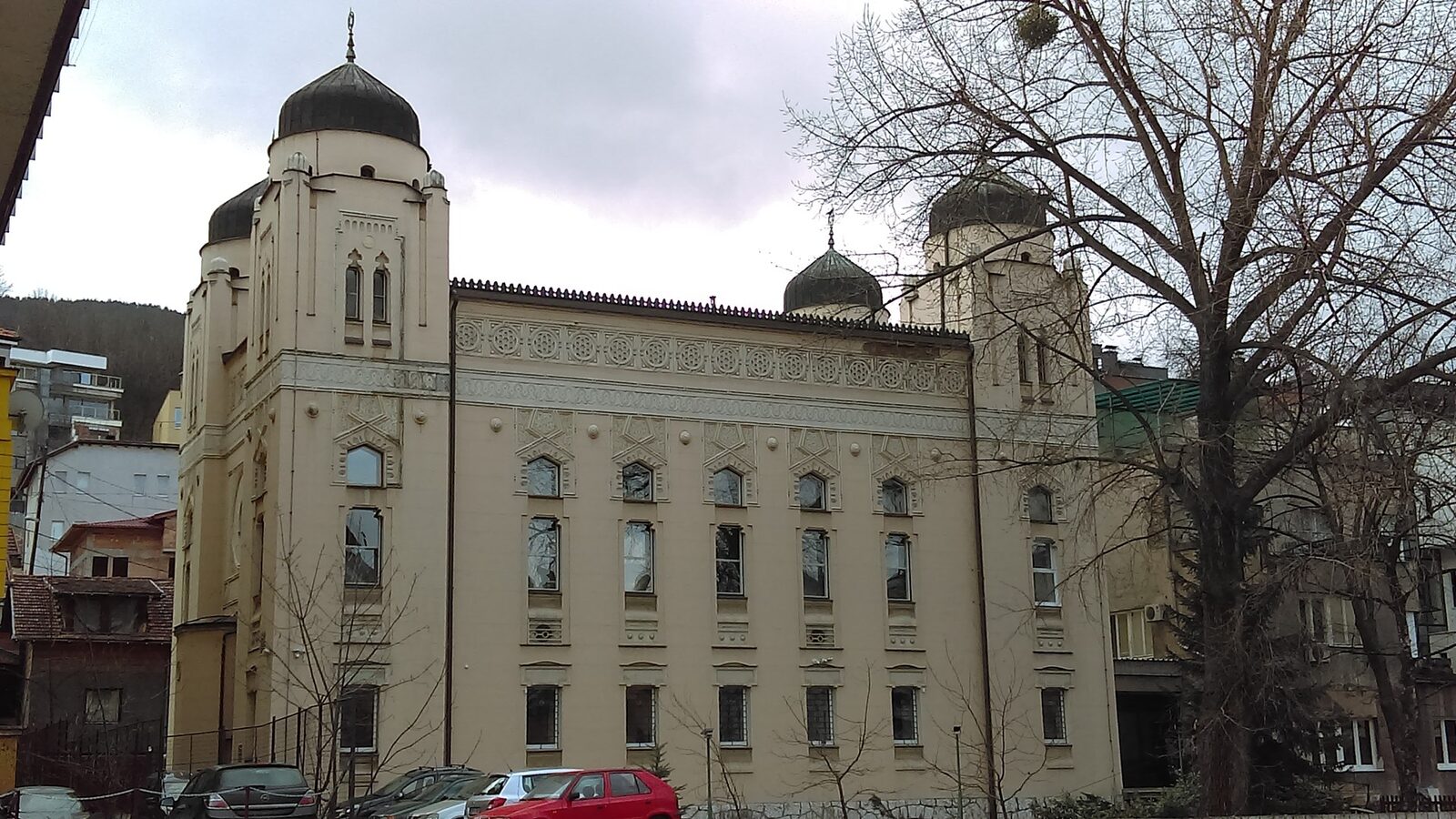

That geometric fact is what the modern “Jerusalem of Europe” phrase points at, once tourism materials started using it in the second half of the 20th century. The phrase carries two things at once now: the Sephardic Mali Jeruzalem memory from the 16th century, and the four-faith building density from the Habsburg period.
Both are real. Both are load-bearing. The label is not marketing invention.
The honest limits of the phrase
That said — “the Jerusalem of Europe” is a loose label, and it does the city few favours in some ways.
It flattens. Sarajevo was and is a specific place. The comparison to Jerusalem is a shorthand that helps a first-time visitor understand what to expect, but the two cities have very little in common beyond religious plurality: different geographies, different empires, different tempos, different centuries of formation.
It over-sells. The Sephardic community that made Sarajevo Mali Jeruzalem was largely destroyed in the Holocaust — around 10,500 of Sarajevo’s ~12,000 Jews were killed between 1941 and 1945. What remains today is a small (~500-person) community, active but small, keeping the Old Temple, the Ashkenazi Synagogue, and the Old Jewish Cemetery alive. The city that carries the nickname today is not the city that earned it.
It sits alongside a much darker fact. The four-faiths geometry has, in the twentieth century alone, endured a genocide (the Ustaše against Jews and Serbs, 1941–1945), a communist secularisation drive (1945–1990), and a siege in which one of those faith communities’ irregular forces surrounded and shelled the city for 1,425 days (1992–1996). The plural city is not a natural, stable equilibrium. It is a hard-won thing.
The label is real. The nickname has genuine roots. But the ease with which the phrase gets deployed — as if the multi-faith city were a permanent, comfortable, effortless condition — is not honest to what it took to keep it going.
How to walk it
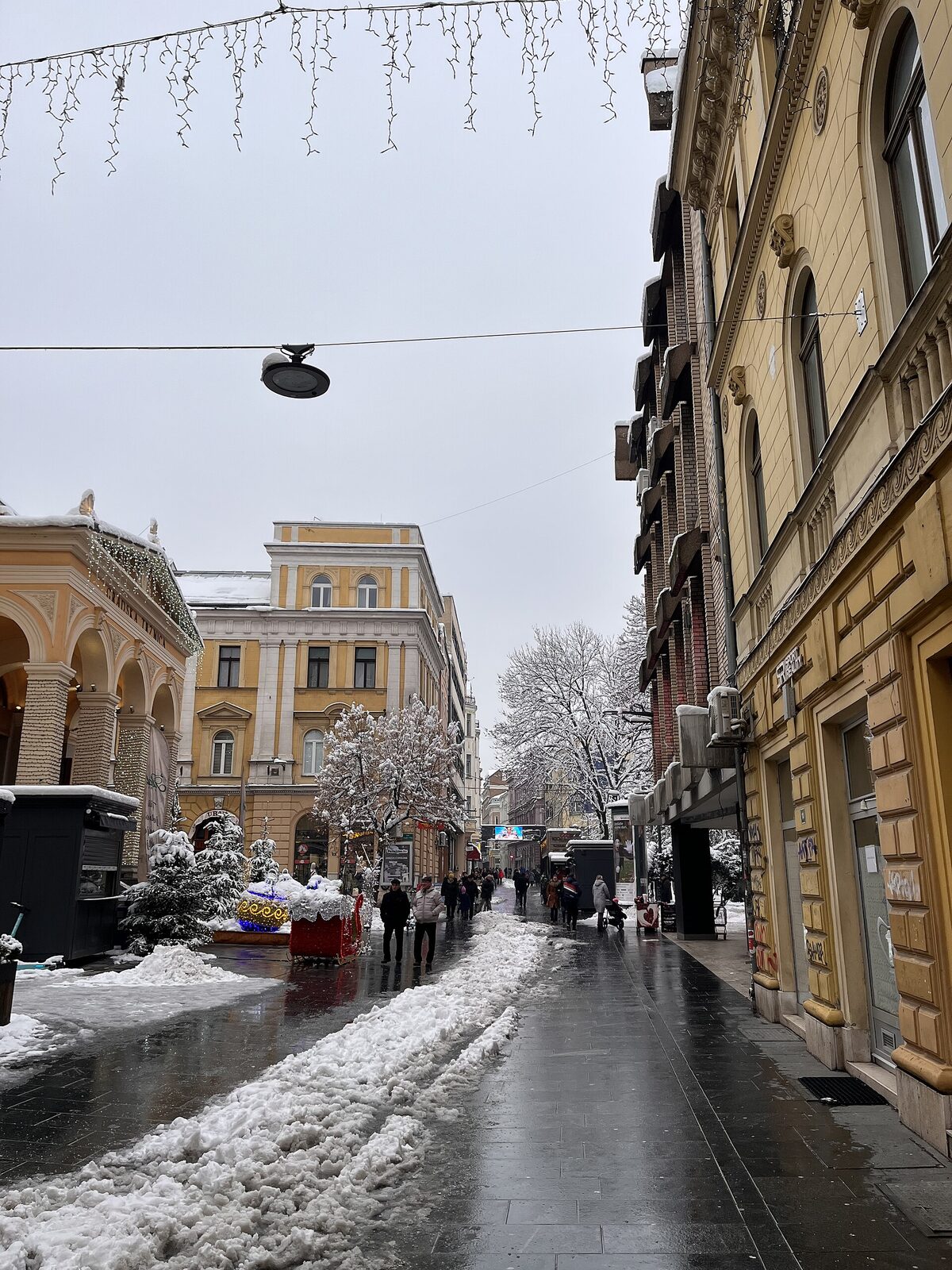

If you want to see the four-faiths geometry for yourself, the route is a short afternoon:
- Start at the Sebilj at the east end of Baščaršija.
- Walk west through the bazaar to the Gazi Husrev-beg Mosque (1531, Ottoman). Modest dress, remove shoes to enter.
- Continue west along Ferhadija to the Meeting of Cultures brass line in the pavement, the physical marker of the transition from Ottoman to Habsburg city.
- Two minutes further west, on your left, the Orthodox Cathedral (1868). Open, active, quiet.
- Two minutes further, the Sacred Heart Catholic Cathedral (1889) on the corner.
- Four minutes east back along the Miljacka, then across to the Ashkenazi Synagogue (1902) on the south bank.
Two hours. Four faiths. One city. That is what the phrase points at, walked.
What the phrase is worth
Mali Jeruzalem was a name the community itself gave the city, in a language (Ladino) that the community itself spoke, in a century (the 16th) when it was newly settled and building institutions from scratch. That is a phrase with a specific historical weight.
“The Jerusalem of Europe” is a 20th-century English inheritance of that. It carries the Sephardic memory forward. It is often over-used and casually deployed. But if you know where it comes from, and you walk the four buildings in an afternoon, the phrase becomes what it should be — a compressed piece of five hundred years of religious plurality, not a brochure line.
Read it as historical inheritance, not as marketing. The city has earned it.
Sources & further reading
- Related on this site: Sarajevo Meeting of Cultures (destination page)
- Related on this site: Sarajevo Ashkenazi Synagogue
- Related on this site: Sarajevo Orthodox Cathedral
- Related on this site: The Sarajevo Haggadah
- Related on this site: Sarajevo hub page
- Sarajevo — Wikipedia (multiethnic history section)
Keep reading
More from the guide.

Who was assassinated during a visit to Sarajevo in Bosnia
Archduke Franz Ferdinand of Austria and his wife Sophie Chotek were assassinated in Sarajevo on Sunday 28 June 1914 by Gavrilo Princip,...

Sarajevo in seven censuses — 175 years of counting a city
Sarajevo has been counted seven times in ways that survive. From the 1851 late-Ottoman nüfus register through the four Habsburg censuses of...

Sarajevo 1814 — the vali had 80,000 troops, the rebels 12,000, and the French consul bet on the wrong side
Our earlier post on the 1814 Sarajevo revolt gives you the outcome: the sultan sacked the vali. Šljivo’s archival source is the...