Sarajevo — how Henri Moser sold it to Victorian Britain
In the 1890s a Swiss watchmaker's son, disgraced in Russia, bankrupt in Central Asia, and reinvented as a scholar of Islamic art, was employed by the Austro-Hungarian regime to write Bosnia into the British upper-class travel imagination. A short guide to a forgotten piece of Sarajevo tourism history.
Before the First World War, Bosnia was a British holiday destination.
That sentence reads strangely now. The received view is that until Yugoslavia broke apart in 1991, British visitors did not come here except on political missions or as journalists. Ross Cameron’s 2023 article in the Journal of Tourism History corrects the record. For two decades before 1914, Bosnia was a fashionable upper-class British destination. Sarajevo had English guidebooks. The country was marketed in the Fortnightly Review and the Westminster Gazette. And the person doing most of that marketing was a Swiss watchmaker’s disgraced son, hired by the Habsburg regime for the job.
His name was Henri Moser.
Who Moser was, and how he ended up working for the Habsburgs
Moser was born in Saint Petersburg in 1844, the son of the Swiss watchmaker and industrialist Heinrich Moser, who had made a fortune selling clocks to the Russian imperial court. A scandalous personal life led to Moser’s estrangement from his father and, after a family split, to his attempt to join the Russian general Mikhail Skobelev’s 1866 Central Asian campaign, an attempt he made without an invitation and which failed on arrival, since the key battles were already fought.
The trip did two things for Moser. It bankrupted him. And it introduced him to Islamic Central Asian material culture, an interest that would shape the rest of his life. He recuperated at his sister’s estate in Transylvania, she was married to a Hungarian count named Benedek Mikes of Zabola, and, during his convalescence, was introduced into upper-echelon Austro-Hungarian society. Cameron cites the historian Ágnes Sebestyén for the plausible suggestion that Moser met the future joint Finance Minister Benjamin von Kállay during this Transylvanian period.
Kállay took over the joint Ministry of Finance in 1882 and, under the odd Habsburg administrative arrangement of the time, that gave him political control of Bosnia and Herzegovina. He would hold the position until his death in 1903. Cameron argues that Kállay’s Bosnia policy had three prongs: modernise, integrate, and advertise, and that Moser was central to the third prong.

The book that sold Bosnia to Britain
Between his Central Asian misadventure and his Austro-Hungarian employment, Moser wrote two books on Central Asia, À Travers l’Asie Centrale (1885) and L’irrigation en Asie Centrale (1894). The first was lavishly illustrated with engravings from photographs taken on his 1883 journey with Prince Wittgenstein and established him, in the eyes of the British press, as a proper “authority” on the region. The Swiss artist Evert van Muyden contributed a portrait of Moser to the frontispiece: rifle in hand, dressed in Russian military uniform with oriental textiles and the skins of big cats draped across his shoulders. Cameron reads it, correctly, as a portrait of a self-invented “explorer”.
The Central Asian books were never translated into English. But because Anglo-Russian rivalry over Central Asia was at its peak in the 1880s, the so-called Great Game, they were widely reviewed in the British press. Moser became, by the mid-1880s, a name.
In 1895, working under Austro-Hungarian sponsorship, Moser published the book that would become the template for British tourist writing on Bosnia for the next twenty years: An Oriental Holiday (French: Une villégiature orientale). It was a guidebook, in Paul Fussell’s technical sense, impersonal, programmatic, “raw data” for a prospective visitor. It listed hotels, described roads and railway timetables, catalogued attractions, and situated the country as a picturesque, safe, and above all civilised place for a European upper-class tourist to spend a few weeks. That last word, civilised, was the whole point.
The pitch, in one paragraph
The British upper-class tourist of the 1890s had a problem. Switzerland, the Franco-Italian Riviera, and the standard Continental destinations had been, in the phrasing of the historian John Pemble that Cameron cites, transformed into “the playground of the multitude”. Cook’s Tours had industrialised European travel. The distinctions the leisure class relied on, where you went, how you got there, whom you met on arrival, had been eroded by railway timetables and steamship pricing.
Bosnia, Moser’s book argued, was the answer. It was exotic enough to satisfy the aristocratic taste for the picturesque, but safe, because Austria-Hungary had, since 1878, built comfortable hotels, reliable railways, and a functioning administrative apparatus. It was peasant and Muslim enough to feel foreign, but modern enough to be habitable. It was cheap. It was uncrowded. Above all, it had not yet been discovered by the wrong sort of tourist.
Cameron summarises the pitch, quoting E.M. Forster’s A Room with a View (1908), as a promise that the traveller could “distinguish themselves from mass tourism”, which had transformed the established destinations into what Miss Lavish calls “the narrowness and superficiality” of lower-class tourists. The paradox of the pitch, that the destination was recommended precisely because it was hard to reach and expensive to travel to, was, in class terms, the whole appeal.
What the tourists saw
Cameron’s article catalogues the British writers who followed Moser: Robert Munro, Harry de Windt (“special correspondent” for the Westminster Gazette, 1905), Arthur Evans (the archaeologist, before he became famous for Knossos), Adelina Paulina Irby (whose Travels in the Slavonic Provinces of Turkey-in-Europe had a preface by William Gladstone), and others. What they wrote about was consistent:
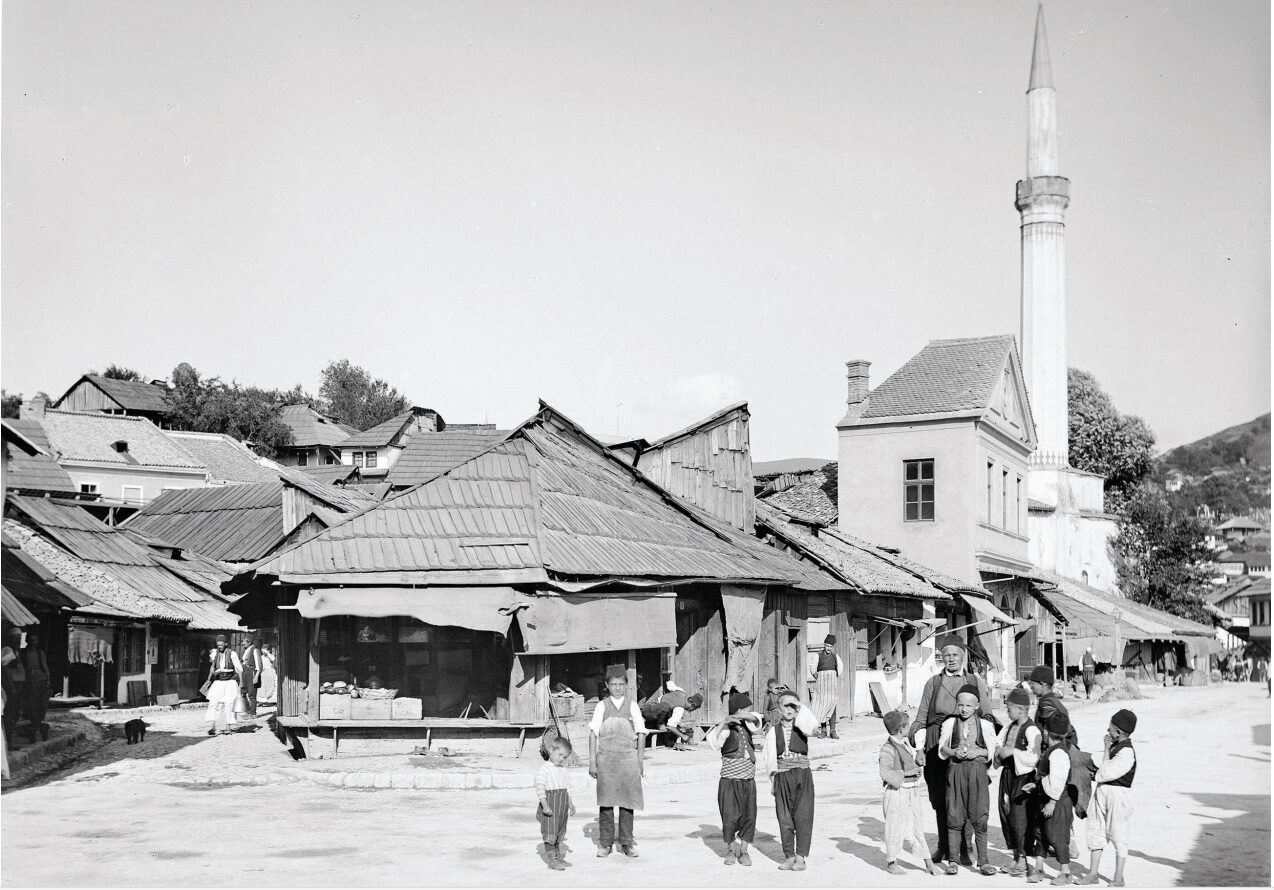
- Baščaršija as an Ottoman survival, coppersmiths, hans, the Sebilj.
- The mosques and turbe, particularly the Gazi Husrev-beg complex.
- The Habsburg administrative buildings, the Vijećnica after 1896, the Post Office after 1913, the Sacred Heart Cathedral, the National Museum, as evidence of the “civilising mission”.
- The countryside: peasant costume, “unspoilt” villages, agricultural life described in the anthropological register.
- The kawas (armed guardians) who accompanied European travellers into the interior. Almost every British account mentions the kawas, it was, in effect, the Habsburg administrative apparatus renting security to visitors.
What British tourists did not generally write about, this is Cameron’s point, was the political tension. The gradual annexation of Bosnia in 1908, the resistance to it, the assassination plot that would kill Franz Ferdinand at the Latin Bridge in 1914, these were subjects for the political press, not the leisure guide. Moser’s Bosnia was a Bosnia without dissent.
Why Baščaršija looks like this to a first-time visitor
Two things follow, and both are useful to a reader walking Baščaršija in 2026.
First, the “Oriental” image of Sarajevo that is now marketed to modern tourists is not a residue of Ottoman Bosnia. It is a Habsburg construction, engineered in the 1890s by an Austro-Hungarian administration that needed a positive international image and hired a Swiss adventurer to produce it. The “East meets West” tableau that appears in every Sarajevo tourism brochure is the direct descendant of Moser’s 1895 book. It was designed for a British upper-class buyer.
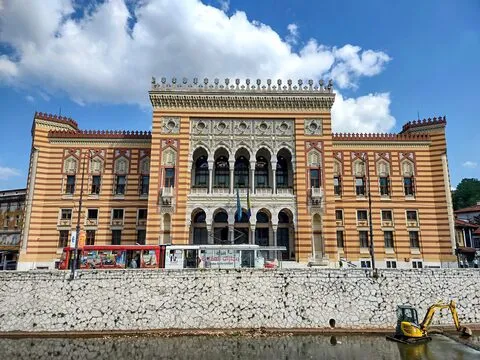
Second, Kállay’s Bosnia policy, modernise, integrate, advertise, is legible on the ground to anyone who has walked the Habsburg quarter. The Vijećnica in Orientalizing style (see Vijećnica has five siblings) was part of the integrate prong. The railway to Ilidža, the reliable hotels, the German-language Bosnische Post were part of the modernise prong. Moser’s An Oriental Holiday was the advertise prong.
The system worked. British tourist numbers in Bosnia rose steadily from the mid-1890s to 1914, and cooled sharply as Austria-Hungary’s alignment with Germany produced anxieties among British commentators about the Habsburgs’ larger political intentions. Then the assassination, then the war, then a hundred years of a very different Bosnia.
Cameron’s article, published in 2023, is 24 pages and freely downloadable under an open licence from the Journal of Tourism History. It is the definitive treatment of the Moser operation. If you take a Sarajevo walking tour and the guide points to a piece of Habsburg administrative architecture, remember that it was almost certainly on Moser’s map before it was on yours.
Sources
- Ross Cameron, “An Oriental Holiday”: constructing Bosnia and Herzegovina as a destination in British tourist literature, c. 1890–1914, Journal of Tourism History 15:3 (2023), 233–256. Open access. DOI
- Henri Moser, Une villégiature orientale (Paris, 1895).
- Robin Okey, Taming Balkan Nationalism: The Habsburg ‘Civilising’ Mission in Bosnia, 1878–1914 (Oxford University Press, 2007).
- Henri Moser Charlottenfels. Wikipedia
Sources & further reading
Keep reading
More from the guide.

Sarajevo 1814 — the vali had 80,000 troops, the rebels 12,000, and the French consul bet on the wrong side
Our earlier post on the 1814 Sarajevo revolt gives you the outcome: the sultan sacked the vali. Šljivo’s archival source is the...
Sarajevo — the book that took the shrapnel: a 1926 letters volume in a Kovačići garden, 22 April 1992
Some siege stories are about buildings. Some are about numbers. This one is about a book. On the night of 22 April...

Sarajevo Kállay era — twenty-one years that built the Sarajevo you walk, run from a desk in Vienna
Béni Kállay ran Bosnia-Herzegovina from a desk in Vienna between 1882 and 1903. His twenty-one-year tenure as Common Minister of Finance overlapped...