
Sarajevo — Thomas Cook sold £46 tours here for eighteen summers, until 28 June 1914
In 1896 Thomas Cook & Son launched its first guided tours to Habsburg Bosnia and Herzegovina. They ran every May to September until 1914. A tour cost between £25 and £46, when a full year of a British working income was £42. Sarajevo, the Illustrated London News wrote, "had a glow of the ultimate East upon it." A short history of the eighteen years when Sarajevo was on the middle-class British itinerary.
In 1896, eighteen years after the Habsburgs occupied Ottoman Bosnia and Herzegovina, the London travel firm Thomas Cook & Son launched its first guided tour to the new provinces. It ran every summer, May through September, for the next eighteen years, until the outbreak of the First World War.
A Cook’s tour to Bosnia cost between £25 and £46. A comparable Swiss tour, in 1897, cost £10 10s. The average British male working income in 1901 was £42 a year. Bosnia was a select excursion. The kind of trip a mid-Victorian doctor’s wife might mention in a letter. An entry in every Baedeker from 1896 to 1911 signalled that the reader had chosen well.
For eighteen years, between the annexation crisis of 1908 and the assassination that ended everything, Sarajevo was on the British middle-class itinerary. The story is short, well-documented, and, until Ross Cameron’s 2023 article assembled it, almost invisible to the current reader.
The Habsburg apparatus
The engine that pulled Bosnia into British travel-agency catalogues was the Habsburg colonial-modernisation project, which the historian Piro Rexhepi has described as an attempt to “synchronise Bosnian Muslims with the historical timeline and space of Europe”. In the thirty years between the 1878 occupation and the 1908 annexation the administration grew from 120 Ottoman civil servants to over 9,500 Habsburg administrators, Austrians, Hungarians, Czechs, and Slovaks, installed to run the new province.
The Times correspondent Henry Wickham Steed, writing at the turn of the century, summarised the transformation for the British reader in fifteen words: the administration had “organised and outwardly converted Bosnia-Herzegovina from a neglected and backward Turkish province into a progressive modern colony.”
That single sentence held the entire British sales pitch for Bosnian tourism. Come see, the pitch said, what Austrian discipline has made of the Turk’s neglected garden.
The Common Ministry of Finance under Béni Kállay (1882–1903) understood that a modern colony required a tourism image in the same way it required a railway and a National Museum. The Habsburgs built all three, in parallel, between 1885 and 1913.

The Cook itinerary
The Cook’s Bosnia tour of the late 1890s ran approximately three weeks. The itinerary is reconstructed from the Baedeker handbook and from surviving Cook advertising in the London illustrated weeklies:
- Vienna, arrival, one night at a Ringstraße hotel.
- Trieste or Fiume, overnight train, then steamer down the Dalmatian coast with stops at Zadar, Split, Ragusa (Dubrovnik).
- Mostar, by rail up the Neretva; visit to Karadjoz-beg Mosque, the Old Bridge, and the karst plateau above; excursion to the Buna spring at Blagaj.
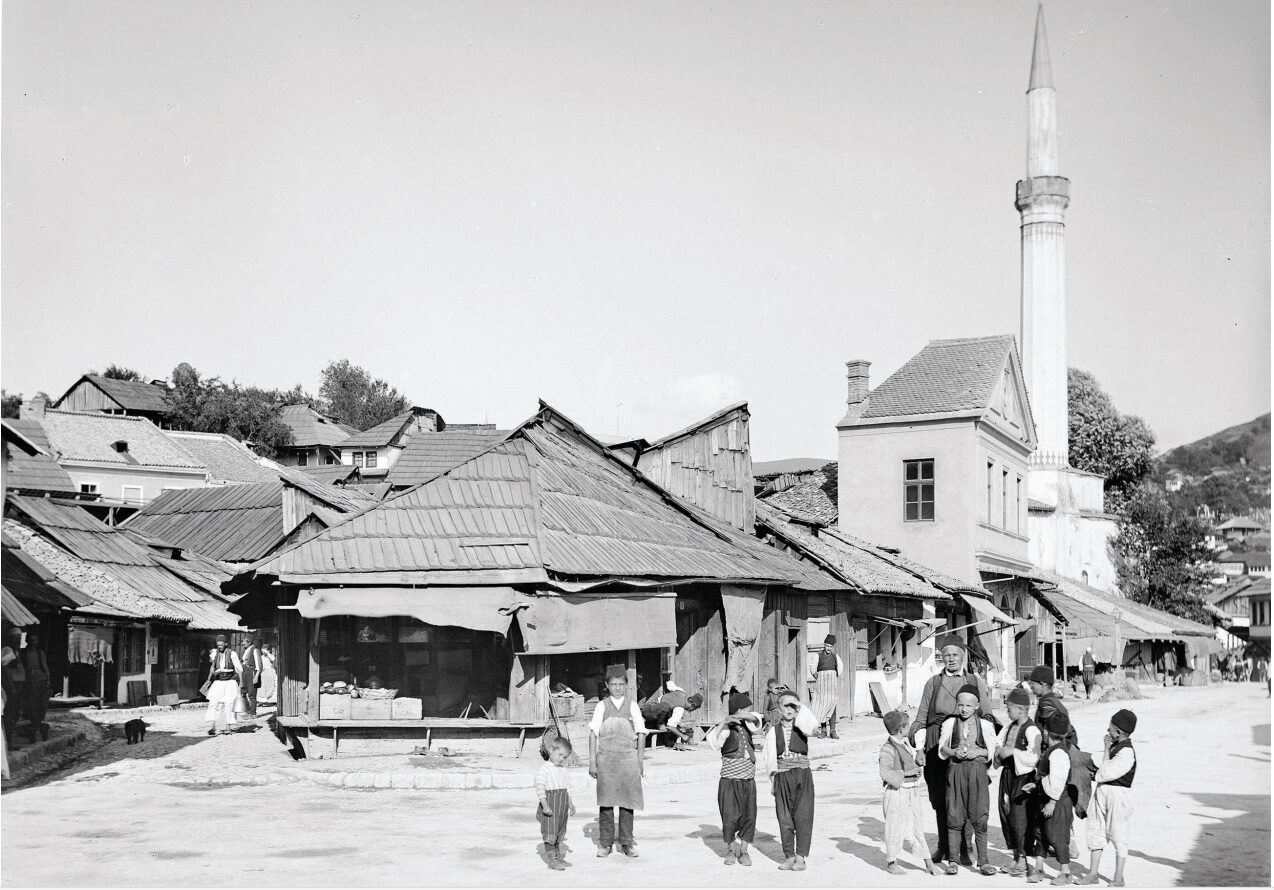
- Sarajevo, three or four nights. The tour visited Baščaršija, the Latin Bridge, the Old Serbian Church, the Cathedral, and the newly-opened National Museum. Excursions to Ilidža for the spa hotel and to Trebević for the panorama.
- Return via Zagreb and Budapest to Vienna, then home.
The Cook advertising presented the itinerary as a middle-East substitute, the Ottoman civilisation, but at railway-connected European prices, with Habsburg policing and Central European hotels. The Illustrated London News, in a 1896 travel feature, wrote of Sarajevo that the city “had a glow of the ultimate East upon it” and that its bazaar was “second only to that of Cairo.” The comparison did the work: for a wealthy British traveller who had already done Cairo, Bosnia was the natural next Orient.
The Baedeker paragraph
The 1896 first edition of Karl Baedeker’s Austria including Hungary, Transylvania, Dalmatia and Bosnia, the standard reference, devoted a substantial section to the new provinces. It was reprinted in 1900, 1905, and 1911. Each reprint added transport corrections, a new hotel entry, a new tramway line. The bones stayed the same.
The Sarajevo entry named:
- The Grand Hotel and the Hotel Europa (three stars; the Grand added by 1911).
- The Ilidža spa hotel, six kilometres out, described as the province’s most comfortable resort.
- Baščaršija as the essential half-day.
- The National Museum, “well-arranged, admission free on Sundays”, with attention to the archaeological collection and, from 1913, the Sarajevo Haggadah (which the Museum had acquired in 1894 but only regularly displayed later).
- The Trebević walk as the best afternoon.
- The Old Serbian Church and the Gazi Husrev-beg Mosque as the two religious buildings.
- The Latin Bridge, noted, from the 1911 edition onward, as the site where “in 1878 the Austro-Hungarian troops first entered the city.”
Read that last line again. The Baedeker of 1911 did not know that within three years a young Bosnian Serb would fire a pistol at that same bridge and change the century.
Ilidža, the spa with the wild-animal cages
The most-photographed Bosnian tourist site of the Cook years was not central Sarajevo. It was Ilidža, the thermal spa five kilometres west of the city, at the foot of the Bjelašnica plateau.
Ilidža had been a Roman thermal site (Aquae Sulphurae), an Ottoman spa, and, after 1892, a Habsburg-engineered resort with a Grand Hotel, a landscaped park, and, for reasons that mid-Victorian tourism has never fully explained, a small zoo of local mountain fauna in cages, viewable from the hotel garden.
The Illustrated London News, in an 1898 feature, described the Ilidža hotel and noted, with the mixture of enthusiasm and mild alarm characteristic of British travel writing of the period, that the hotel’s “recently landscaped English garden” contained “a collection, in cages, of eagles, vultures, bears, and other wild animals indigenous to the country.”
Ilidža was the point of the Cook tour where a British visitor could arrange one of the province’s speciality experiences: a bear-hunt on Bjelašnica, arranged through the local prefecture, at an additional cost that Baedeker did not print.
The British writer boom, 1895–1900
Between 1895 and 1900, at least six substantial English-language travel books appeared on Habsburg Bosnia. Cameron catalogues them:
- Henri Moser, An Oriental Holiday (London: International Sleeping Car Company, 1895). The most-cited of them; Moser was Kállay’s official Commissioner General for Bosnia at the Brussels 1897 and Paris 1900 world expositions. (A separate story on Moser sits here.)
- Anonymous, Ten Days in Bosnia (serialised in the Illustrated London News, 1895).
- Max Pemberton, The Rise of Bosnia (serialised in The Sketch, 1895).
- Robert Dunkin (writing as “Snaffle”), In the Land of the Bora; or, Camp Life and Sport in Dalmatia and Herzegovina (London: Bliss, Sands & Foster, 1897). Dunkin was a professional sports-hunting writer.
- Harry C. Thomson, The Outgoing Turk: Impressions of a Journey Through the Western Balkans (London: Heinemann, 1897). Thomson travelled with the escort of a Captain von Roth of the Bosnian gendarmerie.
- William Miller, Travels and Politics in the Near East (London: T. Fisher Unwin, 1897).
- Robert Munro, Rambles and Studies in Bosnia-Herzegovina (Edinburgh: Blackwood, 1900). Munro’s book was the first English-language travelogue on Bosnia with extensive photographs, a novelty in 1900; he had attended the 1894 archaeological congress in Sarajevo and returned to write the fuller account.
A characteristic sample of the Illustrated London News register: the province was “ideal for tourists who ‘live to open up new countries’” and for whom “Switzerland is passé and the Tyrol a burden.” The tone treats Bosnia as the frontier of European travel, the last place a Baedeker-holder could feel adventurous.
The James Baker press-tour system
The Habsburg administration did not leave the British-language press to write what it wanted. From about 1900 onward, the Ministry of Railways in Vienna ran a paid group-tour system for foreign journalists, coordinated by the London-based journalist James Baker (later awarded the Habsburg Order of Franz Joseph for his services). Baker assembled parties of British writers, brought them out by first-class rail, arranged their itineraries with the provincial governor, and paid their expenses. The published pieces were rarely acknowledged as sponsored.
The largest of the Baker-organised trips, in 1907, brought approximately twenty British journalists to Sarajevo simultaneously. The resulting coverage across The Times, Manchester Guardian, Daily Telegraph, and the illustrated weeklies was, unsurprisingly, favourable.
The end
The last Cook’s Bosnia tour of the 1914 season should have run in July and August. It did not. The archduke was shot on the Latin Bridge on 28 June 1914. By the last days of July the province was on a war footing. By early August Britain was at war with Austria-Hungary. The Cook offices in London and Vienna wound down the Bosnia listings. There was no 1915 tour.
The Habsburg administration collapsed in October 1918. Bosnia entered the Kingdom of Serbs, Croats and Slovenes in December. The British travel-writing establishment did not return for nearly eighty years. When it did, in the mid-1990s, the reason was not tourism.
What survives of the Cook years
Ilidža, the spa hotel Cook’s parties stayed in, was destroyed in the 1992–1995 siege. The Roman baths and the sulphurous springs still work.
The Grand Hotel on the Miljacka is gone. The Hotel Europa was rebuilt after the siege and still operates.
Baščaršija looks approximately as it looked to a Cook’s tourist in 1902. The Ashkenazi Synagogue, the Vijećnica, the Sebilj, the Gazi Husrev-beg Mosque, the Latin Bridge, the Old Orthodox Church all stand. The bazaar streets have kept their trades. The distances between them have not moved.
If you carry a 1911 Baedeker through central Sarajevo today (some editions circulate on eBay for €30), you can follow the walking directions and reach every building the book names, in the order the book gives, on the same streets, in the same hour. That is one of the small strange gifts of a city that Habsburg tourism dressed carefully in 1900 and history refused to modernise afterwards.
Sources
- Roswitha Cameron, Henri Moser’s Bosnian Circle and the British Tourism Boom, 1893–1914, working paper, 2023 (in draft as accessed).
- Karl Baedeker, Austria including Hungary, Transylvania, Dalmatia and Bosnia, first edition (Leipzig, 1896); revised editions 1900, 1905, 1911. Archive.org.
- Henri Moser, An Oriental Holiday (London: International Sleeping Car Company, 1895).
- Robert Munro, Rambles and Studies in Bosnia-Herzegovina (Edinburgh and London: Blackwood, 1900). Archive.org.
- Harry C. Thomson, The Outgoing Turk: Impressions of a Journey Through the Western Balkans (London: Heinemann, 1897). Archive.org.
- William Miller, Travels and Politics in the Near East (London: T. Fisher Unwin, 1897).
- Illustrated London News, Bosnia coverage 1895–1907 (British Library archive).
- The Times, Sarajevo dispatches by Henry Wickham Steed and others, 1898–1908.
Sources & further reading
- Roswitha Cameron, 'Henri Moser's Bosnian Circle and the British Tourism Boom, 1893–1914', article, 2023
- Karl Baedeker, 'Austria including Hungary, Transylvania, Dalmatia and Bosnia' (Leipzig, 1896), reprinted 1900, 1905, 1911
- Harry C. Thomson, 'The Outgoing Turk' (London: Heinemann, 1897)
- Robert Munro, 'Rambles and Studies in Bosnia-Herzegovina' (London: Blackwood, 1900)
Keep reading
More from the guide.

Sarajevo — Oslobođenje never missed an issue while its twin towers were shelled for five months, and it is still being printed
Oslobođenje, Sarajevo’s daily newspaper, founded 1943 as an anti-fascist Partisan sheet, did not miss a single day of publication during the 1,425-day...
Sarajevo siege — 1,425 days, and how to read the marks it left on the city
The Siege of Sarajevo lasted 1,425 days, from 5 April 1992 to 29 February 1996, making it the longest siege in modern...

Sarajevo 1884 — a journalist scored the city one-eighth changed, three-eighths different in spirit
In January 1884 an unsigned Bosnische Post feuilleton titled ‘Sarajevo 1879 und 1884’ compared the city Habsburg rule had inherited with the...