
Sarajevo, twenty-two years apart — Anton Schädler 1879, František Topič 1901
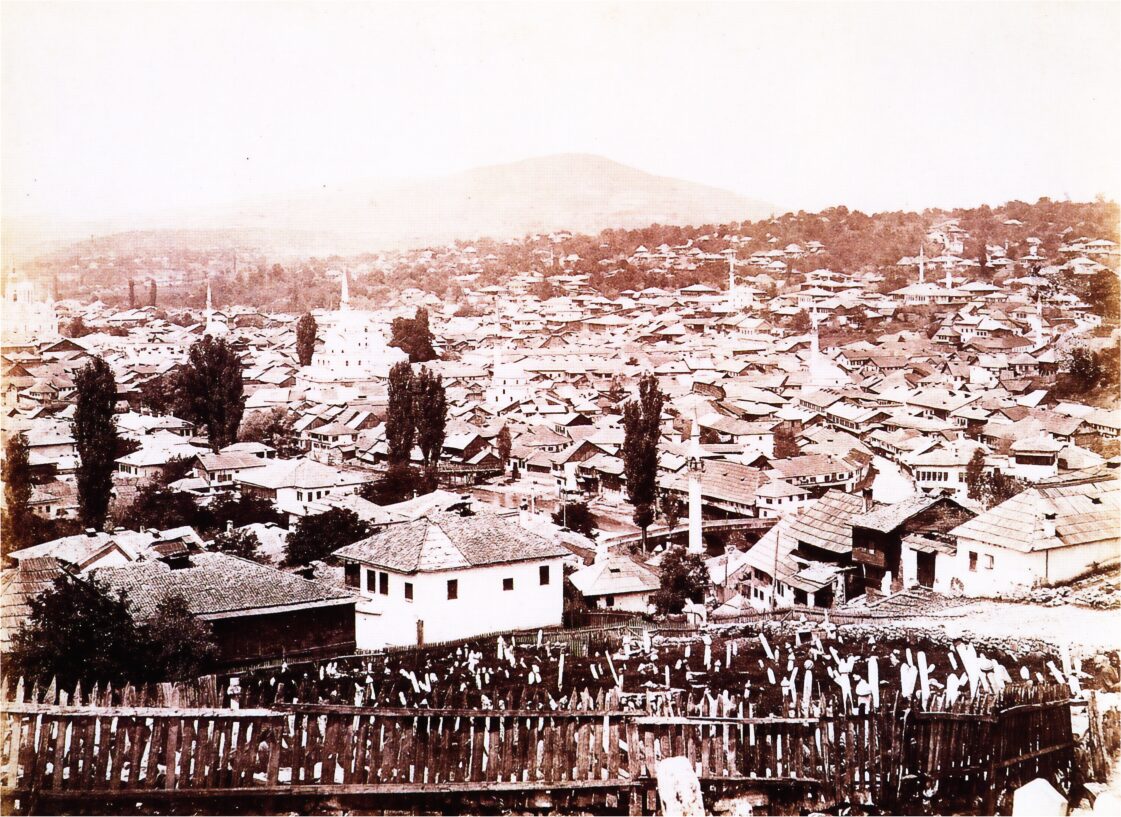
In 1879, a year after the Habsburg army occupied Sarajevo, an Austrian photographer named Anton Schädler climbed to the easternmost end of the city and took what is generally considered Sarajevo's first panoramic photograph. In 1901, a Czech photographer named František Topič — a Habsburg administration hire since 1885 — climbed to the same spot and photographed the same view. The purpose of the second image was to demonstrate what twenty-two years of imperial rule had done to the city. Both photographs are held today at the Zemaljski muzej BiH.
Sometime in 1879, an Austrian photographer named Anton Schädler climbed to the easternmost slope of Sarajevo, the elevated ground below the Bijela Tabija fortress, above the point where the čaršija starts. He took the photograph that is generally regarded as Sarajevo’s first panoramic photograph. He was working within a year of the Habsburg army’s occupation of Bosnia. What his image recorded was the city Isa-beg Ishaković had founded in 1462 and four hundred years of Ottoman rule had produced.
Twenty-two years later, in 1901, a Czech photographer named František Topič, who had joined the Habsburg Landesregierung in 1885, climbed to the same spot. He was carrying instructions from the administration to produce “a series of photographic panoramas of the new modern city.” The point of the second photograph was the difference from the first.
Both images are held today in the Foto arhiv of the Zemaljski muzej Bosne i Hercegovine (the National Museum of Bosnia and Herzegovina) on Zmaja od Bosne. Lebiba Džeko catalogued the Topič holdings in her 2007 monograph Sarajevo između Dvije Carevine. Fotografije Františeka Topiča iz Perioda 1885–1919, Sarajevo Between Two Empires. Photographs of František Topič from the Period 1885–1919. Zahra Kadkani-Schmitt reads the pair as the specific documentary artefact through which the Habsburg administration produced its own visual proof of the Bosnische Post claim that Sarajevo had “more or less lost its Oriental character” (see the 1884 feuilleton).
What the two panoramas show
Kadkani-Schmitt’s reading of the pair, from Chapter 4 and the Epilogue of Framing Bosnia, works image against image.
Schädler 1879 shows:
- A dense, low, red-tiled city of two- and three-storey houses climbing the slopes on both sides of the Miljacka.
- The wooden bridges over the river that had served Sarajevo for centuries.
- The Ottoman skyline: minarets marking the vertical axis, no tower taller than the tallest minaret.
- The čaršija at the centre, hammered copper roofs visible near the Gazi Husrev-beg complex.
- Empty ground on the right bank of the Miljacka where later Habsburg buildings would rise.
Topič 1901 shows, from the same angle:
- Large, four- and five-storey masonry buildings on the right bank of the Miljacka, most of them completed in the 1890s.
- The wooden bridges gone, replaced by iron and stone.
- A fully modern embankment promenade running along the river, illuminated at night by electricity.
- The tracks of the electric tram line that had opened in Sarajevo in 1895: one of the earliest electric tram systems in Europe, and one of the pieces of infrastructure the Landesregierung was most keen to document.
- Two dominant secular buildings framing the east-west axis of the city: the Vijećnica (City Hall, Karel Pařík and Alexander Wittek 1892–96) at the easternmost end near Schädler’s viewpoint, and the Landesregierung (Regional Government Building, Josip Vancaš 1884–85) in the western part.
- Religious structures newly added to the skyline: the Sacred Heart Cathedral (Josip Vancaš 1889), the Ashkenazi Synagogue (Karel Pařík 1902), the Serbian Orthodox Cathedral (Andreja Damjanov’s family workshop tradition, 1863–72 — the one non-Habsburg addition, predating occupation).
The Ottoman skyline is still visible in Topič’s image. The minarets are still there. But they are no longer the tallest verticals in the frame. The Vijećnica’s cupola and the Cathedral’s twin spires now match or exceed them.
Why the pair was made
Kadkani-Schmitt reads Topič’s assignment as a deliberate documentary project of the administration. The Landesregierung had hired Topič in 1885, three years after the civil administration took over from the military, as part of a broader programme of visual record-keeping. The 1901 panorama series was commissioned around the time the administration was preparing to publicise its accomplishments in the run-up to the annexation debate (which would finally happen in 1908, five years after Kadkani-Schmitt’s dissertation ends).
The specific choice of Schädler’s 1879 vantage point was not accidental. The Habsburg administration knew the earlier photograph existed. Topič was sent to the same spot precisely because the resulting pair would function as a before-and-after image, a documentary demonstration of what the imperial civilising mission had done to Sarajevo in twenty-two years.
Kadkani-Schmitt notes the irony. The images are, on their surface, a claim of successful modernisation. But by 1900 the modern city Topič was photographing was already producing the specific social conditions that would undermine Habsburg rule: a working class, student activism, nationalist politics. Schweiger von Lerchenfeld’s 1878 hope for “a new modern generation” was met, but that generation, educated in the Habsburg schools and radicalised in the Habsburg-built cafés and lecture halls, would produce Gavrilo Princip in 1914.

Who Anton Schädler was
The historical record on Schädler is thin. He appears in Habsburg archives as an Austrian photographer active in the immediate aftermath of the 1878 occupation, one of a number of Central European photographers who moved through Bosnia in the first years of imperial rule producing images for military reports, illustrated newspapers, and the imperial ethnographic project.
His 1879 Sarajevo panorama survived because a copy entered the Landesregierung’s own photographic archive, which passed at some point in the twentieth century into the Foto arhiv of the Zemaljski muzej. Schädler himself does not appear to have stayed in Sarajevo. He is one of many peripheral figures in the visual documentation of Habsburg Bosnia whose biography has not been written.
Who František Topič was
Topič is better documented. He was Czech, born in the Habsburg Bohemian lands, and arrived in Sarajevo in 1885 as one of the many Central European professionals, engineers, architects, doctors, teachers, and yes, photographers, who took up positions in the Landesregierung in the first decade of civil administration. He remained in Sarajevo through 1919, the entire span of Habsburg civil rule and the first year after its collapse, producing photographs for the administration, the National Museum, illustrated books, and postcards.
His 1885–1919 photographic archive is one of the most complete visual records of any Habsburg peripheral capital in existence. Lebiba Džeko’s 2007 monograph is the standard scholarly catalogue. The images are on file in the Foto arhiv of the Zemaljski muzej and are accessible to researchers.
Where to see the pair today
The Schädler 1879 and Topič 1901 panoramas are not on permanent display at the Zemaljski muzej. The museum’s photography holdings are shown only in rotating exhibitions and by researcher appointment. When there is a special exhibition on Sarajevo photography (the museum has hosted several since it reopened in 2015), the two images are usually paired.
The best way to see them without visiting the archive is Džeko’s 2007 monograph, which reproduces the Topič 1901 panorama at plate 39 alongside a substantial run of Topič’s other Sarajevo work. The Schädler 1879 panorama is reproduced in several Habsburg-Sarajevo scholarly volumes, including Kadkani-Schmitt’s Framing Bosnia (Figure 26).
Standing at the spot
If you climb up the slope below the Bijela Tabija, the fifteenth-century fortress at the eastern end of the Vratnik neighbourhood, you can stand at approximately the point Schädler and Topič used. The specific ground has been built over in places; the view is now cluttered by twentieth-century additions and the Trebević slope’s own construction. But the axis is still there: eastern high ground looking west along the Miljacka valley toward the čaršija and beyond.
The Zemaljski muzej has, in the last decade, discussed installing an interpretation plaque at the Schädler–Topič spot. As of this writing, no plaque exists. The photographs are known to a small circle of Sarajevo photography historians and to the readers of Kadkani-Schmitt and Džeko.
They deserve a wider audience.
Sources
- Zahra Kadkani-Schmitt, Framing Bosnia: The Politics of Architecture and City Building in the Austro-Hungarian Administration of Bosnia and Hercegovina, 1878–1903, PhD dissertation, University of California, Berkeley, 2017, Epilogue and Chapter 4 (Figures 26 and 27). Berkeley eScholarship.
- Lebiba Džeko, Sarajevo između Dvije Carevine. Fotografije Františeka Topiča iz Perioda 1885–1919 (Sarajevo: Foto arhiv Zemaljski muzej BiH, April 2007), plate 39.
- Foto arhiv, Zemaljski muzej Bosne i Hercegovine, Zmaja od Bosne 3, Sarajevo. Researcher access by appointment.
- Related pieces on this site: Schweiger von Lerchenfeld’s 1878 report, The Kállay Era, Karel Pařík, Josip Vancaš, Alexander Wittek, Sarajevo 1879 und 1884.
Sources & further reading
- Zahra Kadkani-Schmitt, 'Framing Bosnia: The Politics of Architecture and City Building in the Austro-Hungarian Administration of Bosnia and Hercegovina, 1878–1903' (PhD dissertation, UC Berkeley, 2017), Epilogue
- Lebiba Džeko, 'Sarajevo između Dvije Carevine. Fotografije Františeka Topiča iz Perioda 1885–1919' (Sarajevo: Zemaljski muzej BiH, 2007)
- Foto arhiv Zemaljski muzej Bosne i Hercegovine, Sarajevo
Keep reading
More from the guide.
Sarajevo — the largest book-burning in history was one night in August 1992
Everyone knows the Nazis burned books. What most people don’t know is that the single largest book-burning in recorded history happened in...

Sarajevo Institute — founded in 1992, the year it now studies
The University of Sarajevo Institute for the Research of Crimes Against Humanity and International Law hosted a three-day scientific conference in Sarajevo...

Sarajevo defeated the sultan's governor in 1814, and the empire had to sack him
Everyone at the Ottoman court in 1814 knew Sarajevo was difficult. What most people don’t know is that in that year the...