Sarajevo in Edwardian watercolour — the ladies who painted the city in 1909
In the two years after the 1908 annexation crisis, two British women published widely-read travel books about Bosnia. One was a watercolourist named Mary Janet Whitwell. The other was a professional travel writer named Maude Holbach who had been directly commissioned by the Austro-Hungarian administration. Both painted Sarajevo as a peaceful, picturesque idyll, at exactly the moment the region was closest to becoming the flashpoint of the First World War. Ross Cameron's 2023 article is the recent treatment. A short guide to what they wrote, and why.
In June 1908, the Austro-Hungarian empire unilaterally annexed Bosnia and Herzegovina in defiance of the 1878 Berlin Treaty. The Ottoman Empire protested. Russia protested. Serbia mobilised. British political opinion, per the Fortnightly Review, called the annexation “the sudden and most inopportune annexation … has disgusted every lover of justice.” The move brought Europe closer to war than at any point since 1878, and would help set the political conditions for the 1914 crisis.
In the same two years, two British women published widely-read travel books about Bosnia. Both painted the province, and Sarajevo in particular, as a peaceful, pastoral, picturesque idyll. Both books sold well. Neither mentioned the annexation as a political event. And both were, on Ross Cameron’s careful documentation, direct outputs of an Austro-Hungarian tourism-propaganda operation aimed at reassuring British public opinion.
The two writers were Mary Janet Whitwell (usually credited as Mrs E.R. Whitwell), a watercolourist from Darlington who published Through Bosnia and Herzegovina with a Paintbrush in 1909, and Maude Holbach, a London professional travel writer who published Bosnia and Herzegovina: Some Wayside Wanderings in 1910. Their books are worth reading today, both are freely available online, because they are the clearest surviving evidence of how the picturesque image of Sarajevo was manufactured for an English-speaking audience, and by whom, at exactly the moment the region was closest to war.
Ross Cameron’s 2023 article in the Journal of Tourism History is the recent treatment. What follows draws on it.
Mary Janet Whitwell — the watercolourist
Whitwell’s book, Through Bosnia and Herzegovina with a Paintbrush, was published in 1909 by William Dresser and Sons of Darlington, a small provincial press that specialised in illustrated travelogues. The volume is roughly 200 pages, illustrated with Whitwell’s own watercolour plates, and priced for the Edwardian middle-class parlour table.
Whitwell had visited Bosnia in the summer of 1908, months before the annexation crisis broke. Her manuscript was mostly finished before September. She revised it lightly, adding a few paragraphs, and let it go to press in early 1909. Cameron’s analysis notes the specific evasion: Whitwell knew the annexation had occurred, chose not to treat it as significant, and told her readers instead that a “delegation of Orthodox peasants had travelled to Vienna to thank Emperor Franz Josef in person for fully incorporating the country into the monarchy.”
Whether that delegation existed is not the point. Whitwell probably heard the claim from Habsburg tourist-office staff who briefed her in Sarajevo. The point is that her book, published at the height of European anger about the annexation, told British readers that the Bosnians were pleased. She backed the claim with the observation that the Austro-Hungarian administration had brought “a great deal … of improvements” to the province, notably “gendarmes to keep order.”
Her assessment of women’s safety, always a marker of tourist-industry pitch, was categorical: “women tourists can travel alone in these parts quite well.”
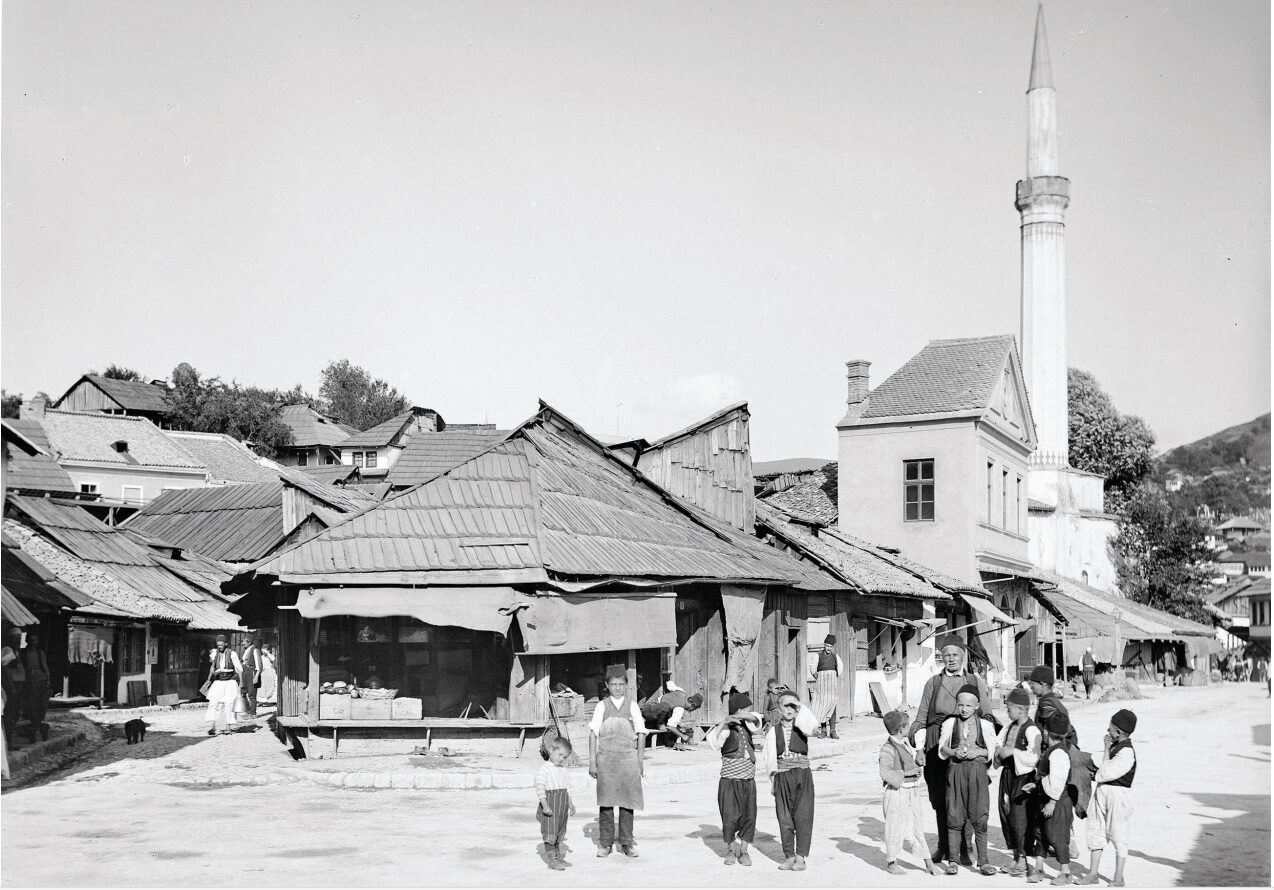
The book is dominated by her watercolours: mahalas seen from the Yellow Fortress, the Miljacka from the Latin Bridge, minarets against the ridge of Trebević, an Ottoman house at Baščaršija, Ilidža park in bloom. There are almost no watercolours of the new Habsburg buildings. The book stages Sarajevo as an Ottoman survival, precisely at the moment the Habsburg administration was trying to Europeanise it. This paradox, Sarajevo marketed as Oriental at exactly the moment its own administration was making it Habsburg, is what the Kállay-era programme required (see our stories on the Kállay era and Sarajevo as showpiece).

Maude Holbach — the professional
Holbach’s Bosnia and Herzegovina: Some Wayside Wanderings was published in 1910 by John Lane, one of London’s more prestigious travel publishers. Holbach was a professional. Her 1908 Dalmatia: The Land Where East Meets West, also for John Lane, had done well in the British market.
Cameron’s article documents the commissioning of the Bosnia book with more directness than one usually gets in tourism history. Holbach was approached by the Austro-Hungarian administration itself in Dalmatia in 1908 and invited to write a similar book about Bosnia. She agreed. Her publisher, John Lane, wanted a political work on the annexation. Holbach, going against her publisher’s wishes, chose to write a pastoral book instead. The pastoral choice was the one the Austro-Hungarian administration wanted.
Her framing is worth quoting in full because it is one of the most influential single passages in the whole English-language image of Bosnia:
“Bosnia-Herzegovina, a primitive pastoral land, where shepherds still play upon their flutes and shepherdesses wander with distaff in hand spinning as they watch their flocks; a land untouched by the fret and hurry of modern life, still wrapped in ancient peace.”
Holbach argued explicitly that this tranquillity was the “direct result” of the Austro-Hungarian administration, which had “brought peace and prosperity to a land which little more than a decade ago was given up to bloodshed and sedition.”
Her book was praised in the British press as “unhackneyed” (Manchester Courier) and “contagious” (London Evening Standard). It became, per Cameron, “a capital holiday combination” in the mind of the reviewer for the London Evening Standard. It was, on the documented evidence of Cameron’s article, the most successful English-language book published about Bosnia before the First World War.
She acknowledged privately that her impressions might not be entirely accurate, since she did not speak the local languages and had not conversed with the Bosnian population. That admission did not make it into the marketing copy.
Why the Austro-Hungarian regime needed these books
Cameron’s argument for why the two books were sponsored is careful. The 1908 annexation had produced serious diplomatic damage. British public opinion was largely against the Habsburgs on the point. Formal state-to-state relations remained correct, but the newspaper campaign that would later shape the 1914 crisis was already legible. The Austro-Hungarian Ministry of Foreign Affairs, working through the joint Ministry of Finance’s tourism budget, decided the answer was apolitical soft power: paint Bosnia as a peaceful destination, get British women writing pastoral prose about it, and let the political anxiety fade behind Whitwell’s watercolours.
The specific administrative mechanism was the Ministry of Railways press-tour system managed by the London-based journalist James Baker, who received the Habsburg Order of Franz Joseph for his services (see Thomas Cook came to Sarajevo). Baker’s operation had, by 1907, produced dozens of British newspaper articles portraying Bosnia in identical terms: “a glorious revelation,” “quieter than Ireland,” “a progressive and orderly European state,” “life and property as secure as in Austria or in Germany.” Whitwell and Holbach’s books extended the same operation into the more expensive and more durable book market.
What the books didn’t tell you
They did not tell you that political nationalism among Bosnian Serbs was accelerating year on year. They did not tell you that Serbian nationalists had, by the time Whitwell’s book went to press, tried to assassinate the new governor Marijan Varešanin. They did not tell you that martial law had been declared to suppress nationalist sentiment. They did not tell you that students had been shot dead by gendarmes during protests in Sarajevo. Cameron catalogues these events from contemporary Habsburg administrative records and the Bosnian and British press.
The books did not tell you that Bosnian Muslims, per Harry Thomson’s earlier 1897 book, were “much interested in India” and asked British visitors “about the status and conditions of the Mohammedans” in the British Empire, a line of enquiry that shows Bosnian Muslim awareness of the colonial dimension of Austro-Hungarian rule and refuses the “grateful subject” framing that Whitwell and Holbach used.
They did not tell you that a young Bosnian Serb activist named Bogdan Žerajić would attempt to shoot Governor Varešanin at the Emperor Bridge in Sarajevo in June 1910 (weeks after Holbach’s book appeared), failing to hit him and then killing himself. Or that his failure would inspire the group Mlada Bosna which, four years later, would succeed in shooting Franz Ferdinand at the Latin Bridge.
Reading the books now
Both books are on Archive.org. Whitwell’s is roughly 200 pages; Holbach’s is roughly 300. Both are freely downloadable in scanned form. Both are worth an afternoon.
Read them slowly. Notice what is described and what is not. Notice the Whitwell watercolour of an old man selling rahat lokum at Baščaršija and think about the fact that the same square, a year after Holbach’s book appeared, would be under martial law. Notice that Holbach called Bosnia, Herzegovina, and Dalmatia “three twin sisters of equal though varied charm” and think about what claim of family relation she was making, in whose favour, and what the sisters were doing to each other by 1913.
Also: notice how much of the imagery still works. The Yellow Fortress panorama has not changed. The mahalas of Bistrik and Kovači are still readable in Whitwell’s plates. The Miljacka still runs green. What has changed is that everyone knows now what Whitwell and Holbach were paid to leave out.
Sources
- Ross Cameron, “An Oriental Holiday”: constructing Bosnia and Herzegovina as a destination in British tourist literature, c. 1890–1914, Journal of Tourism History 15:3 (2023), 233–256. DOI.
- Mary Janet Whitwell, Through Bosnia and Herzegovina with a Paintbrush (Darlington: William Dresser and Sons, 1909). Scanned copy on Archive.org.
- Maude Holbach, Bosnia and Herzegovina: Some Wayside Wanderings (London: John Lane, 1910). Scanned copy on Archive.org.
- Maude Holbach, Dalmatia: The Land Where East Meets West (London: John Lane, 1908), the earlier volume in the same commission.
- Percy E. Henderson, A British Officer in the Balkans; the account of a journey through Dalmatia, Montenegro, Turkey in Austria, Magyarland, Bosnia and Hercegovina (London: Seeley and Co., 1909). Anglo-Indian military officer, portrayed Bosnia as ideal for “the lover of the picturesque.”
- Robin Okey, Taming Balkan Nationalism: The Habsburg Civilising Mission in Bosnia, 1878–1914 (Oxford: Oxford University Press, 2007).
- Robert Donia, Islam Under the Double Eagle: The Muslims of Bosnia and Hercegovina, 1878–1914 (New York: Columbia University Press, 1981).
Sources & further reading
- Ross Cameron, 'An Oriental Holiday: constructing Bosnia and Herzegovina as a destination in British tourist literature, c. 1890–1914', Journal of Tourism History 15:3 (2023), 233–256
- Mary Janet Whitwell, 'Through Bosnia and Herzegovina with a Paintbrush' (Darlington: William Dresser and Sons, 1909)
- Maude Holbach, 'Bosnia and Herzegovina: Some Wayside Wanderings' (London: John Lane, 1910)
- Percy E. Henderson, 'A British Officer in the Balkans' (London: Seeley and Co., 1909)
Keep reading
More from the guide.

Sarajevo — the peasant fantasy Victorian Britain came here to buy
Between 1895 and 1914, at least six substantial English-language travelogues appeared on Habsburg Bosnia. On the whole, they were not looking at...

Sarajevo — how Henri Moser sold it to Victorian Britain
Before 1914, upper-class British tourists visited Bosnia, not despite its ‘Oriental’ character but because of it. The country was branded to them...

Sarajevo Christmas Eve/12/24 — the Trans-Siberian Orchestra hit whose 'white-haired cellist' was 36
Trans-Siberian Orchestra’s Christmas Eve/Sarajevo 12/24 is a six-minute rock instrumental combining God Rest Ye Merry, Gentlemen with Carol of the Bells. Originally...