Sarajevo's oldest name is Butmir — a 7,000-year-old farming village under the airport
The oldest Sarajevo is buried in Ilidža, on the alluvial plain that runs from the spring of the Bosna river to the modern airport. Between 5,100 and 4,500 BCE a farming settlement of about ninety dugout houses stood on 24,000 square metres of that plain. Habsburg archaeologists dug it in 1893–96 and gave the pottery style its own name. The Butmir spiral-banded ceramic is one of Europe's most distinctive Neolithic wares. The finds are held at the National Museum. The site itself is under gradual pressure from new housing and light-industrial construction.
The oldest thing anyone has ever called Sarajevo is not the 1462 charter of Isa-beg Ishaković. It is not the Roman Aquae Sulphurae at Ilidža. It is not the Illyrian hillforts on the ridges above the Miljacka. It is a Late-Neolithic farming settlement of about ninety dugout houses, occupied continuously between 5,100 and 4,500 BCE, on the alluvial plain running east from the springs of the Bosna river at Vrelo Bosne to what is now the Sarajevo airport. The pottery they left behind is at the National Museum, in the same archaeological wing that holds the Sarajevo Haggadah.
The village is called Butmir. It was named, by the Habsburg archaeologists who dug it in 1893–96, after the small village then standing on the site. Butmir the Neolithic settlement gave its name to Butmir culture, a distinctive Late-Neolithic pottery tradition now recognised across European Neolithic scholarship. The reference here is Chapter 2.1 of Boris Trapara’s 2022 PhD.
Where the site sits
Butmir is not in central Sarajevo. It is in Ilidža, on the eastern edge of the airport’s runway, roughly a kilometre east of the Vrelo Bosne karst springs. The site sits on the flat plain the springs feed, the fertile alluvium that made the location viable for Neolithic agriculture in the first place.
The plain has been continuously inhabited ever since. The Romans built the sulphurous spa at Aquae Sulphurae (still visible in the Ilidža bath complex). The Ottomans developed the plain as summer pasture. The Habsburgs built an Agricultural Station on it in the 1890s (which is how the Butmir Neolithic settlement was found). The Yugoslavs built the Sarajevo airport on the western edge. The current municipality of Ilidža builds housing and light industry on the alluvial soil.
The Neolithic village sits under all of that.

What Butmir was
The village occupied about 24,000 square metres, roughly 185 metres by 130. It was made of dugout houses: shallow rectangular pits, three to six metres across, framed with wooden posts and roofed with thatch or reeds. About ninety of them have been counted so far, arranged in five clusters around a central open space that Trapara reads as a community gathering ground. Some had internal hearths; more often the fireplaces sat outside, between the dugouts.
The inhabitants were farmers. Excavations found grain, wheat, barley, lentils, alongside wild apples and hazelnuts and the bones of domesticated animals. The primary activity was crop cultivation; cattle came second. Trapara notes a communal stone-tool workshop at the site: a single working area where axes, hoes, and blades were knapped for the whole community rather than each household making its own.
No jewellery was found. This is unusual for a Late-Neolithic settlement of this scale, and Trapara treats it as an open question. Perhaps the Butmir community expressed status differently. Perhaps the jewellery was made of organic materials that did not survive. Perhaps it left the site with the dead, in burials that have not yet been located.
The site was occupied for about six hundred years across three phases:
- Butmir I, 5,100 to 4,900 BCE.
- Butmir II, 4,850 to 4,750 BCE.
- Butmir III, until 4,500 BCE.
The phasing is based on radiocarbon dating of hearth charcoal and organic remains. The three phases show continuity of dwelling location with steady evolution of the pottery style.
The pottery
Butmir is famous, in European Neolithic archaeology, for its pottery. The Butmir wares are among the most decorated Late-Neolithic ceramics known from southern Europe. Every reader interested in this period who has looked at the standard reference books, Marija Gimbutas, Ruth Whitehouse, Andrew Sherratt, has seen Butmir vessels.
The three basic fine-ware types identified by the Commission to Preserve National Monuments (KONS):
- Black-glazed, the earliest, from Phase 1. A dark burnished slip fired to a lustrous surface.
- Spiral-banded, the signature Butmir ware, from Phase 2. The category the site is internationally known for.
- Hvar-Lisičići type, imported or influenced by the coastal Neolithic culture centred on the Dalmatian island of Hvar.
The spiral-banded ware is the one to look at. The forms include spherical vases, biconical dishes, canopic pear-shaped vessels, tall oval cups, vases on multiple feet, miniature bowls, and four-footed sacrificial altars. Handles were shaped in the form of stylised animal heads. The dominant decorative motif is the spiral, executed in ribbons of red and white paint that circle the body of the vessel, flowing, rhythmic, more like continuous rope than like discrete pattern. Motifs shaped as the letters S, C, and K appear repeatedly. Rectilinear geometric shapes fill the remaining space.
Trapara’s own summary:
“Butmir, after excavating from 1893 to 1896, became the synonym for spiral and banded pottery.” , Boris Trapara, PhD dissertation, 2022, p. 41
For most of the twentieth century, if you looked at Late-Neolithic spiral-banded ware anywhere in southeast Europe, it was labelled Butmir-type by default.
Who dug it, and when
The site was discovered by accident. In 1893, workers building the Habsburg-era Agricultural Station at Ilidža dug into pits of unusual ceramics and stone tools. The provincial administration called in Vaclav Radimsky, the Czech-born geologist and archaeologist then serving as director of the Bosnian State Museum’s Prehistory Department, along with Franjo Fiala and the Viennese archaeologist Moritz Hoernes.
The three excavated the site between 1893 and 1896. The dig covered 5,305 square metres, about a fifth of the settlement’s total area, and, until the 1980s, one of the largest single Neolithic excavations in Europe. They published the results in an 1898 Vienna monograph: Die neolithische Station von Butmir bei Sarajevo in Bosnien. Ausgrabungen in den Jahren 1894–1896 (F. Fiala and M. Hoernes; Adolf Holzhausen, Wien, 1898). The book is in German. It is available in the Wien Universität library and in scanned form on Archive.org.
The 1894 Congress of Archaeology and Anthropology, held in Sarajevo in August of that year, was in significant part a Butmir congress. European archaeologists came to look at the pottery. The Bosnian State Museum used the international attention to build its own Prehistory collection.
Later investigations followed at longer intervals: 1979, 1998, 2002, 2004. The most important of the later phases was the 2002 radiocarbon programme, which produced the current chronology of the three phases. The National Museum planned a full revisionary excavation between 1992 and 1995, Trapara records, but the war made it impossible. That excavation has never taken place.
Where the finds are
Movable Butmir material, the pottery, the stone axes, the animal-bone tools, the grain samples, is held at two Sarajevo institutions:
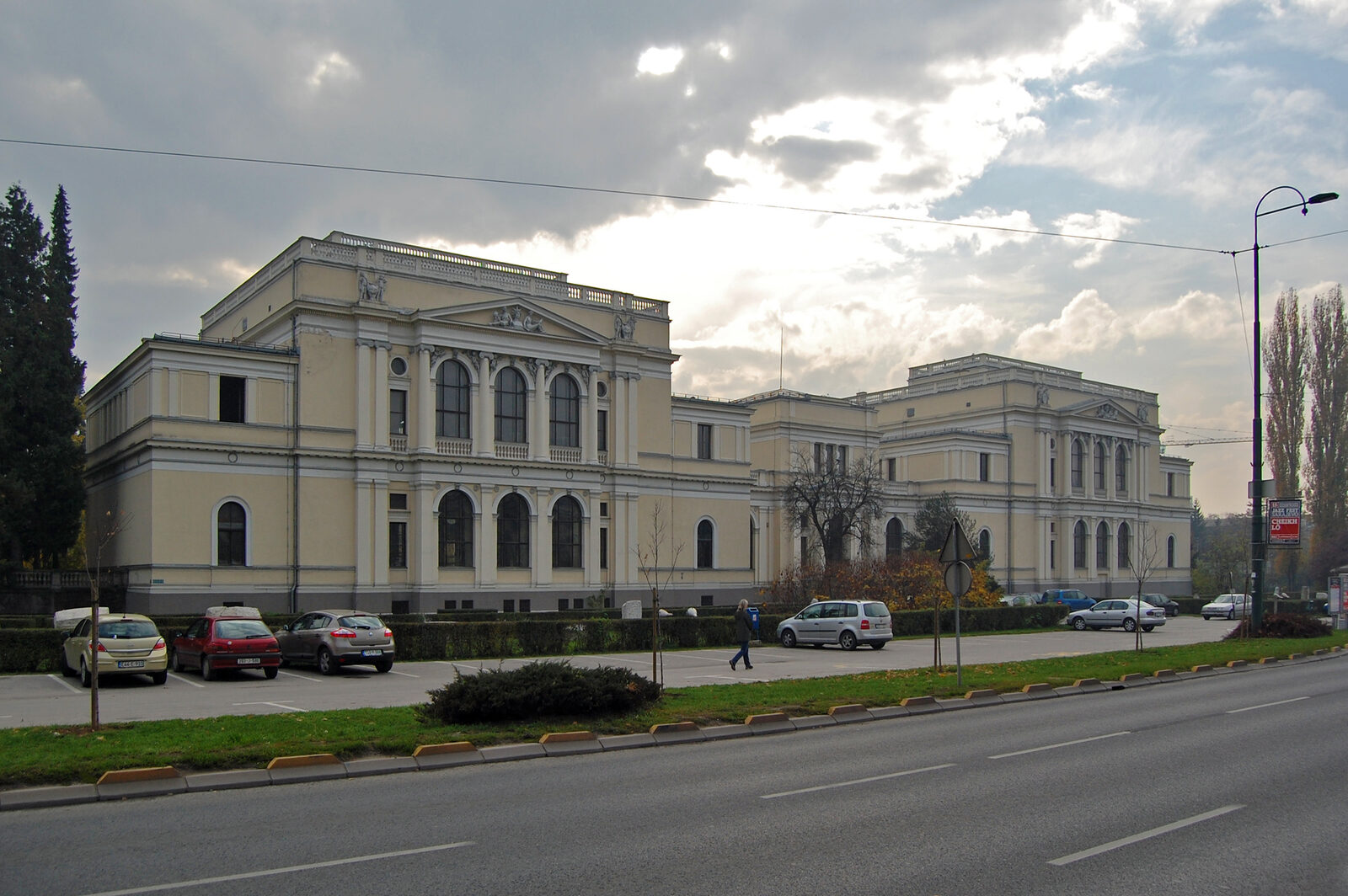
- The National Museum of Bosnia and Herzegovina (Zemaljski muzej) on Zmaja od Bosne, the primary Butmir collection. Displayed in the Archaeology Pavilion, second floor, Prehistory Hall. The signature spiral-banded vessels are here.
- The Sarajevo City Museum (Muzej Sarajeva), a smaller Butmir selection, part of the museum’s Sarajevo through Time exhibition.
Both museums hold artifacts that a visitor can see today. Neither requires the trip out to Ilidža.
If you do want to go to Ilidža, the plain is walkable from the Vrelo Bosne park. There is no visible archaeological monument at the Butmir site itself: no fenced enclosure, no visitor’s centre, no signage. What you can see are the fields, the road east toward the airport, and the increasingly present housing that Trapara’s chapter names as the current threat to the site.
What the site’s condition is now
Trapara’s account of the current state is honest and worth naming carefully. The Butmir site is a National Monument of Bosnia and Herzegovina (declared by the Commission to Preserve National Monuments, ratified 2007). It is protected in principle. In practice, the protection is administrative rather than fenced.
Between the two entities (the Federation of Bosnia and Herzegovina, in which Ilidža sits, and Republika Srpska), Bosnian archaeological heritage sits in a well-documented governance gap. Trapara puts it directly:
“This cultural heritage is not claimed by any of the three constituent peoples of Bosnia and Herzegovina and is thus condemned to decay.” , Boris Trapara, PhD dissertation, 2022, p. 38
Housing plots and small industrial buildings are, gradually, being permitted along the plain. Each new foundation dug is a piece of the Neolithic settlement that will not be excavated. The lost portion is not knowable in advance.
The National Museum is where the story lives. Wallet-friendly (about 5 KM for an adult), permanently open (roughly Tuesday-Sunday, mid-morning through late afternoon), and, since 2015, no longer at risk of closure. The Butmir Hall on the second floor is worth thirty minutes even if you have limited time in the city.
Seven thousand years
Sarajevo’s timeline officially starts in 1462, with the Isa-beg Ishaković charter. Fair enough for the city. Unfair for the ground the city sits on. The alluvial plain at Ilidža was under continuous human occupation six thousand years before Isa-beg drew his mosque. The Butmir farmers do not connect ancestrally to anyone alive today. We do not know their language, their gods, or where they eventually went. But they drank from the springs at Vrelo Bosne, and so does Sarajevo. The connection is geographical, not ethnic. It is enough.
The pottery is the durable part. Spiral-banded, red-and-white on a black slip, made by a farming community whose closest peers were Neolithic villages in the Ohrid basin and along the Dalmatian coast. It sits in the National Museum, three tram stops from Baščaršija. Nothing about it looks like anywhere else in Europe.
Sources
- Boris Trapara, PhD dissertation, Faculty of Civil Engineering and Architecture, Osijek, 2022, Chapter 2.1: Early period: Butmir culture, the most significant archaeological settlement in Bosnia and Herzegovina (pp. 37–43).
- Franjo Fiala and Moritz Hoernes, Die neolithische Station von Butmir bei Sarajevo in Bosnien. Ausgrabungen in den Jahren 1894–1896 (Wien: Adolf Holzhausen, 1898). The founding monograph.
- Komisija za očuvanje nacionalnih spomenika Bosne i Hercegovine, Prahistorijsko naselje u Butmiru, arheološko područje (2017). KONS national monument dossier.
- Tatjana Neidhardt, Sarajevo kroz vrijeme (Sarajevo: Bosanska riječ, 2006), the standard Bosnian-language reference.
- Alojz Benac, Butmirska kultura (Sarajevo: Zemaljski muzej, 1979), the 1979 excavation reports.
- National Museum of Bosnia and Herzegovina, permanent exhibition, Archaeology Pavilion, Prehistory Hall.
Sources & further reading
- Boris Trapara, PhD dissertation, Chapter 2.1 — Early period: Butmir culture
- Franjo Fiala and Moritz Hoernes, 'Die neolithische Station von Butmir bei Sarajevo in Bosnien. Ausgrabungen in den Jahren 1894–1896' (Wien: Adolf Holzhausen, 1898)
- Commission to Preserve National Monuments of Bosnia and Herzegovina — Butmir prehistoric settlement
- National Museum of Bosnia and Herzegovina — Archaeology Department, Butmir collection
Keep reading
More from the guide.

Sarajevo — the bobsled team that crossed the airport runway under sniper fire to reach the 1994 Olympics
Igor Boras had never bobsledded. He was a 100-metre sprinter who joined the Bosnian bobsled team because he wanted to be in...
Sarajevo — the biggest book-burning in history took 90 minutes, and the shells landed on the fire brigade too
The site’s book-burning post tells you 1.25 million volumes went up on the night of 25–26 August 1992 at Vijećnica. It’s the...

Sarajevo — the Muslim family that hid a Jewish family from the Nazis in 1941, and were saved by them fifty years later
There is one Sarajevo story that everyone in the city knows, but that most guidebooks skip, and that fewer non-Sarajevans know than...