
Sarajevo — the royal Kotromanić stećak is thirty steps from the National Museum entrance
About seventy thousand medieval stone tombstones — the stećci — survive in Bosnia and Herzegovina. Thirty of the necropolises are on the UNESCO World Heritage List. If you want to see the finest specimens without leaving Sarajevo, walk into the botanical garden of the National Museum. Guest Milutin is waiting there. So is the royal stećak of the Kotromanići.
Somewhere between the twelfth and sixteenth centuries, on the karst plateaus of southern and eastern Bosnia, stone-cutters began carving monumental slabs of local limestone as tombstones. They set them at the head of a grave in a meadow, in groups of ten or twenty or two hundred, oriented roughly west-to-east. They carved arcades along the edges, spirals along the tops. They chiselled deer, horses, hunting scenes, the round dance called kolo, sometimes a knight in armour. On some they cut inscriptions in Bosančica, the Bosnian variant of Cyrillic, recording who was buried and who paid for the stone.
The tombstones are called stećci (singular stećak). Bosnia and Herzegovina has about seventy thousand of them. Twenty-two thousand more sit in the border regions of Serbia, Montenegro, and Croatia. In 2016 UNESCO inscribed thirty of the necropolises on the World Heritage List.
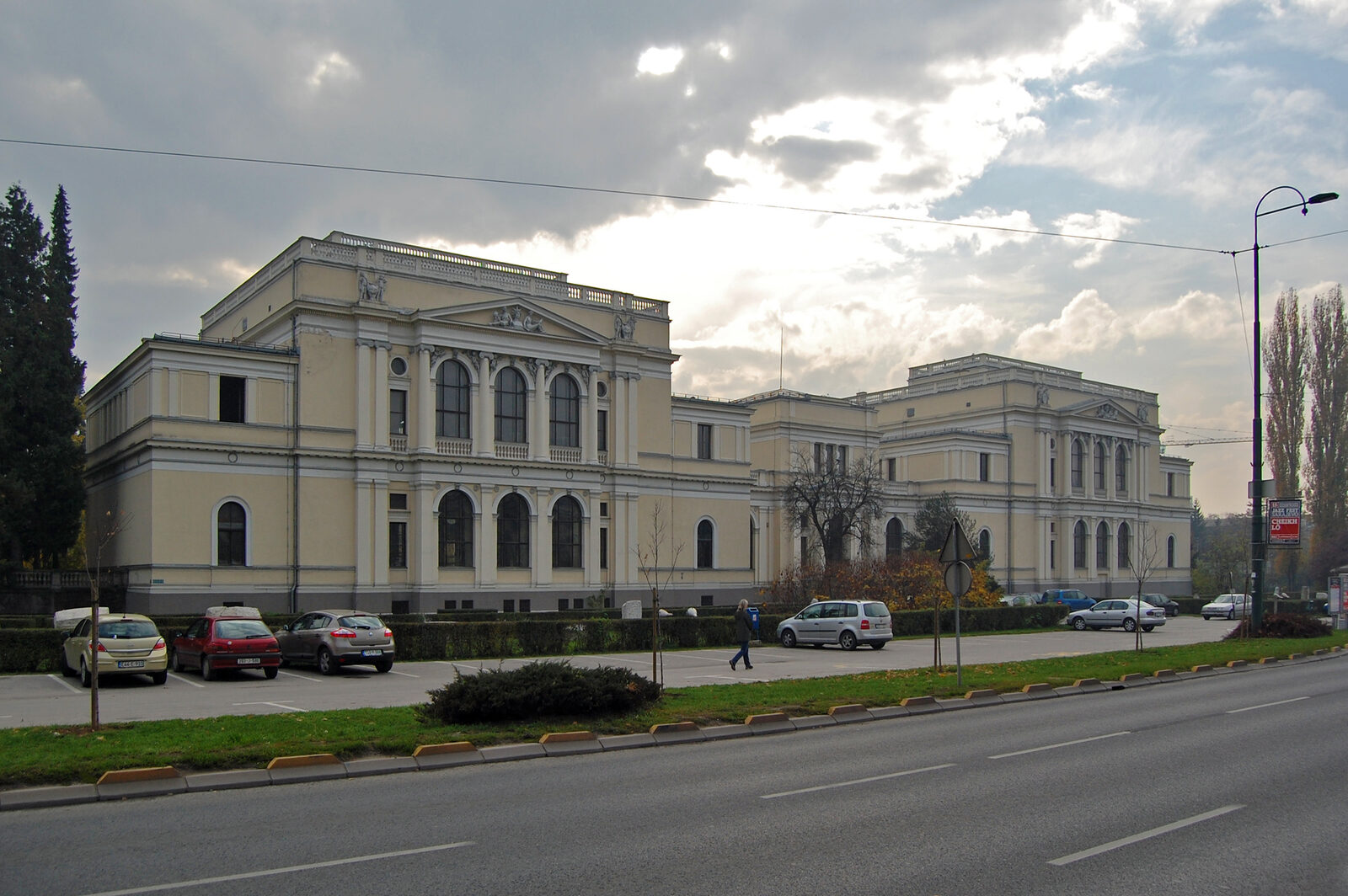
Most first-time visitors to Sarajevo will not travel three hours south to Radimlja, or to Boljuni, Gvozno, or Čengić bara. They don’t need to. Two of the finest single specimens known — the royal stećak of the Kotromanić dynasty and the 254-centimetre figure of Guest Milutin — sit in the botanical garden of the National Museum, on the south bank of the Miljacka, ten minutes’ walk from the Latin Bridge. The museum also holds the Sarajevo Haggadah and the Butmir Neolithic collection. Three deep-time Bosnian stories under one Pařík-designed roof.
The recent English overview is in Chapter 2.2.2 of Boris Trapara’s 2022 PhD at the Faculty of Civil Engineering and Architecture in Osijek. What follows leans on it, oriented toward what a Sarajevan visitor can actually see.
Where the name comes from
Stećak derives from the word stojećak, “standing one”, which Bešlagić glosses as a metaphor for strength, solidity, defiance, and pride. In older Bosnian vernacular the same stones were called mramor (marble), and further south mašet (from Italian massetto, “big rock”, or the Turkish meşhet, “tombstone of a fallen hero”).
The word for the necropolis itself was often grčko groblje, “Greek cemetery”, or kaursko groblje (giaour’s cemetery, from the Turkish gâvur for non-Muslim). Neither name has any scientific basis, Trapara notes; the “Greeks” of the folk-tale are almost certainly not Greek at all. But both names entered scientific literature in the 19th century and stuck.

What a stećak looks like
The stone-cutters worked in five main forms, in this order of appearance across the two centuries:
- Plates (ploče). The oldest form, from the 12th and 13th centuries. A flat low slab lying over the grave.
- Chests (sanduci). A rectangular block, often on a base. The most numerous type overall.
- Sarcophagi (sljemenjaci). The tallest and most sculptural: a chest with a saddle-shaped or ridged roof, like a tiny stone house. The prestige form. The finest carvings sit here.
- Crosses (krstače). An equal-armed cross-shaped stone. Arrives in the 15th and 16th centuries, alongside the Ottomans.
- Obelisks (nišani). An upright pillar. Also 15th–16th century, arriving with the Islamic sepulchral vocabulary.
The stone-cutters were called kovači, “blacksmiths”, although they worked in limestone, not iron. When a stećak carried an inscription, the letters were cut not by the kovač but by a dijak, the medieval Bosnian scribe. A dijak was a rare specialist. Only a feudal patron could afford to commission one.
The two art schools
The archaeologist and long-time director of the National Museum, Alojz Benac (1914–1992), grouped the stećci into two art schools, and the classification has held:
- The Herzegovinian School, southern, focused on the karst fields of Herzegovina. Monumental sarcophagi, tall chests, richly carved crosses. Deer hunts, arcaded blind arches, human figures shown in action. Radimlja near Stolac, the graveyard of the Orthodox feudal family Miloradović-Stjepanović, whose lineage traced back to a house called Hrabren, is the canonical Herzegovinian site.
- The East Bosnian School, more vertical, more purely floral. Plant motifs, geometric arcades, vine leaves. Human figures rare; when present, they are portraits or silhouettes, not scenes. The stećak from Donja Zgošća near Kakanj (associated with the Bosnian royal house of Kotromanić) is the canonical East Bosnian specimen. Bešlagić and Benac both note that Donja Zgošća sits in the “contact zone” between the two schools; the stone shows both.
Herzegovina looks at people. East Bosnia looks at plants. That is the summary Benac gives, and it holds for the great majority of the seventy thousand.
Who is buried under a stećak
For most of the twentieth century, scholars argued fiercely about who commissioned the stećci. The most persistent theory, pushed hardest by the mid-century French orientalist Jean Challet in 1965, held that the stećak was an artefact of the Bosnian Church, the medieval institution the Vatican and Constantinople both regarded as heretical. On this reading the crescent moons, the stars, and the cross-shaped krstače were emblems of a specifically Bogumil-derived sect.
Twentieth-century archaeology has, on the whole, rejected the Bogumil theory. Trapara summarises the current position clearly: members of the Catholic Church, the Orthodox Church, and the Bosnian Church were all buried under stećci. In parts of Bosnia both Catholic and Orthodox communities went on using the same necropolises well into the Ottoman period, and some stećci from that period show up with Islamic motifs added by later hands. The stećci are not a sectarian marker. They are a shared regional practice of monumental stone burial, which the medieval Bosnian and Hum lands developed and which the surrounding regions imitated.
What is carved on a stećak
The carvings are the reason people photograph these stones. The repertoire is deep. The most common motifs, in rough order of frequency:
- Twisted ribbons, trefoil ribbons, arcades along the sides, the geometric border patterns that give a stećak its silhouette.
- Vine leaves. The running vine along the top of a Herzegovinian sarcophagus is almost a signature.
- Crescents, stars, rosettes, the small emblems that provoked the Bogumil-theory arguments.
- The kolo, the traditional Bosnian round dance. Men and women hold hands in a line or a circle. Sometimes only men, rarely only women. The kolo is one of the most frequent figural motifs, especially on Herzegovinian sarcophagi.
- The hunt, deer chased by hounds, deer struck by arrows, deer running in a group with no hunter visible (you have to know the composition to fill in the missing rider). Bears attacked upright while the hunter thrusts a spear into the belly. Falcons stooping.
- Knightly duels and tournaments, knights with shields and lances, sometimes in a formal tourney with women watching, sometimes under a blind arch.
- The single figure, a man in a long tunic holding a sword, or a book, or a crook.
- Family scenes, parents with children, in the plainer domestic register.
Trapara’s summary of the aesthetic is honest and worth quoting: “The artists were unskilled when it comes to proportions, perspective, and usually craftsmanship with stone. Nature is depicted in unrealistic relations.” The hunter’s horse is smaller than the deer he chases. The kolo dancers, however, move in real rhythm; the human circle is where the medieval stone-cutter found his eye.
Guest Milutin
Of the stećci held at the National Museum, the one to walk to first is the stećak of Gost Milutin, Guest Milutin, from Humsko near Foča. The word gost (guest) was a specific rank within the Bosnian Church, ranking below the djed (grandfather) and strojnik but above ordinary members. A gost was a senior teacher who often served on diplomatic missions.
Milutin’s stećak is 254 centimetres tall, nearly two-and-a-half metres, and it shows the man himself. He wears a long dress with a rope belt. In one hand he holds the Gospel. In the other he carries a shepherd’s crook, the Christian symbol of the good shepherd. Below the stone, when the necropolis was excavated between the two world wars, archaeologists found human bones and other material evidence that this stećak marked a person of standing.
The inscription is on three sides of the stone. It is best preserved on the south face. It records that Guest Milutin received gifts from the nobles and “led political affairs in Bosnia”, the paraphrase Trapara offers. He was, in the fifteenth-century sense, a Bosnian statesman.
According to the academician Vladislav Skarić, Milutin’s home village was near Čajniče, on the eastern Bosnian border. The stone stood there for four hundred years before being moved to Sarajevo.
The royal stećak of Donja Zgošća
The other Sarajevo stone worth pausing at is the stećak from Donja Zgošća near Kakanj. It belongs to the East Bosnian School but sits, as Benac notes, in the contact zone with the Herzegovinian School, so it carries features of both.
The Donja Zgošća stećak has been argued, since the late nineteenth century, to be a royal stone of the Kotromanić dynasty, the Bosnian ruling house from the mid-thirteenth to the mid-fifteenth century. Members of the royal family and the royal court are shown carved into its faces. It is the most decorated stećak known.
Trapara reproduces it as Figure 16. In the National Museum botanical garden it stands under a cedar. The carvings on the sides have weathered visibly since the Habsburg-era removal, but the figures are still legible: a procession, a hunt, a formally-composed group with shields.
Where to see them
The National Museum of Bosnia and Herzegovina, Zemaljski muzej, on Zmaja od Bosne. Four pavilions built by Karel Pařík in 1913 enclose a botanical garden. The stećci stand in the garden’s northern half, along the paths between the archaeology and natural-history buildings. The entry ticket to the museum includes the garden. The garden alone is not sold separately. You buy the museum, and the stećci come with it.
If you want to see the finest Herzegovinian stećci in their original setting, the trip is to Radimlja, three kilometres west of Stolac (about a three-hour drive from Sarajevo, or a slow bus down the Neretva). Radimlja is UNESCO 1504. On the way you pass Boljuni, the second Stolac necropolis, also on the list.
If you want a nearer site: Umoljani on the Bjelašnica plateau (an hour and a half from Sarajevo, then thirty minutes’ walk) sits above a small necropolis of medieval stećci, listed by Trapara among Bosnia’s less famous but well-preserved fields. In a day trip from Sarajevo you can hike the Rakitnica canyon rim and see the stones on the ridge above.
What is written on them
The inscriptions, epitafi, are the reason the medieval Bosnian archaeologist and epigrapher Marko Vego (1907–1985) spent his career at the National Museum. Vego catalogued hundreds of stećak inscriptions and translated them from Bosančica. The scripts are short. They give the name of the deceased and sometimes the kovač who made the stone. Occasionally they record a historical event. More often, they carry a verse, a message from the buried to the living, or a summary of the deceased’s life. The recurring line, in various forms:
A se leži… Ne tica pošten čovjek. Ne udari me nikakav zli govor…
“Here lies… I did not steal, I was an honest man. No evil words touched me…”
Which is, if the fifteenth-century Bosnian stone-cutter is to be believed, the epitaph most fifteenth-century Bosnians wanted.
The folk defence
For most of the last five hundred years, the stećci stood in fields where villagers grazed sheep and cut hay. A stećak that could be broken up was, in the strictly practical sense, a large piece of pre-quarried limestone that a farmer needed to build a wall or a threshing floor. Many were.
The reason so many survived, Bešlagić argues, is a body of folk legends that treated stećci as sacred and cursed to disturb. Thunder would strike anyone who broke one up. A stone moved from its original position brought misfortune to the family. A necropolis that a wedding party crossed in bad faith would be filled with the dancers’ own bones, the “nuptial graveyard” legend that gives some sites their names. The legends were not consistent, and they were not scientifically grounded. But they kept the villagers from smashing the stones, and the archaeologists were grateful.
The two Sarajevo stećci, Guest Milutin’s and the Kotromanić, survived by being moved into a Habsburg museum garden in 1913. Most of the field-standing stones survived by being left where the villagers found them and being carefully avoided. The UNESCO inscription of 2016 is the international recognition of a folk-defence that started before writing.
Sources
- Boris Trapara, PhD dissertation Old towns and stećci in Bosnia and Herzegovina, attempt at valorization for tourism, Faculty of Civil Engineering and Architecture Osijek, 2022, Chapter 2.2.2 (pp. 61–75).
- Šefik Bešlagić, Stećci – Kultura i umjetnost (Sarajevo: IRO Veselin Masleša, 1989), the canonical monograph in Bosnian.
- Alojz Benac, Stećci (Beograd: Izdavački zavod Jugoslavija, 1967).
- UNESCO, Stećci Medieval Tombstones Graveyards, Ref. 1504, inscribed at the 40th session of the World Heritage Committee, Istanbul, July 2016. World Heritage List entry.
- Marko Vego, various works on stećak epigraphy, National Museum of Bosnia and Herzegovina archive.
- Dubravko Lovrenović, Stećci: bosansko i humsko mramorje srednjeg vijeka (Sarajevo: Rabic, 2009).
- Nada Miletić, Umetnost na tlu Jugoslavije: Stećci (Beograd/Zagreb: Izdavački zavod Jugoslavija / Spektar, 1982).
Sources & further reading
- Boris Trapara, PhD dissertation, Faculty of Civil Engineering and Architecture Osijek, 2022, Chapter 2.2.2 — Sepulchral Architecture: Stećaks
- UNESCO World Heritage List, 'Stećci Medieval Tombstones Graveyards' (2016)
- Šefik Bešlagić, 'Stećci – Kultura i umjetnost', Sarajevo: Veselin Masleša, 1989 — the canonical monograph
Keep reading
More from the guide.

Sarajevo — three Habsburg firsts you didn't know about: an 1885 horse tram, an 1899 postcard, and a pelican in Ilidža
The Habsburg administration turned Sarajevo into a European modernity in the forty years between 1878 and 1918. Three of the small firsts...

Sarajevo Ottoman bridges — four still cross the Miljacka, and one of them is Roman
Sarajevo had at least seven Ottoman stone bridges in its 16th-century prime. Four survive: Šeher-Ćehaja (1585), Kozija Ćuprija (16th c.), the Latin...

Sarajevo Main Post Office — Vancaš copied Otto Wagner's Vienna original, and finished eight months before the assassination
The Sarajevo Main Post Office, designed by Josip Vancaš and opened in 1913, is the largest Vienna Secession building in Sarajevo. Boris...