
Sarajevo's 'Islam You Didn't Know About' tour — a response to the tourists' comments
In 2015, a Sarajevan tour operator launched a new three-hour walk in Baščaršija — designed not around a place or a period but around the things tourists had, for twenty years, been saying to Muslim war-tour guides.
In 2015, twenty years after Dayton, a Sarajevan tour operator called Insider Tour launched a new three-hour walking tour. Alongside its two war-focused offerings, Times of Misfortune and Tunnel Tour, it added a third: The Islam You Didn’t Know About.
The tour description reads, verbatim: “The recent global events had unfortunately portrait the people of the Muslim faith in a very wrong image. Discover the true meaning of Islam, and the culture and history of tolerance and understanding and the respect Muslims were known for throughout history.” The header photo is the Gazi Husrev-beg Mosque, the largest in Sarajevo, completed in 1531, known to locals as begova (the beg’s, after Gazi Husrev-beg himself).
It is Sarajevo’s most peculiar guided experience: a tour of Islamic Sarajevo built not around a period or a set of monuments, but around the things Western tourists had been saying to Muslim war-tour guides for twenty years. Chapter 5 of Helen M. Orr’s 2019 UNC dissertation lays out what the tour is, why it exists, and what it is trying to fix.
The trigger, what tourists were saying
Orr’s Chapter 5 opens with a straightforward observation. Over the course of her fieldwork with Sarajevo’s war-tour industry, she interviewed dozens of guides. Most were Muslim by cultural background (the population of central Sarajevo is over 80 percent Bosniak). A common thread emerged in the interviews: the guides were routinely fielding comments about their Muslim identity from Western tourists on siege-focused tours.
Orr transcribes several of them.
Adem, a guide at a company called Info Tours, told her that the thing he liked least about his job was the “disrespectful things people say to you because you are a Muslim.” When Orr pressed him for specifics, he said only: “Ignorant things. I don’t want to say more, because it is my job as a tour guide to educate them, you know?”
Mohammed, who leads both war tours and the Islam tour at Insider, told Orr: “Tourists will say things like, ‘You are a Muslim, but you are so normal, like we would be friends if we lived in the same country.’”
Almir, another Insider guide, was more direct. When Orr asked how the Islam tour came about, he said: “The experiences we had on the war tours was, the people are telling you, ‘But you’re not looking like you are a Muslim, how is it that you are a Muslim?’ Or they’re calling you worse things, like, ‘Bloody Muslim.’ So, we decided to create something that will be totally different for people to learn about it and to maybe change the picture of the people who have a wrong picture of Islam or just don’t have a picture.”
The Islam Tour, in short, was invented as an educational response to a set of tourist behaviours. It is not a tour of Islam in general. It is a tour designed for a particular kind of visitor, saying particular kinds of things, in a particular kind of way.

What the tour actually visits
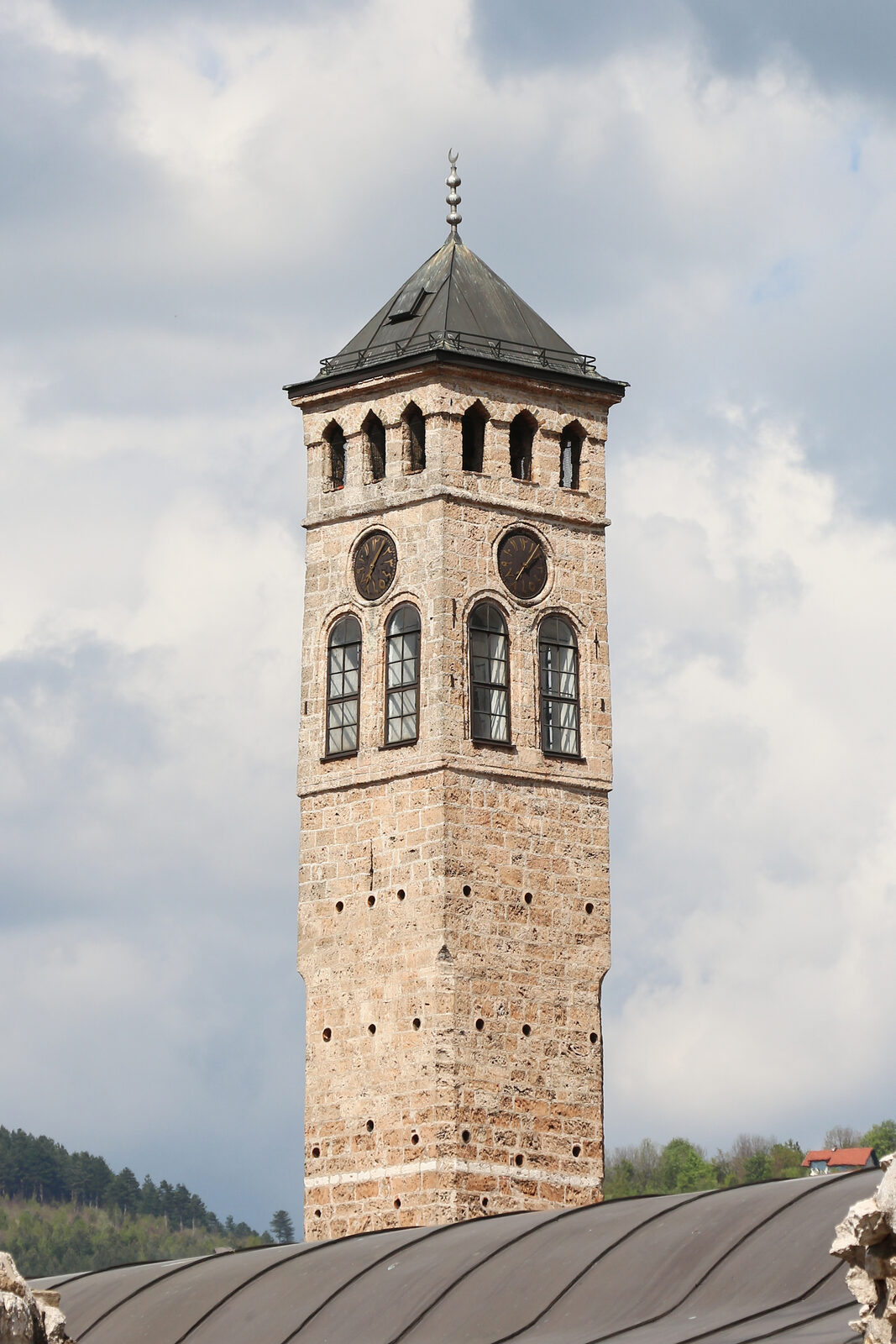
Orr’s chapter (parts of which sit outside the fieldwork sections I have read) walks the tour in detail. From the visible outline: the tour begins in Baščaršija, moves through the Gazi Husrev-beg complex (mosque, madrasa, bezistan, clock tower, founder’s mausoleum), typically enters the mosque itself (the tour operator has arranged access for visitors during non-prayer hours), and continues through the surrounding streets of the historical Muslim quarter. Along the way the guide covers:
- The history of Bosnian Islam, the conversion of the local Slavic population during Ottoman rule (14th–17th centuries), and the ways in which Bosnian Muslim practice differs from the more widely-known Middle Eastern and North African traditions.
- The role of the hodža (imam) and the local mosque as social infrastructure.
- The five pillars of Islam, briefly, aimed at visitors who may not know them.
- Muslim daily life in contemporary Sarajevo, how Ramadan is observed, what happens at Bajram, why the Sebilj is where it is, how ćejf coffee culture fits (see the coffee coverage if it exists on the site).
- The destruction of Bosnian Muslim cultural heritage during the 1992–1995 war, the deliberate targeting of mosques and libraries as documented in the ICTY judgments and elsewhere.
- The contemporary questions, the emergence of small ultra-conservative Salafi communities in Bosnia in the post-war period, how Sarajevo’s mainstream Muslim community (organised through the Islamic Community of Bosnia and Herzegovina) has related to them, and how the outside world’s “Wahhabi” label has been applied to Bosnian Muslims often inaccurately.
The tour costs, at time of writing, around 35 KM per person for a three-hour walk. It runs on a scheduled basis and can be booked through Insider Tour’s website.
What Orr’s chapter argues about it
Orr’s Chapter 5 places the Islam Tour within the theoretical framework of “advocacy tours”, a category the tourism scholar Phaedra Pezzulo has developed to describe tours whose purpose is not to display a monument but to change the visitor’s understanding of the people who live in the visited place. Advocacy tours give guides “a sense of agency,” Pezzulo writes; they let the tour guide “present a particular vision of their community to their visitors so that these ‘tourists’ might be moved to do something to transform the tragic scenes they are presented.”
The Islam Tour in Sarajevo fits the frame. But Orr’s argument goes further. The Islam Tour is, in her reading, an act of “gaze work” — an attempt by Bosnian Muslim tour guides to re-appropriate the way that Western tourists construct them as Other. When a tourist says to a Sarajevan Muslim guide “you’re not looking like you are a Muslim,” the tourist is deploying a particular Orientalist visual imaginary in which “looking Muslim” means one particular register (bearded, robed, dark-skinned, Middle-Eastern) and Sarajevan Bosniaks — pale, urban, Central European in dress and comportment — fail to match it. The remark reveals a mental picture the tourist has, one in which Islam is elsewhere and the West is here.
The Islam Tour is designed to complicate that picture at the source. It does not do so by arguing. It does so by walking the tourist through three hours of Sarajevan Islamic Sarajevo, a place that is, without question, European, and a religion that has been practised on European soil for over five hundred years.
Orr’s chapter deploys the terminology of “nesting Orientalisms”, the term the Yugoslav-American anthropologist Milica Bakić-Hayden developed in her 1995 Slavic Review article to describe the pattern in which Balkan actors themselves reproduce Orientalist hierarchies against groups they perceive as more Eastern than themselves. The Islam Tour, in Orr’s reading, is fighting nesting orientalisms in two directions at once: the Western tourist’s Orientalist framing of Bosnian Islam as Middle Eastern, and the internal Balkan Christian-nationalist framing of Bosnian Muslims as insufficiently European.
Both framings, the Islam Tour argues (walking rather than speaking), are wrong about the Islam that Sarajevo has practised since the sixteenth century.
Why the tour is unusually direct
Sarajevo has, since 1996, developed a war-tour industry that is careful about how it addresses Western audiences (see Crni humor, Tunnel of Smugglers, and Bullets in Baščaršija for the wider pattern). Guides tend to be diplomatic. Political framings are muted. Serbian denial is called out but not aggressively. Western guilt about the international response is acknowledged but not laboured.
The Islam Tour is unusually direct precisely because its subject requires it. If a Sarajevan Muslim tour guide has spent twenty years being told by Western visitors that he doesn’t look Muslim, or being called “Bloody Muslim” to his face, and if the response he has developed is a scheduled three-hour educational walk designed to change that visitor’s mind before the visitor gets on the bus back to the hotel — that response is a piece of civic infrastructure. It is not a marketing product. It is, in Orr’s careful reading, an act of pedagogical patience by a community that has continued, for thirty years, to invite strangers into its city.
Whether the tour works — whether the tourist who calls a Bosnian Muslim “Bloody Muslim” on a war tour also books an Islam Tour, and whether that Islam Tour changes anything in that tourist’s mind — is a question Orr’s ethnography can only partially answer. The tour is booked. Feedback is generally positive. Guides who lead both the war tours and the Islam tour report that the Islam tour is, in Almir’s phrasing, “totally different”.
If you take the tour, take it as what it is: a walk through Sarajevan Islam led by people who have been asked, thousands of times, to explain themselves. Ask thoughtful questions. Don’t ask why anyone would convert.
Practical
- Insider Tour, offices in central Baščaršija. Booking through sarajevoinsider.com or in person.
- Tour length: about 3 hours, walking.
- Best time: late morning, so the mosque visit falls between the duhr and asr prayer times when the mosque is quiet.
- Cost: approximately 35 KM per person; check current pricing.
- Dress: modest cover for the mosque visit; shoes will be removed.
Sources
- Helen M. Orr, Sarajevo and the War: Atrocity, Commodity, and Transgression in Bosnia’s War Tours, PhD dissertation, University of North Carolina at Chapel Hill, 2019, Chapter 5: The Islam You Didn’t Know About Tour: Europe, Orientalism, and the Tourist Gaze (pp. 145–181). UNC Carolina Digital Repository
- Milica Bakić-Hayden, “Nesting Orientalisms: The Case of the Former Yugoslavia”, Slavic Review 54, no. 4 (Winter 1995), 917–931. JSTOR
- Phaedra Carmen Pezzulo, Toxic Tourism: Rhetorics of Pollution, Travel, and Environmental Justice (University of Alabama Press, Tuscaloosa, 2009).
- Edward W. Said, Orientalism (Pantheon, New York, 1978).
- Insider Tour Sarajevo, tour listings at sarajevoinsider.com.
Sources & further reading
- Helen M. Orr, Sarajevo and the War: Atrocity, Commodity, and Transgression in Bosnia's War Tours (PhD dissertation, University of North Carolina at Chapel Hill, 2019), Chapter 5: The Islam You Didn't Know About Tour
- Insider Tour Sarajevo — tour operator website
- Milica Bakić-Hayden, 'Nesting Orientalisms: The Case of the Former Yugoslavia', Slavic Review 54, no. 4 (1995), 917–931
Keep reading
More from the guide.

Sarajevo — Zabranjeno Pušenje got its name because Nenad Janković's mother told them to stop smoking in the basement
Every Sarajevan knows Zabranjeno Pušenje. Fewer know how the band got its name. The future Nadrealisti were rehearsing in a basement on...

Sarajevo Kazandžiluk — the bullet that becomes a pen
Walk down Kazandžiluk in Baščaršija today and you’ll see engraved copper pens, letter-openers, and small ornaments made from spent artillery shells and...

Sarajevo — the fifteen-minute Saturday radio slot that launched Yugoslav absurdist comedy
Before Top Lista Nadrealista was a TV show, it was a fifteen-minute Saturday radio segment on Radio Sarajevo’s second programme. The slot...