Sarajevo Tunnel of Hope was also the Tunnel of Smugglers
The 800-metre Sarajevo Tunnel is now a museum and the most photographed piece of siege infrastructure in the city. Helen Orr's UNC dissertation adds the part the tour tends to skip — the wartime economy that moved through it in both directions.
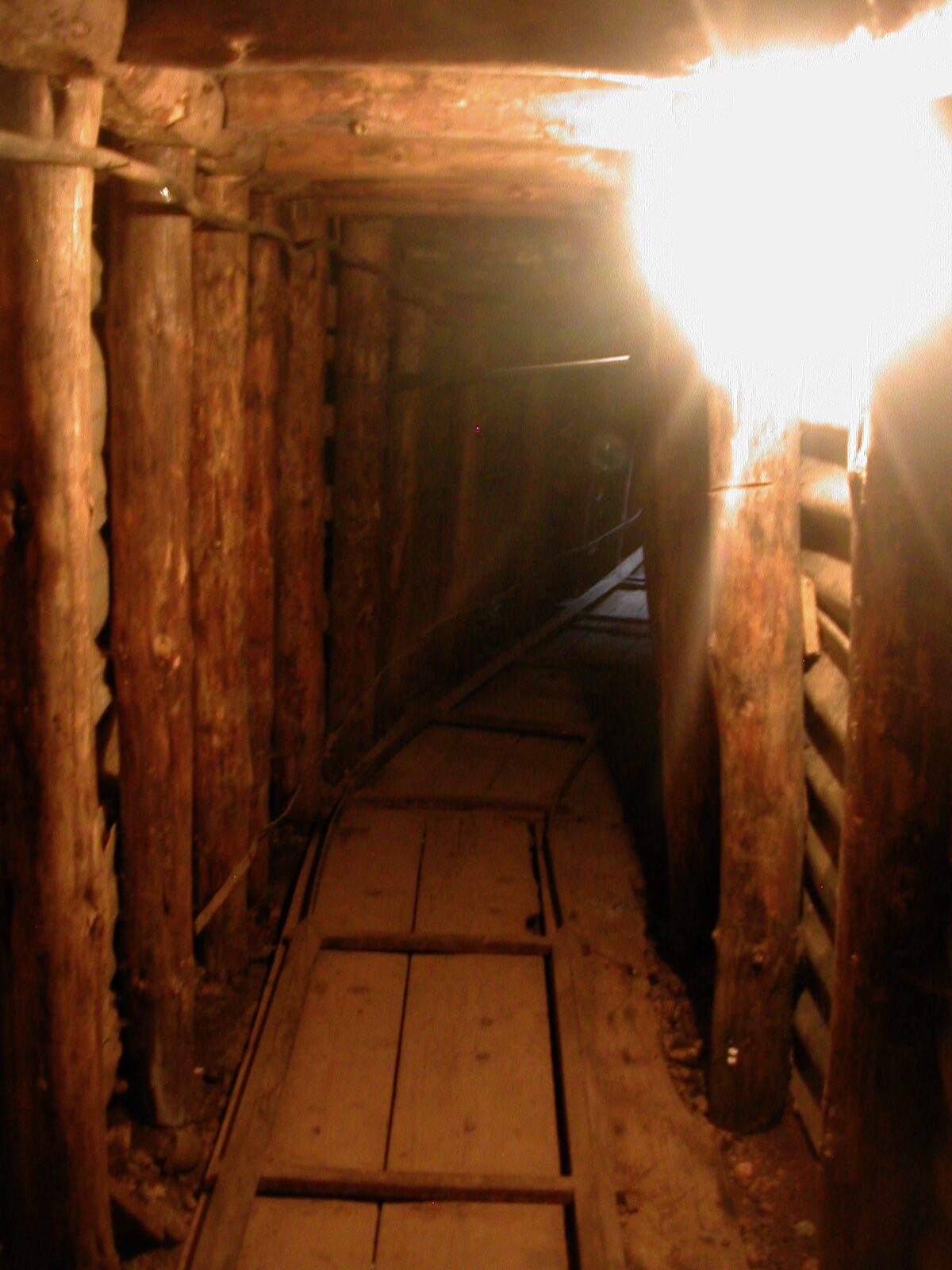
The Sarajevo Tunnel is 800 metres of hand-dug passageway. It ran under the UN-controlled airport runway between two ordinary two-storey houses, one in Butmir on the free side, one in Dobrinja on the besieged side. It opened on 30 July 1993 and stayed in use until the siege ended in February 1996. For thirty months it was the city’s only reliable connection to the outside world.
The tunnel is now a museum. The Butmir end at Tuneli 1 preserves a 25-metre walkable section, a small exhibit of tools and photographs, a scale model, and a short film. Entry is 10 BAM for adults. Almost every war tour stops there, first thing in the morning or last thing in the afternoon, depending on the operator. On a summer weekend, expect 200 to 400 visitors.
What the tour tells you is broadly accurate: food, medicine, ammunition, refugees. President Alija Izetbegović was carried through it. Wounded soldiers came out through it. An estimated twenty million tonnes of material moved through it over its working life. All of that is on the display boards. All of it is true.
What most tours leave off is the tunnel’s second cargo. Helen M. Orr’s UNC dissertation (2019) makes it the central point of her Chapter 2, “The Tunnel of Hope/The Tunnel of Smugglers”. Not instead of the official cargo, alongside it. The tunnel was simultaneously an infrastructure of civilian survival and an infrastructure of siege-economy profiteering. Both are true. The tour tends to tell one of the two.
What Orr’s chapter argues
Orr’s ethnographic method takes her not only through the museum but through a series of long conversations with Sarajevans of different ages and different siege experiences. Chapter 2 is structured around one of them, a Sarajevan interlocutor who nicknames the tunnel Tunel Švercera, “the Tunnel of Smugglers”, in half-joking correction of the official Tunel Nade, “the Tunnel of Hope”.
The nickname is not cynical. It is precise. What moved through the tunnel, alongside the officially-sanctioned traffic, included:
- Cigarettes, which functioned as siege currency. A packet of foreign cigarettes bought inside besieged Sarajevo could sell for many multiples of its Butmir price. Whoever had access to the tunnel, at either end, had access to a currency.
- Coffee, in green-bean form. The Sarajevan ćejf ritual (per the site’s coffee coverage) does not pause for a siege. Roasted coffee arrived through the tunnel and was sold on the black market.
- Alcohol, both foreign spirits and homemade rakija from villages outside the ring.
- Foreign currency, largely Deutsche Marks. The Bosnian dinar collapsed early in the war; whoever controlled the tunnel controlled the exchange.
- Fuel, in small quantities, for generators and vehicles.
- Consumer goods in general, batteries, radios, spare parts, medicine sold above cost.
The people who moved these goods were not, in Orr’s ethnography, a small criminal underclass separate from the defenders of the city. They were, in many cases, the same people. The tunnel was administered by the Bosnian army (the ARBiH), and access to it was rationed through military logistics. The people with access were also the people with an economic opportunity, and the two roles are not, in the historical record, cleanly separable.
Orr’s chapter is careful about this. It does not accuse the Bosnian army of black-marketeering as a policy, and it does not indict individual figures by name. It sits with the historically demonstrated fact that a besieged city with a single supply line will produce, whatever its intentions, an economy structured around that supply line. The Tunnel of Hope and the Tunnel of Smugglers were the same 800 metres of earth.

Why the second history was suppressed
The reason the tour usually tells only the first history is not, in Orr’s reading, deception. It is narrative economy.
The Bosnian counter-memory of the siege, the memory that Sarajevans have spent thirty years defending against Serbian denial and Western indifference, depends on a certain moral clarity. The city was besieged. The city defended itself. The tunnel saved it. To acknowledge, in the same breath, that the tunnel also enriched some of the people around it is to complicate a story that has spent thirty years being simplified against active resistance. It is not that the second story is untrue. It is that telling it in the wrong context can be picked up and weaponised.
This is Orr’s core theoretical claim about the tunnel. She reads the museum’s narrative, and the tour guides’ narrative, as an act of counter-memory production. The choice to emphasise the tunnel’s civilian-survival function over its black-market function is a political choice, made against the pressure of Serbian revisionism that would use the second story to muddy the first. The choice is legible only if you understand the pressure it is made under.
What a visitor should do with this
Two things.
Take the tour. The museum is the best surviving physical witness to the siege infrastructure, and the tour guides, many of whom lived through the siege, are giving you the war in the register in which they choose to give it. That register is largely the register of civilian survival. Trust it. Listen carefully. Ask questions.
Read Orr’s Chapter 2 afterwards. If you want the fuller picture, the tunnel as both hope and market, both moral clarity and economic opportunity, both what saved the city and what fed a specific class of people during a specific 30-month period, Orr’s chapter is 32 pages, freely downloadable from the UNC Carolina Digital Repository, and gives you what the museum wall does not. It does not undo the tour. It thickens it.
The Tunnel of Hope was the tunnel that saved Sarajevo. It was also, in the same 800 metres of earth, the tunnel that let some people make money on the war. Both are Sarajevo. Neither cancels the other.
Practical
- Tunnel of Hope Museum, address: Tuneli 1, Ilidža. About 20 minutes by car from central Sarajevo; taxi, tour van, or tram 3 + walk are the standard ways.
- Entry: 10 KM adult, 5 KM student, 3 KM group per person (as of 2026; check the current tariff).
- Hours: 09:00–16:00 daily in winter, 09:00–17:00 daily in summer. Closed on Bajram and Christmas Day.
- Time on site: about 45 minutes if you walk the exhibit, watch the film, and cover the 25-metre walkable stretch of tunnel. Add 30 minutes if you want to sit with the outdoor display of siege-era vehicles.
The full destination entry: Tunnel of Hope.
Sources
- Helen M. Orr, Sarajevo and the War: Atrocity, Commodity, and Transgression in Bosnia’s War Tours, PhD dissertation, University of North Carolina at Chapel Hill, 2019, Chapter 2: The Tunnel of Hope/The Tunnel of Smugglers: Counter-Memory Authorizes the Production of the Sacred and the Profane. UNC Carolina Digital Repository
- Sarajevo Tunnel. Wikipedia
- Tunnel of Hope Museum. Sarajevo Tourism
Sources & further reading
- Helen M. Orr, Sarajevo and the War: Atrocity, Commodity, and Transgression in Bosnia's War Tours (PhD dissertation, University of North Carolina at Chapel Hill, 2019), especially Chapter 2: The Tunnel of Hope/The Tunnel of Smugglers
- Sarajevo Tunnel — Wikipedia
- Tunnel of Hope Museum — Sarajevo Tourism
Keep reading
More from the guide.

Sarajevo 1878 — a Habsburg officer wrote the playbook for how to civilise Bosnia, and Vienna followed it for thirty years
In 1878, a Habsburg military officer named Armand Schweiger-Lerchenfeld published in Vienna a 245-page ethnographic study of newly-occupied Bosnia titled ‘Das Land...

Sarajevo — the Muslim family that hid a Jewish family from the Nazis in 1941, and were saved by them fifty years later
There is one Sarajevo story that everyone in the city knows, but that most guidebooks skip, and that fewer non-Sarajevans know than...
Sarajevo — the biggest book-burning in history took 90 minutes, and the shells landed on the fire brigade too
The site’s book-burning post tells you 1.25 million volumes went up on the night of 25–26 August 1992 at Vijećnica. It’s the...