
Sarajevo — the peasant fantasy Victorian Britain came here to buy
The British writers who came to Habsburg Bosnia between 1895 and 1914 were not, on the whole, looking at Bosnia. They were looking at the England they thought they had lost. The historian Frank Trentmann named the framework at work — the late-Victorian "matrix of neo-romanticism." Bosnia, in that reading, was less a Balkan province than an anti-industrial pastoral: a physical place where an anxious British reader could locate a way of life that Manchester and Birmingham had extinguished.
Between 1895 and 1914, at least six substantial English-language travelogues appeared on Habsburg Bosnia and Herzegovina. They sold well. They were reviewed in The Athenaeum, The Saturday Review, and The Spectator. In aggregate they made one of the largest bodies of British travel writing on any single Balkan province before 1914.
Read carefully, most of them were not looking at Bosnia. They were looking at the England they thought they had lost.
The historian Frank Trentmann named the framework in a 1994 article: the “matrix of neo-romanticism”, the widespread late-Victorian middle-class conviction that industrial modernity was corrupting British character, and that the cure was contact with a physically-real premodern landscape.
That landscape didn’t have to be in Britain. It could be in the Cotswolds. It could be in Cornwall. It could be in the Alps, the Pyrenees, the Norwegian fjords. Or, for the reader who bought Henri Moser’s book and looked at Robert Munro’s photographs, it could be in Habsburg Bosnia.
Bosnia was on the British anti-industrial itinerary. What the British writers were actually doing when they wrote about it is a question Ross Cameron’s 2023 article makes it possible to answer.
The domestic anxiety
The framework starts at home. Late-Victorian Britain was, from the perspective of the readers who bought these travel books, an increasingly frightening place.
The population of England and Wales had roughly doubled between 1850 and 1900, from about 18 million to about 33 million. Roughly 80 percent of it now lived in cities. Manchester, Birmingham, Sheffield, Leeds, and above all London had grown into the physically largest and most densely-packed urban environments the world had yet seen. The historian John Pemble, in The Mediterranean Passion (1987), assembled the language the late-Victorian middle-class used about its own cities: they were “academies of crime and subversion”; they “unmade” the character of their inhabitants; they were incompatible with “the settled air of orderliness and security” that mid-Victorian gentlemen supposed they had grown up with.
The literature reads, at a century’s distance, as a class panic. What the middle-class writer was worried about was not the industrial city as such; he lived in one, comfortably. He was worried about the working class that the industrial city had produced, and whose habits, politics, and reading matter he did not recognise.
The neo-romantic cure was not to reform the working class. It was, for the writer himself, to physically leave the city on holiday for a landscape that felt older, quieter, and, critically, organised on principles the writer could imagine himself as belonging to.
Rambling (walking in the countryside as a leisure activity) became a middle-class hobby in exactly this period. William Morris’s News from Nowhere (1890), which imagined a de-industrialised medieval-communal London, sold steadily. The Arts and Crafts movement rejected factory manufacture. The National Trust was founded in 1895 to preserve landscapes. What Trentmann’s article did was to show that these apparently disparate movements were expressions of a single underlying conviction: industrial society had gone wrong, and the correction was a return to premodern life, on foot, in a place where cows still grazed and cottages still had thatched roofs.

Why Bosnia fit
For the niche of British reader who wanted the anti-industrial cure but had already done the Cotswolds and the Lake District, Bosnia offered a stronger dose of the same medicine.
Bosnia had:
- Mountains. Bjelašnica, Igman, Trebević, Vranica, genuinely alpine terrain, at continental scale.
- A pre-industrial peasantry, Slavic villagers running the mountain economy in ways that had not visibly changed since the fifteenth century.
- Ottoman architecture, the mosques, the hans (traveller’s inns), the covered markets, the Sebilj, that a British reader could read as evidence of a civilisation rather than a modernity.
- A Habsburg colonial infrastructure, the railways, the hotels, the postal service, the gendarmerie, which meant the British reader could reach the pre-industrial peasantry and be back in Vienna within a week, in comfort.
- A legibility. The 1878 Austro-Hungarian occupation, the 1908 annexation, the archduke Franz Ferdinand’s assassination in 1914, all events the British newspaper reader followed. Bosnia was not, in the imagined-geography sense, exotic; it was newsworthy.
Cameron summarises the fit in one sentence: the British neo-romantic project sought “a settled air of orderliness and security” which the Bosnian province could be presented as embodying.
The catch was that the Bosnian province did not, in fact, embody it. The Habsburg administration ran an actively modernising colonial project in Bosnia between 1878 and 1914, schools, roads, cadastral surveys, railways, factories, banks. The whole point of Kállay’s twenty-one-year tenure at the Common Ministry of Finance was to convert Ottoman Bosnia into a Central European economy. The British writer who came to see the pre-industrial peasantry was seeing a place actively being un-made in exactly the way the British writer had come to escape.
The tension is legible in every British travelogue of the period. The writer photographs a woman drawing water at a village fountain, and describes her as “a scene from a mediaeval fresco”. In the next paragraph, the writer takes the newly-built narrow-gauge railway back to his hotel in Sarajevo, where he types his notes.
The colonial parallel, India, Kashmir, the Turk
The British writer who came to Habsburg Bosnia was, in a real way, coming to see another British colony run by another people.
The clearest example is Harry C. Thomson, whose The Outgoing Turk (1897) sold well in London. Thomson’s book is a running comparison between the Habsburg administration of Bosnia and the British administration of India. He praises Kállay’s “paternal government” using exactly the language British administrators used about themselves in the Indian civil service. He argues that Bosnia should be understood as “the Kashmir of Austria-Hungary”, a mountain province with a Muslim majority whose feudal aristocracy could be won over by a firm but fair Central European regime.
The comparison flatters both administrations. It reassures the British reader that European colonial modernity is, on the whole, a benign force in the world. It also makes Bosnia a comprehensible place for the British reader. He knows Kashmir from newspaper coverage. Bosnia is like Kashmir. The framework transfers.
What the framework does not do is see Bosnia as Bosnia. The Bosnian history (the Bogomil church, the Kotromanić kings, the Ottoman transformation, the local land tenure, the fact that Bosnian Muslims are Slavs) appears in Thomson’s book only as ornament. The book is really about British India, wearing Bosnian dress.
The peasant, photographed
Robert Munro’s Rambles and Studies in Bosnia-Herzegovina (1900) was the first English-language Bosnia travelogue with a substantial photographic apparatus. Munro attended the 1894 international archaeological congress in Sarajevo, a landmark event of the Kállay cultural programme, and returned to write the book from field notes and photographs.
Munro’s photographs are, in retrospect, the clearest documentation of what the British neo-romantic gaze was doing. The photographs are almost all of:
- Rural landscapes without industrial infrastructure visible.
- Peasants at work in traditional dress, women with water jugs, men with ox-carts, boys with sheep.
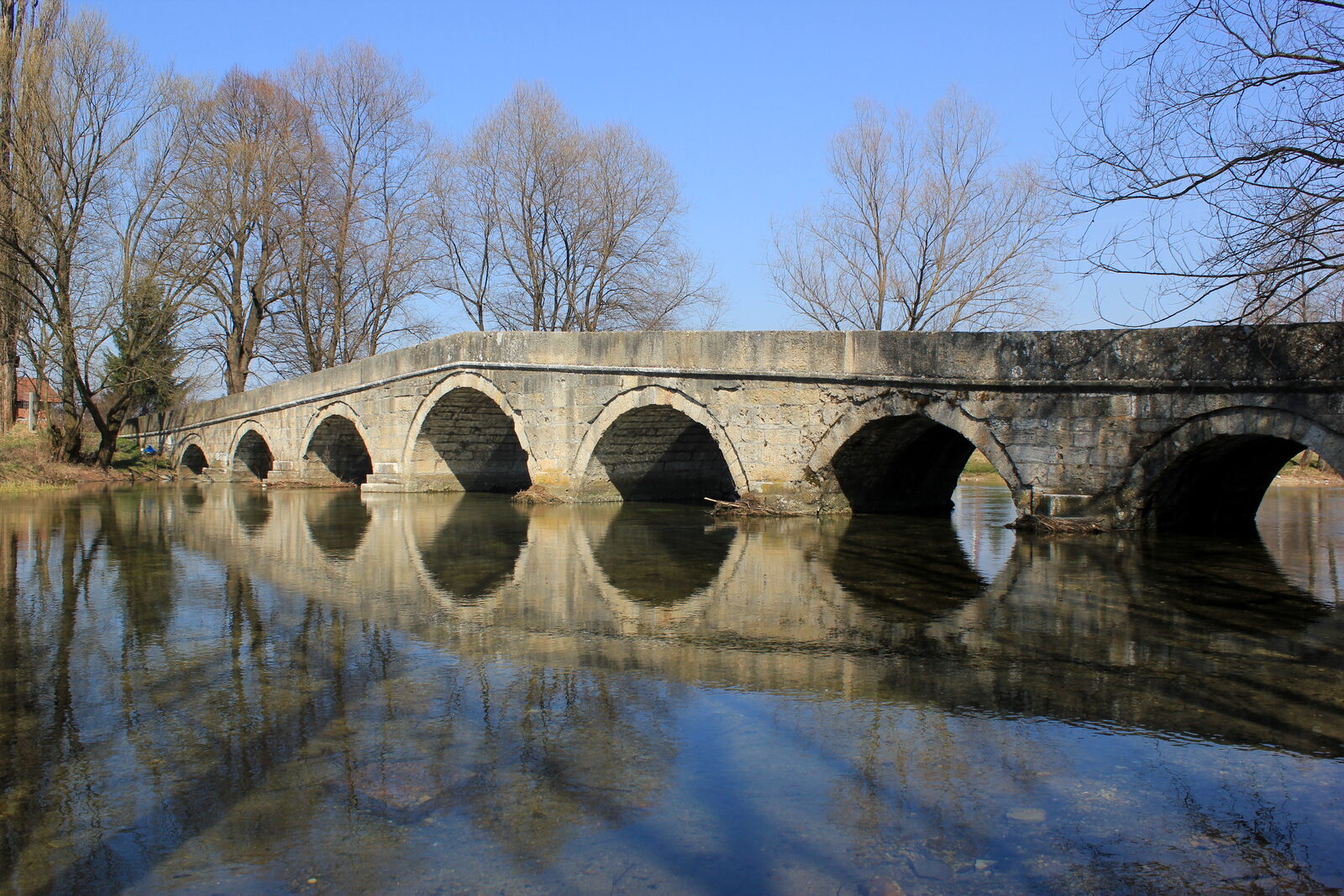
- Ottoman monuments, mosques, bridges, mausoleums, depicted as timeless architecture rather than as functioning contemporary buildings.
- Ancient stone monuments, the medieval stećci (see the stećaks story), the Roman ruins at Ilidža, the mediaeval fortifications at Jajce.
The photographs did not lie. Rural Bosnia contained all of these things. But the photographs were also selective in a pointed way. The city of Sarajevo appears in Munro’s book almost only as a set of Ottoman monuments; the newly-built Habsburg office district around Marijin Dvor, the tramway, the illuminated shopfronts on Ferhadija, the railway station — the things that were changing Bosnia most fundamentally in 1900 — are almost entirely absent.
What Munro’s book photographs is not Habsburg Bosnia. What it photographs is a British readerly fantasy for which Habsburg Bosnia provided the location.
What this pattern is not
It matters what the neo-romantic frame is not. It is not necessarily hostile. It is not, in the strict Saidian sense, only Orientalism. Bosnia in these books is often praised, sometimes lavishly. The British writers did not, in general, want to conquer Bosnia; they wanted to rest in it.
The frame is also not, strictly, Habsburg-nationalist propaganda. The Baker-organised press tours produced favourable coverage of the Habsburg administration, but individual writers, Miller, Munro, Thomson, genuinely liked what they saw. The frame is compatible with sincerity.
What the frame is, in Cameron’s assembly of the material, is displaced. The British writer’s real subject was late-Victorian Britain. Bosnia was the mirror in which he could see, at a comfortable distance, what he wished had not happened to his own country.
The Bosnian response, then and now
The Bosnian population of the 1890s and 1900s had very little visibility of this literature. There were no Bosnian-language editions. The books did not sell in Sarajevo. What Bosnian intellectuals of the period read of foreign writing on their country was, for the most part, the Vienna-Habsburg publications and the Belgrade-Serbian press. The British neo-romantic literature was a British conversation about Britain, held over Bosnian ground, without Bosnian participation.
The books do, however, matter for the current Sarajevan reader, in one way. They are the earliest large body of English-language travel writing about the city. They are what a British visitor Googling Sarajevo in 1904 would have consulted. The images they fixed, Sarajevo as “the Cairo of the Balkans”, Bosnia as “the Kashmir of Austria”, the peasant at the mountain fountain, are still present in the marketing copy the Bosnian tourism board uses today, more than a century later, and the deeper history of that copy is exactly the one Trentmann and Cameron document.
The current reader can, and probably should, notice the pattern and refuse to reproduce it. Bosnia is not a mirror. Sarajevo is not the Cairo of anywhere. The mountain villages of Bjelašnica are what they are, in their own history, and their charm, if you must use the word, does not consist in being unmodern for a British visitor’s benefit. It consists in continuing to be Bosnian.
Sources
- Roswitha Cameron, Henri Moser’s Bosnian Circle and the British Tourism Boom, 1893–1914, working paper, 2023.
- Frank Trentmann, “Civilization and Its Discontents: English Neo-Romanticism and the Transformation of Anti-Modernism in Twentieth-Century Western Culture”, Journal of Contemporary History 29:4 (October 1994), 583–625. JSTOR.
- John Pemble, The Mediterranean Passion: Victorians and Edwardians in the South (Oxford: Clarendon Press, 1987).
- Harry C. Thomson, The Outgoing Turk: Impressions of a Journey Through the Western Balkans (London: Heinemann, 1897).
- Robert Munro, Rambles and Studies in Bosnia-Herzegovina (Edinburgh and London: William Blackwood and Sons, 1900).
- William Miller, Travels and Politics in the Near East (London: T. Fisher Unwin, 1897).
- Henri Moser, An Oriental Holiday (London: International Sleeping Car Company, 1895).
- Piro Rexhepi, “The Colonial ‘Sanitation’ of Muslim Bodies in the Balkans”, journal article, various venues.
- Edward W. Said, Orientalism (New York: Pantheon, 1978), the underlying theoretical frame.
Sources & further reading
- Roswitha Cameron, 'Henri Moser's Bosnian Circle and the British Tourism Boom, 1893–1914', article, 2023
- Frank Trentmann, 'Civilization and Its Discontents: English Neo-Romanticism and the Transformation of Anti-Modernism in Twentieth-Century Western Culture', Journal of Contemporary History 29 (1994), 583–625
- Harry C. Thomson, 'The Outgoing Turk' (London: Heinemann, 1897)
- John Pemble, 'The Mediterranean Passion: Victorians and Edwardians in the South' (Oxford: Clarendon Press, 1987)
Keep reading
More from the guide.
Sarajevo — the book that took the shrapnel: a 1926 letters volume in a Kovačići garden, 22 April 1992
Some siege stories are about buildings. Some are about numbers. This one is about a book. On the night of 22 April...

Sarajevo Brewery — 1864, and the water that kept a besieged city alive
Sarajevska pivara was founded 1864 by a Slovenian brewer under Ottoman contract and has operated on the same site ever since. During...
Sarajevo Holiday Inn — Karadžić's own hotel was the sniper platform, then the press base for 1,425 days
The Ivan Štraus building opened in 1983 as the Olympic showcase, launched two opposing political parties in 1990–91, briefly served as Radovan...