Sarajevo — in 1902 Paržik built a synagogue by borrowing from six different architectures
Karlo Paržik had been running the Habsburg Orientalizing programme for fifteen years when the Ashkenazi Synagogue came across his desk. He pulled decorative elements from Sasanian, Byzantine, Mamluk, Seljuk, and Ottoman precedents into one building for a Jewish congregation. The result was the third-largest synagogue in Europe when it opened. It is the only synagogue in Sarajevo that still functions today.
Karlo Paržik had been the Habsburg Orientalizing bench’s main pen for fifteen years by the time the Ashkenazi Synagogue commission landed. He had done the sharia-judge school on Sagrdžije in 1889. He had drawn the first Vijećnica plan in 1892 (Kállay rejected it, Wittek redressed it, and the Vijećnica opened in 1896). He was a Czech Catholic. And now, in 1900, the Sarajevo Ashkenazi Jewish community — which had arrived in the city only after the 1878 Habsburg occupation, following the imperial railway east — needed a synagogue.
Paržik drew it. Two years of construction. Opened in 1902. On the left bank of the Miljacka, between the Drvenija and Ćumurija bridges — same stretch where Hotel Central sits on the opposite side of Franz Joseph Street. Contractor Ludwig Jungwirth. Interior decoration by Ludwig Oisner, who did the friezes with rosettes and the relief ornaments.
The odd thing about the building — the thing worth stopping in front of — is that Paržik didn’t pick one Islamic tradition and run with it. He borrowed from six different architectural traditions in one building. Sasanian. Byzantine. Mamluk. Seljuk. Ottoman. And a touch of pseudo-Andalusian. All in the same facade.
Why six
By 1902 the Habsburg Orientalizing programme had a fifteen-year track record. On the sharia-judge school, Paržik had gone with a fairly straightforward Andalusian-Moorish vocabulary — horseshoe arches, muqarnas cornices, small minarets. The Vijećnica, which by 1902 had been open six years, used a heavier Cairo-Mamluk register — Alexander Wittek had visited Cairo twice during construction and had taken the Sultan Hassan Madrasa as a reference. So there was already a house style, and Paržik knew it well.
For a synagogue, none of it quite fit. The Jewish community in Sarajevo was Ashkenazi — coming in via the railway from Habsburg lands, Austrian and Hungarian in cultural background. The older Sephardic community, present since the sixteenth century, had its own synagogues in Baščaršija. What Paržik needed was a decorative language that would read as religious and Eastern without reading as Islamic.
His solution was to borrow across the whole Near-Eastern-and-late-antique repertoire. Sasanian rosette forms in the framing panels. Byzantine circular motifs in the arch surrounds. Mamluk pointed arches for the openings. Seljuk knotwork in the ornamental corners. Ottoman-style domes on the corner towers. Andalusian polychromatic tiling on the interior walls. Any single one of these would have felt derivative; six at once produced something the community and the architecture press both accepted as its own thing.
The precedent Paržik was most likely working from is the Dohány Street Synagogue in Budapest — the Great Synagogue, opened 1859 — which was the largest synagogue in Europe at the time. That building used a similar mixed vocabulary. Paržik shrank the Budapest programme, dropped some Byzantine and added more Mamluk, and produced what was, when it opened, the third-largest synagogue in Europe.
What it survived
The Ashkenazi Synagogue opened in 1902 to a congregation of a few thousand. The Ashkenazi community grew steadily until 1941. Then the Wehrmacht walked into Sarajevo in April 1941 and the Ustaše authorities began the machinery of the Holocaust. Of the roughly 12,000 Jews in Sarajevo at the outbreak of war, about 10,500 were murdered. The Sephardic community was disproportionately hit — the older, larger, more entrenched community lost proportionally more people than the newer Ashkenazi community. All of Sarajevo’s older Sephardic synagogues went out of regular use in the war and did not reopen after.
Which is why the Ashkenazi Synagogue is the one that is still functioning. It is not the largest, not the oldest, and not the most historically important synagogue Sarajevo has ever had — that would be the sixteenth-century Old Sephardic Synagogue in Baščaršija, which is now the Jewish Museum. But it is the one where regular services still happen, where the Sarajevo Jewish community’s rabbi holds Shabbat and the High Holidays, where the bar mitzvahs get held.
The older Sephardic synagogue in Baščaršija — a sixteenth-century building damaged in the war and again in later fires — is now the Jewish Museum of Bosnia and Herzegovina, part of the Museum of Sarajevo network. Worth an hour if you have one.
The building survived the war intact. It survived the 1992–95 siege intact — the community shrunk further and did significant humanitarian work through the La Benevolencija society, but the building took no direct hits. In the 2000s it was restored; a heritage plaque went up. It is open for tours some days of the week. Services happen on Shabbat.
What is Paržik’s total by now
By 1902, Paržik had been in Sarajevo eighteen years. He had run through the full arc of Habsburg-era assignments: an educational building for Muslims (the sharia school, 1889), a civic building in Islamic drag (the Vijećnica plan, 1892), and now a religious building for the Ashkenazi Jewish community (the synagogue, 1902). He would keep going. The National Museum opened in 1913, another Paržik commission — this time in Renaissance style, no Islamic decoration at all, because the museum was framed as a European scientific institution.
The sharia school still educates Muslim scholars. The Vijećnica is Sarajevo’s national library, restored after the 1992 shelling. The Ashkenazi Synagogue is where the Sarajevo Jewish community meets on Shabbat. The National Museum has the Haggadah on permanent display.
Four Paržik buildings, four different communities, four different current uses, all still standing, all still doing something like the original brief.
Not bad, for a Czech from Veliš who stepped off the train in 1884 and never really left.
Sources & further reading
Keep reading
More from the guide.

Sarajevo Old Jewish Cemetery — 3,850 Sephardic tombstones, second-largest in Europe
Above Kovačići, on the south slope over the Miljacka, sits a cemetery of about 3,850 stone tombstones on 31,160 square metres. It...
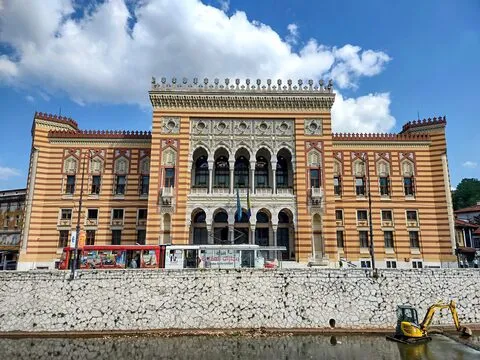
Sarajevo — the Vijećnica reopened on 17 July 2014, twenty-two years after Serb shells burned it, and the new façade is a very careful copy
The Vijećnica opened in 1896 as the Habsburg-era City Hall of Sarajevo. From 1949 it held the National and University Library. On...

Sarajevo — Hotel Central opened in 1889, and Vancaš put horseshoe arches on the front
Hotel Central opened in 1889 on the Habsburg-era main promenade Franz Joseph Street, today Zelenih beretki. It was Josip Vancaš’s first significant...