
Sarajevo — one Ottoman governor built the religious core in 1531
In 1531 a wealthy Ottoman governor built a mosque, a religious school, a covered market, a clock tower, an astronomy station, and his own mausoleum, all clustered inside one square kilometre at the western edge of Baščaršija. The complex has been the working religious, educational, and commercial centre of Sarajevo's Muslim community for nearly five hundred years. What Gazi Husrev-beg founded, what survives, and what a visitor should notice.
Gazi Husrev-beg was born around 1480 in Serres, in northern Greece, to a family of Ottoman military nobility with Bosnian origins (his mother, Selçuk Hatun, was the daughter of Sultan Bayezid II). He entered Ottoman military service young, rose through the ranks in the western Balkan campaigns of the 1510s and 1520s, and served as governor (sanjakbeg) of the Bosnia sanjak in three separate terms between 1521 and his death in 1541. He was killed in June 1541 during a campaign against Habsburg forces along the Drina river. He was sixty-one.
Between his first appointment as Bosnia’s governor in 1521 and his death twenty years later, Gazi Husrev-beg used his substantial personal wealth to found a series of religious, educational, and commercial buildings in Sarajevo. He endowed the whole set as a permanent waqf, the Islamic legal institution of a religious endowment, which continues to administer the buildings under Bosnian law today. The Gazi Husrev-beg Waqf office is on Sarači, one hundred metres from the mosque.
The complex he built is the working Muslim civic and religious centre of Sarajevo. Most of what a visitor associates with Ottoman Sarajevo, the great mosque, the covered market, the clock tower, the religious school, is Gazi Husrev-beg’s endowment. Not incidental. One man designed, funded, and organised the lot over twenty years, five hundred years ago, and it still runs.
The mosque
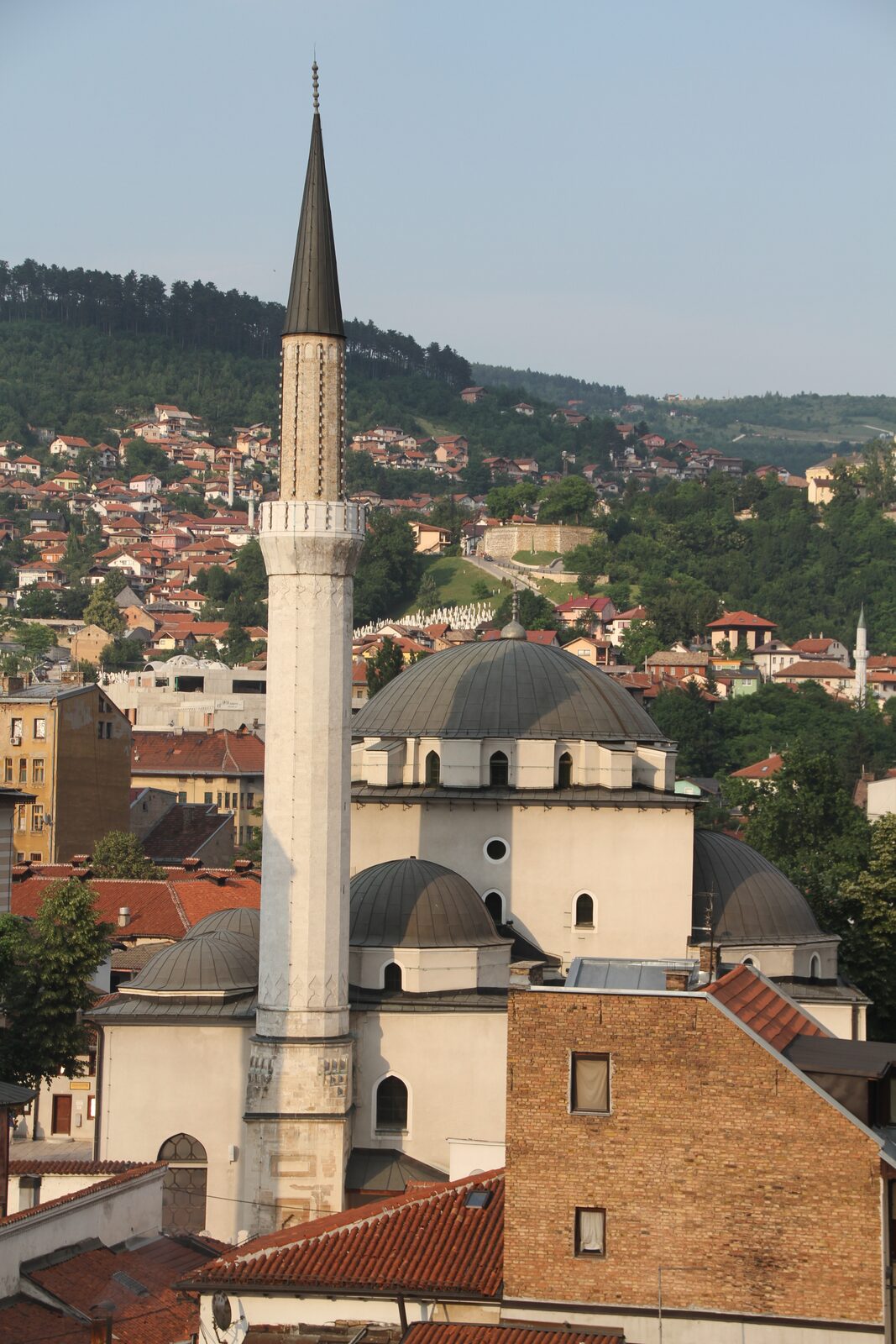
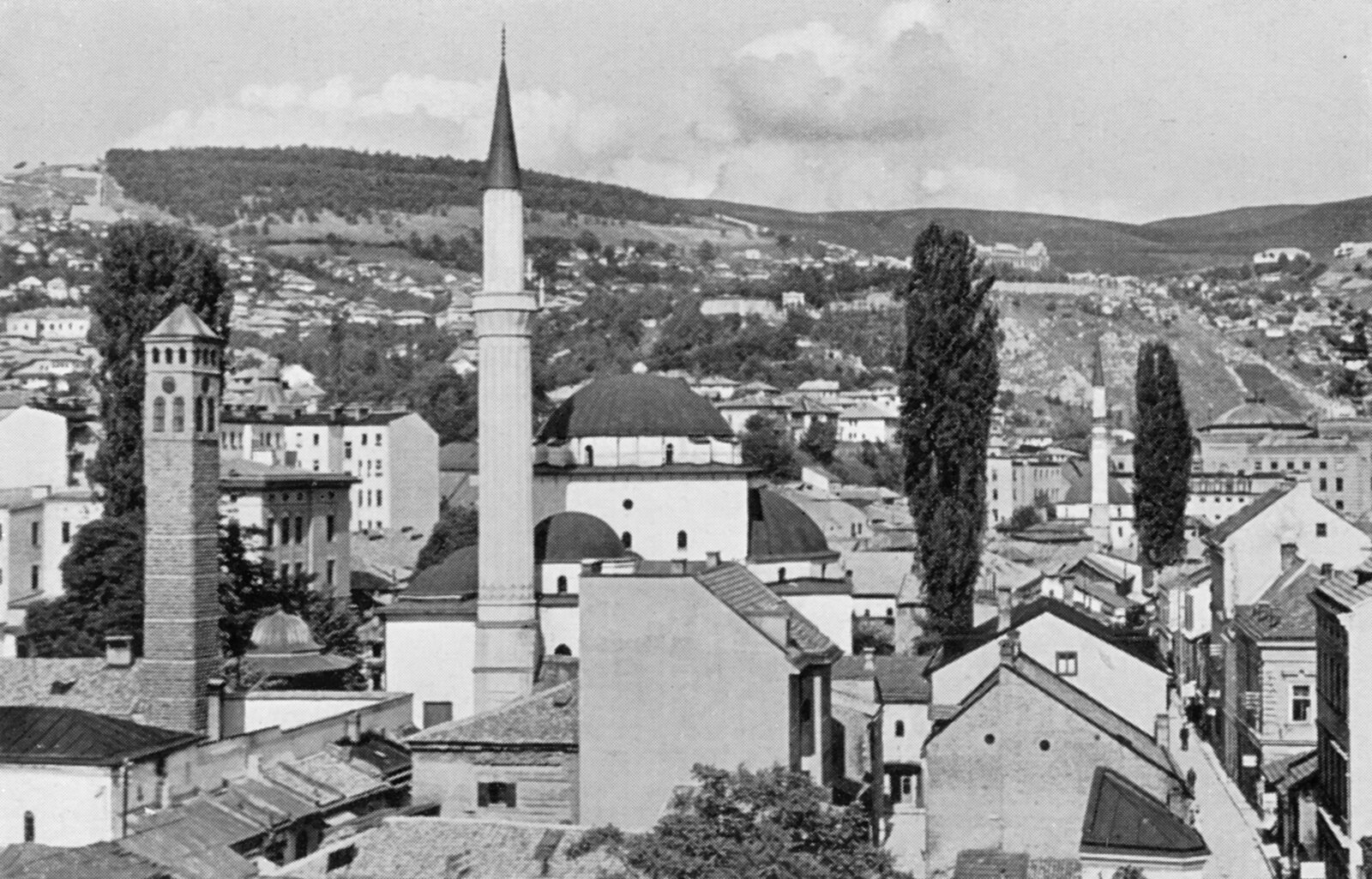
The Gazi Husrev-beg Mosque (Bosnian: Begova Džamija or “the Beg’s mosque”) was completed in 1531. The largest Ottoman mosque in Bosnia. Sources attribute the building to Adjem Esir Ali, a Persian-Ottoman architect who is also credited with several major mosques in Constantinople. Some sources argue that the young Mimar Sinan, later the greatest architect of the Ottoman Empire, worked on the Sarajevo mosque as a draftsman early in his career, though the attribution is contested.
The plan is a classical Ottoman single-dome design: a central prayer hall covered by a large dome (17 metres diameter, 26 metres high), supported by four half-domes on the sides. A five-arched entrance portico with three smaller domes shelters the shadirvan (ablution fountain). The interior is spare by Ottoman standards, with restrained Iznik-style tile work around the mihrab and a lower prayer-hall ornamental programme that emphasises the space rather than the decoration.
The mosque took damage across its history: fire in 1697 during Prince Eugene of Savoy’s Habsburg raid, earthquake damage in the eighteenth and nineteenth centuries, and direct artillery hits during the 1992–1995 siege. The Turkish government partly funded the post-siege reconstruction, completed 1996–2000. The mosque is now, at any given afternoon, essentially indistinguishable from what it was in 1531.
Non-Muslim visitors are welcome outside prayer times. Cover, remove shoes, be quiet. The prayer times are posted at the entrance. Late morning and early afternoon are the reliable non-prayer windows.

The Kuršumlija Medresa
The Kuršumlija Medresa, literally “the lead-roofed madrasa”, was founded by Gazi Husrev-beg in 1537 and functioned as one of the highest-level religious schools in the Balkans until it was formally absorbed into the Bosnian state education system in the twentieth century. The building sits immediately south of the mosque, on Gazi Husrev-begova.
The name comes from the roof, which was covered in lead sheet, an expensive and unusual material for a Bosnian sixteenth-century building. The choice was Gazi Husrev-beg’s own; his waqf documents specifically fund the lead roof as a marker of the school’s status. The lead survived until the twentieth century when it was replaced by copper.
The building is a two-storey stone structure organised around an internal courtyard. Twelve student cells surround the courtyard on the upper floor. The classroom and library sit on the ground floor. Students were housed, fed, and taught for free, funded by the waqf endowment. The library, the Gazi Husrev-beg Library, holds one of the largest collections of Islamic manuscripts in the Balkans, including original documents of the waqf foundation.
The madrasa is a working religious school today, part of the wider Islamic education network in Bosnia. The library is open to researchers by appointment and to the general public through occasional exhibitions.
The Sahat Kula
The Sahat Kula, the clock tower, is one of the more unusual buildings of the complex. It was built shortly after the mosque, probably in the 1530s or 1540s, as a timekeeping tower for the mosque’s prayer times. It is approximately thirty metres tall, four-storey, built of stone with a wooden roof.
The clock is calibrated to lunar time (ala turca) rather than solar time. In the Ottoman timekeeping system, the day begins at sunset, when the clock is reset to 12:00. This means the clock has to be recalibrated approximately every twelve days as the sunset moves through the year. The mechanism was, for centuries, adjusted manually by a specialist official, the muvekkit, who was funded by the waqf.
The current clock mechanism dates from 1874 and was made in England by Gillett & Bland of London. It replaced an earlier Ottoman mechanism that had worn out. Per multiple sources, the only clock in the world still working on lunar time. Still adjusted regularly. The muvekkit position is filled today by a specialist at the waqf office who visits the tower on the required schedule.
The tower is closed to the public. You can see its face from the courtyard of the mosque, from Ferhadija, and from the top of the Yellow Fortress. If you visit Sarajevo during Ramadan, the clock is set to zero at sunset each day, which is the specific moment the iftar meal begins.
The Bezistan
The Bezistan, the covered market, was built in 1543 by Gazi Husrev-beg’s endowment as part of the same funding programme. It is a 51-metre-long vaulted stone hall with six main entrances, running north-south along Ferhadija. Traditionally the bezistan was where the most valuable trade goods (textiles, spices, coffee, later tobacco) were sold, since the enclosed hall provided better security than the open-air shops of Baščaršija.
Fires forced several rebuilds (most notably in 1697) but the fundamental stone-vaulted structure is essentially Gazi Husrev-beg’s original. Now a working covered market with approximately forty small shops selling textiles, souvenirs, coffee, and small tourist items. The rent goes to the waqf and funds the ongoing maintenance of the complex.
Walk through the Bezistan on your way from the mosque to the Sebilj. It takes about five minutes, and you cross from one side of the Ottoman commercial district to the other under a roof that has been over the same stones for nearly five centuries.
The other buildings
Gazi Husrev-beg’s waqf also endowed:
- The Muvekkithana: the small building where the timekeeper worked to calculate prayer times from astronomical observations. Located in the mosque courtyard.
- The Public Kitchen (imaret) — which served free meals to the poor of Sarajevo. The building has been repurposed several times; the imaret function ended in the twentieth century.
- The Han (traveller’s inn): for travelling merchants. The current Morića Han on Sarači, a Habsburg-era rebuild of an older structure, includes elements of the original Gazi Husrev-beg-era han.
- The Hammam (public bath): Ottoman-era public bath just north of Baščaršija. The Habsburg-era Bezistan overlays part of the original site.
- Gazi Husrev-beg’s own turbe (mausoleum) — located in a small courtyard immediately adjacent to the mosque’s east wall. The mausoleum is a small dome-covered stone chamber; visitors can see the exterior but the interior is only opened during specific religious observances.
What the waqf did
The significance of Gazi Husrev-beg’s foundation is not just the buildings. The whole complex was organised as a single legal-financial entity, the waqf, that would fund its own perpetual operation.
Under Islamic law, a waqf is a permanent endowment that cannot be revoked, sold, or reallocated. Gazi Husrev-beg endowed the complex with income-producing property: shops, farmland, houses, a mill, a network of leased commercial buildings. The rent from that property was, and is, used to pay for the ongoing maintenance of the buildings, the salaries of the religious and educational staff, and the food for the public kitchen (when that was operating).
The waqf survived the Habsburg occupation of 1878, the collapse of the Ottoman legal framework, the Kingdom of Yugoslavia’s secular administration, the socialist Yugoslav period, and the war. The Gazi Husrev-beg Waqf continues to administer the complex today. The mosque’s water bill, the madrasa’s electricity, the sahat kula’s mechanism maintenance, and the salaries of the imam, muvekkit, and library staff are still paid from properties that Gazi Husrev-beg himself named in his 1537 endowment document. That document, the waqfnama, is held at the Gazi Husrev-beg Library and is one of the more remarkable pieces of continuous Bosnian legal history.
Where to walk it
The walking tour, hour and a half:
Start at the Sebilj in the centre of Baščaršija. Walk west along Sarači until you reach the mosque’s north entrance. Enter the mosque courtyard. Visit the shadirvan, the muvekkithana, the small turbe of Gazi Husrev-beg. Enter the mosque itself if it is not prayer time. Fifteen minutes minimum inside; longer if you are interested in the tile work.
Exit the mosque courtyard and walk south along Gazi Husrev-begova to the Kuršumlija Medresa. The exterior is visible; the interior courtyard is sometimes accessible.
Continue south to Ferhadija. The Bezistan runs perpendicular. Enter and walk its length. Come out at the south end.
Continue west along Ferhadija a short block to the base of the Sahat Kula. Look up.
Return to the Sebilj. If you want a coffee, one of the cafés on the Sebilj square is where the Ottoman-era imaret would have served free meals to the poor. Order a Bosnian coffee and a piece of baklava and stay a while.
The five-hundred-year test
.jpg)
Five hundred years is a long time for a religious foundation to function continuously. Gazi Husrev-beg’s endowment has passed through: Ottoman rule (1531–1878), Habsburg occupation (1878–1918), Kingdom of Serbs, Croats and Slovenes (1918–1929), Kingdom of Yugoslavia (1929–1941), the Nazi-aligned Independent State of Croatia (1941–1945), socialist Yugoslavia (1945–1992), and the sovereign state of Bosnia and Herzegovina (1992–present). It has survived five wars, three earthquakes, several fires, and the systematic anti-religious pressure of the socialist state. The buildings are still there. The library is still there. The lunar-time clock is still adjusted. The imam still calls the prayer.
That is the thing worth noticing about the Gazi Husrev-beg complex. Not that it is old, or beautiful, but that it is still working, according to specifications that a man named Gazi Husrev-beg wrote down five hundred years ago, on a document that is still legally binding.
Sources
- Alija Bejtić, Gazi Husrev-begov waqf (Sarajevo: El-Kalem, 1985). The standard Bosnian-language treatment.
- Machiel Kiel, “Sarajevo”, in Encyclopaedia of Islam (2nd ed., Leiden: Brill, 2001).
- Andrija Andrić, Islamic Architecture of Ottoman Sarajevo (Sarajevo: Institute for Protection of Cultural Heritage, 2003).
- Boris Trapara, From Vienna to Sarajevo, joint PhD, 2019. Chapter 2 covers the Ottoman-era Sarajevo context.
- Zahra Kadkani-Schmitt, Framing Bosnia, PhD dissertation, UC Berkeley, 2017. For the Habsburg-era treatment of Ottoman heritage.
- Gazi Husrev-beg Waqf, Sarači 82, Sarajevo. The living administrative office of the complex.
- Gazi Husrev-beg Library, adjacent to the Kuršumlija Medresa. Open to researchers by appointment.
Sources & further reading
- Alija Bejtić, 'Gazi Husrev-begov waqf' (Sarajevo: El-Kalem, 1985) — the standard Bosnian-language reference
- Machiel Kiel, 'Sarajevo', in 'Encyclopaedia of Islam' (2nd ed., Leiden: Brill, 2001)
- Rukovođenje Gazi Husrev-begovog vakufa (Administration of the Gazi Husrev-beg Waqf)
- Boris Trapara, 'From Vienna to Sarajevo', 2019, chapter on Ottoman-era Sarajevo
Keep reading
More from the guide.

Sarajevo — the royal Kotromanić stećak is thirty steps from the National Museum entrance
Bosnia and Herzegovina has about seventy thousand medieval tombstones called stećci. They stand across the country in scattered necropolises, and since 2016...

Sarajevo — five things no other European capital has
Sarajevo gets compared to other cities a lot. Istanbul for the bazaar, Vienna for the Habsburg quarter, Berlin for the war-history walks....

Sarajevo's Svrzo House has a country cousin — the čardaklija, catalogued as proto-modern bioclimatic architecture
In the villages of the mountain regions around Sarajevo, Vareš, Ilijaš, Olovo, Konjic, Gornji Vakuf, the Zvijezda and Konjuh chains, a specific...