
Sarajevo cable car — the reopening date wasn't an accident
The Sarajevo cable car reopened on 6 April 2018 — the officially observed Day of the City. 6 April is a saturated date in the Sarajevan calendar: the anniversary of the liberation from Nazi occupation in 1945, the day the Eternal Flame was installed in 1946, and — forty-seven years later — the day the siege began in 1992. The cable car's reopening was staged as another entry in that calendar. What went up between Bistrik and Trebević in 1959, and what came back.

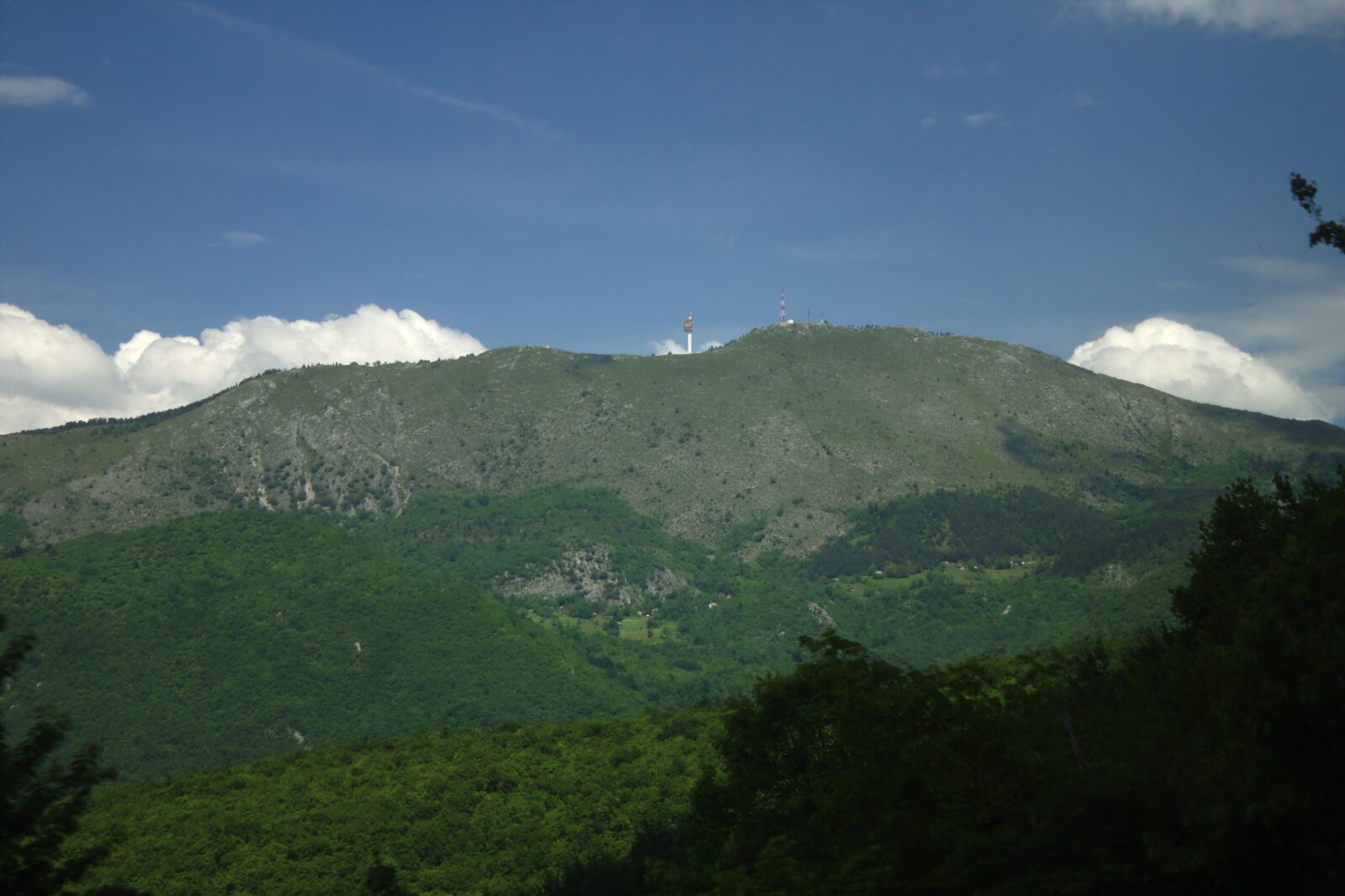
The Sarajevo cable car runs between a lower station at Hrvatin 92 in Bistrik, the mahala directly south of Baščaršija, and an upper station at approximately 1,160 metres on the north-east flank of Trebević, the pine-forested ridge that walls the south side of the Sarajevo valley. The ride is roughly 2,158 metres long. The vertical gain is about 577 metres. Journey time end-to-end is just under nine minutes, technically 7 minutes 15 seconds, depending on load and wind.
The current cable car is the second to run this route. The first opened on 3 May 1959 and ran, with intermittent suspensions, for thirty years until it was closed for financial reasons in November 1989. The pylons still stood when the siege began in April 1992, and the pre-war infrastructure was systematically destroyed during the war. The second cable car was rebuilt on essentially the same route, using Italian aerial-tramway engineering, and reopened on 6 April 2018, the officially observed Day of the City of Sarajevo.
The choice of 6 April as the reopening date was not a coincidence. 6 April is a triple anniversary in the city’s calendar: the anniversary of the liberation from Nazi occupation in 1945, the officially observed Day of the City, and, forty-seven years later, in 1992, the day the first shots of the siege were fired down on a peace demonstration in central Sarajevo. Reopening on 6 April stacked another entry onto an already-saturated date. The lower station’s opening-day plaque marks it.
The 1959 cable car
The first Sarajevo cable car was commissioned in the late 1950s as part of a wider Yugoslav investment in mountain tourism and infrastructure. Construction ran from the late 1950s to opening. The system opened on 3 May 1959 with a formal civic ceremony.
Between 1959 and 1989, the cable car was one of the definitive Sarajevan experiences. Sarajevans of two generations rode it as children on school trips, as teenagers on dates, as young adults with visiting relatives. It ran during the February 1984 Winter Olympics at increased capacity, ferrying spectators up to the events on Trebević. Its lower station at Bistrik was, for its whole run, one of the busiest transit nodes in the city.
The line did not run without interruption. Operational suspensions for financial reasons in 1977, 1982, and 1987 punctuated its later years. In November 1989 it was closed altogether. The operator could no longer cover running costs. The plan was to modernise and restart it. Then the war came.

The destruction
The siege of Sarajevo began in April 1992. Trebević ridge was one of the key positions from which the Bosnian Serb forces surrounding the city fired down. The cable car pylons and lower-station infrastructure were direct targets: not because they were militarily useful (they were not) but because they were legible civic infrastructure that the besieging forces destroyed systematically.
The cables were cut. The Bistrik lower station was damaged. The upper station was destroyed. Most of the surviving mechanical infrastructure, motors, brake systems, tension weights, was destroyed or looted. By the end of the siege in February 1996, essentially nothing of the 1959 cable car remained functional.
Reconstruction was discussed throughout the immediate post-war years. The technical and financial obstacles were substantial. Trebević ridge was, and to some extent still is, a landmine-contaminated area. Any construction on the ridge required specialist demining work first. The mechanical infrastructure required substantial international specialist input, since the original 1959 equipment was long out of production. And the reconstruction budget competed with many other siege-damage reconstruction priorities: hospitals, schools, water infrastructure, housing, the Vijećnica.
The project stayed in the planning stage from about 2000 through the early 2010s. Various city administrations proposed it; various funding models were considered; nothing was built.
The 2018 reopening
Reconstruction began in 2017. The contractor was Leitner Ropeways, the South Tyrolean aerial-tramway firm, building a DirectDrive system with 33 ten-passenger cabins running on 10 towers over 2,158 metres of inclined line. Five of the cabins are painted in the colours of the Olympic rings (blue, red, yellow, green, black). One carries the flag of Bosnia and Herzegovina. The rest are black. Capacity: approximately 1,200 passengers per hour, per direction.
The reconstruction cost roughly €11 million. About €3.5 million of that came from a single private donation from Edmond “Eddy” Offermann, a Dutch nuclear physicist and businessman married to a Sarajevan (family name Serdarević). Offermann also runs Saastal Bergbahnen, the cable car operator at Saas Fee in Switzerland. The balance came from direct city budget allocation and a grant from the Turkish Cooperation and Coordination Agency (TİKA).
The cable car reopened on 6 April 2018. Mayor Abdulah Skaka thanked the Offermans at the ceremony. The line has run continuously since, spring, summer, autumn, and, on reduced winter hours, through the coldest months.
The ride
The lower station is at Hrvatin 92, Bistrik, a fifteen-minute walk south from the Latin Bridge, or a short taxi ride from central Sarajevo. Return ticket: 30 KM (~€15) for foreign visitors, 6 KM for BiH-ID holders; one-way 20 KM / 4 KM. Cards accepted. Children under six ride free with a paying adult; ISIC students get a reduction. Luggage can be left at the counter, useful if you are riding straight from your accommodation.
The ride ascends the north face of Trebević. On a clear day the view opens progressively: first Baščaršija, then the whole Miljacka valley with the Habsburg quarter along the north bank, then the western reaches of the city toward Marijin Dvor, then the far south-western ridges of Igman and Bjelašnica. About four minutes into the ride the whole city is visible from a single window.
The upper station is at approximately 1,160 metres on the ridge. From the station, several walking paths radiate outward. The main ones:
- East along the ridge toward the abandoned bobsled track (about 25 minutes on foot). Pine forest, wildflowers in summer, occasional wildlife.
- South-east down to the former mountain hotel and Ski House site (about 40 minutes). Some sections of the trail are steep.
- West along the ridge toward the Vidikovac viewpoint (about 15 minutes) — the panoramic bench where post-war Sarajevans have taken family photographs for two generations.
The upper station has a small café, a walking-track map, and public toilets. On weekend afternoons in summer the station area is busy; on weekday mornings it is quiet.
Why it matters
The Sarajevo cable car matters as urban infrastructure in a specific way. Unlike essentially every other piece of siege-damaged Sarajevan infrastructure, its reconstruction was not primarily functional. There is no urgent transport need served by a cable car between Bistrik and Trebević. Buses, taxis, and hiking trails already existed. The cable car is a tourist and recreational amenity. Its restoration was a discretionary civic act, not a necessary one.
That discretion is what makes the 2018 reopening interesting. The city chose to spend roughly €11 million, largely underwritten by the Offermann family’s private donation, on rebuilding an item that had no functional need to be rebuilt. What the city was buying was the specific experience of the pre-siege cable car ride: the nine-minute view of Sarajevo from ascending altitude, the ridge-top walking paths, the family photograph at the Vidikovac bench.
The choice of 6 April 2018 for the reopening was, in the same specific way, symbolic. 6 April is the officially observed Day of the City, the anniversary of the liberation from Nazi occupation in 1945 and, forty-seven years later, the anniversary of the day the siege began. The 2018 reopening stacked another entry onto an already-saturated date. What was being marked was not the beginning of anything but the closing of a twenty-six-year interruption.
Ride the cable car on any afternoon and notice the visitors. Some are foreign tourists on a standard Sarajevo itinerary. Some are Sarajevans of the pre-1992 generation, on the same route they rode as children. Some are Sarajevans of the post-1996 generation, on a route their parents talked about but they could not experience until 2018. The cable car is, for that middle demographic, one of the most civic pieces of restored Sarajevan experience.
Practical
- Operating season: year-round. Summer (roughly May–September) hours are Tue–Sun 09:00–21:00 and Mon 12:00–21:00. Winter hours are much shorter, with the last car down at 17:00. Check zicara.ba on the day of your visit.
- Ticket price (as of 2026): 30 KM return / 20 KM one-way for foreign visitors; 6 KM return / 4 KM one-way for BiH-ID holders. Cards accepted. Children under six free with a paying adult; ISIC students get a reduction.
- Queues at the lower station can be substantial on summer weekends between 14:00 and 17:00. Arrive before 11:00 or after 18:00 to avoid them.
- Luggage can be left at the lower-station counter if you’re going straight to the mountain from your accommodation.
- What to bring: a light jacket even in summer (the summit is 5–8°C cooler than the valley), walking shoes if you plan to explore the ridge trails, water.
- The upper station café has drinks and light snacks. A food truck outside sells simple hot food most days in season. For a full meal, walk ten minutes further along the ridge to the mountain restaurants.
- The lower station is a 15-minute walk south from the Latin Bridge or a 5-minute taxi ride. Easiest approach on foot: taxi to the Sarajevska Pivara (the brewery), then five minutes up the stairs.
If you have half a day to spare and one clear-sky window, take the cable car up in the morning, walk to the bobsled track (see our 1984 Olympics story), and take the cable car back down before lunch. The full experience is roughly three hours and produces one of the definitive Sarajevo memories.
Sources
- Žičara Trebević — official operator. zicara.ba.
- The Gondola Project, “LEITNER Ropeways Builds New Trebević Cable Car in Sarajevo”, 25 April 2018 — the source for the Leitner Ropeways contract and technical specifications.
- Ilma Garankić, “The Sarajevo Cable Car: Back and Forth, Tirelessly, for a Better Tomorrow”, Balkan Diskurs, 6 April 2025 — for the operational history including the pre-war suspensions and the 2018 reconstruction.
- City of Sarajevo, historical records of the 1959 cable car construction and the 2018 reopening. sarajevo.ba.
- Ivan Štraus, Arhitektura Jugoslavije 1945–1990 (Sarajevo: Svjetlost, 1991) — includes the 1959 cable car in the Yugoslav-era infrastructure inventory.
- Turkish Cooperation and Coordination Agency (TİKA), records of the 2015–2018 Sarajevo cable car reconstruction project.
- Various Oslobođenje and Dnevni avaz coverage of the 6 April 2018 reopening and subsequent operations.
Sources & further reading
Keep reading
More from the guide.

Sarajevo walking tour — three hours, four centuries, one brass line in the pavement
A self-guided Sarajevo walking tour that a first-time visitor can complete in three hours. Eight stops, from the 1462 Ottoman bazaar to...

Sarajevo — is it safe? A local's honest answer for 2026
Is Sarajevo safe? Yes, meaningfully safer for common tourist risks than Barcelona, Rome, or Paris, though not on the Zurich or Vienna...

Sarajevo sevdah — UNESCO-inscribed in 2024, played live in six specific rooms
Sevdah is Bosnia’s blues. Songs of love, longing, and loss, sung over saz and accordion in small rooms that smell of plum...