
Explore Sarajevo / Hidden Gems / Sarajevo Brewery — Sarajevska Pivara
Hidden Gem · Bistrik · 4 min read
Sarajevo Brewery — Sarajevska Pivara
The 1864 brewery on Pivarska street. The oldest industrial business in Bosnia, the water source that kept the city alive during the siege.
- Established
- 1864
- By
- Founded by Josef Feldbauer


At a glance
Address
Franjevačka 15, Bistrik
Hours
Beer hall typically 11:00 to 24:00. Museum 10:00 to 18:00.
Price
Pints from ~3 BAM. Museum ~5 BAM.
Getting there
10 minutes' walk south from Sebilj across the Šeher-Ćehajina bridge
Time needed
1–2 hours
Best time
Late afternoon for the beer hall, weekday morning for the museum
Coordinates
43.8568° N 18.4321° E
Navigate
Sarajevska Pivara is the working brewery in the Bistrik neighbourhood, ten minutes’ walk south of the Sebilj across the Šeher-Ćehajina bridge. It was founded on 24 May 1864 by Josef Feldbauer, a brewer from Stara Gradiška in what is now Croatia. It is the oldest industrial business in Bosnia and Herzegovina, the only European brewery that has produced continuously through Ottoman rule, Austro-Hungarian rule, two world wars, socialist Yugoslavia, and the siege of the 1990s, and the reason Sarajevo had drinking water from a tap during the war.
The building itself is one of the more remarkable pieces of 19th-century industrial architecture in the Balkans. The beer is good. The story is better.
A 19th-century brewery in an Ottoman city
When Feldbauer arrived in Sarajevo in 1864, the city was still under late-Ottoman rule and beer was almost unknown locally. He founded the brewery with permission from the Ottoman administration, partly to serve the small foreign community, partly speculatively, on the assumption that the city was changing. He was right. Within a decade the Habsburgs had taken over, and by 1907 Sarajevska Pivara was the largest brewery in the entire Austro-Hungarian Empire, exporting to Montenegro, Croatia, Albania, and Italy.
The building was rebuilt in stages during the late 19th century into the red-brick neo-Gothic complex you see today. Tall arched windows, a small clock tower, a long brick façade along Franjevačka street. It is one of the few major industrial buildings in central Sarajevo and the best-preserved.
The water
The brewery’s location is not an accident. The site sits directly above one of central Sarajevo’s most reliable natural springs, with water tapped from approximately 300 metres below ground. That well has been the basis of the brewery’s beer since 1864, and is the reason the brewery survived the most dangerous chapter of its history.
1992 to 1996
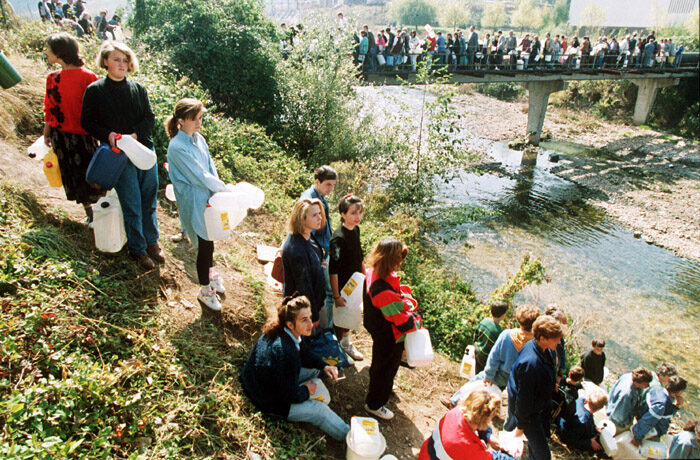

During the siege of Sarajevo, the city’s municipal water system was repeatedly cut by Bosnian Serb forces. Civilians went weeks at a time without running water. To collect water from the few sources that remained, public taps, the river, the brewery’s well, Sarajevans had to walk to fixed locations, often through sniper fire.
Sarajevska Pivara opened its well to the city. Lines of civilians with plastic containers formed daily along Franjevačka street, often three or four hours long. The brewery distributed water for free throughout the siege. It was, for much of the war, the most reliable source of drinking water in the centre of Sarajevo.
Knowing this, the brewery became a target. The complex was hit by several hundred shells. Dozens of civilians were killed or wounded while queuing for water. The brewery continued to operate. Beer production was reduced but never stopped. The well never ran dry.
By the end of the war, Sarajevska Pivara had become one of the most loved institutions in the city, in a way few breweries anywhere have ever been. The water saved lives. The beer carried on. The story is now Sarajevo’s.
What you can do here today
The beer hall
The ground floor of the brewery houses Pivnica HS (often just called the brewery beer hall), one of the best beer halls in central Sarajevo. Long wooden tables. Dark panelled walls. A serious menu of grilled food and traditional Bosnian dishes. Live music on some evenings.
The beers to know:
- Sarajevsko Pivo: the standard lager. Crisp, light, reliable.
- Sarajevsko Tamno: the dark beer. Toasted, malty, slightly sweet. This is what the brewery does best.
- Sarajevsko Premium: a stronger version of the standard lager.
Pints from 3 BAM. Half-litre bottles of Tamno to take away from the brewery shop, around 2.50 BAM each.
The museum
Upstairs, the Sarajevo Brewery Museum opened in 2004 and tells the brewery’s 160-year history through equipment, archives, and photographs. The most affecting section, for most visitors, is the room of siege photographs: the water queues, the bullet-pocked façade, the brewery workers continuing to brew under shellfire. Allow about an hour.
Admission around 5 BAM. Hours typically 10:00 to 18:00, closed Sunday and Monday in winter.
How to use a visit
Walk down to Bistrik in late afternoon. Start with an hour in the museum. Then come downstairs to the beer hall, order a Sarajevsko Tamno and some grilled meat, and stay for a long, slow dinner. The brewery sits about ten minutes’ walk from the lower station of the Sarajevo cable car, so combine if you have the day for it: cable car up to Trebević in the afternoon, walk down through Bistrik, dinner at the brewery.
It is one of the few addresses in Sarajevo where you can drink a beer that is older than the building it is brewed in, and where every glass carries some of the city’s recent history with it.
Sources & further reading
Keep wandering
Nearby & related.

Sarajevo Isa-Begov Hamam
Founded by Isa-beg Ishaković around 1462, the same year he founded the city, the Isa-Begov Hamam is the oldest hammam...

Sarajevo Ashkenazi Synagogue
Sarajevo’s working synagogue, built in 1902 in pseudo-Moorish style by the Austro-Hungarian administration for the Jewish community that had grown...

Sarajevo Avaz Twist Tower
The Avaz Twist Tower is Sarajevo’s tallest building (142 metres, completed 2008). A small public observation deck on the 35th...