
Sarajevo Oriental Institute — 5,263 manuscripts nobody had a copy of
The famous book-burning date is 25 August 1992. The first one was 17 May — the Oriental Institute at Zmaja od Bosne 5, gutted in two hours. Vijećnica lost 1.25 million printed books, most of them reprintable. The Oriental Institute lost 5,263 unique manuscripts, 166 Ottoman sicils, and about 200,000 pages of Ottoman-era records. Nothing was copied. Those specific texts, as read and annotated by Sarajevan Ottoman-era scholars, are gone.
Everybody knows the Vijećnica date, 25 August 1992. Everybody knows the number, 1.25 million volumes. That’s the story on the plaque, the story on every walking tour.
The Oriental Institute burned first, three months and eight days earlier. On the cultural measure, it was the worse loss.
What the Oriental Institute was
The Orijentalni institut u Sarajevu, the Oriental Institute of the University of Sarajevo, was founded in 1950 as the research institution for Ottoman, Persian and Arabic studies in Bosnia and Herzegovina. Its mandate was to preserve, catalogue and study the Islamic-scholarly heritage of the Bosnian Ottoman period.
It sat in a Habsburg-era building on Zmaja od Bosne 5, west of the National Museum in the Marijin Dvor quarter. The building had been Landesregierung residential-administrative in the 1890s. The University transferred it to the Institute in the 1950s.
By 1991 the collection was one of the most significant Islamic-manuscript holdings in south-eastern Europe. Its director was Enes Karić, a specialist in the history of Bosnian Islamic thought.
What burned on the night of 17 May 1992
Bakaršić’s 1994 essay catalogues the losses from his conversation with Karić the day after the fire:
- 5,263 unique Turkish, Persian and Arabic manuscript volumes: the core of the holdings.
- 7,000 catalogued books in the working reference library.
- 166 Ottoman sicils — the register books of the Sarajevo qadi court, dating from 1554 to 1878. The administrative record of Sarajevo’s Ottoman judicial system.
- About 200,000 pages of Ottoman-era administrative records: the archival documentation of the province.
- ~300 microfilm files of manuscripts held in Istanbul, Cairo, Damascus, Ankara.
- 300 periodical sets: the Bosnian and Ottoman journals the Institute had catalogued.
The difference from Vijećnica is what was in the boxes. Vijećnica lost printed 19th- and 20th-century books with copies in other libraries worldwide. The Oriental Institute lost unique manuscript. Each item was one of one.
Bakaršić’s summary: “When the manuscript is gone, the manuscript is gone. There is no copy.”
The attack
Fire started around 21:30 on 17 May 1992. About eight incendiary mortar rounds landed on or near the building over fifteen minutes.
The fire brigade was blocked. Streets around the Institute were shelled with conventional artillery for two hours after the fire started, keeping water tenders away. Incendiary on the target, conventional on the approach routes. The same pattern was used against Vijećnica three months later. This was the rehearsal.
By midnight the building was fully engulfed. By dawn on 18 May, gutted.
The 300 items that got out
Around 300 items had been moved to private homes and to the National Museum vaults in the days between 4 April (start of the siege) and 17 May. That’s what survives.
Karić and a small group of Institute staff organised the transfer in under a week. They knew something was coming. They saved what they could carry.
About 95% of the collection was lost. What sits in the residual Oriental Institute holdings at the University of Sarajevo today is what those 300 items became.
Why it isn’t on the tourist itinerary
Vijećnica has a plaque, a full reconstruction, and a stop on every war-history walking tour. The Oriental Institute has a small marker on the ground floor of the rebuilt building at Zmaja od Bosne 5, naming 17 May 1992 as the destruction date and listing the losses.
Nobody walks past it as a tourist. The reconstruction now houses different tenants. The original building is gone.
Why the site should have started with this
The numerical case for Vijećnica, 1.25 million volumes, is unarguable. But numerically-large printed-book losses are recoverable in principle. The specific manuscript that a Sarajevan Ottoman-era scholar annotated in the margins of a 1650 Persian text is not.
The Oriental Institute is the more irreversible loss. This post is the correction the site’s earlier coverage owed.
What to do with this
Walk to Zmaja od Bosne 5, west of the National Museum. The commemorative marker is on the ground-floor exterior. It’s small.
Read Bakaršić’s essay. It’s public and free at The New Combat online archive. He was the chief librarian of the National Museum during the siege, and his 1994 account is still the primary documentary source.
Sources
- Kemal Bakaršić, The Libraries of Sarajevo and the Book That Saved Our Lives, The New Combat (Autumn 1994).
- András Riedlmayer, Convivencia under Fire: Genocide and Book-Burning in Bosnia, in Rebecca Knuth, Libricide (Praeger, 2003).
- ICTY judgments — Prlić et al. (IT-04-74) and Karadžić (IT-95-5/18-T).
- Enes Karić, later published accounts of the pre-17 May emergency transfer.
Sources & further reading
- Kemal Bakaršić, The Libraries of Sarajevo and the Book That Saved Our Lives — The New Combat, Autumn 1994
- András Riedlmayer, Convivencia under Fire — chapter in Rebecca Knuth, Libricide (2003)
- Related on this site: The largest book-burning in history
- Related on this site: The book that took the shrapnel
Keep reading
More from the guide.
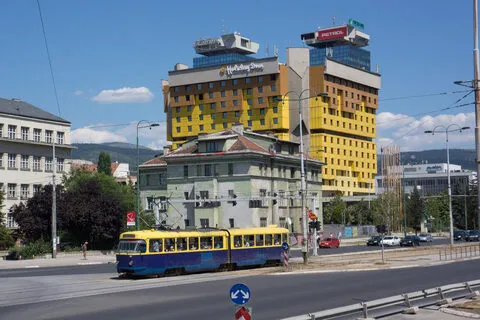
Sarajevo Holiday Inn — Karadžić's own hotel was the sniper platform, then the press base for 1,425 days
The Ivan Štraus building opened in 1983 as the Olympic showcase, launched two opposing political parties in 1990–91, briefly served as Radovan...

Sarajevo Historical Archive — 14,000 Ottoman units, a 1631 dictionary, and a siege-war fund the staff actively collected while under shelling
The Historical Archive of Sarajevo, Istorijski arhiv Sarajeva, was founded on 3 May 1948 by the National Committee of Sarajevo. It began...

Sarajevo Kállay era — twenty-one years that built the Sarajevo you walk, run from a desk in Vienna
Béni Kállay ran Bosnia-Herzegovina from a desk in Vienna between 1882 and 1903. His twenty-one-year tenure as Common Minister of Finance overlapped...