
Sarajevo Eternal Flame — the memorial to a day that later became the siege
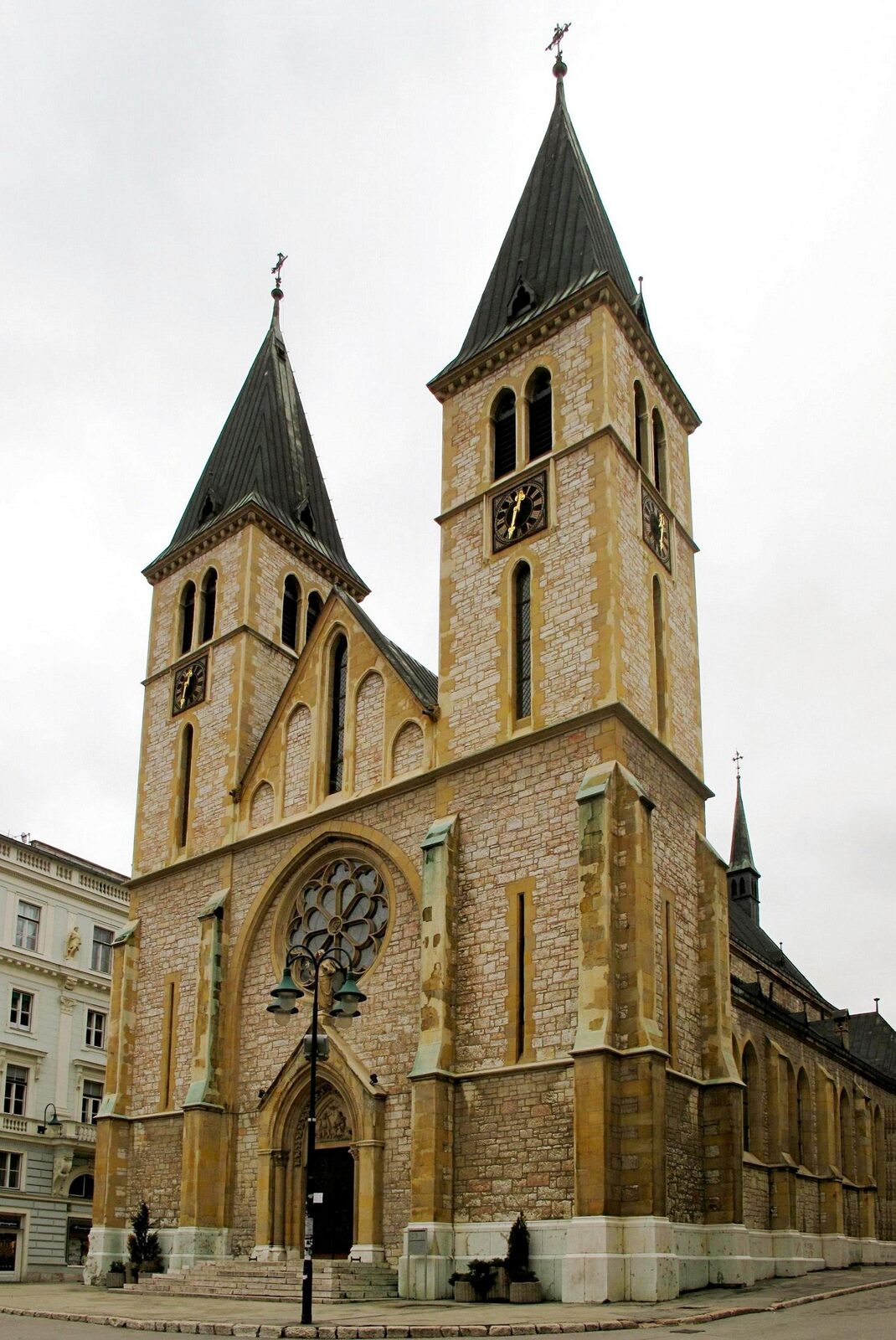
On the corner of Ferhadija and Mula Mustafe Bašeskije, a small brass burner set into a stone niche has been burning almost continuously since 6 April 1946. It commemorates the Yugoslav Partisan liberation of Sarajevo from Nazi and Ustaša forces on 6 April 1945. Forty-seven years later, on 5 April 1992, the siege of Sarajevo began. The flame is thirty steps from the Sacred Heart Cathedral, on the Ferhadija pedestrian street, and most first-time visitors walk straight past it. What it commemorates, why it went out during the war, and why it was relit.


If you walk Ferhadija, the pedestrian street through central Sarajevo, from the Sacred Heart Cathedral east toward Baščaršija, you will pass, about thirty steps east of the Cathedral on the north side of the street, a small stone niche set into the ground floor of an ordinary Habsburg-era building. Inside the niche, a small brass burner emits a steady flame, about the size of a candle-flame, in daylight and at night, in every season.
The Vječna Vatra, the Eternal Flame of Sarajevo. Installed on 6 April 1946, exactly one year after the Yugoslav Partisan liberation of Sarajevo from Nazi and Ustaša forces. It commemorates that liberation and, more broadly, the participation of Sarajevans of every background in the anti-fascist resistance of 1941–1945.
The flame is small enough to be missed. Many first-time visitors walk past it without noticing. It is thirty metres east of the Sacred Heart Cathedral and directly opposite a small square (Trg oslobođenja, Alija Izetbegović, the Square of Liberation) where locals meet, drink coffee, and read newspapers. The scale of the installation is deliberate. Not a monumental memorial in the Vraca sense (see our Vraca story). A piece of civic infrastructure, roughly the size of a fire hydrant, set at pedestrian eye level.
The date it commemorates
6 April 1945 was the day Yugoslav Partisan forces entered Sarajevo and formally liberated the city from Nazi German occupation and its Nazi-aligned Croatian (Ustaša) administration. The occupation had begun on 15 April 1941, four days after the German invasion of Yugoslavia, and had lasted four years. During those four years, approximately 10,000 Sarajevans were killed by the occupying forces, most of them the Jewish population of the city (the pre-war Jewish population of approximately 12,000 was reduced to fewer than 2,000 by the end of the war), and thousands more Roma, Serbian civilians, Bosniak resisters, and anti-fascist partisans of various backgrounds. The Vraca Memorial Park (see our previous story) lists their names.
The Yugoslav Partisan leadership chose the date 6 April 1945 for practical reasons: the first workable date after the German withdrawal from central Sarajevo, and it symbolically closed the four-year occupation cycle that had begun on 15 April 1941. The city commemorated the day, from 1946 onward, as the Day of Sarajevo, an annual civic holiday.

The 1946 installation
Juraj Neidhardt (see our Grabrijan-Neidhardt story) designed the Eternal Flame, installed on 6 April 1946, the first anniversary of the liberation. Neidhardt was then in his early career in Sarajevo, having arrived from Zagreb in 1938. By his own account in later writings, the design was deliberately modest.
The installation consists of:
- A stone niche set into the ground floor of an existing Habsburg-era building at the corner of Ferhadija and Mula Mustafe Bašeskije, approximately 1 metre wide by 2 metres tall.
- A brass burner connected to the municipal gas line, producing a continuous flame of roughly 15 centimetres.
- A stone-carved inscription in the walls of the niche, in Bosnian Cyrillic and Latin scripts.
- A small paved area immediately in front of the niche, where visitors can stand and read.
The inscription, in its original 1946 wording (my translation, approximate):
“With courage and joint sacrifice of the Serbian, Muslim, and Croatian peoples’ patriots of Sarajevo, in the fight against the Nazi-fascist occupiers and their servants, for the final liberation of Sarajevo on 6 April 1945, this eternal flame — the day of common patriotism of the peoples of Bosnia and Herzegovina — is dedicated.”
The wording is Yugoslav-socialist. It names the three constituent peoples of Sarajevo (Serbian, Muslim, Croatian), it acknowledges “the Nazi-fascist occupiers and their servants” (the second phrase covers the Ustaša Croatian regime and its Bosniak and Serb collaborators), and it dedicates the flame to the common patriotism of the constituent peoples.
The Yugoslav Muslim population was not, at that time, officially recognised as a distinct nationality. The word Muslimani in the inscription referred to Bosnian Muslims in a confessional-cultural sense; the term Bošnjaci (Bosniaks) as a national category was formalised only in 1993. The 1946 wording is, in that Yugoslav-socialist sense, of its moment.
What happened during the siege
The Eternal Flame went out on 6 April 1992, the day the siege began. Nobody agrees on the cause. Some sources say the municipal gas line was cut by the Bosnian Serb forces surrounding the city; others say the flame was deliberately extinguished by Sarajevan authorities to save gas for essential heating. The immediate reality was that Sarajevo lost its gas supply within days of the siege beginning, and the Eternal Flame was one of the many small municipal amenities that went dark.
For the four years of the siege, the flame was not lit. The niche remained. The inscription remained. The Ferhadija corner remained. But the flame itself was out.
The coincidence of dates is unavoidable. The Eternal Flame was installed on 6 April 1946. The siege of Sarajevo began on 5 April 1992 and the city-wide artillery shelling that the siege is dated from began on the morning of 6 April 1992. The day the flame was installed to commemorate the end of one occupation was, forty-six years later, the day the beginning of another was formally marked.
Multiple Sarajevan writers and journalists have written about this coincidence. Semezdin Mehmedinović’s siege-era book Sarajevo Blues (1995) devotes a short chapter to it. Zdravko Grebo’s postwar essays return to the coincidence repeatedly. The reading, in each case, is that the coincidence is not a deliberate historical parallel; it is an accident of the calendar that Sarajevo has to live with.
The 1996 relighting
On 6 April 1996 — four years to the day after the siege began, and one year after the Yugoslav Partisan liberation of Sarajevo the flame originally commemorated — the Sarajevo City Council relit it. Senior members of the Bosnian state administration attended.
Survivors of the siege performed the act (a group of ten Sarajevan children, aged between five and fifteen, who had lived through the whole four years), lighting the flame together with a small brass lighter. The city administration chose children deliberately: the flame was being relit for the next generation of Sarajevans, not as a state commemoration of past politics.
The flame has burned continuously since 6 April 1996. Occasional gas-supply interruptions have briefly extinguished it, but the municipal service protocol requires immediate relighting when the supply is restored. As of a walking check in 2026, the flame is lit.
What the inscription now says
Someone rewrote the original 1946 inscription at least once in the postwar period. The current text, installed in 1996 or shortly after, retains the substance of the original but adjusts the wording to fit the post-Yugoslav political framing. The current inscription (my rough translation):
“With the courage and shared sacrifice of Sarajevan patriots — Serbs, Bosniaks, Croats — in the fight against the Nazi-fascist occupiers and their servants, for the liberation of Sarajevo on 6 April 1945, this eternal flame, symbol of the common patriotism of the peoples of Bosnia and Herzegovina, is dedicated.”
The change: the 1946 word Muslimani has been replaced by the 1996 word Bošnjaci (Bosniaks). The Bosnian Muslim population’s national self-identification, formalised as Bošnjaci in the 1993 Constitution of Bosnia and Herzegovina, has been backdated into the 1946 memorial. That edit is a small piece of the wider postwar re-naming project that this site treats in the seven-censuses story.
Everything else in the inscription is essentially unchanged.
Why we visit
The Eternal Flame is one of the smaller and quieter of Sarajevo’s memorials. No attempt at monumentality. No competition with the Vijećnica or the Sacred Heart Cathedral. It sits at the pedestrian scale of Ferhadija and lets the passer-by notice it or not, at their own pace.
That modesty is, in the postwar Sarajevan memorial register, unusual. The larger memorial projects (Vraca, the Markale Museum, the various individual siege-era commemorations) are institutional in scale. The Eternal Flame is a piece of street furniture. You walk past it on your way to a café. Always there. Eighty years now.
Visiting it consists of walking east on Ferhadija from the Sacred Heart Cathedral, noticing the niche in the ground floor on the north side of the street, stopping for maybe thirty seconds, reading the inscription if you can, and continuing east toward Baščaršija. The whole visit. About a minute.
What it commemorates — the 1945 liberation from Nazi occupation, and by historical accident of the calendar, also the 1992 beginning of the siege — is worth a minute of anyone’s Ferhadija walk.
Where to see it
The Eternal Flame is on the corner of Ferhadija and Mula Mustafe Bašeskije, at the west end of Ferhadija just east of the Sacred Heart Cathedral. Free entry; always accessible; always lit (barring rare gas-supply outages).
The best time to see it is at dusk in autumn or winter, when the small flame is more visible against the low light. In summer daylight it can be nearly invisible until you are right next to the niche.
If you sit at one of the cafés on Trg oslobođenja, the small square directly opposite the flame, you can see the niche from your table. Per multiple Sarajevans, that is the way to visit the flame: not as a formal act of remembrance but as a small notice at the corner of your afternoon coffee.
Practical
- Location: Corner of Ferhadija and Mula Mustafe Bašeskije, central Sarajevo. Thirty steps east of the Sacred Heart Cathedral.
- Free. Always accessible. No entrance.
- The best time to see the flame: dusk in autumn or winter.
- The commemoration ceremony on 6 April each year is small and quiet. It is worth attending if you happen to be in Sarajevo on that day; the crowd is usually manageable.
Sources
- Robert J. Donia, Sarajevo: A Biography (Ann Arbor: University of Michigan Press, 2006). Chapter on the 1941–1945 occupation and its aftermath.
- Marko Attila Hoare, The History of Bosnia: From the Middle Ages to the Present Day (London: Saqi Books, 2007).
- Marko Attila Hoare, The Bosnian Muslims in the Second World War: A History (London: Hurst, 2013).
- Ivan Štraus, Nova arhitektura Bosne i Hercegovine 1945–1975 (Sarajevo: Svjetlost, 1977). The Neidhardt attribution for the Eternal Flame installation appears in the 1946–1950 section.
- Semezdin Mehmedinović, Sarajevo Blues (Sarajevo, 1995; English translation City Lights Books, 1998). Contains a short essay on the Eternal Flame.
- Sarajevo City Council records, 6 April 1996 relighting ceremony documentation.
- Various Oslobođenje coverage of the annual 6 April commemoration, 1946 through 2026.
Sources & further reading
Keep reading
More from the guide.

Sarajevo in Edwardian watercolour — the ladies who painted the city in 1909
Between 1909 and 1910, two British women published widely-read travel books about Bosnia at exactly the moment the region was closest to...

Sarajevo — the bobsled team that crossed the airport runway under sniper fire to reach the 1994 Olympics
Igor Boras had never bobsledded. He was a 100-metre sprinter who joined the Bosnian bobsled team because he wanted to be in...

Sarajevo — the corner where the twentieth century started, 28 June 1914
At 10:55 a.m. on Sunday 28 June 1914, on the corner of the Latin Bridge and what is now Zelenih Beretki, a...