Sarajevo — Wikipedia calls it 'pseudo-Moorish' but the scholars say 'Orientalizing', and the difference matters
English Wikipedia's Sarajevo architecture articles use 'pseudo-Moorish' throughout — the 19th-century label. The ERC 758099 project at the University of Vienna uses 'Orientalizing' and argues the distinction is not cosmetic: the style was not decorative pastiche but a deliberate political programme aimed at Muslim citizens across six towns.
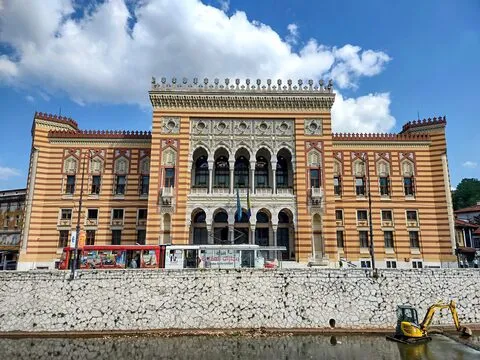
Search English Wikipedia for the Sarajevo City Hall. The article calls its architectural style pseudo-Moorish. Search for Austro-Hungarian architecture in Bosnia. Same label. The term appears dozens of times across the English-language Sarajevo articles, always without qualification, always as if it were the settled descriptor.
It is not settled. The most focused academic study of this architecture, the European Research Council project ERC 758099, The Moorish style in Habsburg Bosnia, led by art historian Maximilian Hartmuth at the University of Vienna, uses a different term: Orientalizing. The project’s 2020 working paper argues the distinction is not cosmetic. It changes what the reader understands the buildings to be.
What ‘pseudo-Moorish’ implies
The prefix pseudo- does specific work. It tells the reader the style is fake, a surface imitation of Moorish (i.e. Islamic Iberian) architecture applied to buildings that are structurally European. The word positions the ornament as decorative pastiche: horseshoe arches, striped voussoirs, and arabesques borrowed from the Alhambra and Cairo and stapled onto a Viennese Neo-Renaissance frame.
That reading is not wrong, exactly. The buildings are structurally European, and the ornament is borrowed. But pseudo-Moorish stops there. It describes the surface and implies the motive was fashion, as if the Habsburg administration had picked the style the way a restaurateur picks a wallpaper pattern.
What ‘Orientalizing’ implies
Hartmuth’s term carries a political argument. Orientalizing names the style as an active programme, something the Habsburg administration did to the built environment of Bosnia, with specific political goals, over four decades.
After the 1878 occupation, Austria-Hungary governed a province whose Muslim population had been Ottoman subjects until months earlier. The administration needed the loyalty of those citizens. Kadkani-Schmitt’s 2017 UC Berkeley dissertation, Framing Bosnia, argues that architectural and urban projects were the administration’s primary political tool for reordering the former Ottoman lands as modern Central European space. Building everything in Viennese Neo-Renaissance would have read as conquest. The Orientalizing style was the compromise: a monumental European composition, symmetrical, columned, institutionally scaled, dressed in ornament borrowed from Islamic sources that would be legible to Bosnia’s Muslims as a gesture of inclusion.
The most telling evidence is at Bosanska Gradiška. Hartmuth’s working paper documents the town hall there, which carries a central belfry capped with an onion-shaped cupola. The onion shape was chosen, Hartmuth argues, so the belfry could not be mistaken for a church tower. The Habsburg administration wanted a civic building that signalled town hall, not Christian institution. That is not pastiche. That is specific political communication through architectural form.
The programme was not Sarajevo-only
Wikipedia’s articles treat the Vijećnica as a one-off. It was not. Hartmuth’s 2020 paper catalogues at least five other town halls in the same Orientalizing style, spread along Bosnia’s northern border: Brčko (1891, architect Ćiril Iveković), Bosanska Gradiška (1890s with extension c. 1907), Kostajnica, Bosanski Novi (now Novi Grad), and Odžak. Sarajevo makes six.
The geographic pattern is the argument. The northern-border town halls sit along the Sava river, facing Croatia, facing, that is, the Christian Habsburg hinterland. The Orientalizing style on the border was a statement directed outward as much as inward: this province is different, this province has Muslim citizens, and the architecture tells you so before you cross the river.
Kadkani-Schmitt and Trapara (INALCO 2019) reinforce the point. The style was commissioned from Vienna-trained architects, Karel Pařík, Alexander Wittek, Ćiril Iveković, who had no personal connection to Islamic architecture. They studied in Vienna, worked from Viennese pattern books adapted for the Bosnian commission, and produced buildings that are legible as Viennese institutional architecture with an Islamic ornamental layer. The Orientalizing label names that process. Pseudo-Moorish flattens it into a question of decorative taste.
Why Wikipedia’s label costs the reader
A reader who encounters pseudo-Moorish on the Vijećnica article walks away thinking the building is a folly, a decorative curiosity, perhaps slightly ridiculous, certainly not politically serious. A reader who encounters Orientalizing walks away thinking the building is part of a forty-year imperial programme to hold Muslim loyalty through monumental architecture. The first reading produces a photograph. The second reading produces an argument.
The argument is documented. Hartmuth’s working paper is on the University of Vienna’s ERC project site. Kadkani-Schmitt’s dissertation is open-access at eScholarship. Trapara’s dissertation, which devotes its Chapter 3.6 to the Neo-Moorish / Orientalizing distinction, is open-access at HAL. Three sources, all in English, all freely available, all published between 2017 and 2020. The scholarship has been sitting in the open for years. It has not reached the encyclopaedia article that more people will read than will ever open a dissertation PDF.
The term is not ours to impose
This site uses Orientalizing in its editorial copy, following the ERC project’s usage, but we are a travel journal, not an encyclopaedia. Wikipedia’s editorial process is its own. The point is not that Wikipedia should adopt the term because we say so. The point is that a European Research Council project with a six-figure grant, a dedicated art historian, and on-the-ground fieldwork across six Bosnian towns has produced a more precise term backed by specific political-historical evidence, and that term has not yet appeared in the English-language articles it most directly corrects. The papers are there. The evidence is there. The correction is waiting.
By Nedim Hadzimahmutovic · last updated 14 July 2026
Sources & further reading
- Maximilian Hartmuth, 'Orientalizing architecture in northern Bosnia under Habsburg rule: Exaggerating alterity as a means of cohesion?' ERC 758099 Working Paper #4 (Vienna: University of Vienna, 2020)
- Zahra Kadkani-Schmitt, Framing Bosnia: The Politics of Architecture and City Building in the Austro-Hungarian Administration of Bosnia and Hercegovina, 1878–1903 (PhD dissertation, UC Berkeley, 2017)
- Boris Trapara, From Vienna to Sarajevo (joint PhD, INALCO Paris and IBU Sarajevo, 2019)
Keep reading
More from the guide.

Sarajevo modernism began with 15,000 letters from Le Corbusier's Paris studio
Between 1933 and 1941 the Slovenian architect Dušan Grabrijan taught at the Secondary Technical School in Sarajevo, and between the same years...
Sarajevo Vijećnica — Pařík drew it in August 1892, Kállay personally rejected it, then Wittek re-dressed it
The stock story of Sarajevo Vijećnica names Alexander Wittek as the architect, Iveković as his completer, Pařík as the site supervisor. Nedžad...

Sarajevo National Theatre — 22 years before it staged its first play
Sarajevo’s National Theatre didn’t open as a theatre. In October 1899 it opened as Društveni dom, a private cultural club for the...