

Architect Yugoslav (1960s–1990s)
Ivan Štraus
Between 1970 and 1986 Ivan Štraus designed three buildings that most first-time visitors to Sarajevo see within twelve hours of arrival: the airport terminal, the Holiday Inn hotel, and the UNIS Twin Towers. He also wrote the standard reference on postwar Yugoslav modernist architecture. He lived through the siege in his apartment on Alipašina, watched most of his buildings get shelled, and kept working until his death at 89 in 2018. A short guide to the last great modernist of Sarajevo.
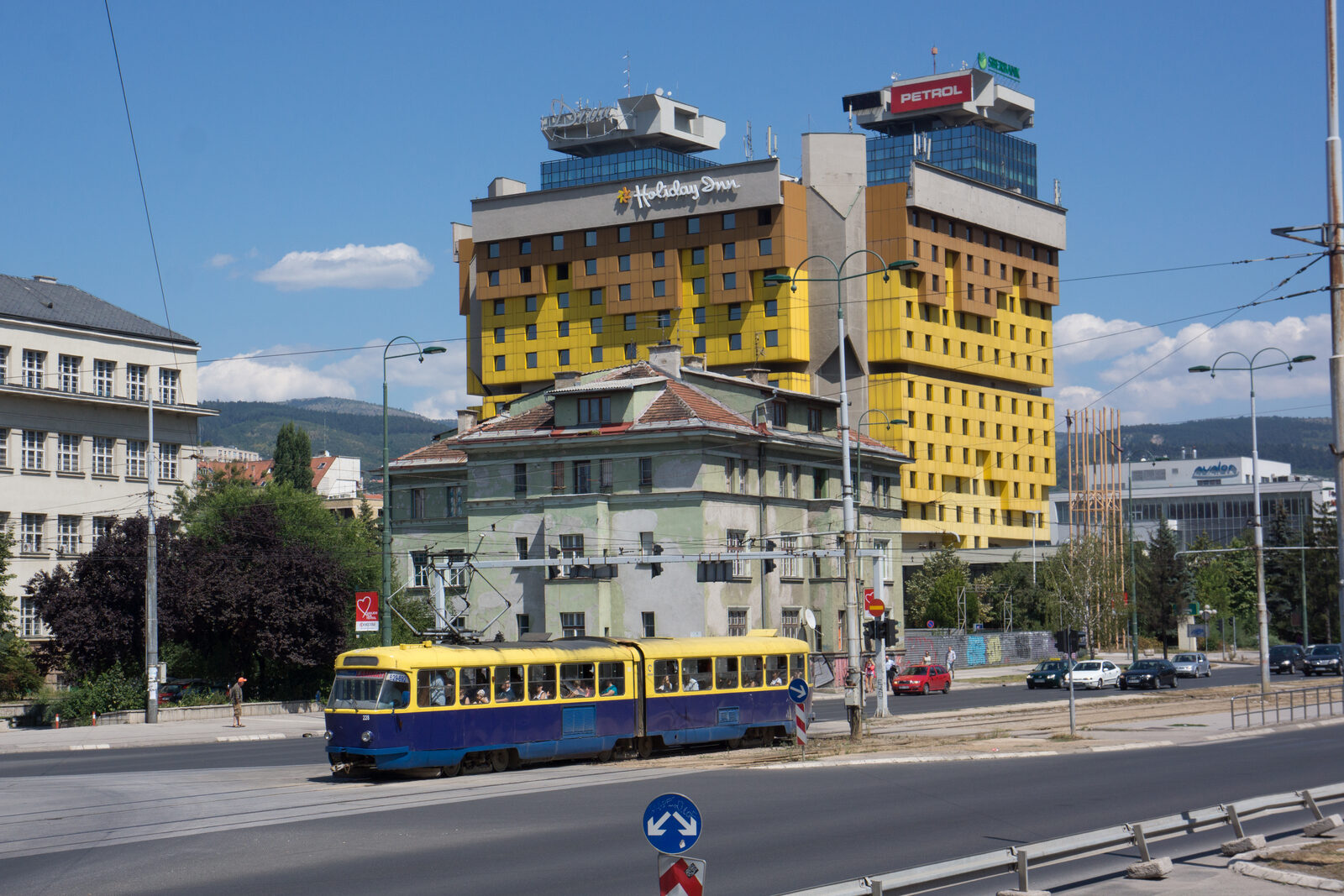
Holiday Inn Sarajevo, 1983 · Ph: Fanny Schertzer · Wikimedia Commons · CC BY-SA 3.0
- Born
- 1928
- Died
- 2018
- Nationality
- Bosnian
- Trained
- University of Sarajevo Faculty of Architecture
- Era
- Yugoslav (1960s–1990s)
- Key work
- Sarajevo Airport (1969) · Holiday Inn Sarajevo (1983) · UNIS Twin Towers (1986) · Parliament of Bosnia and Herzegovina
Ivan Štraus was born on 24 October 1928 in Vareš, a Bosnian mining town forty kilometres north of Sarajevo. Ethnically Croatian and religiously Catholic in a country and generation for which those identities would become, in ways he could not have predicted, existentially loaded. He studied architecture at the newly-founded Faculty of Architecture in Sarajevo in the late 1940s, graduating around 1953. He spent the next sixty-five years working in the city.
Between 1960 and 1990 Štraus was probably the single most productive modernist architect in Bosnia and Herzegovina. He designed the Sarajevo Airport terminal (1970), the Holiday Inn hotel (1983 for the Winter Olympics), the UNIS Twin Towers (1986), the Bosnian Institutions building complex, the Skenderija cultural centre annex, and a substantial catalogue of residential and commercial buildings that fills the Marijin Dvor / Novo Sarajevo commercial district.
He also wrote the standard reference on postwar Yugoslav modernist architecture. Nova arhitektura Bosne i Hercegovine 1945–1975 (New Architecture of Bosnia and Herzegovina 1945–1975), published in 1977 by Svjetlost in Sarajevo, is cited by essentially every subsequent study of Bosnian modernist architecture. His later book, Arhitektura Jugoslavije 1945–1990 (Architecture of Yugoslavia 1945–1990, Svjetlost 1991), remains the canonical Yugoslav-language treatment of the wider period.
Štraus lived through the 1992–1995 siege of Sarajevo in his apartment on Alipašina, refusing to leave, watching most of his buildings get shelled from his window. He rebuilt what he could after 1996 and kept working until, in the last years of his life, illness slowed him. He died in Sarajevo on 21 August 2018, aged 89.
The recent reference on his work is Stefania Gruosso and Emina Zejnilović’s 2023 article in FAM, which catalogues the wider Sarajevo modernist inheritance. Štraus is one of the architects the article names. What follows draws on his own books and on subsequent scholarship.

The three buildings you probably know
Three Štraus buildings are seen, in some form, by essentially every visitor who arrives in Sarajevo by air, stays overnight in the centre, and walks the Marijin Dvor axis.
Sarajevo Airport terminal, 1970. Štraus won the design competition. His terminal was one of the earliest Yugoslav airports designed for regular international traffic, and its low-slung concrete-and-glass terminal with a tent-like roof was widely admired in Yugoslav architectural press. The original terminal was heavily damaged during the siege (the airport was under UN control and the surrounding area was the front line) and has been substantially rebuilt since 1996, but the core Štraus design elements, the low roof, the linear terminal massing, the entrance canopy, remain.
Holiday Inn Sarajevo, 1983. Built for the 1984 Winter Olympics on Zmaja od Bosne (later renamed to that stretch’s siege-era nickname, Sniper Alley), the Holiday Inn is the yellow modernist hotel that appears in essentially every siege-era photograph and news report. Štraus designed it as a working conference hotel with a specifically Sarajevan approach to the standard Holiday Inn brief: instead of the anonymous multi-storey slab the American chain preferred, Štraus’s building steps up in terraces, with a distinctive yellow-and-brown façade cladding that made it, and continues to make it, one of the most recognisable buildings on the Marijin Dvor axis.
The Holiday Inn became the international press headquarters during the siege. Reuters, CNN, BBC, and the print press worked out of the hotel’s tenth-floor rooms. It was hit by shells repeatedly, Reuters’ war-time coverage documented an average of one shell impact every eleven days between April 1992 and February 1996. The hotel structurally survived. It reopened in 1996, was fully renovated by 2007, and continues to operate.
UNIS Twin Towers, 1986. The two towers on Fra Anđela Zvizdovića, nicknamed “Momo and Uzeir” after two characters from a popular Yugoslav television series (Momo being a Serbian name and Uzeir a Muslim name, chosen deliberately to symbolise Sarajevan multiculture), were built as the headquarters of the UNIS industrial conglomerate. They were, at completion, the tallest twin buildings in Yugoslavia at approximately 90 metres each. Štraus’s design was Structural Expressionism: an exposed steel frame, glass-curtain façades, twin identical volumes with a covered pedestrian passage between them at ground level.
The towers were destroyed by artillery fire in June 1992. They burned for several days. The interior was gutted; the concrete cores survived. Reconstruction began in 1998 and continued until roughly 2007. The rebuilt towers are on the original plans, with modernised interiors and cladding. They are again the anchor of the Marijin Dvor skyline, and Momo and Uzeir are again their names.
The book — Nova arhitektura Bosne i Hercegovine 1945–1975
Štraus’s first book, published when he was forty-nine, was an attempt to catalogue and analyse the whole thirty-year output of postwar Bosnian modernist architecture. Written in Serbo-Croatian for a Yugoslav-wide readership, it catalogued approximately 200 buildings across Bosnia and Herzegovina, with photographs, floor plans, and short critical commentary.
The book created a canon. Before 1977 no systematic account of postwar Bosnian architecture existed. After 1977 the buildings Štraus had named, the Historical Museum (Magaš, Šmidihen, Horvat), Skenderija (Janković), Alipašino Polje (Medić, Milić, Muftić), Ciglane (Muftić, Delalle), Grbavica, the various Neidhardt housing projects, were the buildings any subsequent Bosnian architectural historian would treat as canonical. Gruosso and Zejnilović (2023), Alić (2010), and every other subsequent English-language treatment cites Štraus’s 1977 book as the starting point.
His second book, Arhitektura Jugoslavije 1945–1990 (1991), extended the same treatment to the whole of Yugoslavia through 1990. Published within months of the beginning of the Yugoslav dissolution, its final chapter treats the 1984 Winter Olympics infrastructure as the culmination of a generation of Bosnian modernist practice. Reading it now, knowing what happened in April 1992, is difficult.
The siege years and the hospital
Štraus stayed in Sarajevo for the entire four-year siege. He was in his mid-sixties, refused to be evacuated on humanitarian flights, and continued working from his apartment on Alipašina. His siege-era diary, published in 1995 as Arhitekt i barbari (The Architect and the Barbarians) by Sarajevo publisher Ljiljan, is a specific document: a modernist architect watching his own buildings get shelled, taking notes, and refusing to leave.
The diary records the day-by-day damage to specific buildings he had designed. The UNIS Twin Towers burning in June 1992. The Holiday Inn’s tenth floor being hit again on 15 August 1993. The airport terminal partial collapse. It also records his continuing work on smaller commissions during the siege, repair projects, planning for eventual reconstruction, teaching sessions with young Faculty of Architecture students who were still in the city.
The diary is one of the more difficult modernist architectural documents of the twentieth century — an architect watching his life’s work get systematically destroyed by artillery, in real time, choosing to stay and watch.
Post-1996: The reconstruction
After the war, Štraus led or contributed to the reconstruction of several of his own damaged buildings. The UNIS Twin Towers reconstruction was substantially his own work, completed 2007. The Holiday Inn renovation involved his consultation. The airport reconstruction, more heavily reworked by other architects, still preserved his terminal massing.
He also continued to work as a critic, publishing regularly in Oslobođenje and Dani on the postwar rebuilding of the city. His editorial line, per multiple obituaries and post-mortem tributes, was that Sarajevo should rebuild as itself — a modernist Bosnian city with its own architectural voice — rather than as a generic post-conflict international city. He was, in the last years, one of the more outspoken critics of the foreign-capital-driven glass-and-steel building programme that has dominated central Sarajevo since 2000 (see our imperial nostalgia story for the wider critique).
Where to walk it
The Štraus walking tour in Sarajevo, half-day at a slow pace:
Fly into Sarajevo International Airport. The terminal you walk through is a rebuilt version of Štraus’s 1970 design.
Take a taxi or the tram east along Zmaja od Bosne (formerly Sniper Alley) to Marijin Dvor. Get out at the Holiday Inn. Enter the lobby. The tenth-floor rooms that hosted CNN and Reuters during the siege are still working rooms; you can book one for the night. The hotel bar has a small photo display of the siege years.
Walk one block west to the UNIS Twin Towers. Momo and Uzeir. Take the ground-floor pedestrian passage. Look up at the twin volumes and notice the reconstructed façades.
If you have another half-day, continue up Alipašina to see the modernist residential fabric Štraus and his generation shaped. Notice the mix of Kadić-era 1940s (Džidžikovac), Neidhardt-era 1950s (Alipašina backdrop), and Muftić-era 1970s (Ciglane) buildings that together make up the neighbourhood.
The grave of Ivan Štraus is at the Bare cemetery on the north side of the city. It is a small marker with the architect’s name, dates 1928–2018, and no elaborate decoration. The choice reflects his own late-career editorial line about restraint.
Why he matters
Štraus matters because he is the architect who, more than any single individual, produced the visual identity of late-Yugoslav Sarajevo. The airport you arrive through, the hotel you stay in, the towers you see from the tramway, three of the four are Štraus. All three designed by the same architect — not a coincidence. Sarajevo in the 1970s and 1980s was small enough that a single generation of major architects could dominate the commissions, and Štraus was, of that generation, the most sustained producer.
He also matters because his books gave the profession a canon. Nova arhitektura Bosne i Hercegovine 1945–1975 established what Bosnian modernism was as a coherent architectural tradition. Every subsequent scholarly treatment of the period, in Bosnian or in English, cites his catalogue.
Finally, he matters because he stayed. Karel Pařík stayed through the Habsburg collapse and died in Sarajevo in 1942 (see our Pařík story). Josip Vancaš left for Zagreb in 1921 (see our Vancaš story). Ivan Štraus, of the third generation, stayed through the siege, watched his buildings burn, and rebuilt them. The Sarajevo you fly into is the third stage of a fifty-year modernist project that its author chose to see through to the end.
Sources
- Ivan Štraus, Nova arhitektura Bosne i Hercegovine 1945–1975 (Sarajevo: Svjetlost, 1977). The founding catalogue.
- Ivan Štraus, Arhitektura Jugoslavije 1945–1990 (Sarajevo: Svjetlost, 1991). The extended Yugoslav-wide treatment.
- Ivan Štraus, Arhitekt i barbari (Sarajevo: Ljiljan, 1995). The siege-era diary.
- Stefania Gruosso and Emina Zejnilović, “The Socialist Sarajevo: between heritage and modernity”, FAM 64 (2023), 59–69. Contains a substantial treatment of Štraus’s work in the wider socialist Sarajevo context. DOI.
- Museum of Modern Art, New York, Toward a Concrete Utopia: Architecture in Yugoslavia, 1948–1980, exhibition catalogue, 2018. Includes several Štraus buildings.
- Association of Architects of Bosnia and Herzegovina (Savez arhitekata BiH), records of Ivan Štraus’s professional career and awards.
- Various obituaries in Oslobođenje, Dani, and Preporod, August 2018.
Sources & further reading
- Ivan Štraus, 'Nova arhitektura Bosne i Hercegovine 1945–1975' (Sarajevo: Svjetlost, 1977)
- Ivan Štraus, 'Arhitektura Jugoslavije 1945–1990' (Sarajevo: Svjetlost, 1991)
- Stefania Gruosso and Emina Zejnilović, 'The Socialist Sarajevo: between heritage and modernity', FAM 64 (2023), 59–69
- MoMA New York, 'Toward a Concrete Utopia: Architecture in Yugoslavia, 1948–1980' (exhibition catalogue, 2018)