
Sarajevo 1984 — the twelve days that eight years later became the front line
Between 8 and 19 February 1984, Sarajevo hosted the Fourteenth Winter Olympic Games. It was the first Winter Olympics held in a socialist country and, for the city, the largest single event in its Yugoslav history. Twelve hundred athletes. Forty-nine nations. Torvill and Dean's Boléro. Jure Franko's silver medal. Vučko the wolf mascot. Eight years later most of the infrastructure was on the front line of the siege. A guide to what the Olympics were, what they built, and what survives.
On the morning of 18 May 1978, in an International Olympic Committee vote at the IOC Congress in Athens, Sarajevo defeated Sapporo and Göteborg to win the right to host the Fourteenth Winter Olympic Games. The vote surprised the international press. Sapporo had already hosted (in 1972) and was regarded as the safe choice. Göteborg had strong political backing from the Swedish government. Sarajevo was a mid-sized Yugoslav city whose Winter Olympic pitch had, on paper, one unusual feature: it was proposing to host in an ideologically neutral country that was neither NATO nor Warsaw Pact.
The pitch worked. Between 8 and 19 February 1984, Sarajevo hosted the Games. The first Winter Olympics held in a socialist country. The third held in Europe outside the traditional Alpine tourism belt (after Cortina 1956 and Grenoble 1968). For Sarajevo, the largest single organised event in its Yugoslav history, larger by attendance and infrastructure than the previous top event, the 1978 Non-Aligned Movement Summit.
Twelve hundred and seventy-two athletes from forty-nine nations competed in thirty-nine events. Approximately 400,000 spectators attended live. Global television broadcast reached, per the IOC official report, roughly two billion viewers over the twelve days. The Games broke even financially, one of the very few Winter Olympics of the 1980s to do so.
Eight years later, most of the sports venues were on the front line of the siege.
What was built
The Sarajevo Games required approximately 189 million US dollars in construction, distributed across a network of venues in and around the city. The larger complexes:
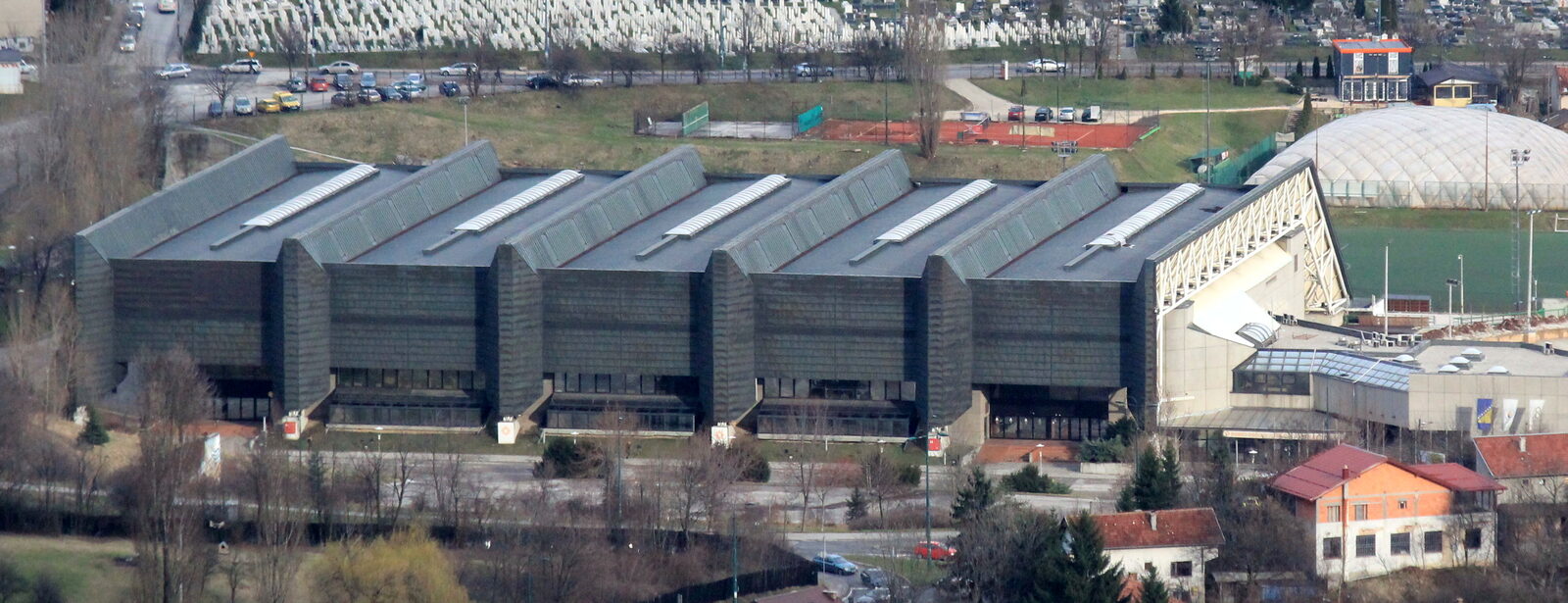
Zetra Olympic Hall, new-build 1981–1983. Ice arena for figure skating, ice hockey, and speed skating. Opening and closing ceremonies. Located in the Koševo valley, ten minutes’ walk north from central Sarajevo. Renamed the Juan Antonio Samaranch Olympic Hall in 2010 after the long-serving IOC president who had presided over the 1984 Games as an athlete-delegate.
Skenderija Cultural and Sports Centre, 1969 building (architect Živorad Janković), retrofitted for the Games. Hosted the ice hockey preliminary matches, gymnastics, and various cultural events. Still working as a venue today.
Trebević bobsled and luge track, new-build 1981–1983. Concrete channel running roughly 1,300 metres down the north face of Trebević ridge, above the Sarajevo valley. Designed by the Sarajevo engineer Kemal Muftić with international specialist consultation. Fifteen curves. Vertical drop 128 metres.
Bjelašnica and Igman, men’s alpine and Nordic events. New chairlifts, run infrastructure, and a small athletes’ village at Malo polje.
Jahorina, women’s alpine events. New chairlifts and run infrastructure. Athletes’ village at Rajska dolina.
Olympic Village at Mojmilo, new-build 1981–1984, roughly 2,300 apartments organised into a residential neighbourhood south of central Sarajevo. After the Games the apartments were handed over as public housing.
Beyond the sports infrastructure, the Games required an enormous secondary build: the Sarajevo Airport terminal was expanded, four new hotel complexes (including the Holiday Inn at Marijin Dvor by Ivan Štraus, opened 1983 for the Games), the tramway line extension to Ilidža, new road infrastructure to the mountain venues, and the entire suite of broadcast and media facilities.

Vučko
The mascot was Vučko the wolf, designed by the Slovenian artist Jože Trobec. Wolves are the largest predator native to the Dinaric Alps around Sarajevo, and the character was chosen to represent, per the design brief, “the spirit of the region and the boldness of a mountain animal.” Vučko wears a scarf and a mountaineer’s hat. He does not, in the standard renderings, hold anything.
Trobec’s Vučko sketches, the character-development artwork, and the licensing archive are held at the Museum of Modern Art (MAO) in Ljubljana. The character appeared on approximately 400 commercial licensed products during the Games: pins, plush toys, ceramic mugs, official IOC-branded stationery. Vučko products are still, forty years later, one of the most-sought categories of Yugoslav-era Olympic memorabilia on the collector market.
Sarajevans over forty remember Vučko as the definitive positive image of the pre-war Yugoslav years. He appears repeatedly in siege-era diaries and memoirs as an ironic point of reference: the wolf who was supposed to represent Sarajevo’s toughness watched the city be destroyed for four years.
The twelve days
The moments the Sarajevo Games are remembered for:
The opening ceremony on 8 February at Koševo stadium, with a partly cloudy sky and light snow. President of the Yugoslav Presidency Mika Špiljak formally opened the Games. IOC President Juan Antonio Samaranch presided.
Jure Franko (Yugoslav, from Slovenia) winning silver in the men’s giant slalom on Bjelašnica on 14 February. It was Yugoslavia’s first Winter Olympic medal in the country’s history. Franko’s silver has been described in the Yugoslav sporting press as the medal that Sarajevo won, on Sarajevo’s mountain, for the entire country.
Torvill and Dean’s Boléro on 14 February. British ice dancers Jayne Torvill and Christopher Dean performed a four-and-a-half-minute programme to Ravel’s Boléro at Zetra Olympic Hall and received twelve perfect 6.0 scores from the judging panel, a competition record that still stands. Their performance is generally considered one of the most influential single moments in figure skating history.
Katarina Witt (East German) winning her first Olympic gold in ladies’ figure skating on 18 February.
Bill Johnson (American) winning men’s downhill on 16 February in unusually warm conditions on Bjelašnica, in the first-ever American Olympic downhill victory.
Debbie Armstrong and Christin Cooper (American) taking gold and silver in women’s giant slalom on 13 February.
The closing ceremony on 19 February at Zetra, with the flag of the next host city (Calgary 1988) receiving the Olympic flag.
Post-Olympics: 1984–1992
For the eight years between the Games and the siege, Sarajevo lived off the Olympic infrastructure. Bjelašnica and Jahorina became the anchor of Yugoslav ski tourism. The Zetra Hall hosted international figure skating and hockey competitions. The Holiday Inn hotel and the expanded airport supported growing international business travel. The Olympic Village apartments at Mojmilo were fully occupied by young families.
The Games had also produced a civic pride that outlasted the Yugoslav state. Sarajevans of the immediate post-1984 generation grew up with the Olympic infrastructure as background. The generation of Sarajevans who were teenagers or young adults during the Games would, ten years later, be the generation defending the city under siege.
What happened during the siege
The 1992–1995 siege of Sarajevo turned the Olympic infrastructure into a battleground. Here is what happened to each venue:
Zetra Olympic Hall — shelling set the wooden roof alight in 1992 and destroyed it. The hall served as a temporary morgue during the worst siege years. The concrete shell survived. Reconstruction 1996–1999 with funding from the IOC and international donors.
Trebević bobsled and luge track — the mountain ridge sat on the front line for most of the siege. Heavy shelling damaged the track. The concrete channel survived structurally but graffiti and shell scars cover it now. Nobody rebuilt it as a working sports facility. Now walkable; it is one of the most-photographed post-Yugoslav ruins in Europe.
Bjelašnica and Igman ski infrastructure — the mountain became a Bosnian army defence position. Some chairlifts were destroyed, most sports buildings damaged. The Olympic ski jump at Malo polje was ruined and nobody has rebuilt it. The chairlifts have been progressively restored since 2005 and Bjelašnica is again a functioning ski resort.
Jahorina — Bosnian Serb forces controlled the mountain during the siege, and it remains part of Republika Srpska. The ski infrastructure took less damage and continued operating through the war. Jahorina is now the largest working ski resort in Bosnia and Herzegovina.
Skenderija, heavily damaged in 1992 but structural shell survived. Restored 1998–2000. Now a working sports and cultural centre.
Olympic Village at Mojmilo, the neighbourhood was on the siege front line and took extensive damage. Many apartments destroyed, most rebuilt after 1996. The neighbourhood functions today as regular Sarajevan housing.
Holiday Inn, the famous yellow Ivan Štraus hotel at Marijin Dvor became the international press headquarters during the siege. It was hit repeatedly by shells (per Reuters’ wartime coverage, hit an average of once every eleven days between April 1992 and February 1996). It survived, was renovated, and continues to operate.
Sarajevo Airport, a functional element during the siege as the site of the UN-controlled runway that the Tunnel of Hope ran under.
Where to walk it
The Sarajevo 1984 pilgrimage that a visitor can do today, in rough one-day itinerary:
Start at Zetra Olympic Hall in the Koševo valley. It is a working sports venue; enter if there is an event, walk the perimeter otherwise. Notice the reconstructed roof.
Walk south to Skenderija on the Miljacka. The 1969 Janković building is essentially unchanged in its main massing.
Take the cable car up to Trebević. The current cable car was reopened in 2018, rebuilt after siege destruction. Ride to the top. Walk the ridge to the bobsled track. Give it half an hour. The graffiti is part of the artefact; do not add to it.
Return to the valley by cable car. If you have another day, take a taxi or bus up to Bjelašnica for the ski runs, or to Malo polje on Igman for the ruined ski jump.
Why the Olympics still matter
The Sarajevo Games matter because they document, at high resolution, what Sarajevo was in 1984. The Olympic infrastructure was designed by Sarajevan architects (Janković at Skenderija, Muftić at Trebević, Štraus at the Holiday Inn), commissioned by Yugoslav institutions, built by Bosnian workers, and organised by a Sarajevan Olympic Committee. The Games represented an entire civic and technical apparatus that could stage, at Alpine altitudes, in an Ottoman-Habsburg-modernist mountain city, an event that met the strictest international operational standards.
Eight years later that apparatus was under artillery fire from the same ridges it had built the ski jumps on. Whether the Olympic apparatus could have prevented the siege is a counterfactual nobody can answer. What is certain is that the physical infrastructure, the bobsled track, the Zetra roof, the Igman ski jump, now reads as an elegy: a city that hosted an Olympics eight years before its own attempted destruction.
The IOC’s 2024 official rating of the 1984 Games, long after the siege, was that they remained “among the technically most successful Winter Olympics of the twentieth century.” The rating names, in institutional language, what everyone who was in Sarajevo in February 1984 already knew.
Sources
- International Olympic Committee, Official Report of the XIV Olympic Winter Games, Sarajevo 1984 (Sarajevo: Organising Committee, 1984), three volumes. Reference at IOC library and at olympics.com.
- Ivan Štraus, Arhitektura Jugoslavije 1945–1990 (Sarajevo: Svjetlost, 1991), especially the chapter on Sarajevo Olympic infrastructure.
- Toward a Concrete Utopia: Architecture in Yugoslavia, 1948–1980, exhibition catalogue, Museum of Modern Art, New York, 2018.
- Peter Maass, Love Thy Neighbor: A Story of War (Vintage, 1996). Contains extensive coverage of the Holiday Inn during the siege.
- Emma Daly, Reporting from Sarajevo: 1992–1995 (various dispatches, Reuters and The Independent). Contemporary reporting on Olympic infrastructure damage.
- BiH Olympic Committee, records of the 1978–1984 preparation period.
- Muzej Sarajeva, Sarajevo 1984 permanent exhibition, at the Skenderija venue.
Sources & further reading
- International Olympic Committee, Official Report of the XIV Olympic Winter Games, Sarajevo 1984
- Ivan Štraus, 'Arhitektura Jugoslavije 1945–1990' (Sarajevo: Svjetlost, 1991) — chapter on Sarajevo Olympic infrastructure
- MoMA New York, 'Toward a Concrete Utopia: Architecture in Yugoslavia, 1948–1980' (exhibition catalogue, 2018)
Keep reading
More from the guide.

Sarajevo — the British historian who interviewed the 1914 conspirators
R.W. Seton-Watson visited Sarajevo in 1912 and 1913 before the assassination, returned in 1920 and 1925 to interview the surviving members of...
Sarajevo — the biggest book-burning in history took 90 minutes, and the shells landed on the fire brigade too
The site’s book-burning post tells you 1.25 million volumes went up on the night of 25–26 August 1992 at Vijećnica. It’s the...

Sarajevo's Velika avlija — the Sephardic courtyard between two synagogues, and Laura Papo's living room
Velika avlija Laure Papo is a small Sarajevan courtyard between Mula Mustafa Bašeskije Street and Ferhadija, at the seam where the Ottoman...