
Sarajevo Miljacka walk — six bridges, three empires, one 1914 corner
The Miljacka runs about ten kilometres through central Sarajevo. Walking it end to end takes an afternoon and crosses six bridges from three empires: the Ottoman Šeher-Ćehaja (1585), the Latin (1798) where Gavrilo Princip fired on Franz Ferdinand in 1914, the Habsburg Ćumurija (1886), the socialist-era Skenderija, and two contemporary spans. What you see, and what happened at each bridge.
The Miljacka is not a grand river. It is narrow, sometimes shallow, occasionally green, occasionally rust-coloured depending on what fell into the mountains overnight. It threads through the entire historic city, and walking it is the single best way to understand how Sarajevo’s eras stack on top of each other.

Start: Vijećnica
Begin at the City Hall, the Moorish-revival masterpiece built by the Austro-Hungarians in 1894, burned during the siege, restored over eighteen years and reopened in 2014. Even from the outside it is a marvel. Step inside if you can.
Bridge 1: Šeher-Ćehajina
Just east of Vijećnica. Ottoman stonework, eight arches, the oldest of the surviving bridges in this stretch.
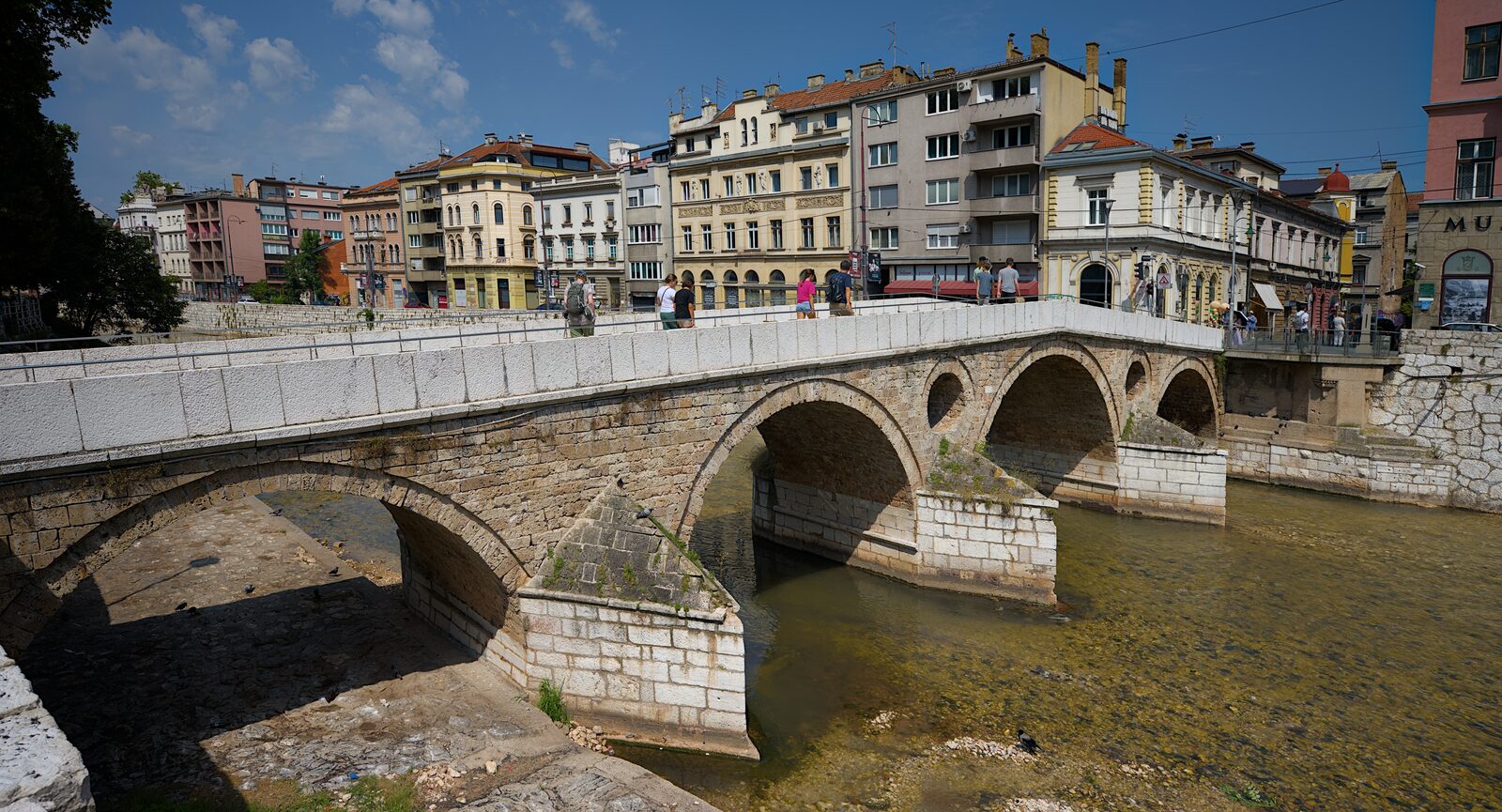
Bridge 2: Latinska Ćuprija
You know this one. Pause. Read the modest plaque. The page on the Latin Bridge tells you what happened on the corner in 1914. Keep moving.
Bridge 3: Drvenija
Wooden in name (no longer in fact). A favourite local crossing.
Bridge 4: Festina Lente
Modern, twisted, knot-shaped, installed by art students in 2012. The name means make haste slowly, which feels like a Sarajevan motto if there ever was one.
Bridge 5: Ćumurija
Iron, dating from 1886. Cross here and you step out of the Ottoman bazaar into the Austro-Hungarian quarter.
Bridge 6: Skenderija pedestrian bridge
The end of your walk. Take a coffee at one of the cafés along Wilsonovo Šetalište, then turn around and look back. Six bridges, six centuries, one river. Vala (honestly), Sarajevo, in summary.
Sources & further reading
Keep reading
More from the guide.

Sarajevo Ferhadija to Marijin Dvor — the Habsburg mile, from the brass line to the Parliament
A 1.2 km flat walk west from the Meeting of Cultures brass line to Marijin Dvor, through the full Habsburg architectural programme...

Sarajevo Kovači climb — from the river to the fortress, 120 metres up and four centuries back
A 45-minute linear walk uphill from the bazaar to the Yellow Fortress. Start at Čajdžinica Džirlo, climb through Kovači Cemetery, pass Ministry...

Sarajevo Baščaršija loop — 90 minutes, 1462 to 1914, and every faith within five minutes
A 90-minute circular walk through Sarajevo’s old bazaar. Start at the Sebilj, cross into the coppersmiths’ alley, pass the Gazi Husrev-beg Mosque,...