Sarajevo sevdah and the two souls
Bosnia's UNESCO-listed folk music, the Arabic word for melancholy it takes its name from, and the technical reason it sounds simultaneously Eastern and European.
Sevdalinka (the urban folk-song tradition of Bosnia, shortened in conversation to just sevdah) is the music the city of Sarajevo holds closest. It was inscribed on UNESCO’s list of Intangible Cultural Heritage in late 2024, a fact you can read in any tourism brochure. The deeper fact is that nobody in Bosnia needed UNESCO to confirm what they already knew. Sevdah is the sound the city has long used to explain itself.

This is a short essay on why it sounds the way it sounds.
The word
Sevdah comes from the Arabic sawda, which means black bile: one of the four medieval humours, the one that was believed to cause melancholy. The word travelled into Ottoman Turkish as sevda, meaning love, with a strong implication of love that hurts. From Turkish it entered Bosnian as sevdah, by which point it had collected all of its meanings at once: melancholy, longing, a particular kind of romantic ache, the mood you are in when the mood is the point.
The songs the word names share this layered etymology. They are about love, but mostly about love-from-a-distance: a glimpsed face, a remembered courtyard, a marriage that did not happen. They are about longing, but mostly about longing that the singer has agreed to keep, rather than longing they expect to resolve. They are not lament. Lament is grief. Sevdah is something quieter and stranger. It is grief that has decided to stay.
The dual architecture
What makes sevdah sound distinctive (the reason a Bosnian recognises it inside the first two notes) is its emotional architecture. Scholars of the form often describe it as having two seats in the body. The srce (heart), which is the Western emotional centre, the European inheritance, the place where romantic love lives in the Petrarchan tradition. And the duša (soul), which is the Slavic emotional centre, deeper than the heart, older than the heart, the place where things sit when they have nowhere else to go.
The songs work both centres. The melody often sits squarely in the heart range: major-key fragments, intervals that resolve, the kind of phrase a European ear has been hearing for five hundred years. But the ornamentation (the bent notes, the held microtones, the breath that draws a single syllable out for a measure and a half) comes from the soul. From the Eastern, Ottoman, melismatic tradition.
The two systems coexist in the same song without harmonising. They run in parallel. A sevdah singer is performing, technically and audibly, two different musical traditions at once. That is the reason it sounds the way it sounds. Not a fusion. Two registers running side by side, with the listener completing them.
What to listen for
If you are new to sevdah, three things are worth listening for:
- The held note at the end of a vocal phrase. It will go on longer than seems reasonable. The singer will let it bend slightly downward, sometimes upward, sometimes both. Pay attention to where it lands.
- The instrument behind the voice. Traditionally a saz (a long-necked Ottoman lute) or an accordion in the more modern style. The instrument carries the chord changes, but it is also, deliberately, restrained. Sevdah does not let the band play over the singer. The voice is in front.
- The space between the lines. Sevdah is slow. Sometimes very slow. The pauses are not gaps. They are part of the music, and the audience honours them by being completely silent during them.
Most sevdah songs are short: two or three minutes in their original form, sometimes much shorter. The depth comes from how slowly they go, not from how long.
A short canon
Four singers across three generations are the canonical place to start:
- Himzo Polovina (1927–1986): the great mid-century voice, often regarded as the genre’s defining male performer.
- Safet Isović (1936–2007): a contemporary of Polovina, equally beloved, with a more dramatic delivery.
- Amira Medunjanin (b. 1972): the voice that brought sevdah back to international attention in the 2000s. Several of her live albums are recorded in Sarajevo.
- Damir Imamović (b. 1978): the leading musicologist-performer of the current generation, who has spent two decades reconstructing the older repertoire. His work is the easiest English-language entry point.
You will recognise the form within ten minutes of listening to any of them. The first three notes will tell you what kind of song it is.
Where to hear it live
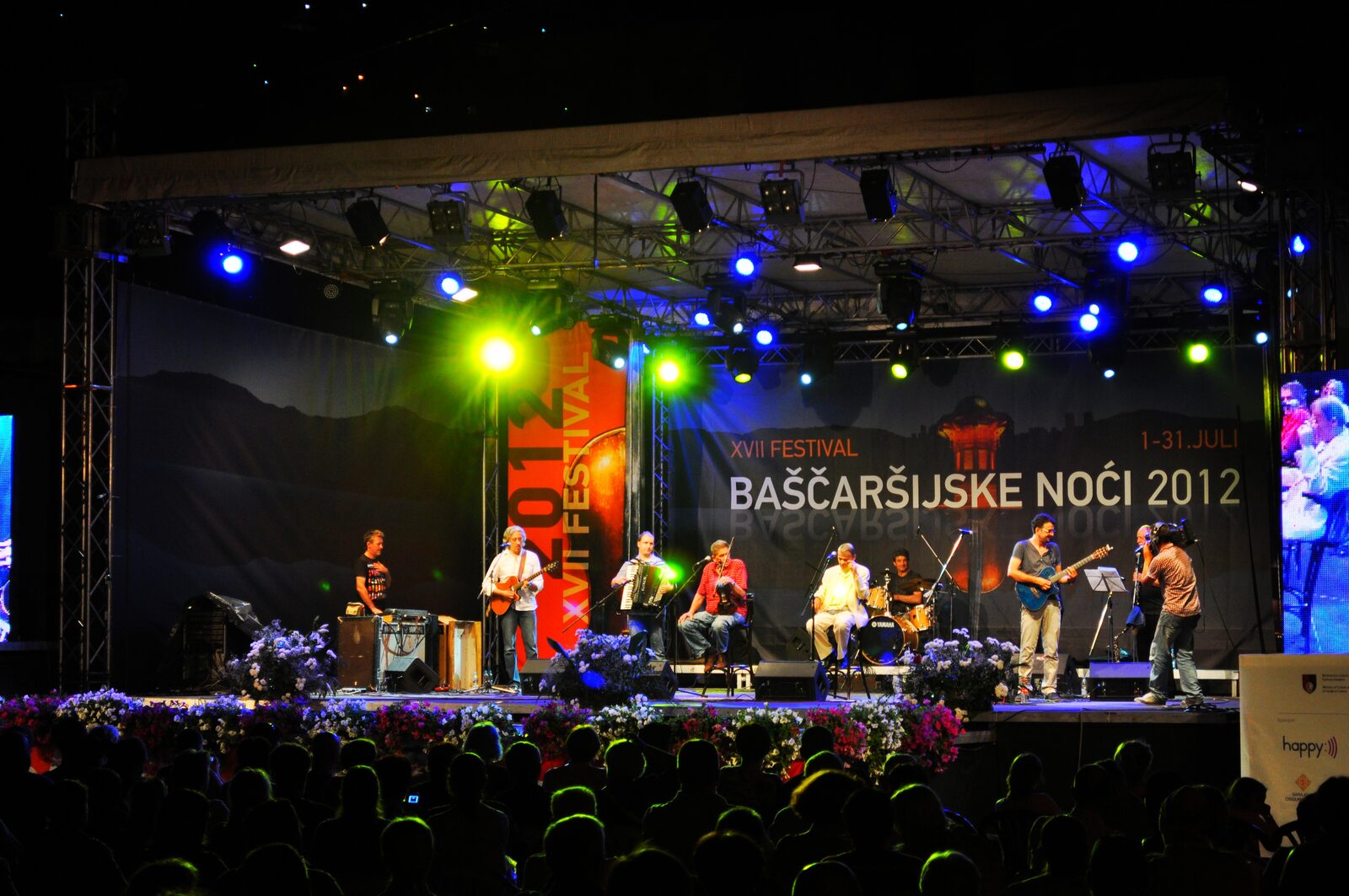
Sarajevo’s main venue is the Kafana Sevdah Art House in Baščaršija. The room is small. The musicians play within arm’s reach. The audience drinks šljivovica slowly. The short night-out guide covers it in more detail.
There is also a more public version on certain evenings at Pivnica HS (the brewery’s beer hall), and occasional sevdah nights at Inat Kuća on the south bank. If you have one evening in Sarajevo, give it to sevdah, in any of these rooms. You will not understand the lyrics. That is not the obstacle people think it is. The room knows. The singer knows. Bujrum. Pull up a chair.
Sources & further reading
- Sevdalinka — Wikipedia.
- Roads & Kingdoms — A Sad Song for the Slavic Soul.
- Daily Sabah — Bosnian sevdalinka: sound of a soul that endures.
Sources & further reading
Keep reading
More from the guide.

Sarajevo sevdah — UNESCO-inscribed in 2024, played live in six specific rooms
Sevdah is Bosnia’s blues. Songs of love, longing, and loss, sung over saz and accordion in small rooms that smell of plum...

Sarajevo Olympics — twelve days on mountains that became the front line eight years later
The 1984 Winter Olympics were held in Sarajevo — twelve days on mountains that eight years later became artillery positions. The bobsled...

Sarajevo's iron fences — the pheasant on Sime Milutinovića 15, and other pieces you walk past
Push a heavy oak door open in a Habsburg-era palace on Strossmayerova, or Vrazova, or Obala Kulina bana, and look up. The...