Explore Sarajevo / Hidden Gems / Sarajevo Ćevabdžinica Željo
Hidden Gem · Baščaršija · 4 min read
Sarajevo Ćevabdžinica Željo
Sarajevo's most famous ćevapi house, opened 1968. Two locations on the same street. The eternal debate about which is better.
- Established
- 1968


At a glance
Address
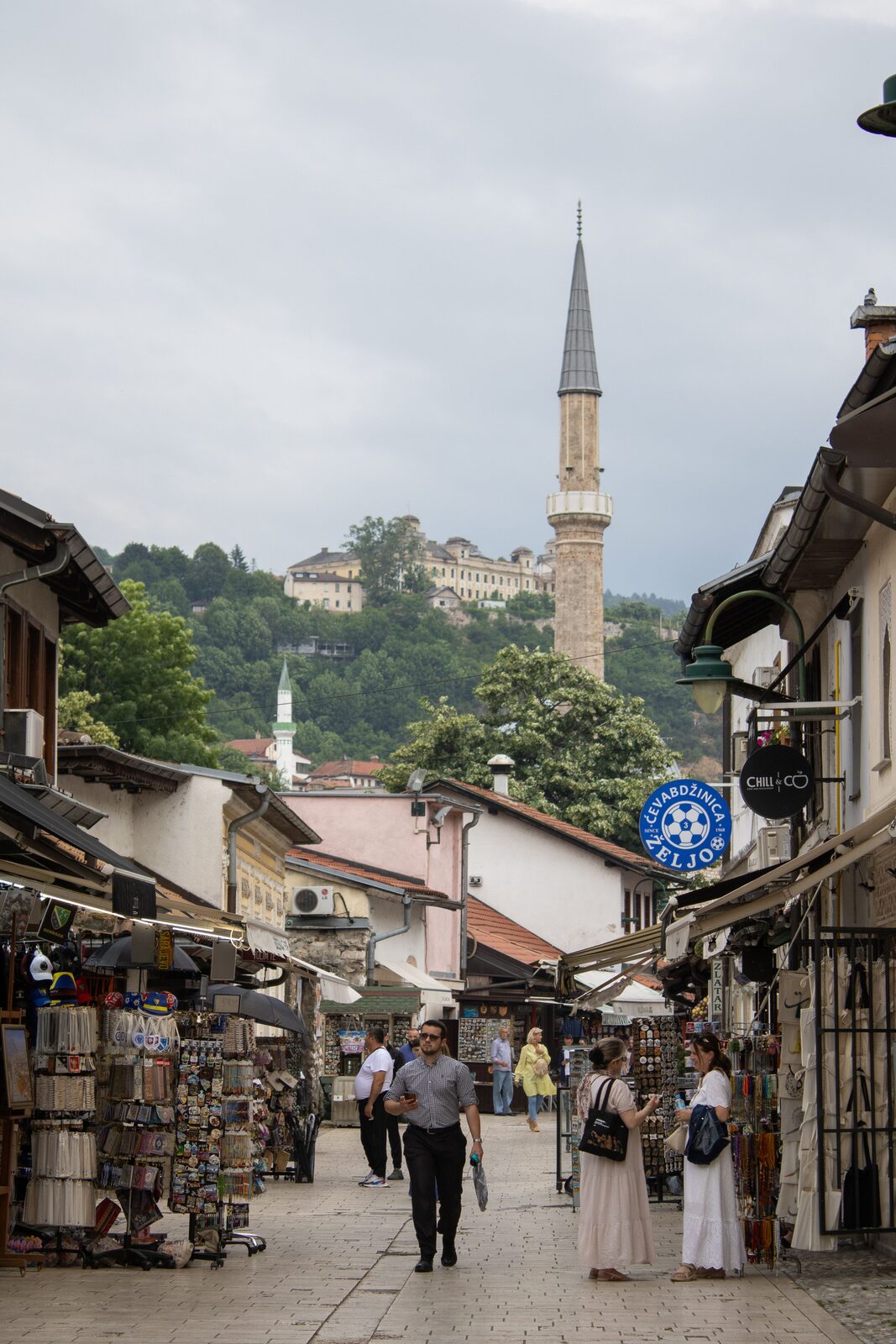
Kundurdžiluk 19, Baščaršija
Hours
Typically 09:00 to 22:00
Price
10 ćevapi ~10–12 BAM
Getting there
3 minutes' walk east of the Sebilj
Time needed
30–45 minutes
Best time
Late lunch around 14:00, after the office crowd
Coordinates
43.8586° N 18.4298° E
Navigate
There is no honest list of Sarajevo’s ćevabdžinicas that does not start with Željo. It opened in 1968. It has been the city’s most famous ćevapi house for half a century. Most lifelong Sarajevans have an opinion about it. Most visitors are taken to it within forty-eight hours of arriving. The reputation is fully deserved.
The dish
Ćevapi (singular ćevap) are small hand-rolled minced-beef sausages, about the size of a thumb, grilled over beech charcoal, served inside a hot, soft, fluffy round flatbread called somun, with raw onion and a generous spoonful of kajmak (a soft slightly tangy Bosnian clotted cream). The flavour is what happens when meat, fire, and bread come together with the right amount of restraint. There is no marinade, no sauce, no garnish beyond the onion. The seasoning is salt, pepper, and the smoke.
It is one of the great single-dish street foods of Europe. Sarajevans will tell you it is the great one. They are not unbiased witnesses, but they are not entirely wrong.
The story of Željo
The restaurant was founded in 1968 on Kundurdžiluk street in the bazaar. It has been in family ownership across the decades since, surviving the socialist years, the siege, and the post-war boom in tourism without losing what makes it work: a tight menu, fast service, real meat, hot bread, and the patience of an institution that has nothing to prove. (If you have a source for the founder’s name, the editor would like to hear from you, the historical attribution is contested in English-language sources.)
Today there are two Željo locations on the same street, facing each other (Željo 1 and Željo 2), and the choice between them is one of the small ongoing debates of Sarajevan life. Both are owned by the same family. Both serve essentially the same dish. Loyalists will argue, sometimes passionately, about which one is better. The honest answer, after eating at both more than once, is that they are both excellent, and the difference is mostly which one had a free table when you walked past.
Sarajevo’s most famous ćevapi come from four Baščaršija institutions: Željo (1968), Nune (1966), Petica Ferhatović (1957), and Hodžić (a three-time Golden Crown winner). Most informal surveys put Željo at the top.
How to order
The system is simple and unchanged in five decades.
- Walk in. There may be a queue at peak times. It moves fast.
- Tell the staff how many ćevapi you want. The standard portions are 5 (with one somun) or 10 (with two somuns). Order 10. Five is for tourists who don’t know.
- Sit down at any free table. Communal seating is normal.
- The plate arrives in two to three minutes. Onion and kajmak come standard, on the side. Move the kajmak into the somun before the bread cools.
- Eat with your hands. There is a sink in the corner for exactly this reason.
- Pay at the counter on the way out. Cash works best. A meal costs around 10 to 15 BAM per person.
What to drink
Tradition dictates cold yoghurt (jogurt, served in a glass) alongside ćevapi. It is a drinking yoghurt, slightly salty, perfectly balanced against the smoke and the fat. Boza in summer (a slightly fizzy fermented millet drink) is also correct. Soft drinks and water are available. Beer is fine but slightly unorthodox. Wine, no.
Coffee comes after, and not at Željo. For that, walk three minutes to Dibek or Morića Han and stay for an hour.
Where it sits in the ecosystem
Several other excellent ćevabdžinicas operate within five minutes’ walk of Željo, and serious eaters will visit two or three on the same trip. Petica Ferhatović (1957) is the older institution. Mrkva (1963) uses Argentine charcoal for a smokier note. Hodžić on Pigeon Square has the awards and a slightly more refined interior.
None of them will be a wasted meal. But the first time you eat ćevapi in Sarajevo, the consensus answer is to eat them at Željo. Preferably at lunchtime, at a communal table, with a glass of cold yoghurt and a small queue still forming at the door.
Sources & further reading
Keep wandering
Nearby & related.

Sarajevo Gazi Husrev-beg Mosque
The most important Ottoman mosque in the Balkans, built in 1531 at the centre of Baščaršija by the Ottoman governor...

Sarajevo Morića Han
A 16th-century Ottoman han (traveller’s inn) on Sarači, the spine street of Baščaršija. Now home to one of the oldest...

Sarajevo Ashkenazi Synagogue
Sarajevo’s working synagogue, built in 1902 in pseudo-Moorish style by the Austro-Hungarian administration for the Jewish community that had grown...