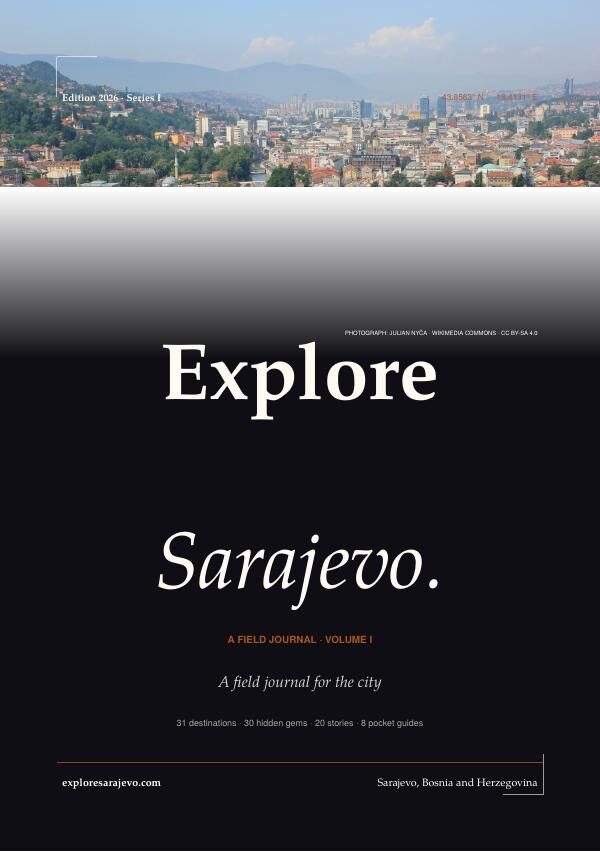
Explore Sarajevo / Hidden Gems / Sarajevo Vrelo Mošćanice
Hidden Gem · Faletići, north slopes · 3 min read
Sarajevo Vrelo Mošćanice
Sarajevo's other source. A smaller, wilder version of Vrelo Bosne, above the Faletići neighbourhood. No swans, no buses, no entrance fee.


At a glance
Address
Above Faletići, off Bulbulistan
Hours
Always accessible
Price
Free
Getting there
Taxi to Faletići (~10 BAM) or bus 69 + 20 minutes uphill
Time needed
1–2 hours including the walk up
Best time
Hot summer days; spring after rain for full flow
Coordinates
43.8843° N 18.4818° E
Navigate
Most guides to Sarajevo include Vrelo Bosne: the broad, popular spring park at Ilidža, with its swans, fiacres, and 19th-century avenue of plane trees. Fewer mention that the city has a second source of comparable beauty, on the opposite side of the valley, with none of the infrastructure and almost none of the visitors. This is the spring of the Mošćanica river, locally Vrelo Mošćanice, sitting in a steep wooded gorge above the residential neighbourhood of Faletići on Sarajevo’s northern slopes.
The river
The Mošćanica is one of Sarajevo’s smaller rivers, a tributary of the Miljacka that flows down from the hills north of the city and joins the larger river just east of the bazaar. Its source is a substantial spring at about 750 metres of altitude, where cold water rises straight out of the limestone into a small natural pool. Locals have been coming here to fill bottles for generations. The water is consistently 6 to 8 °C year-round, and is widely held, fairly or not, to be the best-tasting drinking water in the Sarajevo basin.
The spring sits in a steep wooded amphitheatre. The water gathers into a shallow pool, drops over a small natural lip, and from there begins its descent toward Faletići and on to the Miljacka. The slopes around it are covered in beech and oak, with patches of fir higher up. A few small footbridges have been built across the stream by the people who use the spring, informal, sturdy, mossed at the corners.
What you find there
Very little, by design. No entrance fees. No kiosks. No fiacres. No swans. There is one well-trodden footpath leading up to the source from the road in Faletići, and a handful of side trails that meander through the forest above. No railings around the pool. No signs in English. You will likely find two or three locals filling large plastic carboys at any one time. They will nod politely. Beyond that, the only sound is the water.
A short, steep walk
From the city centre, the trip up to Vrelo Mošćanice takes about an hour by public transport and on foot. Bus 69 runs from the city centre toward the Faletići neighbourhood. Ask the driver for the closest stop to Vrelo Mošćanice. From the road it is a 20-minute uphill walk along a marked footpath through the forest. The grade is real (these are the same slopes that make Sarajevo’s northern neighbourhoods famously steep) but the path is well-trodden and reaches the source without any technical difficulty.
A simpler alternative is to take a taxi from the centre to Faletići (about 10 BAM, 15 minutes), saving the bus and the lower walk.
What to do once you’re there
There is no agenda. Drink the water. Bring an empty bottle. Sit on the small footbridge above the pool. Walk a few hundred metres further uphill on the side trails for a view back through the trees over the northern half of the city. Listen for the sudden roar of meltwater after a spring storm, or the slower hush of the same water in late summer.
If you have the energy and the right shoes, the trails continue up toward the higher villages of Krivoglavci and Faletići itself, and on toward the slopes of Hum, the smaller mountain that sits at the head of the valley. These are not signposted routes for foreign visitors. They are paths the people who live here have walked for a hundred years to fetch water and gather firewood, and they remain entirely usable as a quiet half-day’s walking.
Most travellers in Sarajevo will never come here. That is part of the recommendation. If you have already seen the Sebilj, the Latin Bridge, and Vrelo Bosne, and you find yourself wanting one more morning that belongs entirely to the city’s quieter geography, this is where to spend it.
Sources & further reading
Keep wandering
Nearby & related.

Sarajevo Ashkenazi Synagogue
Sarajevo’s working synagogue, built in 1902 in pseudo-Moorish style by the Austro-Hungarian administration for the Jewish community that had grown...

Sarajevo Avaz Twist Tower
The Avaz Twist Tower is Sarajevo’s tallest building (142 metres, completed 2008). A small public observation deck on the 35th...

Sarajevo Baščaršija
The 1462 Ottoman bazaar of Sarajevo, still a working bazaar. Copper workshops on Kazandžiluk, Bosnian coffee at Morića Han, and...